 Add to Chrome
 Add to Firefox
 Add to Edge
JetViT: Efficient High-Resolution Vision Transformer with Post-Training Attention Search
May 26, 2026
We introduce JetViT, a novel family of hybrid-architecture Vision Transformer (ViT) models that match the accuracy of state-of-the-art full-attention vision foundation models while achieving substantially higher inference efficiency on high-resolution images. At the core of our approach is Post-Training Attention Search, a post-training acceleration framework that converts pre-trained full-attention ViTs into efficient hybrid-attention variants by identifying and replacing redundant full-attention blocks with linear or window-attention blocks. By inheriting the MLP and attention weights from the base model, Post-Training Attention Search efficiently explores the architectural design space through three key steps: (1) optimizing the linear-attention block design; (2) finding the best combination of linear-attention and window-attention blocks; and (3) identifying and preserving critical full-attention blocks. We evaluate JetViT on two representative high-resolution vision foundation models, DINOv3 and DepthAnythingV2. On the NVIDIA H100 GPU, JetViT achieves up to 1.79x higher throughput and up to 44.81% lower latency without sacrificing accuracy. We will release our code and accelerated ViT models soon.

Identify Critical Nodes in Complex Network with Large Language Models
Mar 01, 2024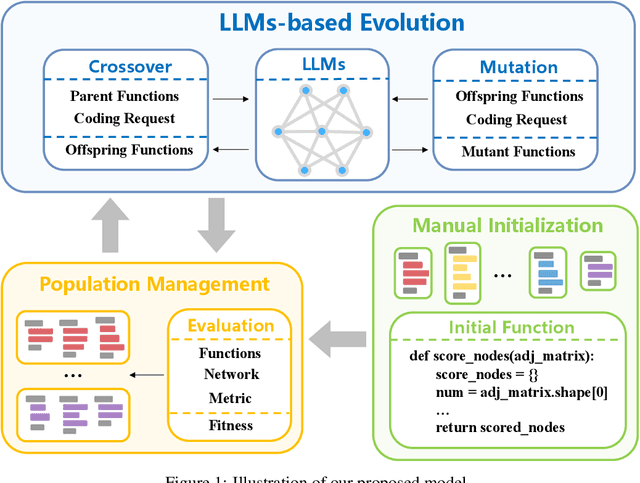
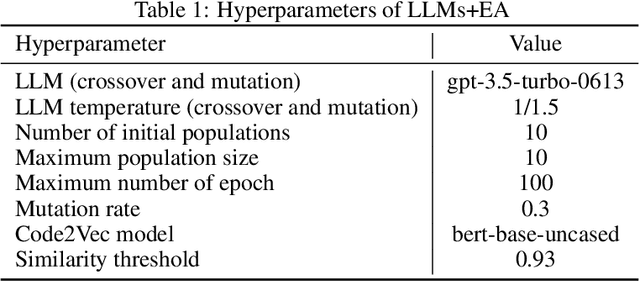
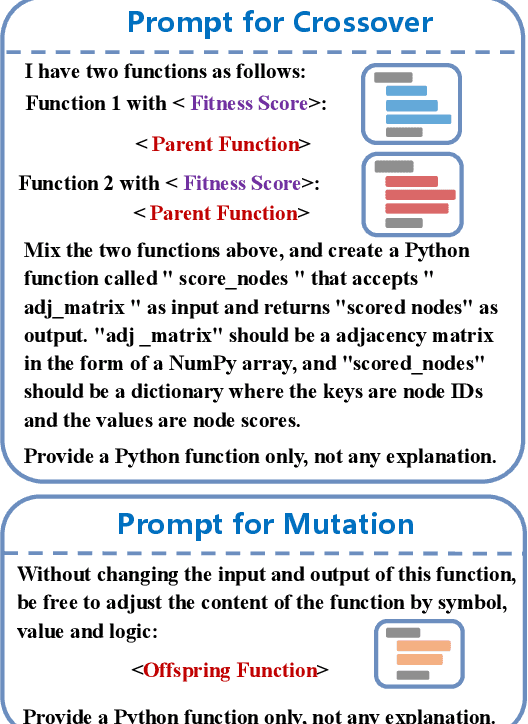

Identifying critical nodes in networks is a classical decision-making task, and many methods struggle to strike a balance between adaptability and utility. Therefore, we propose an approach that empowers Evolutionary Algorithm (EA) with Large Language Models (LLMs), to generate a function called "score\_nodes" which can further be used to identify crucial nodes based on their assigned scores. Our model consists of three main components: Manual Initialization, Population Management, and LLMs-based Evolution. It evolves from initial populations with a set of designed node scoring functions created manually. LLMs leverage their strong contextual understanding and rich programming skills to perform crossover and mutation operations on the individuals, generating excellent new functions. These functions are then categorized, ranked, and eliminated to ensure the stable development of the populations while preserving diversity. Extensive experiments demonstrate the excellent performance of our method, showcasing its strong generalization ability compared to other state-of-the-art algorithms. It can consistently and orderly generate diverse and efficient node scoring functions. All source codes and models that can reproduce all results in this work are publicly available at this link: \url{https://anonymous.4open.science/r/LLM4CN-6520}