 Add to Chrome
 Add to Firefox
 Add to Edge
Adversarial Defense in Vision-Language Models: An Overview
Jan 18, 2026
The widespread use of Vision Language Models (VLMs, e.g. CLIP) has raised concerns about their vulnerability to sophisticated and imperceptible adversarial attacks. These attacks could compromise model performance and system security in cross-modal tasks. To address this challenge, three main defense paradigms have been proposed: Training-time Defense, Test-time Adaptation Defense, and Training-free Defense. Training-time Defense involves modifying the training process, typically through adversarial fine-tuning to improve the robustness to adversarial examples. While effective, this approach requires substantial computational resources and may not generalize across all adversarial attacks. Test-time Adaptation Defense focuses on adapting the model at inference time by updating its parameters to handle unlabeled adversarial examples, offering flexibility but often at the cost of increased complexity and computational overhead. Training-free Defense avoids modifying the model itself, instead focusing on altering the adversarial inputs or their feature embeddings, which enforces input perturbations to mitigate the impact of attacks without additional training. This survey reviews the latest advancements in adversarial defense strategies for VLMs, highlighting the strengths and limitations of such approaches and discussing ongoing challenges in enhancing the robustness of VLMs.

The Llama 4 Herd: Architecture, Training, Evaluation, and Deployment Notes
Jan 15, 2026This document consolidates publicly reported technical details about Metas Llama 4 model family. It summarizes (i) released variants (Scout and Maverick) and the broader herd context including the previewed Behemoth teacher model, (ii) architectural characteristics beyond a high-level MoE description covering routed/shared-expert structure, early-fusion multimodality, and long-context design elements reported for Scout (iRoPE and length generalization strategies), (iii) training disclosures spanning pre-training, mid-training for long-context extension, and post-training methodology (lightweight SFT, online RL, and lightweight DPO) as described in release materials, (iv) developer-reported benchmark results for both base and instruction-tuned checkpoints, and (v) practical deployment constraints observed across major serving environments, including provider-specific context limits and quantization packaging. The manuscript also summarizes licensing obligations relevant to redistribution and derivative naming, and reviews publicly described safeguards and evaluation practices. The goal is to provide a compact technical reference for researchers and practitioners who need precise, source-backed facts about Llama 4.
Beyond External Guidance: Unleashing the Semantic Richness Inside Diffusion Transformers for Improved Training
Jan 12, 2026Recent works such as REPA have shown that guiding diffusion models with external semantic features (e.g., DINO) can significantly accelerate the training of diffusion transformers (DiTs). However, this requires the use of pretrained external networks, introducing additional dependencies and reducing flexibility. In this work, we argue that DiTs actually have the power to guide the training of themselves, and propose \textbf{Self-Transcendence}, a simple yet effective method that achieves fast convergence using internal feature supervision only. It is found that the slow convergence in DiT training primarily stems from the difficulty of representation learning in shallow layers. To address this, we initially train the DiT model by aligning its shallow features with the latent representations from the pretrained VAE for a short phase (e.g., 40 epochs), then apply classifier-free guidance to the intermediate features, enhancing their discriminative capability and semantic expressiveness. These enriched internal features, learned entirely within the model, are used as supervision signals to guide a new DiT training. Compared to existing self-contained methods, our approach brings a significant performance boost. It can even surpass REPA in terms of generation quality and convergence speed, but without the need for any external pretrained models. Our method is not only more flexible for different backbones but also has the potential to be adopted for a wider range of diffusion-based generative tasks. The source code of our method can be found at https://github.com/csslc/Self-Transcendence.
WFR-FM: Simulation-Free Dynamic Unbalanced Optimal Transport
Jan 11, 2026The Wasserstein-Fisher-Rao (WFR) metric extends dynamic optimal transport (OT) by coupling displacement with change of mass, providing a principled geometry for modeling unbalanced snapshot dynamics. Existing WFR solvers, however, are often unstable, computationally expensive, and difficult to scale. Here we introduce WFR Flow Matching (WFR-FM), a simulation-free training algorithm that unifies flow matching with dynamic unbalanced OT. Unlike classical flow matching which regresses only a transport vector field, WFR-FM simultaneously regresses a vector field for displacement and a scalar growth rate function for birth-death dynamics, yielding continuous flows under the WFR geometry. Theoretically, we show that minimizing the WFR-FM loss exactly recovers WFR geodesics. Empirically, WFR-FM yields more accurate and robust trajectory inference in single-cell biology, reconstructing consistent dynamics with proliferation and apoptosis, estimating time-varying growth fields, and applying to generative dynamics under imbalanced data. It outperforms state-of-the-art baselines in efficiency, stability, and reconstruction accuracy. Overall, WFR-FM establishes a unified and efficient paradigm for learning dynamical systems from unbalanced snapshots, where not only states but also mass evolve over time.
Detecting AI-Generated Images via Distributional Deviations from Real Images
Jan 07, 2026The rapid advancement of generative models has significantly enhanced the quality of AI-generated images, raising concerns about misinformation and the erosion of public trust. Detecting AI-generated images has thus become a critical challenge, particularly in terms of generalizing to unseen generative models. Existing methods using frozen pre-trained CLIP models show promise in generalization but treat the image encoder as a basic feature extractor, failing to fully exploit its potential. In this paper, we perform an in-depth analysis of the frozen CLIP image encoder (CLIP-ViT), revealing that it effectively clusters real images in a high-level, abstract feature space. However, it does not truly possess the ability to distinguish between real and AI-generated images. Based on this analysis, we propose a Masking-based Pre-trained model Fine-Tuning (MPFT) strategy, which introduces a Texture-Aware Masking (TAM) mechanism to mask textured areas containing generative model-specific patterns during fine-tuning. This approach compels CLIP-ViT to attend to the "distributional deviations"from authentic images for AI-generated image detection, thereby achieving enhanced generalization performance. Extensive experiments on the GenImage and UniversalFakeDetect datasets demonstrate that our method, fine-tuned with only a minimal number of images, significantly outperforms existing approaches, achieving up to 98.2% and 94.6% average accuracy on the two datasets, respectively.
Learning from Prompt itself: the Hierarchical Attribution Prompt Optimization
Jan 06, 2026Optimization is fundamental across numerous disciplines, typically following an iterative process of refining an initial solution to enhance performance. This principle is equally critical in prompt engineering, where designing effective prompts for large language models constitutes a complex optimization challenge. A structured optimization approach requires automated or semi-automated procedures to develop improved prompts, thereby reducing manual effort, improving performance, and yielding an interpretable process. However, current prompt optimization methods often induce prompt drift, where new prompts fix prior failures but impair performance on previously successful tasks. Additionally, generating prompts from scratch can compromise interpretability. To address these limitations, this study proposes the Hierarchical Attribution Prompt Optimization (HAPO) framework, which introduces three innovations: (1) a dynamic attribution mechanism targeting error patterns in training data and prompting history, (2) semantic-unit optimization for editing functional prompt segments, and (3) multimodal-friendly progression supporting both end-to-end LLM and LLM-MLLM workflows. Applied in contexts like single/multi-image QA (e.g., OCRV2) and complex task analysis (e.g., BBH), HAPO demonstrates enhanced optimization efficiency, outperforming comparable automated prompt optimization methods and establishing an extensible paradigm for scalable prompt engineering.
D$^3$R-DETR: DETR with Dual-Domain Density Refinement for Tiny Object Detection in Aerial Images
Jan 06, 2026Detecting tiny objects plays a vital role in remote sensing intelligent interpretation, as these objects often carry critical information for downstream applications. However, due to the extremely limited pixel information and significant variations in object density, mainstream Transformer-based detectors often suffer from slow convergence and inaccurate query-object matching. To address these challenges, we propose D$^3$R-DETR, a novel DETR-based detector with Dual-Domain Density Refinement. By fusing spatial and frequency domain information, our method refines low-level feature maps and utilizes their rich details to predict more accurate object density map, thereby guiding the model to precisely localize tiny objects. Extensive experiments on the AI-TOD-v2 dataset demonstrate that D$^3$R-DETR outperforms existing state-of-the-art detectors for tiny object detection.
SWE-RM: Execution-free Feedback For Software Engineering Agents
Dec 26, 2025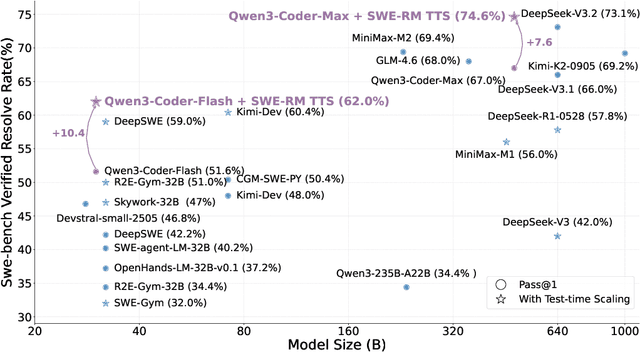
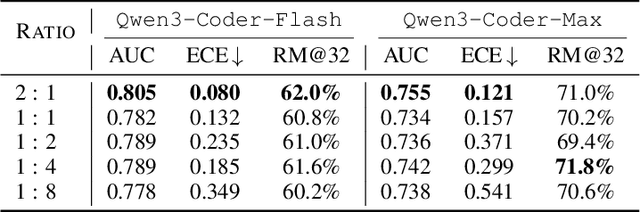
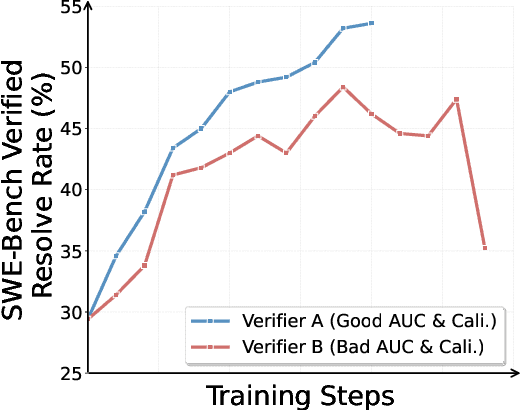
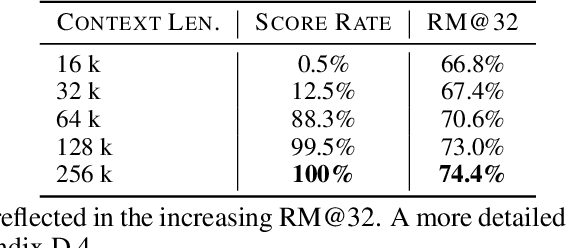
Execution-based feedback like unit testing is widely used in the development of coding agents through test-time scaling (TTS) and reinforcement learning (RL). This paradigm requires scalable and reliable collection of unit test cases to provide accurate feedback, and the resulting feedback is often sparse and cannot effectively distinguish between trajectories that are both successful or both unsuccessful. In contrast, execution-free feedback from reward models can provide more fine-grained signals without depending on unit test cases. Despite this potential, execution-free feedback for realistic software engineering (SWE) agents remains underexplored. Aiming to develop versatile reward models that are effective across TTS and RL, however, we observe that two verifiers with nearly identical TTS performance can nevertheless yield very different results in RL. Intuitively, TTS primarily reflects the model's ability to select the best trajectory, but this ability does not necessarily generalize to RL. To address this limitation, we identify two additional aspects that are crucial for RL training: classification accuracy and calibration. We then conduct comprehensive controlled experiments to investigate how to train a robust reward model that performs well across these metrics. In particular, we analyze the impact of various factors such as training data scale, policy mixtures, and data source composition. Guided by these investigations, we introduce SWE-RM, an accurate and robust reward model adopting a mixture-of-experts architecture with 30B total parameters and 3B activated during inference. SWE-RM substantially improves SWE agents on both TTS and RL performance. For example, it increases the accuracy of Qwen3-Coder-Flash from 51.6% to 62.0%, and Qwen3-Coder-Max from 67.0% to 74.6% on SWE-Bench Verified using TTS, achieving new state-of-the-art performance among open-source models.
Robust-R1: Degradation-Aware Reasoning for Robust Visual Understanding
Dec 19, 2025Multimodal Large Language Models struggle to maintain reliable performance under extreme real-world visual degradations, which impede their practical robustness. Existing robust MLLMs predominantly rely on implicit training/adaptation that focuses solely on visual encoder generalization, suffering from limited interpretability and isolated optimization. To overcome these limitations, we propose Robust-R1, a novel framework that explicitly models visual degradations through structured reasoning chains. Our approach integrates: (i) supervised fine-tuning for degradation-aware reasoning foundations, (ii) reward-driven alignment for accurately perceiving degradation parameters, and (iii) dynamic reasoning depth scaling adapted to degradation intensity. To facilitate this approach, we introduce a specialized 11K dataset featuring realistic degradations synthesized across four critical real-world visual processing stages, each annotated with structured chains connecting degradation parameters, perceptual influence, pristine semantic reasoning chain, and conclusion. Comprehensive evaluations demonstrate state-of-the-art robustness: Robust-R1 outperforms all general and robust baselines on the real-world degradation benchmark R-Bench, while maintaining superior anti-degradation performance under multi-intensity adversarial degradations on MMMB, MMStar, and RealWorldQA.
Toward expert-level motivational interviewing for health behavior improvement with LLMs
Dec 17, 2025Background: Motivational interviewing (MI) is an effective counseling approach for promoting health behavior change, but its impact is constrained by the need for highly trained human counselors. Objective: This study aimed to explore a scalable alternative by developing and evaluating Large Language Models for Motivational Interviewing (MI-LLMs). Methods: We first curated five Chinese psychological counseling corpora and, using GPT-4 with an MI-informed prompt, transcribed multi-turn dialogues from the two highest-quality datasets (CPsyCounD and PsyDTCorpus) into 2,040 MI-style counseling conversations, of which 2,000 were used for training and 40 for testing. Three Chinese-capable open-source LLMs (Baichuan2-7B-Chat, ChatGLM-4-9B-Chat and Llama-3-8B-Chinese-Chat-v2) were fine-tuned on this corpus and were named as MI-LLMs. We evaluated MI-LLMs using round-based automatic metrics and expert manual coding with the Motivational Interviewing Treatment Integrity (MITI) Coding Manual 4.2.1. Results: Across all three models, fine-tuning substantially improved BLEU-4 and ROUGE scores compared with the base models, and manual coding showed that MI-LLMs achieved technical and relational global scores, and MI-adherent ratios that approached those of real MI dialogues, although complex reflections and reflection-to-question ratios remained less frequent. Conclusions: These findings provide initial evidence that MI-oriented fine-tuning can endow general-purpose LLMs with core MI-consistent counseling behaviors, suggesting a scalable pathway toward AI-assisted health behavior change support while underscoring the need for further work on data scale, complex MI skills and real-world intervention trials.