 Add to Chrome
 Add to Firefox
 Add to Edge
RIDE: Real-time Intrusion Detection via Explainable Machine Learning Implemented in a Memristor Hardware Architecture
Nov 27, 2023
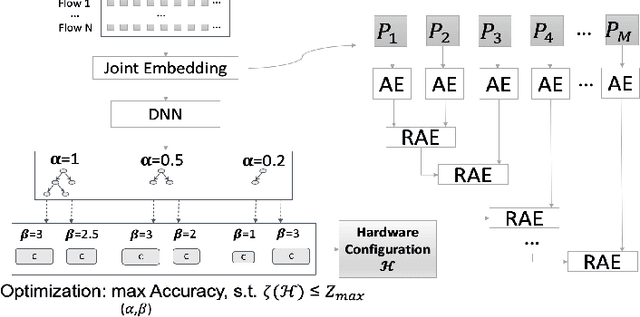
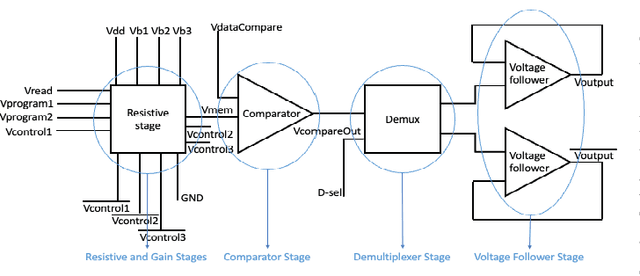
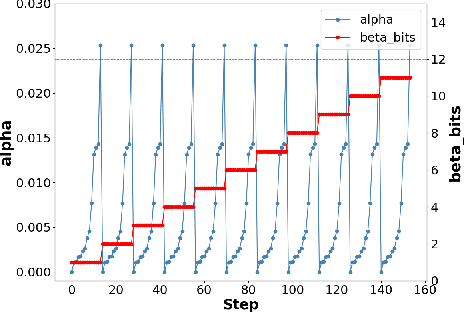
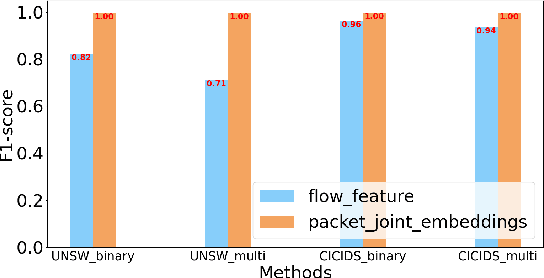
Deep Learning (DL) based methods have shown great promise in network intrusion detection by identifying malicious network traffic behavior patterns with high accuracy, but their applications to real-time, packet-level detections in high-speed communication networks are challenging due to the high computation time and resource requirements of Deep Neural Networks (DNNs), as well as lack of explainability. To this end, we propose a packet-level network intrusion detection solution that makes novel use of Recurrent Autoencoders to integrate an arbitrary-length sequence of packets into a more compact joint feature embedding, which is fed into a DNN-based classifier. To enable explainability and support real-time detections at micro-second speed, we further develop a Software-Hardware Co-Design approach to efficiently realize the proposed solution by converting the learned detection policies into decision trees and implementing them using an emerging architecture based on memristor devices. By jointly optimizing associated software and hardware constraints, we show that our approach leads to an extremely efficient, real-time solution with high detection accuracy at the packet level. Evaluation results on real-world datasets (e.g., UNSW and CIC-IDS datasets) demonstrate nearly three-nines detection accuracy with a substantial speedup of nearly four orders of magnitude.

E-CORE: Emotion Correlation Enhanced Empathetic Dialogue Generation
Nov 25, 2023Achieving empathy is a crucial step toward humanized dialogue systems. Current approaches for empathetic dialogue generation mainly perceive an emotional label to generate an empathetic response conditioned on it, which simply treat emotions independently, but ignore the intrinsic emotion correlation in dialogues, resulting in inaccurate emotion perception and unsuitable response generation. In this paper, we propose a novel emotion correlation enhanced empathetic dialogue generation framework, which comprehensively realizes emotion correlation learning, utilization, and supervising. Specifically, a multi-resolution emotion graph is devised to capture context-based emotion interactions from different resolutions, further modeling emotion correlation. Then we propose an emotion correlation enhanced decoder, with a novel correlation-aware aggregation and soft/hard strategy, respectively improving the emotion perception and response generation. Experimental results on the benchmark dataset demonstrate the superiority of our model in both empathetic perception and expression.
* 19 pages, 6 figures
Parameter Exchange for Robust Dynamic Domain Generalization
Nov 23, 2023Agnostic domain shift is the main reason of model degradation on the unknown target domains, which brings an urgent need to develop Domain Generalization (DG). Recent advances at DG use dynamic networks to achieve training-free adaptation on the unknown target domains, termed Dynamic Domain Generalization (DDG), which compensates for the lack of self-adaptability in static models with fixed weights. The parameters of dynamic networks can be decoupled into a static and a dynamic component, which are designed to learn domain-invariant and domain-specific features, respectively. Based on the existing arts, in this work, we try to push the limits of DDG by disentangling the static and dynamic components more thoroughly from an optimization perspective. Our main consideration is that we can enable the static component to learn domain-invariant features more comprehensively by augmenting the domain-specific information. As a result, the more comprehensive domain-invariant features learned by the static component can then enforce the dynamic component to focus more on learning adaptive domain-specific features. To this end, we propose a simple yet effective Parameter Exchange (PE) method to perturb the combination between the static and dynamic components. We optimize the model using the gradients from both the perturbed and non-perturbed feed-forward jointly to implicitly achieve the aforementioned disentanglement. In this way, the two components can be optimized in a mutually-beneficial manner, which can resist the agnostic domain shifts and improve the self-adaptability on the unknown target domain. Extensive experiments show that PE can be easily plugged into existing dynamic networks to improve their generalization ability without bells and whistles.
Visual In-Context Prompting
Nov 22, 2023In-context prompting in large language models (LLMs) has become a prevalent approach to improve zero-shot capabilities, but this idea is less explored in the vision domain. Existing visual prompting methods focus on referring segmentation to segment the most relevant object, falling short of addressing many generic vision tasks like open-set segmentation and detection. In this paper, we introduce a universal visual in-context prompting framework for both tasks. In particular, we build on top of an encoder-decoder architecture, and develop a versatile prompt encoder to support a variety of prompts like strokes, boxes, and points. We further enhance it to take an arbitrary number of reference image segments as the context. Our extensive explorations show that the proposed visual in-context prompting elicits extraordinary referring and generic segmentation capabilities to refer and detect, yielding competitive performance to close-set in-domain datasets and showing promising results on many open-set segmentation datasets. By joint training on COCO and SA-1B, our model achieves $57.7$ PQ on COCO and $23.2$ PQ on ADE20K. Code will be available at https://github.com/UX-Decoder/DINOv.
T-Rex: Counting by Visual Prompting
Nov 22, 2023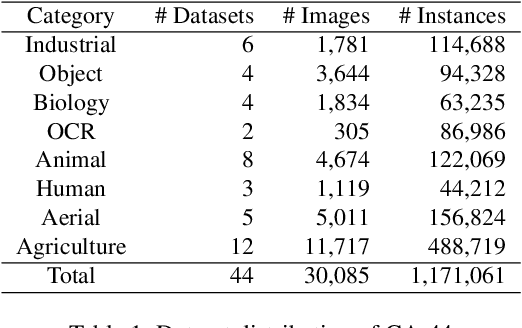
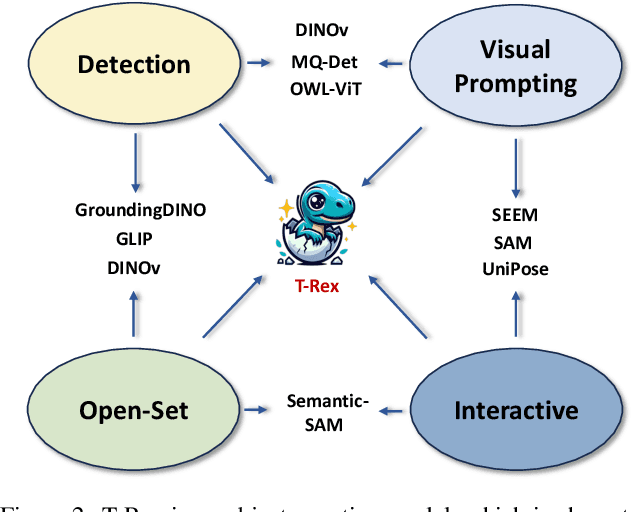
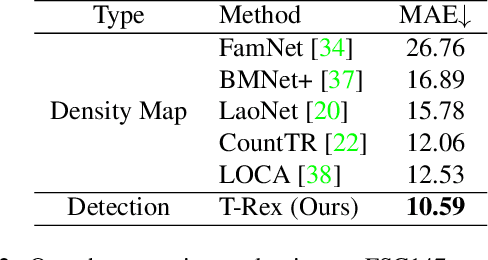
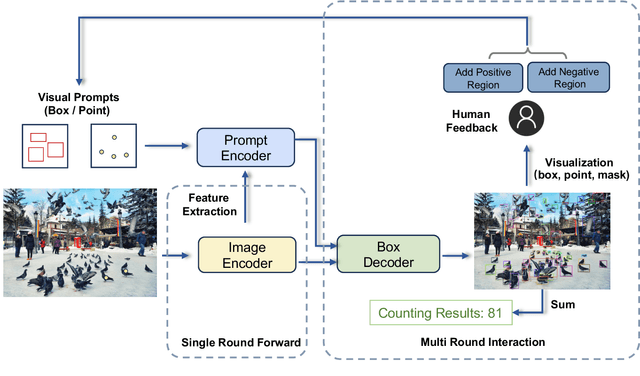
We introduce T-Rex, an interactive object counting model designed to first detect and then count any objects. We formulate object counting as an open-set object detection task with the integration of visual prompts. Users can specify the objects of interest by marking points or boxes on a reference image, and T-Rex then detects all objects with a similar pattern. Guided by the visual feedback from T-Rex, users can also interactively refine the counting results by prompting on missing or falsely-detected objects. T-Rex has achieved state-of-the-art performance on several class-agnostic counting benchmarks. To further exploit its potential, we established a new counting benchmark encompassing diverse scenarios and challenges. Both quantitative and qualitative results show that T-Rex possesses exceptional zero-shot counting capabilities. We also present various practical application scenarios for T-Rex, illustrating its potential in the realm of visual prompting.
AcademicGPT: Empowering Academic Research
Nov 21, 2023

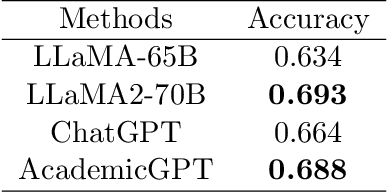

Large Language Models (LLMs) have demonstrated exceptional capabilities across various natural language processing tasks. Yet, many of these advanced LLMs are tailored for broad, general-purpose applications. In this technical report, we introduce AcademicGPT, designed specifically to empower academic research. AcademicGPT is a continual training model derived from LLaMA2-70B. Our training corpus mainly consists of academic papers, thesis, content from some academic domain, high-quality Chinese data and others. While it may not be extensive in data scale, AcademicGPT marks our initial venture into a domain-specific GPT tailored for research area. We evaluate AcademicGPT on several established public benchmarks such as MMLU and CEval, as well as on some specialized academic benchmarks like PubMedQA, SCIEval, and our newly-created ComputerScienceQA, to demonstrate its ability from general knowledge ability, to Chinese ability, and to academic ability. Building upon AcademicGPT's foundation model, we also developed several applications catered to the academic area, including General Academic Question Answering, AI-assisted Paper Reading, Paper Review, and AI-assisted Title and Abstract Generation.
LLaVA-Plus: Learning to Use Tools for Creating Multimodal Agents
Nov 09, 2023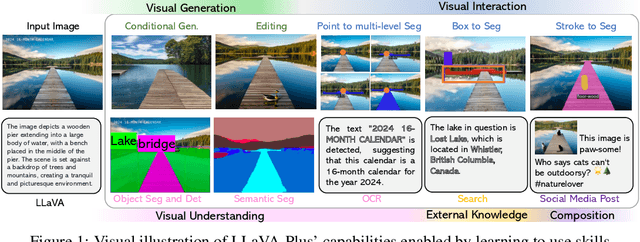
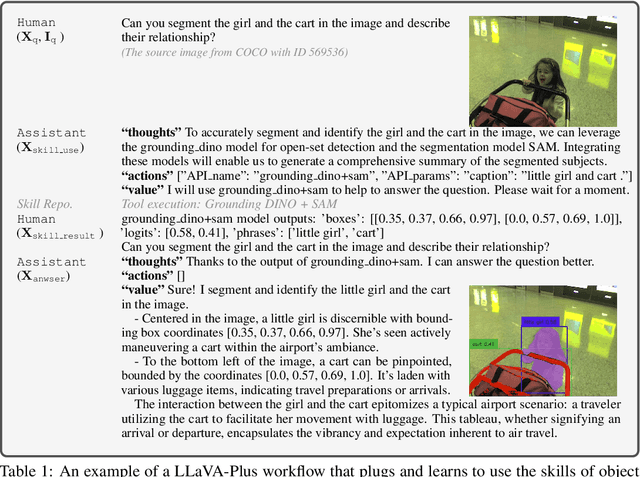
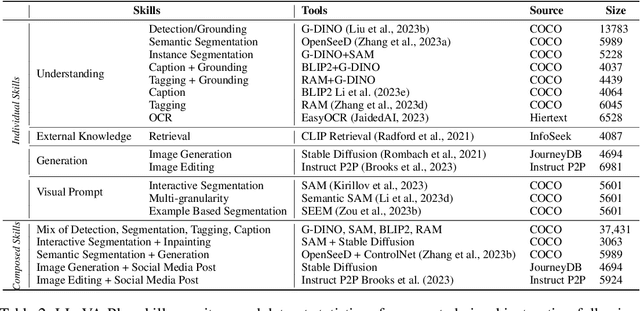
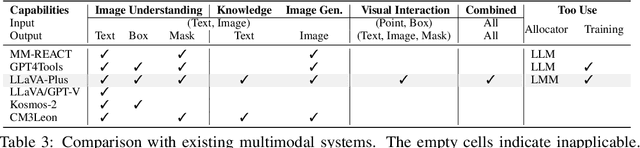
LLaVA-Plus is a general-purpose multimodal assistant that expands the capabilities of large multimodal models. It maintains a skill repository of pre-trained vision and vision-language models and can activate relevant tools based on users' inputs to fulfill real-world tasks. LLaVA-Plus is trained on multimodal instruction-following data to acquire the ability to use tools, covering visual understanding, generation, external knowledge retrieval, and compositions. Empirical results show that LLaVA-Plus outperforms LLaVA in existing capabilities and exhibits new ones. It is distinct in that the image query is directly grounded and actively engaged throughout the entire human-AI interaction sessions, significantly improving tool use performance and enabling new scenarios.
MatNexus: A Comprehensive Text Mining and Analysis Suite for Materials Discover
Nov 07, 2023MatNexus is a specialized software for the automated collection, processing, and analysis of text from scientific articles. Through an integrated suite of modules, the MatNexus facilitates the retrieval of scientific articles, processes textual data for insights, generates vector representations suitable for machine learning, and offers visualization capabilities for word embeddings. With the vast volume of scientific publications, MatNexus stands out as an end-to-end tool for researchers aiming to gain insights from scientific literature in material science, making the exploration of materials, such as the electrocatalyst examples we show here, efficient and insightful.
Optimization-Free Test-Time Adaptation for Cross-Person Activity Recognition
Oct 28, 2023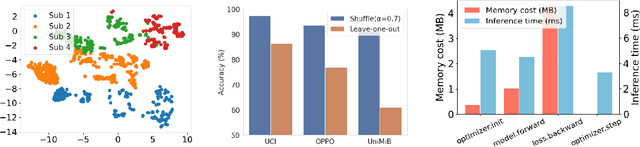
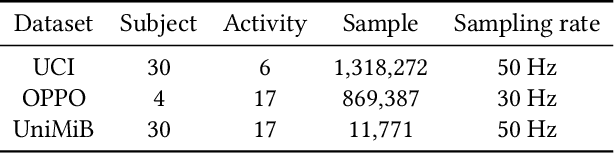

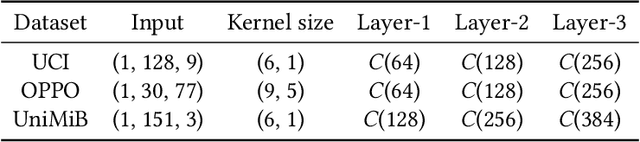
Human Activity Recognition (HAR) models often suffer from performance degradation in real-world applications due to distribution shifts in activity patterns across individuals. Test-Time Adaptation (TTA) is an emerging learning paradigm that aims to utilize the test stream to adjust predictions in real-time inference, which has not been explored in HAR before. However, the high computational cost of optimization-based TTA algorithms makes it intractable to run on resource-constrained edge devices. In this paper, we propose an Optimization-Free Test-Time Adaptation (OFTTA) framework for sensor-based HAR. OFTTA adjusts the feature extractor and linear classifier simultaneously in an optimization-free manner. For the feature extractor, we propose Exponential DecayTest-time Normalization (EDTN) to replace the conventional batch normalization (CBN) layers. EDTN combines CBN and Test-time batch Normalization (TBN) to extract reliable features against domain shifts with TBN's influence decreasing exponentially in deeper layers. For the classifier, we adjust the prediction by computing the distance between the feature and the prototype, which is calculated by a maintained support set. In addition, the update of the support set is based on the pseudo label, which can benefit from reliable features extracted by EDTN. Extensive experiments on three public cross-person HAR datasets and two different TTA settings demonstrate that OFTTA outperforms the state-of-the-art TTA approaches in both classification performance and computational efficiency. Finally, we verify the superiority of our proposed OFTTA on edge devices, indicating possible deployment in real applications. Our code is available at \href{https://github.com/Claydon-Wang/OFTTA}{this https URL}.
A Wireless AI-Generated Content (AIGC) Provisioning Framework Empowered by Semantic Communication
Oct 26, 2023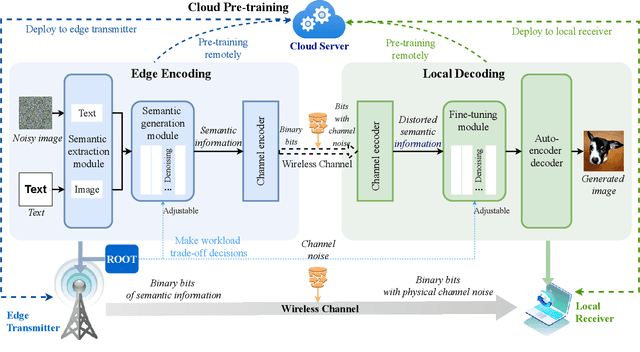
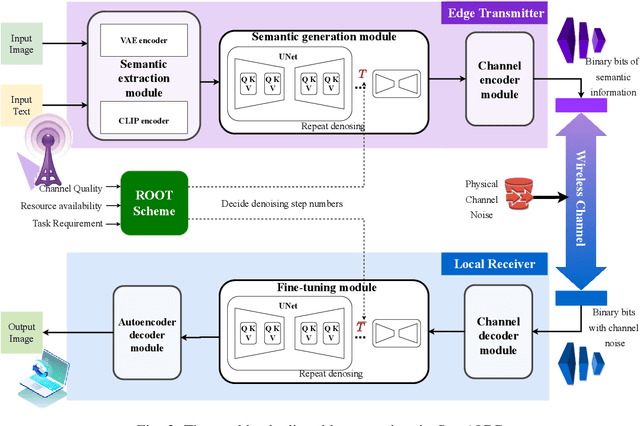
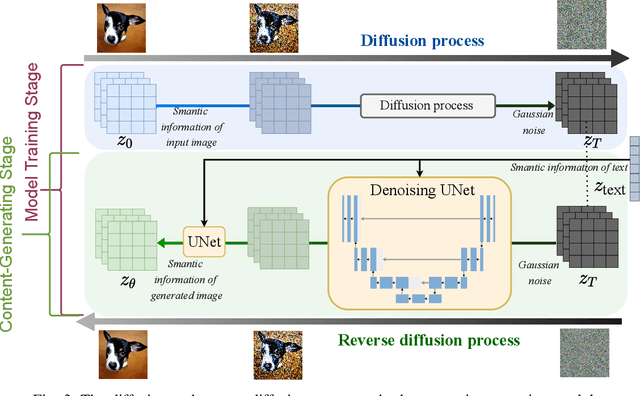
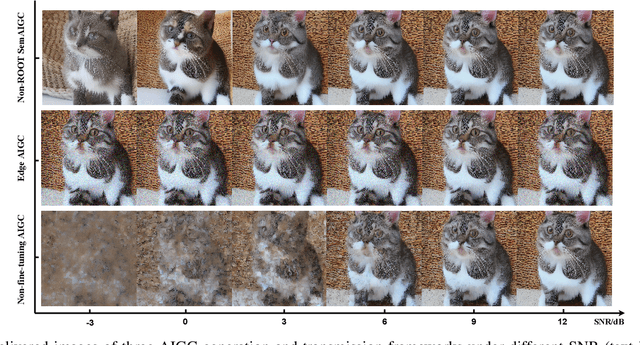
Generative AI applications are recently catering to a vast user base by creating diverse and high-quality AI-generated content (AIGC). With the proliferation of mobile devices and rapid growth of mobile traffic, providing ubiquitous access to high-quality AIGC services via wireless communication networks is becoming the future direction for AIGC products. However, it is challenging to provide optimal AIGC services in wireless networks with unstable channels, limited bandwidth resources, and unevenly distributed computational resources. To tackle these challenges, we propose a semantic communication (SemCom)-empowered AIGC (SemAIGC) generation and transmission framework, where only semantic information of the content rather than all the binary bits should be extracted and transmitted by using SemCom. Specifically, SemAIGC integrates diffusion-based models within the semantic encoder and decoder for efficient content generation and flexible adjustment of the computing workload of both transmitter and receiver. Meanwhile, we devise a resource-aware workload trade-off (ROOT) scheme into the SemAIGC framework to intelligently decide transmitter/receiver workload, thus adjusting the utilization of computational resource according to service requirements. Simulations verify the superiority of our proposed SemAIGC framework in terms of latency and content quality compared to conventional approaches.