 Add to Chrome
 Add to Firefox
 Add to Edge
ClouDens: Operational Context-Aware Anomaly Detection for Large-scale Cloud System Monitoring
Jul 20, 2026
With the rapid growth of cloud computing infrastructures in scale and complexity, network monitoring for Large-scale Cloud Systems (LCSs) has become increasingly challenging, requiring automated and reliable anomaly detection to maintain service availability. Modern LCSs continuously generate telemetry logs from distributed cloud services, producing high-dimensional multivariate time series that capture system operations. Detecting anomalies in this context is difficult due to extreme dimensionality, complex dependencies among distributed components, and severe sparsity from intermittently active services. Taking these challenges into account, we first conduct an empirical study on telemetry logs from the IBM Cloud Console platform, and then propose ClouDens, an anomaly detection framework tailored to LCS monitoring that leverages operational-context attributes encoded in the telemetry log schema to improve detection accuracy and early identification of anomalies. ClouDens partitions high-dimensional telemetry logs into domain-guided subsets, constructs a context-aware graph modeling operational service dependencies, and employs Spatio-Temporal Graph Neural Networks for forecasting-based anomaly detection. We evaluate ClouDens on the recently released IBM Cloud Telemetry Dataset and provide practical insights into designing reliable anomaly detection solutions for LCS monitoring. Results show ClouDens achieves higher NAB scores in count-based telemetry features, indicating more accurate, earlier anomaly detection with broader coverage than a GRU-based model. Our study further reveals that telemetry feature subsets, operational-context modeling, scoring strategies, and sparsity imputation all substantially influence detection performance, offering practical guidance for designing and fairly benchmarking anomaly detection approaches for LCS monitoring.

Benchmarking Anomaly Detection Across Heterogeneous Cloud Telemetry Datasets
Feb 07, 2026Anomaly detection is important for keeping cloud systems reliable and stable. Deep learning has improved time-series anomaly detection, but most models are evaluated on one dataset at a time. This raises questions about whether these models can handle different types of telemetry, especially in large-scale and high-dimensional environments. In this study, we evaluate four deep learning models, GRU, TCN, Transformer, and TSMixer. We also include Isolation Forest as a classical baseline. The models are tested across four telemetry datasets: the Numenta Anomaly Benchmark, Microsoft Cloud Monitoring dataset, Exathlon dataset, and IBM Console dataset. These datasets differ in structure, dimensionality, and labelling strategy. They include univariate time series, synthetic multivariate workloads, and real-world production telemetry with over 100,000 features. We use a unified training and evaluation pipeline across all datasets. The evaluation includes NAB-style metrics to capture early detection behaviour for datasets where anomalies persist over contiguous time intervals. This enables window-based scoring in settings where anomalies occur over contiguous time intervals, even when labels are recorded at the point level. The unified setup enables consistent analysis of model behaviour under shared scoring and calibration assumptions. Our results demonstrate that anomaly detection performance in cloud systems is governed not only by model architecture, but critically by calibration stability and feature-space geometry. By releasing our preprocessing pipelines, benchmark configuration, and evaluation artifacts, we aim to support reproducible and deployment-aware evaluation of anomaly detection systems for cloud environments.
Anomaly Detection in Large-Scale Cloud Systems: An Industry Case and Dataset
Nov 13, 2024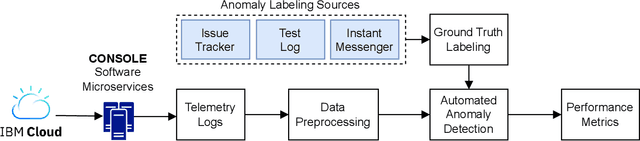
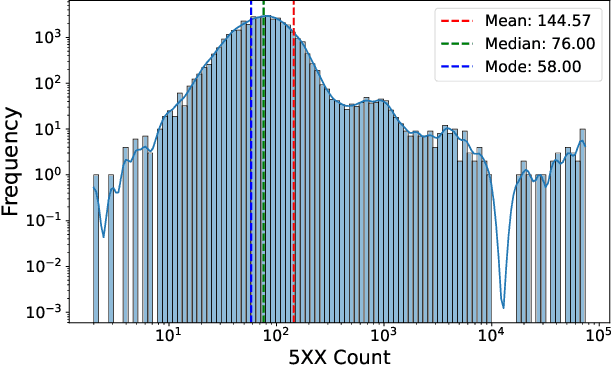
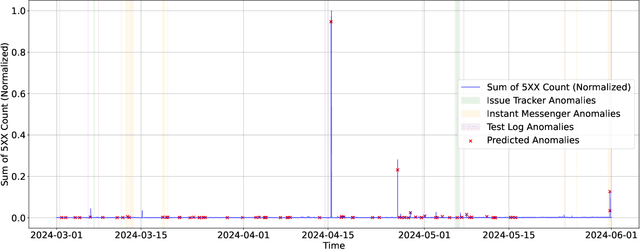
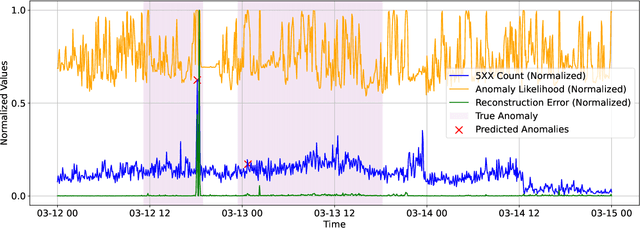
As Large-Scale Cloud Systems (LCS) become increasingly complex, effective anomaly detection is critical for ensuring system reliability and performance. However, there is a shortage of large-scale, real-world datasets available for benchmarking anomaly detection methods. To address this gap, we introduce a new high-dimensional dataset from IBM Cloud, collected over 4.5 months from the IBM Cloud Console. This dataset comprises 39,365 rows and 117,448 columns of telemetry data. Additionally, we demonstrate the application of machine learning models for anomaly detection and discuss the key challenges faced in this process. This study and the accompanying dataset provide a resource for researchers and practitioners in cloud system monitoring. It facilitates more efficient testing of anomaly detection methods in real-world data, helping to advance the development of robust solutions to maintain the health and performance of large-scale cloud infrastructures.
Anomaly Detection in a Large-scale Cloud Platform
Oct 21, 2020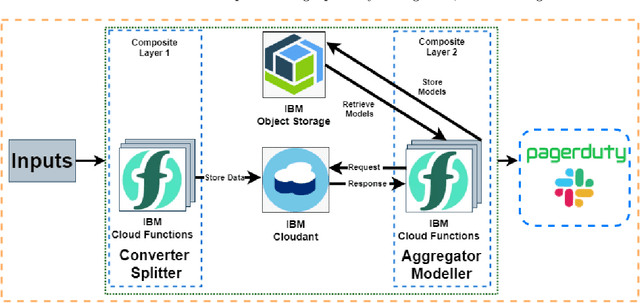
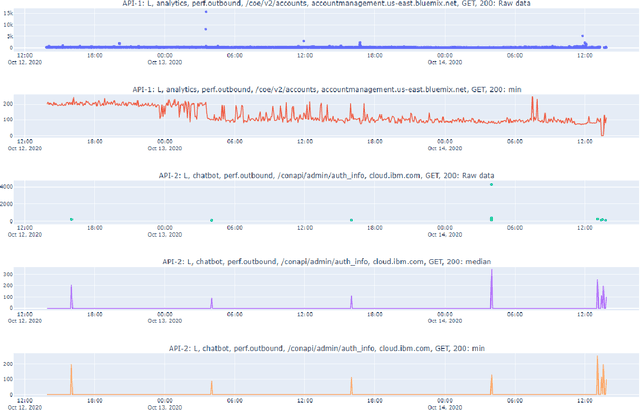
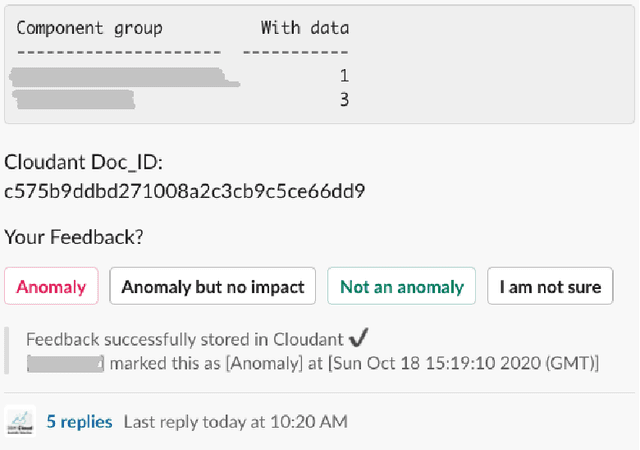
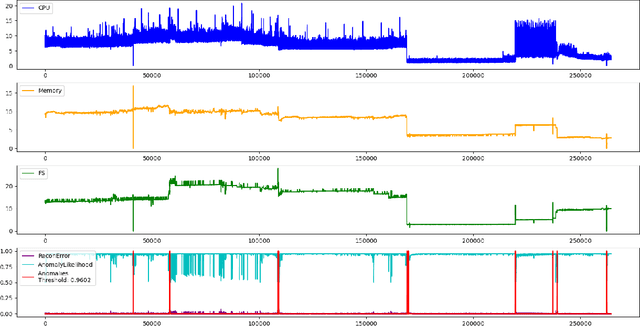
Cloud computing is ubiquitous: more and more companies are moving the workloads into the Cloud. However, this rise in popularity challenges Cloud service providers, as they need to monitor the quality of their ever-growing offerings effectively. To address the challenge, we designed and implemented an automated monitoring system for the IBM Cloud Platform. This monitoring system utilizes deep learning neural networks to detect anomalies in near-real-time in multiple Platform components simultaneously. After running the system for a year, we observed that the proposed solution frees the DevOps team's time and human resources from manually monitoring thousands of Cloud components. Moreover, it increases customer satisfaction by reducing the risk of Cloud outages. In this paper, we share our solutions' architecture, implementation notes, and best practices that emerged while evolving the monitoring system. They can be leveraged by other researchers and practitioners to build anomaly detectors for complex systems.
Anomaly Detection in Cloud Components
May 18, 2020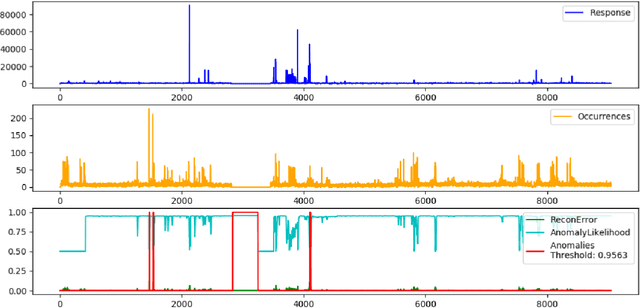
Cloud platforms, under the hood, consist of a complex inter-connected stack of hardware and software components. Each of these components can fail which may lead to an outage. Our goal is to improve the quality of Cloud services through early detection of such failures by analyzing resource utilization metrics. We tested Gated-Recurrent-Unit-based autoencoder with a likelihood function to detect anomalies in various multi-dimensional time series and achieved high performance.