 Add to Chrome
 Add to Firefox
 Add to Edge
Prompting Large Language Models with Chain-of-Thought for Few-Shot Knowledge Base Question Generation
Oct 23, 2023
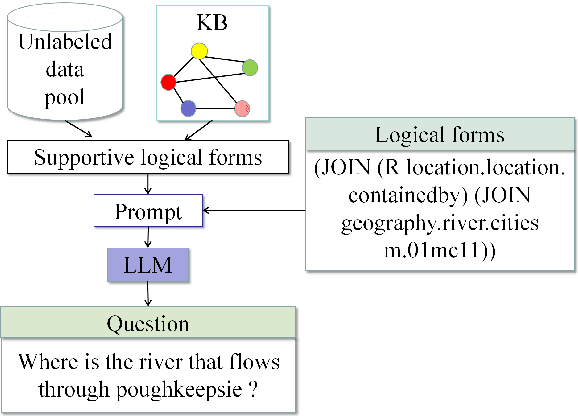
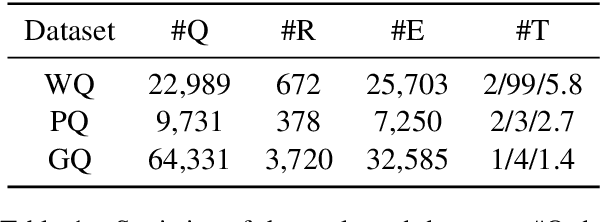
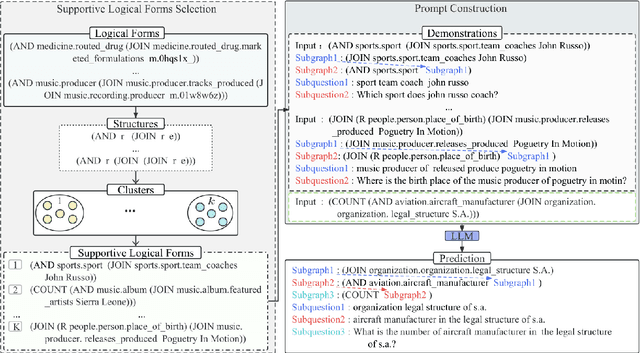
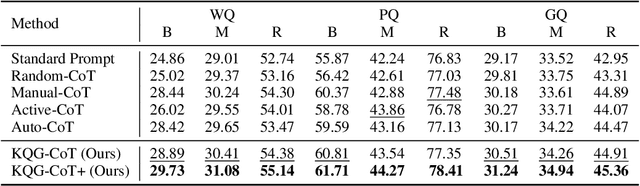
The task of Question Generation over Knowledge Bases (KBQG) aims to convert a logical form into a natural language question. For the sake of expensive cost of large-scale question annotation, the methods of KBQG under low-resource scenarios urgently need to be developed. However, current methods heavily rely on annotated data for fine-tuning, which is not well-suited for few-shot question generation. The emergence of Large Language Models (LLMs) has shown their impressive generalization ability in few-shot tasks. Inspired by Chain-of-Thought (CoT) prompting, which is an in-context learning strategy for reasoning, we formulate KBQG task as a reasoning problem, where the generation of a complete question is splitted into a series of sub-question generation. Our proposed prompting method KQG-CoT first retrieves supportive logical forms from the unlabeled data pool taking account of the characteristics of the logical form. Then, we write a prompt to explicit the reasoning chain of generating complicated questions based on the selected demonstrations. To further ensure prompt quality, we extend KQG-CoT into KQG-CoT+ via sorting the logical forms by their complexity. We conduct extensive experiments over three public KBQG datasets. The results demonstrate that our prompting method consistently outperforms other prompting baselines on the evaluated datasets. Remarkably, our KQG-CoT+ method could surpass existing few-shot SoTA results of the PathQuestions dataset by 18.25, 10.72, and 10.18 absolute points on BLEU-4, METEOR, and ROUGE-L, respectively.

LLM-Based Agent Society Investigation: Collaboration and Confrontation in Avalon Gameplay
Oct 23, 2023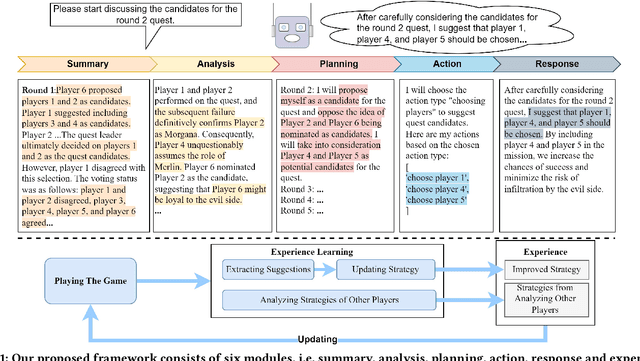
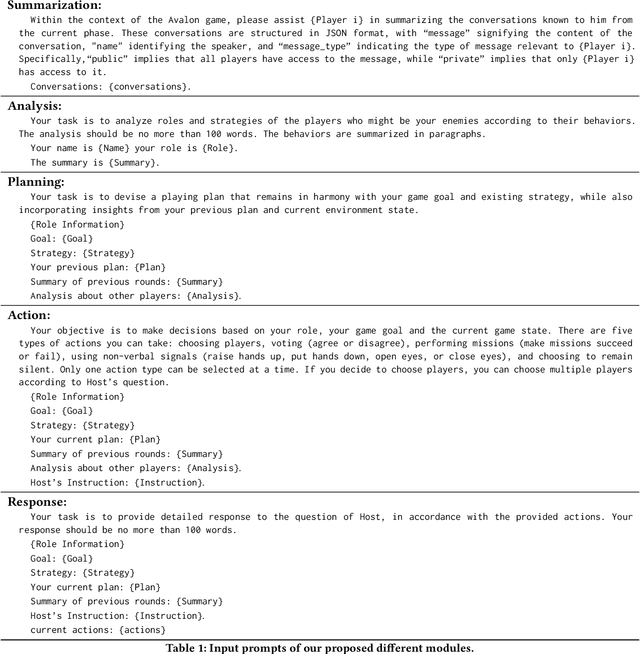
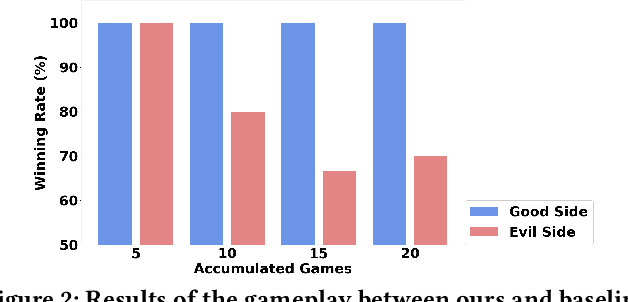

This paper aims to investigate the open research problem of uncovering the social behaviors of LLM-based agents. To achieve this goal, we adopt Avalon, a representative communication game, as the environment and use system prompts to guide LLM agents to play the game. While previous studies have conducted preliminary investigations into gameplay with LLM agents, there lacks research on their social behaviors. In this paper, we present a novel framework designed to seamlessly adapt to Avalon gameplay. The core of our proposed framework is a multi-agent system that enables efficient communication and interaction among agents. We evaluate the performance of our framework based on metrics from two perspectives: winning the game and analyzing the social behaviors of LLM agents. Our results demonstrate the effectiveness of our framework in generating adaptive and intelligent agents and highlight the potential of LLM-based agents in addressing the challenges associated with dynamic social environment interaction. By analyzing the social behaviors of LLM agents from the aspects of both collaboration and confrontation, we provide insights into the research and applications of this domain.
LLM4Vis: Explainable Visualization Recommendation using ChatGPT
Oct 16, 2023Data visualization is a powerful tool for exploring and communicating insights in various domains. To automate visualization choice for datasets, a task known as visualization recommendation has been proposed. Various machine-learning-based approaches have been developed for this purpose, but they often require a large corpus of dataset-visualization pairs for training and lack natural explanations for their results. To address this research gap, we propose LLM4Vis, a novel ChatGPT-based prompting approach to perform visualization recommendation and return human-like explanations using very few demonstration examples. Our approach involves feature description, demonstration example selection, explanation generation, demonstration example construction, and inference steps. To obtain demonstration examples with high-quality explanations, we propose a new explanation generation bootstrapping to iteratively refine generated explanations by considering the previous generation and template-based hint. Evaluations on the VizML dataset show that LLM4Vis outperforms or performs similarly to supervised learning models like Random Forest, Decision Tree, and MLP in both few-shot and zero-shot settings. The qualitative evaluation also shows the effectiveness of explanations generated by LLM4Vis. We make our code publicly available at \href{https://github.com/demoleiwang/LLM4Vis}{https://github.com/demoleiwang/LLM4Vis}.
Flow Dynamics Correction for Action Recognition
Oct 16, 2023Various research studies indicate that action recognition performance highly depends on the types of motions being extracted and how accurate the human actions are represented. In this paper, we investigate different optical flow, and features extracted from these optical flow that capturing both short-term and long-term motion dynamics. We perform power normalization on the magnitude component of optical flow for flow dynamics correction to boost subtle or dampen sudden motions. We show that existing action recognition models which rely on optical flow are able to get performance boosted with our corrected optical flow. To further improve performance, we integrate our corrected flow dynamics into popular models through a simple hallucination step by selecting only the best performing optical flow features, and we show that by 'translating' the CNN feature maps into these optical flow features with different scales of motions leads to the new state-of-the-art performance on several benchmarks including HMDB-51, YUP++, fine-grained action recognition on MPII Cooking Activities, and large-scale Charades.
HeightFormer: A Multilevel Interaction and Image-adaptive Classification-regression Network for Monocular Height Estimation with Aerial Images
Oct 12, 2023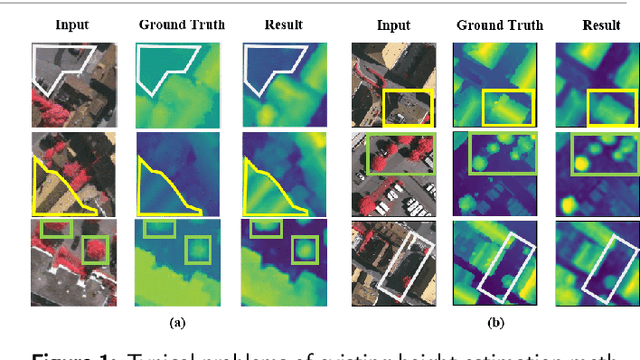
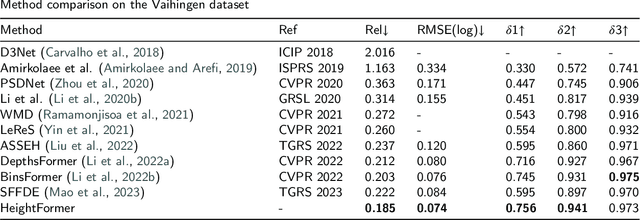
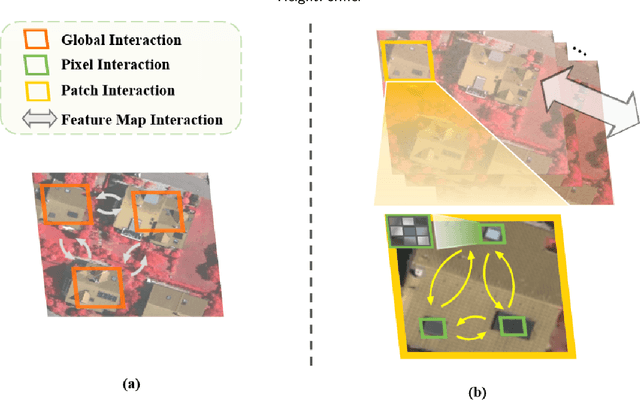

Height estimation has long been a pivotal topic within measurement and remote sensing disciplines, proving critical for endeavours such as 3D urban modelling, MR and autonomous driving. Traditional methods utilise stereo matching or multisensor fusion, both well-established techniques that typically necessitate multiple images from varying perspectives and adjunct sensors like SAR, leading to substantial deployment costs. Single image height estimation has emerged as an attractive alternative, boasting a larger data source variety and simpler deployment. However, current methods suffer from limitations such as fixed receptive fields, a lack of global information interaction, leading to noticeable instance-level height deviations. The inherent complexity of height prediction can result in a blurry estimation of object edge depth when using mainstream regression methods based on fixed height division. This paper presents a comprehensive solution for monocular height estimation in remote sensing, termed HeightFormer, combining multilevel interactions and image-adaptive classification-regression. It features the Multilevel Interaction Backbone (MIB) and Image-adaptive Classification-regression Height Generator (ICG). MIB supplements the fixed sample grid in CNN of the conventional backbone network with tokens of different interaction ranges. It is complemented by a pixel-, patch-, and feature map-level hierarchical interaction mechanism, designed to relay spatial geometry information across different scales and introducing a global receptive field to enhance the quality of instance-level height estimation. The ICG dynamically generates height partition for each image and reframes the traditional regression task, using a refinement from coarse to fine classification-regression that significantly mitigates the innate ill-posedness issue and drastically improves edge sharpness.
An Initial Investigation of Neural Replay Simulator for Over-the-Air Adversarial Perturbations to Automatic Speaker Verification
Oct 12, 2023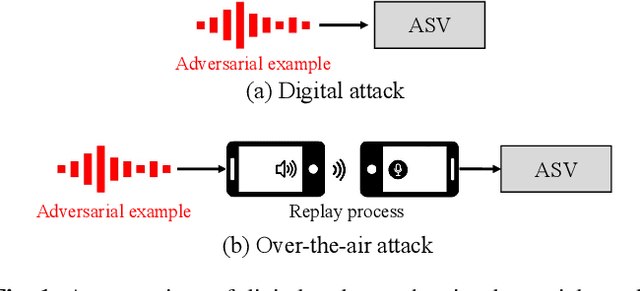
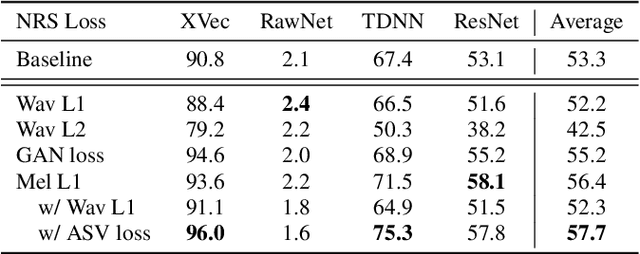
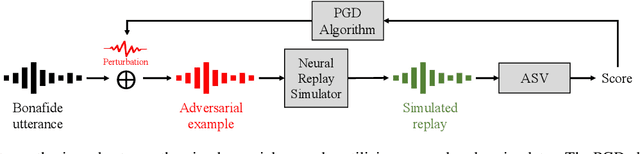
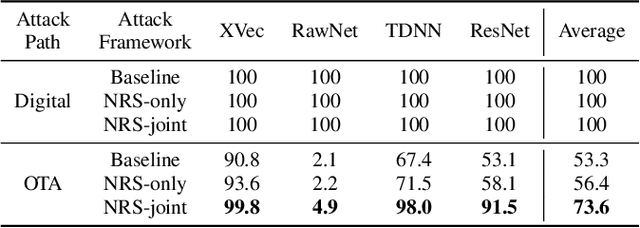
Deep Learning has advanced Automatic Speaker Verification (ASV) in the past few years. Although it is known that deep learning-based ASV systems are vulnerable to adversarial examples in digital access, there are few studies on adversarial attacks in the context of physical access, where a replay process (i.e., over the air) is involved. An over-the-air attack involves a loudspeaker, a microphone, and a replaying environment that impacts the movement of the sound wave. Our initial experiment confirms that the replay process impacts the effectiveness of the over-the-air attack performance. This study performs an initial investigation towards utilizing a neural replay simulator to improve over-the-air adversarial attack robustness. This is achieved by using a neural waveform synthesizer to simulate the replay process when estimating the adversarial perturbations. Experiments conducted on the ASVspoof2019 dataset confirm that the neural replay simulator can considerably increase the success rates of over-the-air adversarial attacks. This raises the concern for adversarial attacks on speaker verification in physical access applications.
Audio compression-assisted feature extraction for voice replay attack detection
Oct 10, 2023


Replay attack is one of the most effective and simplest voice spoofing attacks. Detecting replay attacks is challenging, according to the Automatic Speaker Verification Spoofing and Countermeasures Challenge 2021 (ASVspoof 2021), because they involve a loudspeaker, a microphone, and acoustic conditions (e.g., background noise). One obstacle to detecting replay attacks is finding robust feature representations that reflect the channel noise information added to the replayed speech. This study proposes a feature extraction approach that uses audio compression for assistance. Audio compression compresses audio to preserve content and speaker information for transmission. The missed information after decompression is expected to contain content- and speaker-independent information (e.g., channel noise added during the replay process). We conducted a comprehensive experiment with a few data augmentation techniques and 3 classifiers on the ASVspoof 2021 physical access (PA) set and confirmed the effectiveness of the proposed feature extraction approach. To the best of our knowledge, the proposed approach achieves the lowest EER at 22.71% on the ASVspoof 2021 PA evaluation set.
Adaptive Multi-head Contrastive Learning
Oct 09, 2023In contrastive learning, two views of an original image generated by different augmentations are considered as a positive pair whose similarity is required to be high. Moreover, two views of two different images are considered as a negative pair, and their similarity is encouraged to be low. Normally, a single similarity measure given by a single projection head is used to evaluate positive and negative sample pairs, respectively. However, due to the various augmentation strategies and varying intra-sample similarity, augmented views from the same image are often not similar. Moreover, due to inter-sample similarity, augmented views of two different images may be more similar than augmented views from the same image. As such, enforcing a high similarity for positive pairs and a low similarity for negative pairs may not always be achievable, and in the case of some pairs, forcing so may be detrimental to the performance. To address this issue, we propose to use multiple projection heads, each producing a separate set of features. Our loss function for pre-training emerges from a solution to the maximum likelihood estimation over head-wise posterior distributions of positive samples given observations. The loss contains the similarity measure over positive and negative pairs, each re-weighted by an individual adaptive temperature that is regularized to prevent ill solutions. Our adaptive multi-head contrastive learning (AMCL) can be applied to and experimentally improves several popular contrastive learning methods such as SimCLR, MoCo and Barlow Twins. Such improvement is consistent under various backbones and linear probing epoches and is more significant when multiple augmentation methods are used.
AdvSV: An Over-the-Air Adversarial Attack Dataset for Speaker Verification
Oct 09, 2023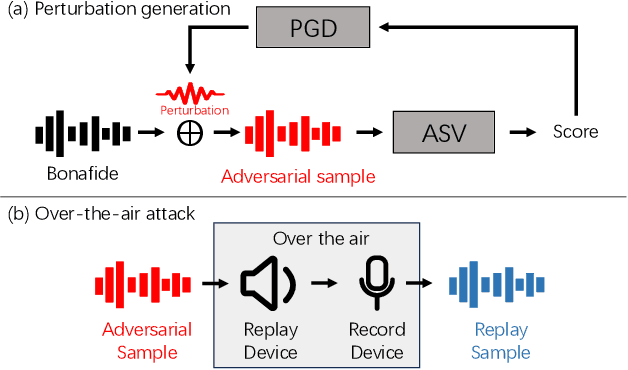
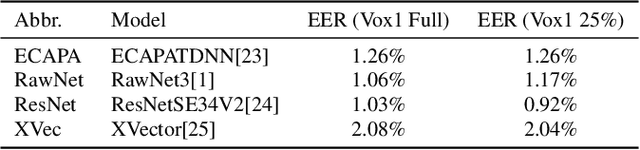

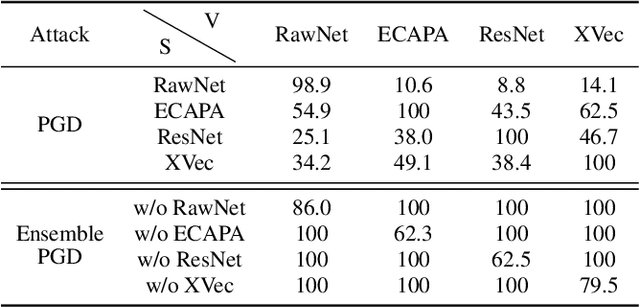
It is known that deep neural networks are vulnerable to adversarial attacks. Although Automatic Speaker Verification (ASV) built on top of deep neural networks exhibits robust performance in controlled scenarios, many studies confirm that ASV is vulnerable to adversarial attacks. The lack of a standard dataset is a bottleneck for further research, especially reproducible research. In this study, we developed an open-source adversarial attack dataset for speaker verification research. As an initial step, we focused on the over-the-air attack. An over-the-air adversarial attack involves a perturbation generation algorithm, a loudspeaker, a microphone, and an acoustic environment. The variations in the recording configurations make it very challenging to reproduce previous research. The AdvSV dataset is constructed using the Voxceleb1 Verification test set as its foundation. This dataset employs representative ASV models subjected to adversarial attacks and records adversarial samples to simulate over-the-air attack settings. The scope of the dataset can be easily extended to include more types of adversarial attacks. The dataset will be released to the public under the CC-BY license. In addition, we also provide a detection baseline for reproducible research.
AI in Software Engineering: Case Studies and Prospects
Sep 27, 2023Artificial intelligence (AI) and software engineering (SE) are two important areas in computer science. In recent years, researchers are trying to apply AI techniques in various stages of software development to improve the overall quality of software products. Moreover, there are also some researchers focus on the intersection between SE and AI. In fact, the relationship between SE and AI is very weak; however, methods and techniques in one area have been adopted in another area. More and more software products are capable of performing intelligent behaviour like human beings. In this paper, two cases studies which are IBM Watson and Google AlphaGo that use different AI techniques in solving real world challenging problems have been analysed, evaluated and compared. Based on the analysis of both case studies, using AI techniques such as deep learning and machine learning in software systems contributes to intelligent systems. Watson adopts 'decision making support' strategy to help human make decisions; whereas AlphaGo uses 'self-decision making' to choose operations that contribute to the best outcome. In addition, Watson learns from man-made resources such as paper; AlphaGo, on the other hand, learns from massive online resources such as photos. AlphaGo uses neural networks and reinforcement learning to mimic human brain, which might be very useful in medical research for diagnosis and treatment. However, there is still a long way to go if we want to reproduce human brain in machine and view computers as thinkers, because human brain and machines are intrinsically different. It would be more promising to see whether computers and software systems will become more and more intelligent to help with real world challenging problems that human beings cannot do.