 Add to Chrome
 Add to Firefox
 Add to Edge
Long-Horizon Agent Trajectory Attribution: A Unified Benchmark and Fine-Grained Annotation Framework
Aug 07, 2026
Large language model (LLM) agents increasingly operate through long-horizon trajectories involving user instructions, tool use, external observations, and memory. Existing benchmarks primarily evaluate behavioral outcomes but provide limited support for fine-grained attribution analysis. We introduce trajectory attribution and develop a benchmark and annotation framework for this task. The benchmark organizes heterogeneous trajectories under a unified component schema and provides annotations of the primary attribution component, together with attack and execution chains where applicable. Instantiating the benchmark with trajectories from AgentDojo and the Stage and Canary settings of Agent3Sigma yields more than 1,300 annotated trajectories covering task-aligned actions, unsafe actions, and safety refusals. The benchmark defines two evaluation tasks, primary attribution localization and attribution-chain recovery, and provides reference baselines based on incremental trajectory contribution and component-level leave-one-out perturbation. It captures diverse attribution settings, including local and long-range attribution as well as structured attribution chains. Reference baseline results exhibit substantial performance differences across these settings, providing an initial characterization of the benchmark's attribution challenges. Beyond this initial instantiation, we release a reusable annotation skill that enables trajectories generated by new agent models to be standardized, annotated, and evaluated under the same framework. Project resources and future releases are available at https://github.com/chenjing-2024/agent-trajectory-attribution.

VoxSafeBench: Not Just What Is Said, but Who, How, and Where
Apr 16, 2026As speech language models (SLMs) transition from personal devices into shared, multi-user environments, their responses must account for far more than the words alone. Who is speaking, how they sound, and where the conversation takes place can each turn an otherwise benign request into one that is unsafe, unfair, or privacy-violating. Existing benchmarks, however, largely focus on basic audio comprehension, study individual risks in isolation, or conflate content that is inherently harmful with content that only becomes problematic due to its acoustic context. We introduce VoxSafeBench, among the first benchmarks to jointly evaluate social alignment in SLMs across three dimensions: safety, fairness, and privacy. VoxSafeBench adopts a Two-Tier design: Tier1 evaluates content-centric risks using matched text and audio inputs, while Tier2 targets audio-conditioned risks in which the transcript is benign but the appropriate response hinges on the speaker, paralinguistic cues, or the surrounding environment. To validate Tier2, we include intermediate perception probes and confirm that frontier SLMs can successfully detect these acoustic cues yet still fail to act on them appropriately. Across 22 tasks with bilingual coverage, we find that safeguards appearing robust on text often degrade in speech: safety awareness drops for speaker- and scene-conditioned risks, fairness erodes when demographic differences are conveyed vocally, and privacy protections falter when contextual cues arrive acoustically. Together, these results expose a pervasive speech grounding gap: current SLMs frequently recognize the relevant social norm in text but fail to apply it when the decisive cue must be grounded in speech. Code and data are publicly available at: https://amphionteam.github.io/VoxSafeBench_demopage/
A Diffusion-Contrastive Graph Neural Network with Virtual Nodes for Wind Nowcasting in Unobserved Regions
Apr 11, 2026Accurate weather nowcasting remains one of the central challenges in atmospheric science, with critical implications for climate resilience, energy security, and disaster preparedness. Since it is not feasible to deploy observation stations everywhere, some regions lack dense observational networks, resulting in unreliable short-term wind predictions across those unobserved areas. Here we present a deep graph self-supervised framework that extends nowcasting capability into such unobserved regions without requiring new sensors. Our approach introduces "virtual nodes" into a diffusion and contrastive-based graph neural network, enabling the model to learn wind condition (i.e., speed, direction and gusts) in places with no direct measurements. Using high-temporal resolution weather station data across the Netherlands, we demonstrate that this approach reduces nowcast mean absolute error (MAE) of wind speed, gusts, and direction in unobserved regions by more than 30% - 46% compared with interpolation and regression methods. By enabling localized nowcasts where no measurements exist, this method opens new pathways for renewable energy integration, agricultural planning, and early-warning systems in data-sparse regions.
Over-the-Air Adversarial Attack Detection: from Datasets to Defenses
Sep 11, 2025
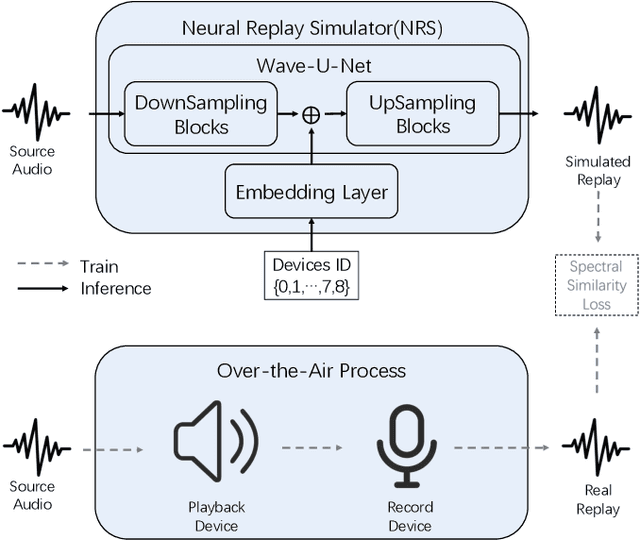

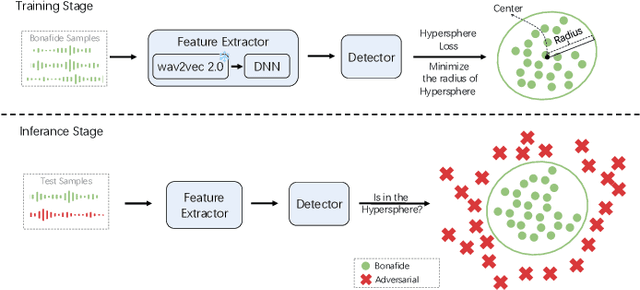
Automatic Speaker Verification (ASV) systems can be used for voice-enabled applications for identity verification. However, recent studies have exposed these systems' vulnerabilities to both over-the-line (OTL) and over-the-air (OTA) adversarial attacks. Although various detection methods have been proposed to counter these threats, they have not been thoroughly tested due to the lack of a comprehensive data set. To address this gap, we developed the AdvSV 2.0 dataset, which contains 628k samples with a total duration of 800 hours. This dataset incorporates classical adversarial attack algorithms, ASV systems, and encompasses both OTL and OTA scenarios. Furthermore, we introduce a novel adversarial attack method based on a Neural Replay Simulator (NRS), which enhances the potency of adversarial OTA attacks, thereby presenting a greater threat to ASV systems. To defend against these attacks, we propose CODA-OCC, a contrastive learning approach within the one-class classification framework. Experimental results show that CODA-OCC achieves an EER of 11.2% and an AUC of 0.95 on the AdvSV 2.0 dataset, outperforming several state-of-the-art detection methods.
Enhanced Prediction of CAR T-Cell Cytotoxicity with Quantum-Kernel Methods
Jul 30, 2025Chimeric antigen receptor (CAR) T-cells are T-cells engineered to recognize and kill specific tumor cells. Through their extracellular domains, CAR T-cells bind tumor cell antigens which triggers CAR T activation and proliferation. These processes are regulated by co-stimulatory domains present in the intracellular region of the CAR T-cell. Through integrating novel signaling components into the co-stimulatory domains, it is possible to modify CAR T-cell phenotype. Identifying and experimentally testing new CAR constructs based on libraries of co-stimulatory domains is nontrivial given the vast combinatorial space defined by such libraries. This leads to a highly data constrained, poorly explored combinatorial problem, where the experiments undersample all possible combinations. We propose a quantum approach using a Projected Quantum Kernel (PQK) to address this challenge. PQK operates by embedding classical data into a high dimensional Hilbert space and employs a kernel method to measure sample similarity. Using 61 qubits on a gate-based quantum computer, we demonstrate the largest PQK application to date and an enhancement in the classification performance over purely classical machine learning methods for CAR T cytotoxicity prediction. Importantly, we show improved learning for specific signaling domains and domain positions, particularly where there was lower information highlighting the potential for quantum computing in data-constrained problems.
ACE: Concept Editing in Diffusion Models without Performance Degradation
Mar 11, 2025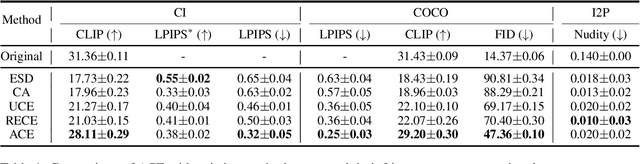
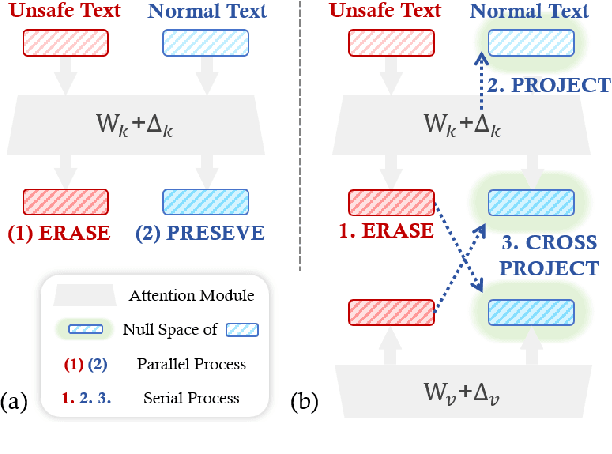
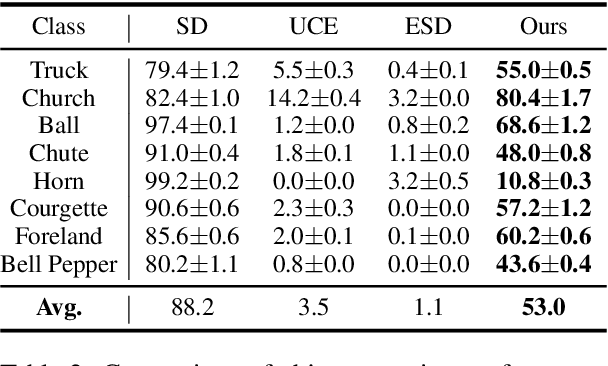
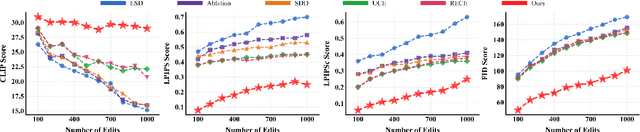
Diffusion-based text-to-image models have demonstrated remarkable capabilities in generating realistic images, but they raise societal and ethical concerns, such as the creation of unsafe content. While concept editing is proposed to address these issues, they often struggle to balance the removal of unsafe concept with maintaining the model's general genera-tive capabilities. In this work, we propose ACE, a new editing method that enhances concept editing in diffusion models. ACE introduces a novel cross null-space projection approach to precisely erase unsafe concept while maintaining the model's ability to generate high-quality, semantically consistent images. Extensive experiments demonstrate that ACE significantly outperforms the advancing baselines,improving semantic consistency by 24.56% and image generation quality by 34.82% on average with only 1% of the time cost. These results highlight the practical utility of concept editing by mitigating its potential risks, paving the way for broader applications in the field. Code is avaliable at https://github.com/littlelittlenine/ACE-zero.git
Integrating Weather Station Data and Radar for Precipitation Nowcasting: SmaAt-fUsion and SmaAt-Krige-GNet
Feb 22, 2025


In recent years, data-driven, deep learning-based approaches for precipitation nowcasting have attracted significant attention, showing promising results. However, many existing models fail to fully exploit the extensive atmospheric information available, relying primarily on precipitation data alone. This study introduces two novel deep learning architectures, SmaAt-fUsion and SmaAt-Krige-GNet, specifically designed to enhance precipitation nowcasting by integrating multi-variable weather station data with radar datasets. By leveraging additional meteorological information, these models improve representation learning in the latent space, resulting in enhanced nowcasting performance. The SmaAt-fUsion model extends the SmaAt-UNet framework by incorporating weather station data through a convolutional layer, integrating it into the bottleneck of the network. Conversely, the SmaAt-Krige-GNet model combines precipitation maps with weather station data processed using Kriging, a geo-statistical interpolation method, to generate variable-specific maps. These maps are then utilized in a dual-encoder architecture based on SmaAt-GNet, allowing multi-level data integration. Experimental evaluations were conducted using four years (2016--2019) of weather station and precipitation radar data from the Netherlands. Results demonstrate that SmaAt-Krige-GNet outperforms the standard SmaAt-UNet, which relies solely on precipitation radar data, in low precipitation scenarios, while SmaAt-fUsion surpasses SmaAt-UNet in both low and high precipitation scenarios. This highlights the potential of incorporating discrete weather station data to enhance the performance of deep learning-based weather nowcasting models.
SpMis: An Investigation of Synthetic Spoken Misinformation Detection
Sep 17, 2024


In recent years, speech generation technology has advanced rapidly, fueled by generative models and large-scale training techniques. While these developments have enabled the production of high-quality synthetic speech, they have also raised concerns about the misuse of this technology, particularly for generating synthetic misinformation. Current research primarily focuses on distinguishing machine-generated speech from human-produced speech, but the more urgent challenge is detecting misinformation within spoken content. This task requires a thorough analysis of factors such as speaker identity, topic, and synthesis. To address this need, we conduct an initial investigation into synthetic spoken misinformation detection by introducing an open-source dataset, SpMis. SpMis includes speech synthesized from over 1,000 speakers across five common topics, utilizing state-of-the-art text-to-speech systems. Although our results show promising detection capabilities, they also reveal substantial challenges for practical implementation, underscoring the importance of ongoing research in this critical area.
ADBM: Adversarial diffusion bridge model for reliable adversarial purification
Aug 01, 2024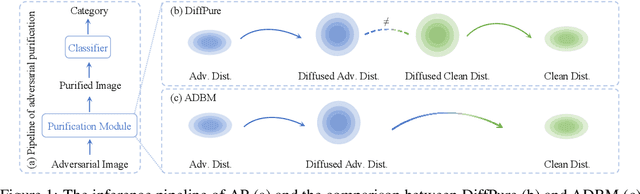
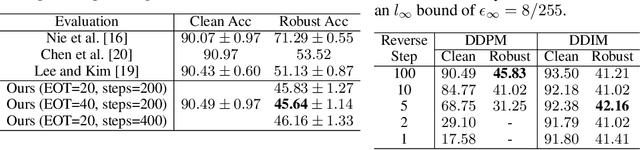
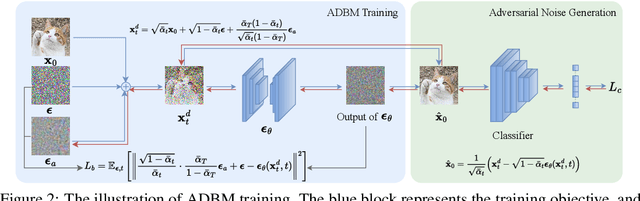
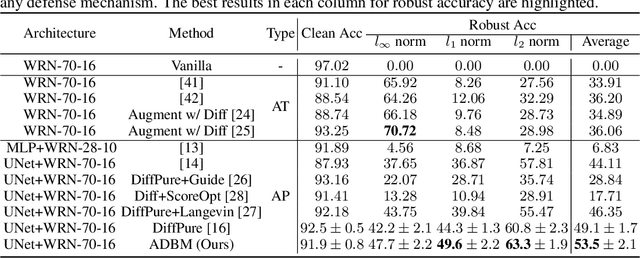
Recently Diffusion-based Purification (DiffPure) has been recognized as an effective defense method against adversarial examples. However, we find DiffPure which directly employs the original pre-trained diffusion models for adversarial purification, to be suboptimal. This is due to an inherent trade-off between noise purification performance and data recovery quality. Additionally, the reliability of existing evaluations for DiffPure is questionable, as they rely on weak adaptive attacks. In this work, we propose a novel Adversarial Diffusion Bridge Model, termed ADBM. ADBM directly constructs a reverse bridge from the diffused adversarial data back to its original clean examples, enhancing the purification capabilities of the original diffusion models. Through theoretical analysis and experimental validation across various scenarios, ADBM has proven to be a superior and robust defense mechanism, offering significant promise for practical applications.
Mitigating Hallucinations in Large Language Models via Self-Refinement-Enhanced Knowledge Retrieval
May 10, 2024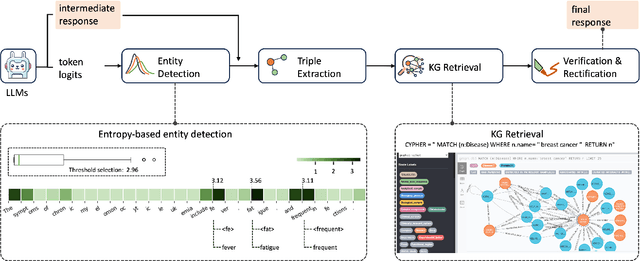
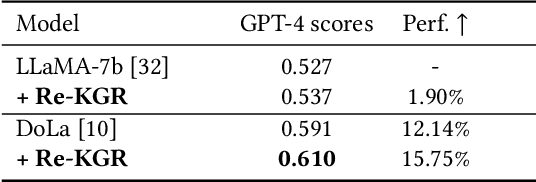
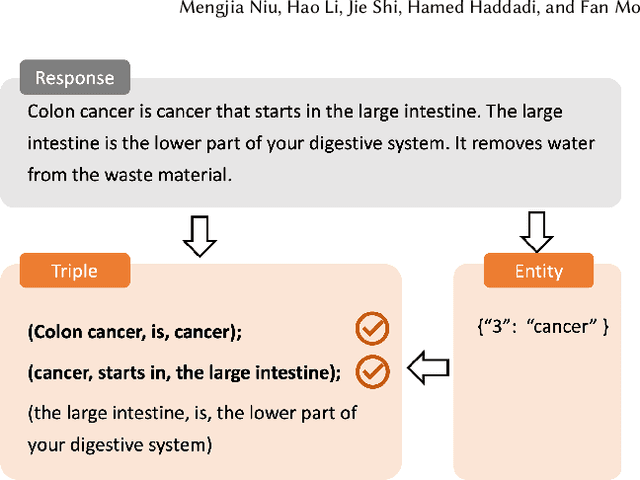
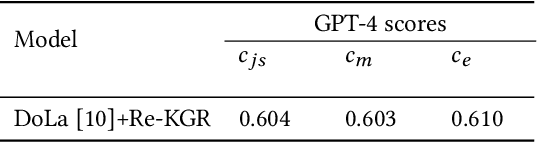
Large language models (LLMs) have demonstrated remarkable capabilities across various domains, although their susceptibility to hallucination poses significant challenges for their deployment in critical areas such as healthcare. To address this issue, retrieving relevant facts from knowledge graphs (KGs) is considered a promising method. Existing KG-augmented approaches tend to be resource-intensive, requiring multiple rounds of retrieval and verification for each factoid, which impedes their application in real-world scenarios. In this study, we propose Self-Refinement-Enhanced Knowledge Graph Retrieval (Re-KGR) to augment the factuality of LLMs' responses with less retrieval efforts in the medical field. Our approach leverages the attribution of next-token predictive probability distributions across different tokens, and various model layers to primarily identify tokens with a high potential for hallucination, reducing verification rounds by refining knowledge triples associated with these tokens. Moreover, we rectify inaccurate content using retrieved knowledge in the post-processing stage, which improves the truthfulness of generated responses. Experimental results on a medical dataset demonstrate that our approach can enhance the factual capability of LLMs across various foundational models as evidenced by the highest scores on truthfulness.