 Add to Chrome
 Add to Firefox
 Add to Edge
Unpaired Multi-view Clustering via Reliable View Guidance
Apr 27, 2024


This paper focuses on unpaired multi-view clustering (UMC), a challenging problem where paired observed samples are unavailable across multiple views. The goal is to perform effective joint clustering using the unpaired observed samples in all views. In incomplete multi-view clustering, existing methods typically rely on sample pairing between views to capture their complementary. However, that is not applicable in the case of UMC. Hence, we aim to extract the consistent cluster structure across views. In UMC, two challenging issues arise: uncertain cluster structure due to lack of label and uncertain pairing relationship due to absence of paired samples. We assume that the view with a good cluster structure is the reliable view, which acts as a supervisor to guide the clustering of the other views. With the guidance of reliable views, a more certain cluster structure of these views is obtained while achieving alignment between reliable views and other views. Then we propose Reliable view Guidance with one reliable view (RG-UMC) and multiple reliable views (RGs-UMC) for UMC. Specifically, we design alignment modules with one reliable view and multiple reliable views, respectively, to adaptively guide the optimization process. Also, we utilize the compactness module to enhance the relationship of samples within the same cluster. Meanwhile, an orthogonal constraint is applied to latent representation to obtain discriminate features. Extensive experiments show that both RG-UMC and RGs-UMC outperform the best state-of-the-art method by an average of 24.14\% and 29.42\% in NMI, respectively.

Beyond ESM2: Graph-Enhanced Protein Sequence Modeling with Efficient Clustering
Apr 24, 2024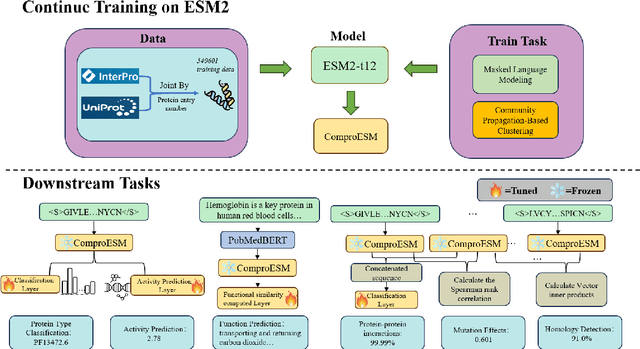


Proteins are essential to life's processes, underpinning evolution and diversity. Advances in sequencing technology have revealed millions of proteins, underscoring the need for sophisticated pre-trained protein models for biological analysis and AI development. Facebook's ESM2, the most advanced protein language model to date, leverages a masked prediction task for unsupervised learning, crafting amino acid representations with notable biochemical accuracy. Yet, it lacks in delivering functional protein insights, signaling an opportunity for enhancing representation quality.Our study addresses this gap by incorporating protein family classification into ESM2's training.This approach, augmented with Community Propagation-Based Clustering Algorithm, improves global protein representations, while a contextual prediction task fine-tunes local amino acid accuracy. Significantly, our model achieved state-of-the-art results in several downstream experiments, demonstrating the power of combining global and local methodologies to substantially boost protein representation quality.
Optimizing Calibration by Gaining Aware of Prediction Correctness
Apr 19, 2024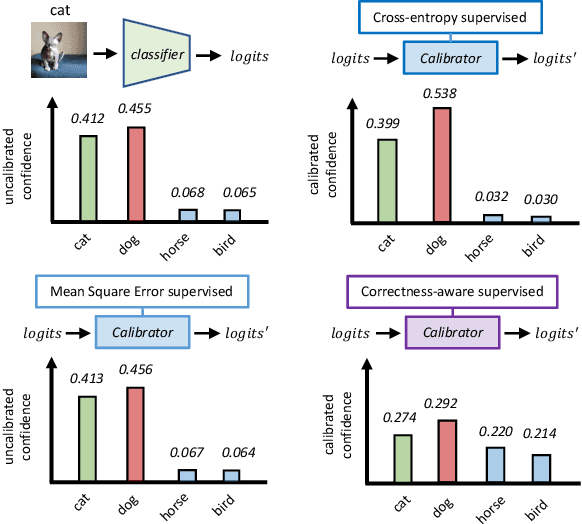
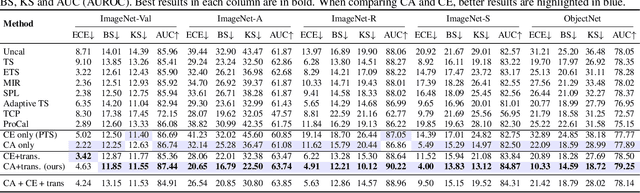

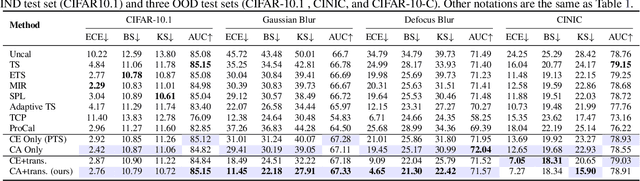
Model calibration aims to align confidence with prediction correctness. The Cross-Entropy CE) loss is widely used for calibrator training, which enforces the model to increase confidence on the ground truth class. However, we find the CE loss has intrinsic limitations. For example, for a narrow misclassification, a calibrator trained by the CE loss often produces high confidence on the wrongly predicted class (e.g., a test sample is wrongly classified and its softmax score on the ground truth class is around 0.4), which is undesirable. In this paper, we propose a new post-hoc calibration objective derived from the aim of calibration. Intuitively, the proposed objective function asks that the calibrator decrease model confidence on wrongly predicted samples and increase confidence on correctly predicted samples. Because a sample itself has insufficient ability to indicate correctness, we use its transformed versions (e.g., rotated, greyscaled and color-jittered) during calibrator training. Trained on an in-distribution validation set and tested with isolated, individual test samples, our method achieves competitive calibration performance on both in-distribution and out-of-distribution test sets compared with the state of the art. Further, our analysis points out the difference between our method and commonly used objectives such as CE loss and mean square error loss, where the latters sometimes deviates from the calibration aim.
Nonlinear sparse variational Bayesian learning based model predictive control with application to PEMFC temperature control
Apr 15, 2024The accuracy of the underlying model predictions is crucial for the success of model predictive control (MPC) applications. If the model is unable to accurately analyze the dynamics of the controlled system, the performance and stability guarantees provided by MPC may not be achieved. Learning-based MPC can learn models from data, improving the applicability and reliability of MPC. This study develops a nonlinear sparse variational Bayesian learning based MPC (NSVB-MPC) for nonlinear systems, where the model is learned by the developed NSVB method. Variational inference is used by NSVB-MPC to assess the predictive accuracy and make the necessary corrections to quantify system uncertainty. The suggested approach ensures input-to-state (ISS) and the feasibility of recursive constraints in accordance with the concept of an invariant terminal region. Finally, a PEMFC temperature control model experiment confirms the effectiveness of the NSVB-MPC method.
HyperCLOVA X Technical Report
Apr 13, 2024We introduce HyperCLOVA X, a family of large language models (LLMs) tailored to the Korean language and culture, along with competitive capabilities in English, math, and coding. HyperCLOVA X was trained on a balanced mix of Korean, English, and code data, followed by instruction-tuning with high-quality human-annotated datasets while abiding by strict safety guidelines reflecting our commitment to responsible AI. The model is evaluated across various benchmarks, including comprehensive reasoning, knowledge, commonsense, factuality, coding, math, chatting, instruction-following, and harmlessness, in both Korean and English. HyperCLOVA X exhibits strong reasoning capabilities in Korean backed by a deep understanding of the language and cultural nuances. Further analysis of the inherent bilingual nature and its extension to multilingualism highlights the model's cross-lingual proficiency and strong generalization ability to untargeted languages, including machine translation between several language pairs and cross-lingual inference tasks. We believe that HyperCLOVA X can provide helpful guidance for regions or countries in developing their sovereign LLMs.
Weakly-Supervised Learning via Multi-Lateral Decoder Branching for Guidewire Segmentation in Robot-Assisted Cardiovascular Catheterization
Apr 11, 2024Although robot-assisted cardiovascular catheterization is commonly performed for intervention of cardiovascular diseases, more studies are needed to support the procedure with automated tool segmentation. This can aid surgeons on tool tracking and visualization during intervention. Learning-based segmentation has recently offered state-of-the-art segmentation performances however, generating ground-truth signals for fully-supervised methods is labor-intensive and time consuming for the interventionists. In this study, a weakly-supervised learning method with multi-lateral pseudo labeling is proposed for tool segmentation in cardiac angiograms. The method includes a modified U-Net model with one encoder and multiple lateral-branched decoders that produce pseudo labels as supervision signals under different perturbation. The pseudo labels are self-generated through a mixed loss function and shared consistency in the decoders. We trained the model end-to-end with weakly-annotated data obtained during robotic cardiac catheterization. Experiments with the proposed model shows weakly annotated data has closer performance to when fully annotated data is used. Compared to three existing weakly-supervised methods, our approach yielded higher segmentation performance across three different cardiac angiogram data. With ablation study, we showed consistent performance under different parameters. Thus, we offer a less expensive method for real-time tool segmentation and tracking during robot-assisted cardiac catheterization.
AUEditNet: Dual-Branch Facial Action Unit Intensity Manipulation with Implicit Disentanglement
Apr 10, 2024Facial action unit (AU) intensity plays a pivotal role in quantifying fine-grained expression behaviors, which is an effective condition for facial expression manipulation. However, publicly available datasets containing intensity annotations for multiple AUs remain severely limited, often featuring a restricted number of subjects. This limitation places challenges to the AU intensity manipulation in images due to disentanglement issues, leading researchers to resort to other large datasets with pretrained AU intensity estimators for pseudo labels. In addressing this constraint and fully leveraging manual annotations of AU intensities for precise manipulation, we introduce AUEditNet. Our proposed model achieves impressive intensity manipulation across 12 AUs, trained effectively with only 18 subjects. Utilizing a dual-branch architecture, our approach achieves comprehensive disentanglement of facial attributes and identity without necessitating additional loss functions or implementing with large batch sizes. This approach offers a potential solution to achieve desired facial attribute editing despite the dataset's limited subject count. Our experiments demonstrate AUEditNet's superior accuracy in editing AU intensities, affirming its capability in disentangling facial attributes and identity within a limited subject pool. AUEditNet allows conditioning by either intensity values or target images, eliminating the need for constructing AU combinations for specific facial expression synthesis. Moreover, AU intensity estimation, as a downstream task, validates the consistency between real and edited images, confirming the effectiveness of our proposed AU intensity manipulation method.
ONNXPruner: ONNX-Based General Model Pruning Adapter
Apr 10, 2024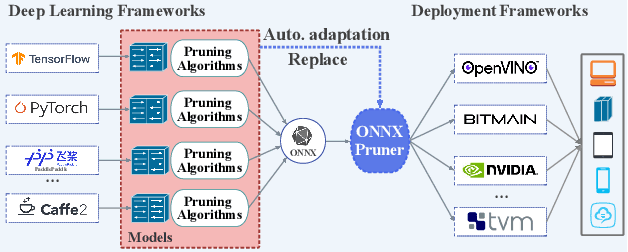
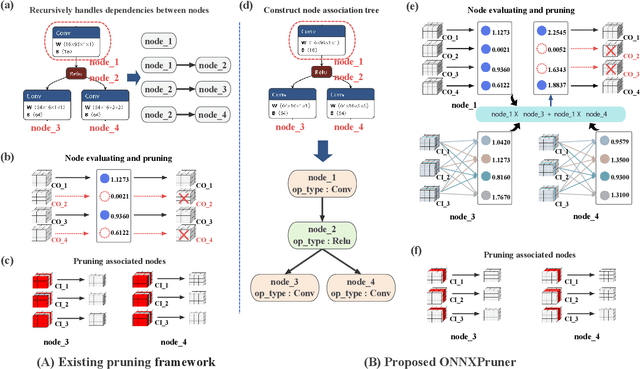
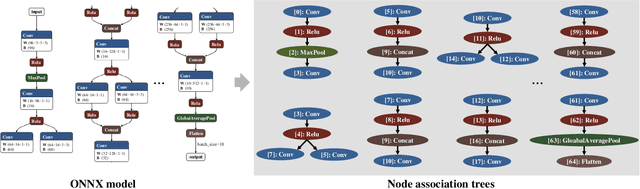
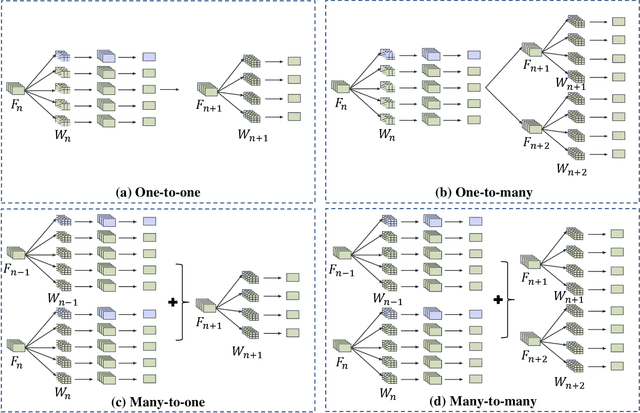
Recent advancements in model pruning have focused on developing new algorithms and improving upon benchmarks. However, the practical application of these algorithms across various models and platforms remains a significant challenge. To address this challenge, we propose ONNXPruner, a versatile pruning adapter designed for the ONNX format models. ONNXPruner streamlines the adaptation process across diverse deep learning frameworks and hardware platforms. A novel aspect of ONNXPruner is its use of node association trees, which automatically adapt to various model architectures. These trees clarify the structural relationships between nodes, guiding the pruning process, particularly highlighting the impact on interconnected nodes. Furthermore, we introduce a tree-level evaluation method. By leveraging node association trees, this method allows for a comprehensive analysis beyond traditional single-node evaluations, enhancing pruning performance without the need for extra operations. Experiments across multiple models and datasets confirm ONNXPruner's strong adaptability and increased efficacy. Our work aims to advance the practical application of model pruning.
CSST Strong Lensing Preparation: a Framework for Detecting Strong Lenses in the Multi-color Imaging Survey by the China Survey Space Telescope (CSST)
Apr 02, 2024Strong gravitational lensing is a powerful tool for investigating dark matter and dark energy properties. With the advent of large-scale sky surveys, we can discover strong lensing systems on an unprecedented scale, which requires efficient tools to extract them from billions of astronomical objects. The existing mainstream lens-finding tools are based on machine learning algorithms and applied to cut-out-centered galaxies. However, according to the design and survey strategy of optical surveys by CSST, preparing cutouts with multiple bands requires considerable efforts. To overcome these challenges, we have developed a framework based on a hierarchical visual Transformer with a sliding window technique to search for strong lensing systems within entire images. Moreover, given that multi-color images of strong lensing systems can provide insights into their physical characteristics, our framework is specifically crafted to identify strong lensing systems in images with any number of channels. As evaluated using CSST mock data based on an Semi-Analytic Model named CosmoDC2, our framework achieves precision and recall rates of 0.98 and 0.90, respectively. To evaluate the effectiveness of our method in real observations, we have applied it to a subset of images from the DESI Legacy Imaging Surveys and media images from Euclid Early Release Observations. 61 new strong lensing system candidates are discovered by our method. However, we also identified false positives arising primarily from the simplified galaxy morphology assumptions within the simulation. This underscores the practical limitations of our approach while simultaneously highlighting potential avenues for future improvements.
Exploiting Inter-sample and Inter-feature Relations in Dataset Distillation
Mar 31, 2024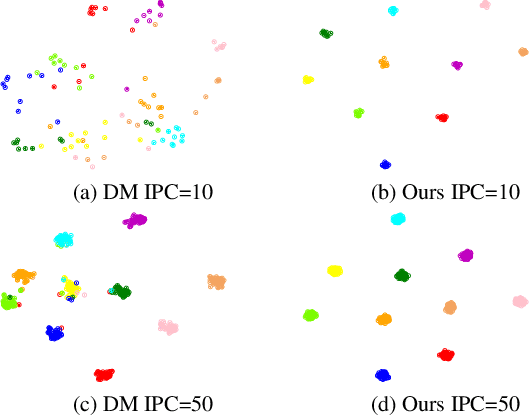
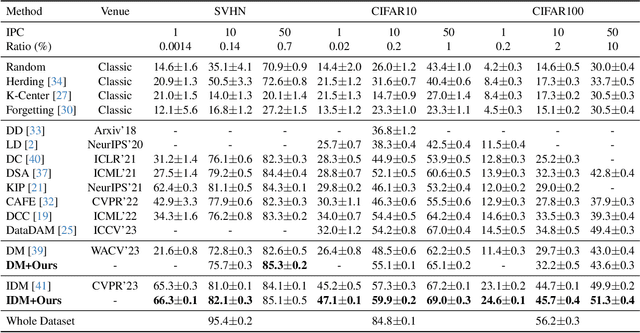
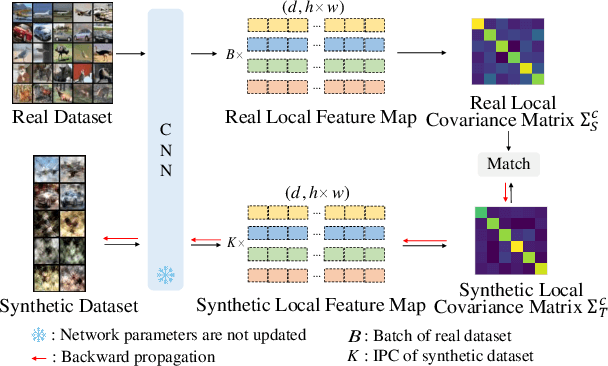
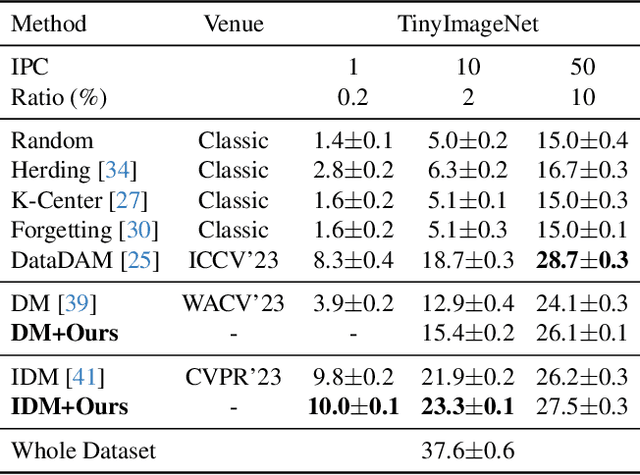
Dataset distillation has emerged as a promising approach in deep learning, enabling efficient training with small synthetic datasets derived from larger real ones. Particularly, distribution matching-based distillation methods attract attention thanks to its effectiveness and low computational cost. However, these methods face two primary limitations: the dispersed feature distribution within the same class in synthetic datasets, reducing class discrimination, and an exclusive focus on mean feature consistency, lacking precision and comprehensiveness. To address these challenges, we introduce two novel constraints: a class centralization constraint and a covariance matching constraint. The class centralization constraint aims to enhance class discrimination by more closely clustering samples within classes. The covariance matching constraint seeks to achieve more accurate feature distribution matching between real and synthetic datasets through local feature covariance matrices, particularly beneficial when sample sizes are much smaller than the number of features. Experiments demonstrate notable improvements with these constraints, yielding performance boosts of up to 6.6% on CIFAR10, 2.9% on SVHN, 2.5% on CIFAR100, and 2.5% on TinyImageNet, compared to the state-of-the-art relevant methods. In addition, our method maintains robust performance in cross-architecture settings, with a maximum performance drop of 1.7% on four architectures. Code is available at https://github.com/VincenDen/IID.