 Add to Chrome
 Add to Firefox
 Add to Edge
VeCAF: VLM-empowered Collaborative Active Finetuning with Training Objective Awareness
Jan 15, 2024
Finetuning a pretrained vision model (PVM) is a common technique for learning downstream vision tasks. The conventional finetuning process with the randomly sampled data points results in diminished training efficiency. To address this drawback, we propose a novel approach, VLM-empowered Collaborative Active Finetuning (VeCAF). VeCAF optimizes a parametric data selection model by incorporating the training objective of the model being tuned. Effectively, this guides the PVM towards the performance goal with improved data and computational efficiency. As vision-language models (VLMs) have achieved significant advancements by establishing a robust connection between image and language domains, we exploit the inherent semantic richness of the text embedding space and utilize text embedding of pretrained VLM models to augment PVM image features for better data selection and finetuning. Furthermore, the flexibility of text-domain augmentation gives VeCAF a unique ability to handle out-of-distribution scenarios without external augmented data. Extensive experiments show the leading performance and high efficiency of VeCAF that is superior to baselines in both in-distribution and out-of-distribution image classification tasks. On ImageNet, VeCAF needs up to 3.3x less training batches to reach the target performance compared to full finetuning and achieves 2.8% accuracy improvement over SOTA methods with the same number of batches.

Learned Best-Effort LLM Serving
Jan 15, 2024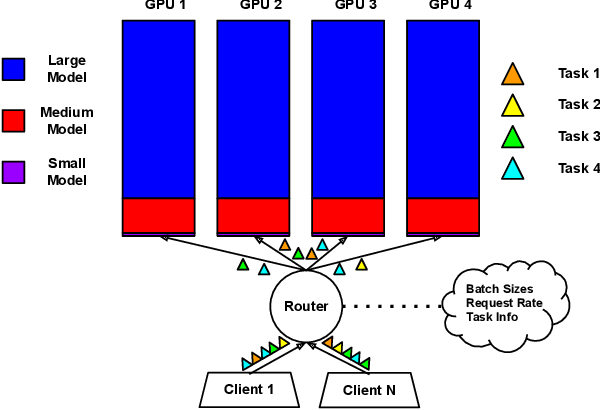
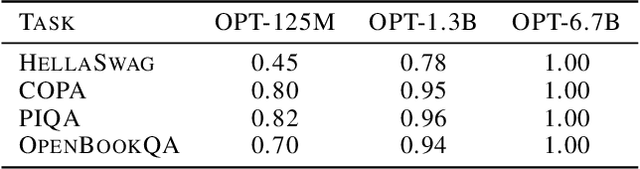
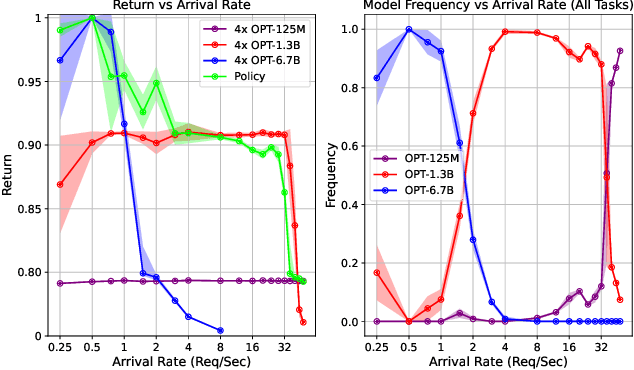
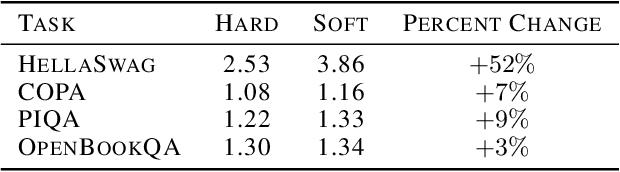
Many applications must provide low-latency LLM service to users or risk unacceptable user experience. However, over-provisioning resources to serve fluctuating request patterns is often prohibitively expensive. In this work, we present a best-effort serving system that employs deep reinforcement learning to adjust service quality based on the task distribution and system load. Our best-effort system can maintain availability with over 10x higher client request rates, serves above 96% of peak performance 4.1x more often, and serves above 98% of peak performance 2.3x more often than static serving on unpredictable workloads. Our learned router is robust to shifts in both the arrival and task distribution. Compared to static serving, learned best-effort serving allows for cost-efficient serving through increased hardware utility. Additionally, we argue that learned best-effort LLM serving is applicable in wide variety of settings and provides application developers great flexibility to meet their specific needs.
Efficient Deweather Mixture-of-Experts with Uncertainty-aware Feature-wise Linear Modulation
Dec 27, 2023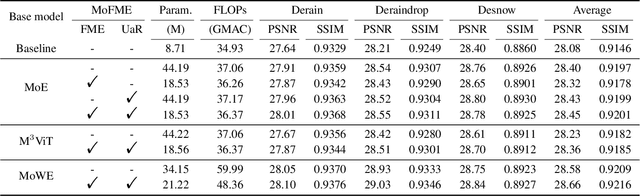
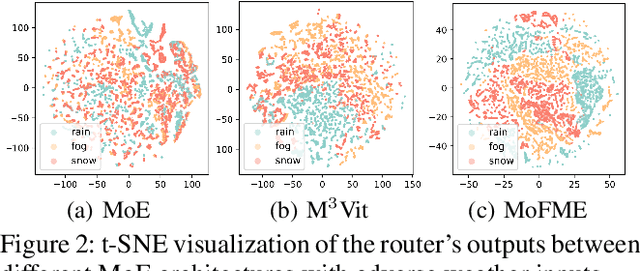
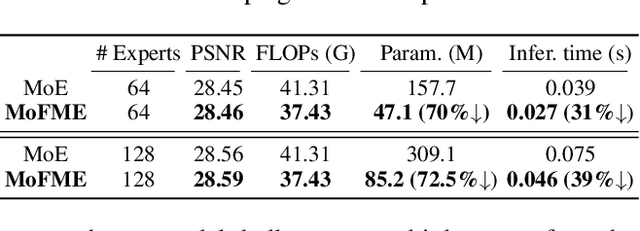
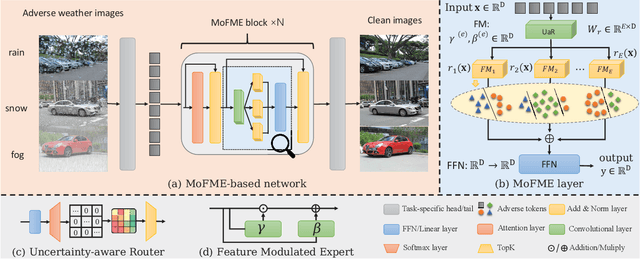
The Mixture-of-Experts (MoE) approach has demonstrated outstanding scalability in multi-task learning including low-level upstream tasks such as concurrent removal of multiple adverse weather effects. However, the conventional MoE architecture with parallel Feed Forward Network (FFN) experts leads to significant parameter and computational overheads that hinder its efficient deployment. In addition, the naive MoE linear router is suboptimal in assigning task-specific features to multiple experts which limits its further scalability. In this work, we propose an efficient MoE architecture with weight sharing across the experts. Inspired by the idea of linear feature modulation (FM), our architecture implicitly instantiates multiple experts via learnable activation modulations on a single shared expert block. The proposed Feature Modulated Expert (FME) serves as a building block for the novel Mixture-of-Feature-Modulation-Experts (MoFME) architecture, which can scale up the number of experts with low overhead. We further propose an Uncertainty-aware Router (UaR) to assign task-specific features to different FM modules with well-calibrated weights. This enables MoFME to effectively learn diverse expert functions for multiple tasks. The conducted experiments on the multi-deweather task show that our MoFME outperforms the baselines in the image restoration quality by 0.1-0.2 dB and achieves SOTA-compatible performance while saving more than 72% of parameters and 39% inference time over the conventional MoE counterpart. Experiments on the downstream segmentation and classification tasks further demonstrate the generalizability of MoFME to real open-world applications.
StreamDiffusion: A Pipeline-level Solution for Real-time Interactive Generation
Dec 19, 2023We introduce StreamDiffusion, a real-time diffusion pipeline designed for interactive image generation. Existing diffusion models are adept at creating images from text or image prompts, yet they often fall short in real-time interaction. This limitation becomes particularly evident in scenarios involving continuous input, such as Metaverse, live video streaming, and broadcasting, where high throughput is imperative. To address this, we present a novel approach that transforms the original sequential denoising into the batching denoising process. Stream Batch eliminates the conventional wait-and-interact approach and enables fluid and high throughput streams. To handle the frequency disparity between data input and model throughput, we design a novel input-output queue for parallelizing the streaming process. Moreover, the existing diffusion pipeline uses classifier-free guidance(CFG), which requires additional U-Net computation. To mitigate the redundant computations, we propose a novel residual classifier-free guidance (RCFG) algorithm that reduces the number of negative conditional denoising steps to only one or even zero. Besides, we introduce a stochastic similarity filter(SSF) to optimize power consumption. Our Stream Batch achieves around 1.5x speedup compared to the sequential denoising method at different denoising levels. The proposed RCFG leads to speeds up to 2.05x higher than the conventional CFG. Combining the proposed strategies and existing mature acceleration tools makes the image-to-image generation achieve up-to 91.07fps on one RTX4090, improving the throughputs of AutoPipline developed by Diffusers over 59.56x. Furthermore, our proposed StreamDiffusion also significantly reduces the energy consumption by 2.39x on one RTX3060 and 1.99x on one RTX4090, respectively.
Split-Ensemble: Efficient OOD-aware Ensemble via Task and Model Splitting
Dec 14, 2023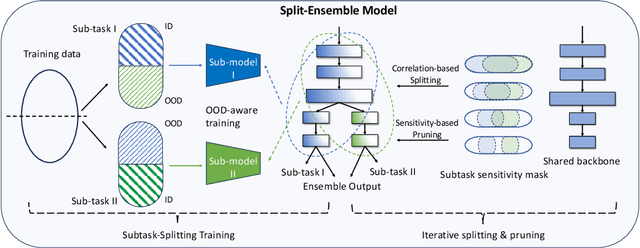
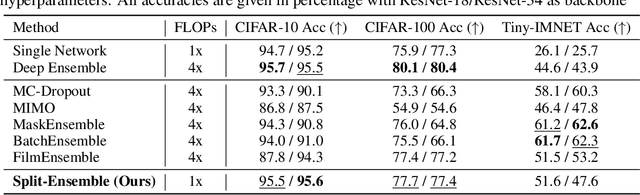
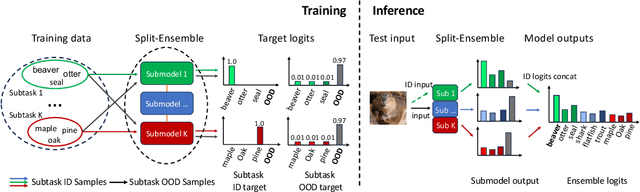
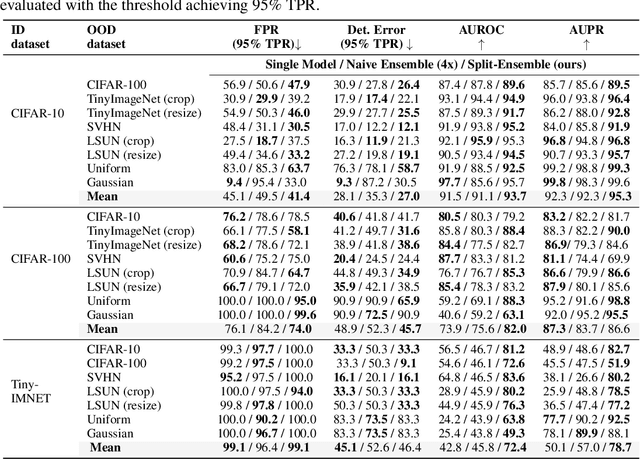
Uncertainty estimation is crucial for machine learning models to detect out-of-distribution (OOD) inputs. However, the conventional discriminative deep learning classifiers produce uncalibrated closed-set predictions for OOD data. A more robust classifiers with the uncertainty estimation typically require a potentially unavailable OOD dataset for outlier exposure training, or a considerable amount of additional memory and compute to build ensemble models. In this work, we improve on uncertainty estimation without extra OOD data or additional inference costs using an alternative Split-Ensemble method. Specifically, we propose a novel subtask-splitting ensemble training objective, where a common multiclass classification task is split into several complementary subtasks. Then, each subtask's training data can be considered as OOD to the other subtasks. Diverse submodels can therefore be trained on each subtask with OOD-aware objectives. The subtask-splitting objective enables us to share low-level features across submodels to avoid parameter and computational overheads. In particular, we build a tree-like Split-Ensemble architecture by performing iterative splitting and pruning from a shared backbone model, where each branch serves as a submodel corresponding to a subtask. This leads to improved accuracy and uncertainty estimation across submodels under a fixed ensemble computation budget. Empirical study with ResNet-18 backbone shows Split-Ensemble, without additional computation cost, improves accuracy over a single model by 0.8%, 1.8%, and 25.5% on CIFAR-10, CIFAR-100, and Tiny-ImageNet, respectively. OOD detection for the same backbone and in-distribution datasets surpasses a single model baseline by, correspondingly, 2.2%, 8.1%, and 29.6% mean AUROC. Codes will be publicly available at https://antonioo-c.github.io/projects/split-ensemble
An LLM Compiler for Parallel Function Calling
Dec 07, 2023Large Language Models (LLMs) have shown remarkable results on various complex reasoning benchmarks. The reasoning capabilities of LLMs enable them to execute function calls, using user-provided functions to overcome their inherent limitations, such as knowledge cutoffs, poor arithmetic skills, or lack of access to private data. This development has expanded LLMs' scope to include multi-function calling, where LLMs are equipped with a variety of functions and select the proper functions based on the context. Multi-function calling abilities of LLMs have catalyzed LLM-based software development, allowing them to tackle more complex problems. However, current methods for multi-function calling often require sequential reasoning and acting for each function which can result in high latency, cost, and sometimes inaccurate behavior. To address this, we introduce LLMCompiler, which executes functions in parallel to efficiently orchestrate multi-function calling. Drawing from the principles of classical compilers, LLMCompiler streamlines parallel function calling with three components: (i) an LLM Planner, formulating execution strategies and dependencies; (ii) a Task Fetching Unit, dispatching function calling tasks; and (iii) an Executor, executing these tasks in parallel. LLMCompiler automatically computes an optimized orchestration for the function calls and can be used with open-source models such as LLaMA-2. We have benchmarked LLMCompiler on a range of tasks including cases with non-trivial inter-dependency between function calls, as well as cases that require dynamic replanning based on intermediate results. We observe consistent latency speedup of up to 3.7x, cost savings of up to 6.7x, and accuracy improvement of up to ~9% as compared to ReAct. Additionally, LLMCompiler achieves up to 1.35x latency gain over OpenAI's recent parallel function calling, while achieving similar accuracy.
MAgIC: Investigation of Large Language Model Powered Multi-Agent in Cognition, Adaptability, Rationality and Collaboration
Nov 16, 2023
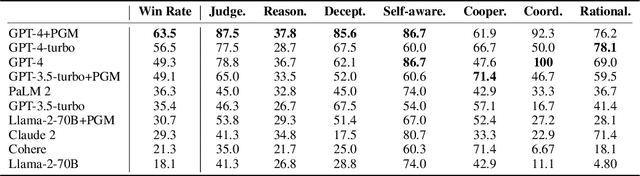

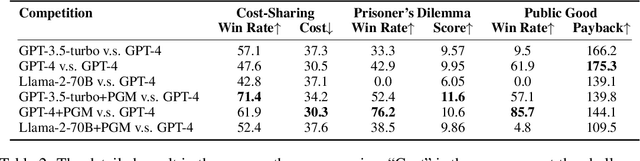
Large Language Models (LLMs) have marked a significant advancement in the field of natural language processing, demonstrating exceptional capabilities in reasoning, tool usage, and memory. As their applications extend into multi-agent environments, a need has arisen for a comprehensive evaluation framework that captures their abilities in reasoning, planning, collaboration, and more. This work introduces a novel benchmarking framework specifically tailored to assess LLMs within multi-agent settings, providing quantitative metrics to evaluate their judgment, reasoning, deception, self-awareness, cooperation, coordination, and rationality. We utilize games such as Chameleon and Undercover, alongside game theory scenarios like Cost Sharing, Multi-player Prisoner's Dilemma, and Public Good, to create diverse testing environments. Our framework is fortified with the Probabilistic Graphical Modeling (PGM) method, enhancing the LLMs' capabilities in navigating complex social and cognitive dimensions. The benchmark evaluates seven multi-agent systems powered by different LLMs, quantitatively highlighting a significant capability gap over threefold between the strongest, GPT-4, and the weakest, Llama-2-70B. It also confirms that our PGM enhancement boosts the inherent abilities of all selected models by 50% on average. Our codes are released here https://github.com/cathyxl/MAgIC.
EPIM: Efficient Processing-In-Memory Accelerators based on Epitome
Nov 12, 2023The exploration of Processing-In-Memory (PIM) accelerators has garnered significant attention within the research community. However, the utilization of large-scale neural networks on Processing-In-Memory (PIM) accelerators encounters challenges due to constrained on-chip memory capacity. To tackle this issue, current works explore model compression algorithms to reduce the size of Convolutional Neural Networks (CNNs). Most of these algorithms either aim to represent neural operators with reduced-size parameters (e.g., quantization) or search for the best combinations of neural operators (e.g., neural architecture search). Designing neural operators to align with PIM accelerators' specifications is an area that warrants further study. In this paper, we introduce the Epitome, a lightweight neural operator offering convolution-like functionality, to craft memory-efficient CNN operators for PIM accelerators (EPIM). On the software side, we evaluate epitomes' latency and energy on PIM accelerators and introduce a PIM-aware layer-wise design method to enhance their hardware efficiency. We apply epitome-aware quantization to further reduce the size of epitomes. On the hardware side, we modify the datapath of current PIM accelerators to accommodate epitomes and implement a feature map reuse technique to reduce computation cost. Experimental results reveal that our 3-bit quantized EPIM-ResNet50 attains 71.59% top-1 accuracy on ImageNet, reducing crossbar areas by 30.65 times. EPIM surpasses the state-of-the-art pruning methods on PIM.
Simple and Effective Input Reformulations for Translation
Nov 12, 2023Foundation language models learn from their finetuning input context in different ways. In this paper, we reformulate inputs during finetuning for challenging translation tasks, leveraging model strengths from pretraining in novel ways to improve downstream performance. These reformulations are simple data level modifications, require no additional collection of training data or modification of data at inference time. They can be applied either on single language pair translation tasks or massively multilingual translation tasks. Experiments with these techniques demonstrate significant performance improvements up to $\textbf{3.5 chrF++ on the Flores200 translation benchmark}$. We hope our research accessibly improves finetuning data efficiency, enabling more effective training to scalably improve state-of-the-art performance. Our code is released $\href{https://github.com/bri25yu/LanguageModelExperimentation}{here}.$
S-LoRA: Serving Thousands of Concurrent LoRA Adapters
Nov 07, 2023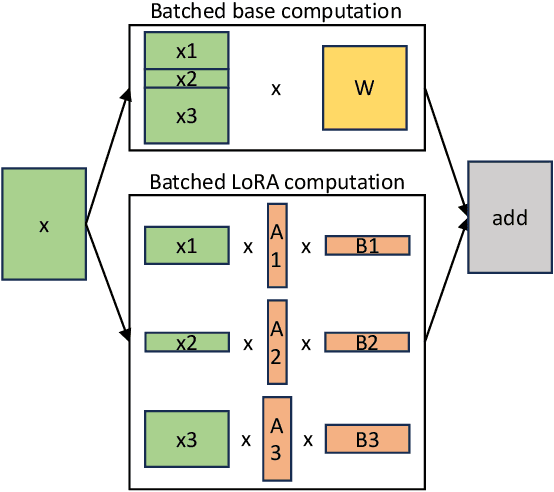
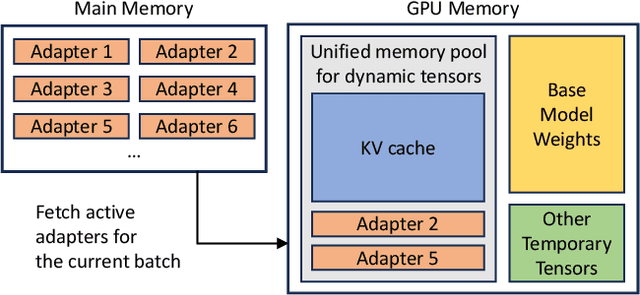
The "pretrain-then-finetune" paradigm is commonly adopted in the deployment of large language models. Low-Rank Adaptation (LoRA), a parameter-efficient fine-tuning method, is often employed to adapt a base model to a multitude of tasks, resulting in a substantial collection of LoRA adapters derived from one base model. We observe that this paradigm presents significant opportunities for batched inference during serving. To capitalize on these opportunities, we present S-LoRA, a system designed for the scalable serving of many LoRA adapters. S-LoRA stores all adapters in the main memory and fetches the adapters used by the currently running queries to the GPU memory. To efficiently use the GPU memory and reduce fragmentation, S-LoRA proposes Unified Paging. Unified Paging uses a unified memory pool to manage dynamic adapter weights with different ranks and KV cache tensors with varying sequence lengths. Additionally, S-LoRA employs a novel tensor parallelism strategy and highly optimized custom CUDA kernels for heterogeneous batching of LoRA computation. Collectively, these features enable S-LoRA to serve thousands of LoRA adapters on a single GPU or across multiple GPUs with a small overhead. Compared to state-of-the-art libraries such as HuggingFace PEFT and vLLM (with naive support of LoRA serving), S-LoRA can improve the throughput by up to 4 times and increase the number of served adapters by several orders of magnitude. As a result, S-LoRA enables scalable serving of many task-specific fine-tuned models and offers the potential for large-scale customized fine-tuning services. The code is available at https://github.com/S-LoRA/S-LoRA