 Add to Chrome
 Add to Firefox
 Add to Edge
Accurate and Scalable Matrix Mechanisms via Divide and Conquer
Apr 01, 2026
Matrix mechanisms are often used to provide unbiased differentially private query answers when publishing statistics or creating synthetic data. Recent work has developed matrix mechanisms, such as ResidualPlanner and Weighted Fourier Factorizations, that scale to high dimensional datasets while providing optimality guarantees for workloads such as marginals and circular product queries. They operate by adding noise to a linearly independent set of queries that can compactly represent the desired workloads. In this paper, we present QuerySmasher, an alternative scalable approach based on a divide-and-conquer strategy. Given a workload that can be answered from various data marginals, QuerySmasher splits each query into sub-queries and re-assembles the pieces into mutually orthogonal sub-workloads. These sub-workloads represent small, low-dimensional problems that can be independently and optimally answered by existing low-dimensional matrix mechanisms. QuerySmasher then stitches these solutions together to answer queries in the original workload. We show that QuerySmasher subsumes prior work, like ResidualPlanner (RP), ResidualPlanner+ (RP+), and Weighted Fourier Factorizations (WFF). We prove that it can dominate those approaches, under sum squared error, for all workloads. We also experimentally demonstrate the scalability and accuracy of QuerySmasher.

GeoSense: Internalizing Geometric Necessity Perception for Multimodal Reasoning
Mar 11, 2026Advancing towards artificial superintelligence requires rich and intelligent perceptual capabilities. A critical frontier in this pursuit is overcoming the limited spatial understanding of Multimodal Large Language Models (MLLMs), where geometry information is essential. Existing methods often address this by rigidly injecting geometric signals into every input, while ignoring their necessity and adding computation overhead. Contrary to this paradigm, our framework endows the model with an awareness of perceptual insufficiency, empowering it to autonomously engage geometric features in reasoning when 2D cues are deemed insufficient. To achieve this, we first introduce an independent geometry input channel to the model architecture and conduct alignment training, enabling the effective utilization of geometric features. Subsequently, to endow the model with perceptual awareness, we curate a dedicated spatial-aware supervised fine-tuning dataset. This serves to activate the model's latent internal cues, empowering it to autonomously determine the necessity of geometric information. Experiments across multiple spatial reasoning benchmarks validate this approach, demonstrating significant spatial gains without compromising 2D visual reasoning capabilities, offering a path toward more robust, efficient and self-aware multi-modal intelligence.
SeaVIS: Sound-Enhanced Association for Online Audio-Visual Instance Segmentation
Mar 02, 2026Recently, an audio-visual instance segmentation (AVIS) task has been introduced, aiming to identify, segment and track individual sounding instances in videos. However, prevailing methods primarily adopt the offline paradigm, that cannot associate detected instances across consecutive clips, making them unsuitable for real-world scenarios that involve continuous video streams. To address this limitation, we introduce SeaVIS, the first online framework designed for audio-visual instance segmentation. SeaVIS leverages the Causal Cross Attention Fusion (CCAF) module to enable efficient online processing, which integrates visual features from the current frame with the entire audio history under strict causal constraints. A major challenge for conventional VIS methods is that appearance-based instance association fails to distinguish between an object's sounding and silent states, resulting in the incorrect segmentation of silent objects. To tackle this, we employ an Audio-Guided Contrastive Learning (AGCL) strategy to generate instance prototypes that encode not only visual appearance but also sounding activity. In this way, instances preserved during per-frame prediction that do not emit sound can be effectively suppressed during instance association process, thereby significantly enhancing the audio-following capability of SeaVIS. Extensive experiments conducted on the AVISeg dataset demonstrate that SeaVIS surpasses existing state-of-the-art models across multiple evaluation metrics while maintaining a competitive inference speed suitable for real-time processing.
Towards Long-Form Spatio-Temporal Video Grounding
Feb 26, 2026In real scenarios, videos can span several minutes or even hours. However, existing research on spatio-temporal video grounding (STVG), given a textual query, mainly focuses on localizing targets in short videos of tens of seconds, typically less than one minute, which limits real-world applications. In this paper, we explore Long-Form STVG (LF-STVG), which aims to locate targets in long-term videos. Compared with short videos, long-term videos contain much longer temporal spans and more irrelevant information, making it difficult for existing STVG methods that process all frames at once. To address this challenge, we propose an AutoRegressive Transformer architecture for LF-STVG, termed ART-STVG. Unlike conventional STVG methods that require the entire video sequence to make predictions at once, ART-STVG treats the video as streaming input and processes frames sequentially, enabling efficient handling of long videos. To model spatio-temporal context, we design spatial and temporal memory banks and apply them to the decoders. Since memories from different moments are not always relevant to the current frame, we introduce simple yet effective memory selection strategies to provide more relevant information to the decoders, significantly improving performance. Furthermore, instead of parallel spatial and temporal localization, we propose a cascaded spatio-temporal design that connects the spatial decoder to the temporal decoder, allowing fine-grained spatial cues to assist complex temporal localization in long videos. Experiments on newly extended LF-STVG datasets show that ART-STVG significantly outperforms state-of-the-art methods, while achieving competitive performance on conventional short-form STVG.
Cocoon: A System Architecture for Differentially Private Training with Correlated Noises
Oct 08, 2025Machine learning (ML) models memorize and leak training data, causing serious privacy issues to data owners. Training algorithms with differential privacy (DP), such as DP-SGD, have been gaining attention as a solution. However, DP-SGD adds a noise at each training iteration, which degrades the accuracy of the trained model. To improve accuracy, a new family of approaches adds carefully designed correlated noises, so that noises cancel out each other across iterations. We performed an extensive characterization study of these new mechanisms, for the first time to the best of our knowledge, and show they incur non-negligible overheads when the model is large or uses large embedding tables. Motivated by the analysis, we propose Cocoon, a hardware-software co-designed framework for efficient training with correlated noises. Cocoon accelerates models with embedding tables through pre-computing and storing correlated noises in a coalesced format (Cocoon-Emb), and supports large models through a custom near-memory processing device (Cocoon-NMP). On a real system with an FPGA-based NMP device prototype, Cocoon improves the performance by 2.33-10.82x(Cocoon-Emb) and 1.55-3.06x (Cocoon-NMP).
Generalized Scattering Matrix Framework for Modeling Implantable Antennas in Multilayered Spherical Media
Jul 17, 2025This paper presents a unified and efficient framework for analyzing antennas embedded in spherically stratified media -- a model broadly applicable to implantable antennas in biomedical systems and radome-enclosed antennas in engineering applications. The proposed method decouples the modeling of the antenna and its surrounding medium by combining the antenna's free-space generalized scattering matrix (GSM) with a set of extended spherical scattering operators (SSOs) that rigorously capture the electromagnetic interactions with multilayered spherical environments. This decoupling enables rapid reevaluation under arbitrary material variations without re-simulating the antenna, offering substantial computational advantages over traditional dyadic Green's function (DGF)-based MoM approaches. The framework supports a wide range of spherical media, including radially inhomogeneous and uniaxially anisotropic layers. Extensive case studies demonstrate excellent agreement with full-wave and DGF-based solutions, confirming the method's accuracy, generality, and scalability. Code implementations are provided to facilitate adoption and future development.
SuperEdit: Rectifying and Facilitating Supervision for Instruction-Based Image Editing
May 05, 2025Due to the challenges of manually collecting accurate editing data, existing datasets are typically constructed using various automated methods, leading to noisy supervision signals caused by the mismatch between editing instructions and original-edited image pairs. Recent efforts attempt to improve editing models through generating higher-quality edited images, pre-training on recognition tasks, or introducing vision-language models (VLMs) but fail to resolve this fundamental issue. In this paper, we offer a novel solution by constructing more effective editing instructions for given image pairs. This includes rectifying the editing instructions to better align with the original-edited image pairs and using contrastive editing instructions to further enhance their effectiveness. Specifically, we find that editing models exhibit specific generation attributes at different inference steps, independent of the text. Based on these prior attributes, we define a unified guide for VLMs to rectify editing instructions. However, there are some challenging editing scenarios that cannot be resolved solely with rectified instructions. To this end, we further construct contrastive supervision signals with positive and negative instructions and introduce them into the model training using triplet loss, thereby further facilitating supervision effectiveness. Our method does not require the VLM modules or pre-training tasks used in previous work, offering a more direct and efficient way to provide better supervision signals, and providing a novel, simple, and effective solution for instruction-based image editing. Results on multiple benchmarks demonstrate that our method significantly outperforms existing approaches. Compared with previous SOTA SmartEdit, we achieve 9.19% improvements on the Real-Edit benchmark with 30x less training data and 13x smaller model size.
Vidi: Large Multimodal Models for Video Understanding and Editing
Apr 22, 2025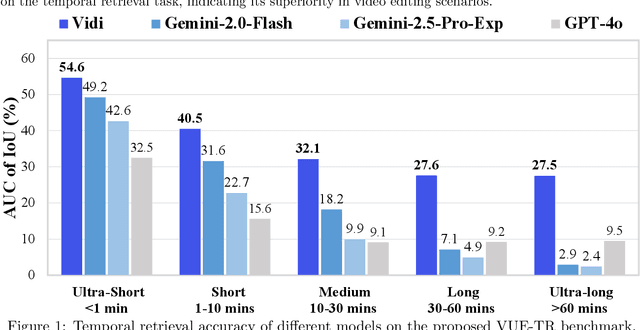


Humans naturally share information with those they are connected to, and video has become one of the dominant mediums for communication and expression on the Internet. To support the creation of high-quality large-scale video content, a modern pipeline requires a comprehensive understanding of both the raw input materials (e.g., the unedited footage captured by cameras) and the editing components (e.g., visual effects). In video editing scenarios, models must process multiple modalities (e.g., vision, audio, text) with strong background knowledge and handle flexible input lengths (e.g., hour-long raw videos), which poses significant challenges for traditional models. In this report, we introduce Vidi, a family of Large Multimodal Models (LMMs) for a wide range of video understand editing scenarios. The first release focuses on temporal retrieval, i.e., identifying the time ranges within the input videos corresponding to a given text query, which plays a critical role in intelligent editing. The model is capable of processing hour-long videos with strong temporal understanding capability, e.g., retrieve time ranges for certain queries. To support a comprehensive evaluation in real-world scenarios, we also present the VUE-TR benchmark, which introduces five key advancements. 1) Video duration: significantly longer than existing temporal retrival datasets, 2) Audio support: includes audio-based queries, 3) Query format: diverse query lengths/formats, 4) Annotation quality: ground-truth time ranges are manually annotated. 5) Evaluation metric: a refined IoU metric to support evaluation over multiple time ranges. Remarkably, Vidi significantly outperforms leading proprietary models, e.g., GPT-4o and Gemini, on the temporal retrieval task, indicating its superiority in video editing scenarios.
OmniSTVG: Toward Spatio-Temporal Omni-Object Video Grounding
Mar 13, 2025In this paper, we propose spatio-temporal omni-object video grounding, dubbed OmniSTVG, a new STVG task that aims at localizing spatially and temporally all targets mentioned in the textual query from videos. Compared to classic STVG locating only a single target, OmniSTVG enables localization of not only an arbitrary number of text-referred targets but also their interacting counterparts in the query from the video, making it more flexible and practical in real scenarios for comprehensive understanding. In order to facilitate exploration of OmniSTVG, we introduce BOSTVG, a large-scale benchmark dedicated to OmniSTVG. Specifically, our BOSTVG consists of 10,018 videos with 10.2M frames and covers a wide selection of 287 classes from diverse scenarios. Each sequence in BOSTVG, paired with a free-form textual query, encompasses a varying number of targets ranging from 1 to 10. To ensure high quality, each video is manually annotated with meticulous inspection and refinement. To our best knowledge, BOSTVG is to date the first and the largest benchmark for OmniSTVG. To encourage future research, we introduce a simple yet effective approach, named OmniTube, which, drawing inspiration from Transformer-based STVG methods, is specially designed for OmniSTVG and demonstrates promising results. By releasing BOSTVG, we hope to go beyond classic STVG by locating every object appearing in the query for more comprehensive understanding, opening up a new direction for STVG. Our benchmark, model, and results will be released at https://github.com/JellyYao3000/OmniSTVG.
Multi-Reward as Condition for Instruction-based Image Editing
Nov 06, 2024
High-quality training triplets (instruction, original image, edited image) are essential for instruction-based image editing. Predominant training datasets (e.g., InsPix2Pix) are created using text-to-image generative models (e.g., Stable Diffusion, DALL-E) which are not trained for image editing. Accordingly, these datasets suffer from inaccurate instruction following, poor detail preserving, and generation artifacts. In this paper, we propose to address the training data quality issue with multi-perspective reward data instead of refining the ground-truth image quality. 1) we first design a quantitative metric system based on best-in-class LVLM (Large Vision Language Model), i.e., GPT-4o in our case, to evaluate the generation quality from 3 perspectives, namely, instruction following, detail preserving, and generation quality. For each perspective, we collected quantitative score in $0\sim 5$ and text descriptive feedback on the specific failure points in ground-truth edited images, resulting in a high-quality editing reward dataset, i.e., RewardEdit20K. 2) We further proposed a novel training framework to seamlessly integrate the metric output, regarded as multi-reward, into editing models to learn from the imperfect training triplets. During training, the reward scores and text descriptions are encoded as embeddings and fed into both the latent space and the U-Net of the editing models as auxiliary conditions. During inference, we set these additional conditions to the highest score with no text description for failure points, to aim at the best generation outcome. Experiments indicate that our multi-reward conditioned model outperforms its no-reward counterpart on two popular editing pipelines, i.e., InsPix2Pix and SmartEdit. The code and dataset will be released.