 Add to Chrome
 Add to Firefox
 Add to Edge
Glance, Scrutinize, and Think: Advancing Video Anomaly Detection from Training-Free to Agentic Reasoning
Aug 07, 2026
Video Anomaly Detection (VAD) aims to identify anomalous events and localize their temporal intervals. Existing approaches exhibit a "when-what" dissociation: traditional DNN-based methods localize when anomalies occur but lack semantic understanding, whereas LLM-based methods explain what happens but neglect precise temporal grounding. We attribute this to the absence of a unified reasoning paradigm. Inspired by how humans inspect surveillance videos - glancing globally to form temporal hypotheses, scrutinizing suspicious segments, and thinking iteratively to correct errors - we study this global-to-local paradigm from two perspectives. We first propose Glance then Scrutinize (GtS), a training-free framework using static and dynamic textual guidance for coarse-to-fine anomaly grounding and understanding, balancing accuracy and speed. To break the ceiling imposed by frozen external modules, we further propose a tool-augmented agentic VAD method, where a multimodal large language model learns to invoke a video cropping tool, inspect densely resampled frames, and self-correct mislocalized hypotheses, via cold-start supervised fine-tuning followed by reinforcement learning with a joint answer-grounding reward. For training and evaluation, we extend our prior VAGU benchmark into VAGU-T (Video Anomaly Grounding, Understanding, and Thinking), comprising 7,567 real-world videos over 21 anomaly categories with human-validated grounding, explanations, QA pairs, and chain-of-thought tool-calling traces. We further introduce JeAUG, a metric jointly evaluating semantic interpretability and temporal precision. Experiments show that GtS substantially surpasses training-free baselines, while the agentic model delivers both higher accuracy and faster inference.

I Seek You in Videos: Identity-Conditioned Queries for Person-Centric Video Reasoning
Aug 07, 2026Real-world video reasoning often involves multimodal, multi-source inputs, whereas existing video reasoning tasks typically assume a simplified video-text setting, limiting identity matching and person-centric reasoning. To bridge this gap, we introduce the Identity-conditioned Queries (ICQ) task, in which models are required to jointly associate and interpret an input video and a reference image of a person, and leverage this conditioning to address identity grounding, behavior understanding, and temporal reasoning, among other challenges. Building on ICQ, we present ISYV (I Seek You in Videos), a systematic solution comprising three components: (1) ISYV-Bench, a challenging evaluation benchmark with 1,377 real-world complex videos and 1,377 question-answer pairs, organized into six difficulty levels spanning capabilities from identity recognition to causal reasoning; (2) ISYV-75K, a large-scale training set of 75K high-quality samples constructed via automated annotation, multi-stage verification, and manual review; and (3) ISYV-Framework, containing an ICQ-oriented model and training strategy for learning to exploit informative video shots without additional shot-level annotations. Extensive experiments show that both mainstream closed-source and open-source MLLMs struggle on ISYV-Bench, especially in cross-domain identity matching and long-horizon tracking. ISYV-Model outperforms strong baselines and in some aspects approaches closed-source performance. Overall, ISYV provides a unified task definition, scalable datasets/benchmarks, and modeling insights for person-centric video reasoning.
Fine-Grained Post-Training Quantization for Large Vision Language Models with Quantization-Aware Integrated Gradients
Mar 18, 2026Large Vision Language Models (LVLMs) have achieved remarkable success in a range of downstream tasks that require multimodal interaction, but their capabilities come with substantial computational and memory overhead, which hinders practical deployment. Among numerous acceleration techniques, post-training quantization is a popular and effective strategy for reducing memory cost and accelerating inference. However, existing LVLM quantization methods typically measure token sensitivity at the modality level, which fails to capture the complex cross-token interactions and falls short in quantitatively measuring the quantization error at the token level. As tokens interact within the model, the distinction between modalities gradually diminishes, suggesting the need for fine-grained calibration. Inspired by axiomatic attribution in mechanistic interpretability, we introduce a fine-grained quantization strategy on Quantization-aware Integrated Gradients (QIG), which leverages integrated gradients to quantitatively evaluate token sensitivity and push the granularity from modality level to token level, reflecting both inter-modality and intra-modality dynamics. Extensive experiments on multiple LVLMs under both W4A8 and W3A16 settings show that our method improves accuracy across models and benchmarks with negligible latency overhead. For example, under 3-bit weight-only quantization, our method improves the average accuracy of LLaVA-onevision-7B by 1.60%, reducing the gap to its full-precision counterpart to only 1.33%. The code is available at https://github.com/ucas-xiang/QIG.
InfEngine: A Self-Verifying and Self-Optimizing Intelligent Engine for Infrared Radiation Computing
Feb 22, 2026Infrared radiation computing underpins advances in climate science, remote sensing and spectroscopy but remains constrained by manual workflows. We introduce InfEngine, an autonomous intelligent computational engine designed to drive a paradigm shift from human-led orchestration to collaborative automation. It integrates four specialized agents through two core innovations: self-verification, enabled by joint solver-evaluator debugging, improves functional correctness and scientific plausibility; self-optimization, realized via evolutionary algorithms with self-discovered fitness functions, facilitates autonomous performance optimization. Evaluated on InfBench with 200 infrared-specific tasks and powered by InfTools with 270 curated tools, InfEngine achieves a 92.7% pass rate and delivers workflows 21x faster than manual expert effort. More fundamentally, it illustrates how researchers can transition from manual coding to collaborating with self-verifying, self-optimizing computational partners. By generating reusable, verified and optimized code, InfEngine transforms computational workflows into persistent scientific assets, accelerating the cycle of scientific discovery. Code: https://github.com/kding1225/infengine
Benchmarking Continual Learning from Cognitive Perspectives
Dec 06, 2023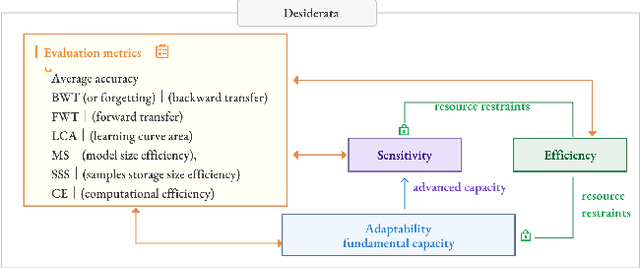
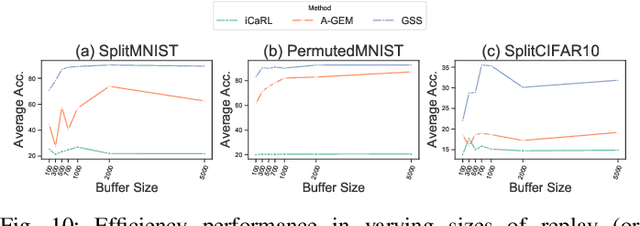
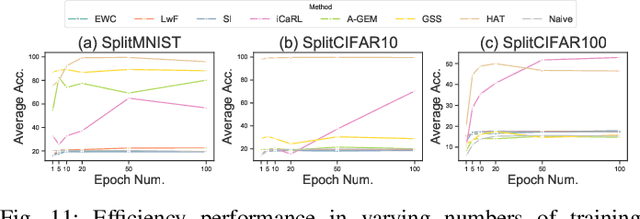
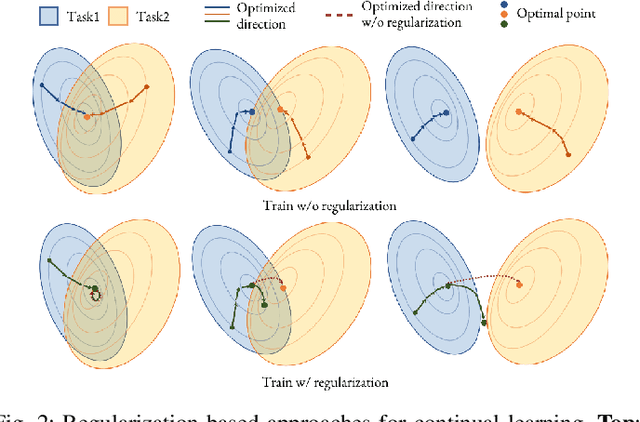
Continual learning addresses the problem of continuously acquiring and transferring knowledge without catastrophic forgetting of old concepts. While humans achieve continual learning via diverse neurocognitive mechanisms, there is a mismatch between cognitive properties and evaluation methods of continual learning models. First, the measurement of continual learning models mostly relies on evaluation metrics at a micro-level, which cannot characterize cognitive capacities of the model. Second, the measurement is method-specific, emphasizing model strengths in one aspect while obscuring potential weaknesses in other respects. To address these issues, we propose to integrate model cognitive capacities and evaluation metrics into a unified evaluation paradigm. We first characterize model capacities via desiderata derived from cognitive properties supporting human continual learning. The desiderata concern (1) adaptability in varying lengths of task sequence; (2) sensitivity to dynamic task variations; and (3) efficiency in memory usage and training time consumption. Then we design evaluation protocols for each desideratum to assess cognitive capacities of recent continual learning models. Experimental results show that no method we consider has satisfied all the desiderata and is still far away from realizing truly continual learning. Although some methods exhibit some degree of adaptability and efficiency, no method is able to identify task relationships when encountering dynamic task variations, or achieve a trade-off in learning similarities and differences between tasks. Inspired by these results, we discuss possible factors that influence model performance in these desiderata and provide guidance for the improvement of continual learning models.