 Add to Chrome
 Add to Firefox
 Add to Edge
Resource-Efficient Affordance Grounding with Complementary Depth and Semantic Prompts
Mar 04, 2025
Affordance refers to the functional properties that an agent perceives and utilizes from its environment, and is key perceptual information required for robots to perform actions. This information is rich and multimodal in nature. Existing multimodal affordance methods face limitations in extracting useful information, mainly due to simple structural designs, basic fusion methods, and large model parameters, making it difficult to meet the performance requirements for practical deployment. To address these issues, this paper proposes the BiT-Align image-depth-text affordance mapping framework. The framework includes a Bypass Prompt Module (BPM) and a Text Feature Guidance (TFG) attention selection mechanism. BPM integrates the auxiliary modality depth image directly as a prompt to the primary modality RGB image, embedding it into the primary modality encoder without introducing additional encoders. This reduces the model's parameter count and effectively improves functional region localization accuracy. The TFG mechanism guides the selection and enhancement of attention heads in the image encoder using textual features, improving the understanding of affordance characteristics. Experimental results demonstrate that the proposed method achieves significant performance improvements on public AGD20K and HICO-IIF datasets. On the AGD20K dataset, compared with the current state-of-the-art method, we achieve a 6.0% improvement in the KLD metric, while reducing model parameters by 88.8%, demonstrating practical application values. The source code will be made publicly available at https://github.com/DAWDSE/BiT-Align.

Unveiling the Potential of Segment Anything Model 2 for RGB-Thermal Semantic Segmentation with Language Guidance
Mar 04, 2025The perception capability of robotic systems relies on the richness of the dataset. Although Segment Anything Model 2 (SAM2), trained on large datasets, demonstrates strong perception potential in perception tasks, its inherent training paradigm prevents it from being suitable for RGB-T tasks. To address these challenges, we propose SHIFNet, a novel SAM2-driven Hybrid Interaction Paradigm that unlocks the potential of SAM2 with linguistic guidance for efficient RGB-Thermal perception. Our framework consists of two key components: (1) Semantic-Aware Cross-modal Fusion (SACF) module that dynamically balances modality contributions through text-guided affinity learning, overcoming SAM2's inherent RGB bias; (2) Heterogeneous Prompting Decoder (HPD) that enhances global semantic information through a semantic enhancement module and then combined with category embeddings to amplify cross-modal semantic consistency. With 32.27M trainable parameters, SHIFNet achieves state-of-the-art segmentation performance on public benchmarks, reaching 89.8% on PST900 and 67.8% on FMB, respectively. The framework facilitates the adaptation of pre-trained large models to RGB-T segmentation tasks, effectively mitigating the high costs associated with data collection while endowing robotic systems with comprehensive perception capabilities. The source code will be made publicly available at https://github.com/iAsakiT3T/SHIFNet.
TS-CGNet: Temporal-Spatial Fusion Meets Centerline-Guided Diffusion for BEV Mapping
Mar 04, 2025Bird's Eye View (BEV) perception technology is crucial for autonomous driving, as it generates top-down 2D maps for environment perception, navigation, and decision-making. Nevertheless, the majority of current BEV map generation studies focusing on visual map generation lack depth-aware reasoning capabilities. They exhibit limited efficacy in managing occlusions and handling complex environments, with a notable decline in perceptual performance under adverse weather conditions or low-light scenarios. Therefore, this paper proposes TS-CGNet, which leverages Temporal-Spatial fusion with Centerline-Guided diffusion. This visual framework, grounded in prior knowledge, is designed for integration into any existing network for building BEV maps. Specifically, this framework is decoupled into three parts: Local mapping system involves the initial generation of semantic maps using purely visual information; The Temporal-Spatial Aligner Module (TSAM) integrates historical information into mapping generation by applying transformation matrices; The Centerline-Guided Diffusion Model (CGDM) is a prediction module based on the diffusion model. CGDM incorporates centerline information through spatial-attention mechanisms to enhance semantic segmentation reconstruction. We construct BEV semantic segmentation maps by our methods on the public nuScenes and the robustness benchmarks under various corruptions. Our method improves 1.90%, 1.73%, and 2.87% for perceived ranges of 60x30m, 120x60m, and 240x60m in the task of BEV HD mapping. TS-CGNet attains an improvement of 1.92% for perceived ranges of 100x100m in the task of BEV semantic mapping. Moreover, TS-CGNet achieves an average improvement of 2.92% in detection accuracy under varying weather conditions and sensor interferences in the perception range of 240x60m. The source code will be publicly available at https://github.com/krabs-H/TS-CGNet.
One-Shot Affordance Grounding of Deformable Objects in Egocentric Organizing Scenes
Mar 03, 2025Deformable object manipulation in robotics presents significant challenges due to uncertainties in component properties, diverse configurations, visual interference, and ambiguous prompts. These factors complicate both perception and control tasks. To address these challenges, we propose a novel method for One-Shot Affordance Grounding of Deformable Objects (OS-AGDO) in egocentric organizing scenes, enabling robots to recognize previously unseen deformable objects with varying colors and shapes using minimal samples. Specifically, we first introduce the Deformable Object Semantic Enhancement Module (DefoSEM), which enhances hierarchical understanding of the internal structure and improves the ability to accurately identify local features, even under conditions of weak component information. Next, we propose the ORB-Enhanced Keypoint Fusion Module (OEKFM), which optimizes feature extraction of key components by leveraging geometric constraints and improves adaptability to diversity and visual interference. Additionally, we propose an instance-conditional prompt based on image data and task context, effectively mitigates the issue of region ambiguity caused by prompt words. To validate these methods, we construct a diverse real-world dataset, AGDDO15, which includes 15 common types of deformable objects and their associated organizational actions. Experimental results demonstrate that our approach significantly outperforms state-of-the-art methods, achieving improvements of 6.2%, 3.2%, and 2.9% in KLD, SIM, and NSS metrics, respectively, while exhibiting high generalization performance. Source code and benchmark dataset will be publicly available at https://github.com/Dikay1/OS-AGDO.
Multi-Keypoint Affordance Representation for Functional Dexterous Grasping
Feb 27, 2025


Functional dexterous grasping requires precise hand-object interaction, going beyond simple gripping. Existing affordance-based methods primarily predict coarse interaction regions and cannot directly constrain the grasping posture, leading to a disconnection between visual perception and manipulation. To address this issue, we propose a multi-keypoint affordance representation for functional dexterous grasping, which directly encodes task-driven grasp configurations by localizing functional contact points. Our method introduces Contact-guided Multi-Keypoint Affordance (CMKA), leveraging human grasping experience images for weak supervision combined with Large Vision Models for fine affordance feature extraction, achieving generalization while avoiding manual keypoint annotations. Additionally, we present a Keypoint-based Grasp matrix Transformation (KGT) method, ensuring spatial consistency between hand keypoints and object contact points, thus providing a direct link between visual perception and dexterous grasping actions. Experiments on public real-world FAH datasets, IsaacGym simulation, and challenging robotic tasks demonstrate that our method significantly improves affordance localization accuracy, grasp consistency, and generalization to unseen tools and tasks, bridging the gap between visual affordance learning and dexterous robotic manipulation. The source code and demo videos will be publicly available at https://github.com/PopeyePxx/MKA.
DeProPose: Deficiency-Proof 3D Human Pose Estimation via Adaptive Multi-View Fusion
Feb 23, 2025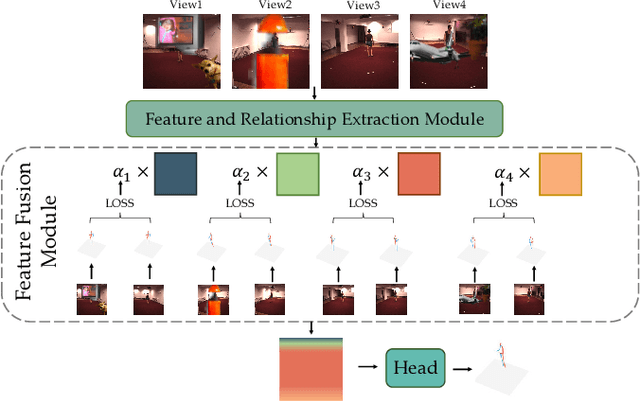
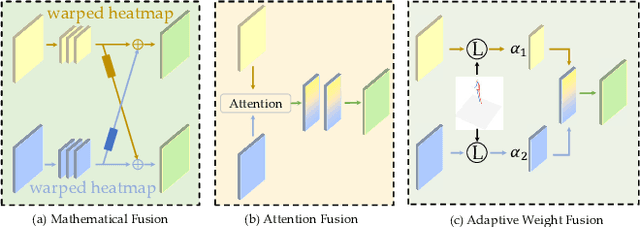
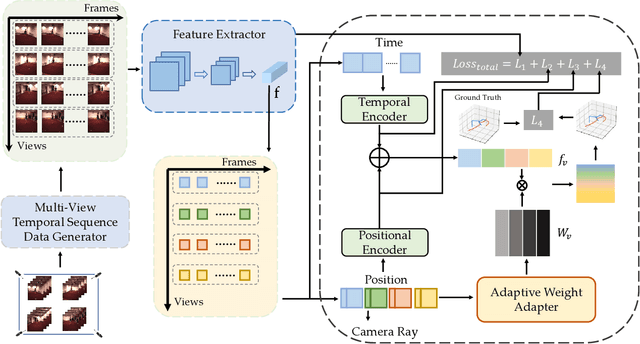
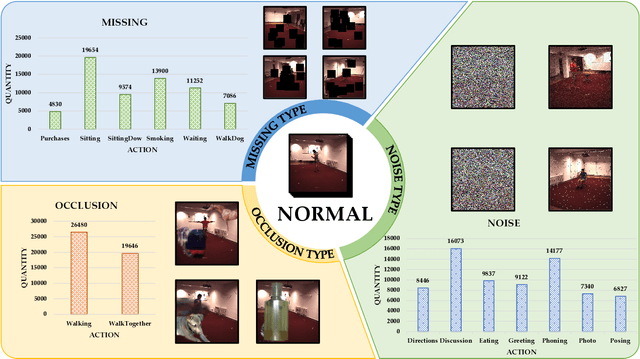
3D human pose estimation has wide applications in fields such as intelligent surveillance, motion capture, and virtual reality. However, in real-world scenarios, issues such as occlusion, noise interference, and missing viewpoints can severely affect pose estimation. To address these challenges, we introduce the task of Deficiency-Aware 3D Pose Estimation. Traditional 3D pose estimation methods often rely on multi-stage networks and modular combinations, which can lead to cumulative errors and increased training complexity, making them unable to effectively address deficiency-aware estimation. To this end, we propose DeProPose, a flexible method that simplifies the network architecture to reduce training complexity and avoid information loss in multi-stage designs. Additionally, the model innovatively introduces a multi-view feature fusion mechanism based on relative projection error, which effectively utilizes information from multiple viewpoints and dynamically assigns weights, enabling efficient integration and enhanced robustness to overcome deficiency-aware 3D Pose Estimation challenges. Furthermore, to thoroughly evaluate this end-to-end multi-view 3D human pose estimation model and to advance research on occlusion-related challenges, we have developed a novel 3D human pose estimation dataset, termed the Deficiency-Aware 3D Pose Estimation (DA-3DPE) dataset. This dataset encompasses a wide range of deficiency scenarios, including noise interference, missing viewpoints, and occlusion challenges. Compared to state-of-the-art methods, DeProPose not only excels in addressing the deficiency-aware problem but also shows improvement in conventional scenarios, providing a powerful and user-friendly solution for 3D human pose estimation. The source code will be available at https://github.com/WUJINHUAN/DeProPose.
CT-UIO: Continuous-Time UWB-Inertial-Odometer Localization Using Non-Uniform B-spline with Fewer Anchors
Feb 10, 2025Ultra-wideband (UWB) based positioning with fewer anchors has attracted significant research interest in recent years, especially under energy-constrained conditions. However, most existing methods rely on discrete-time representations and smoothness priors to infer a robot's motion states, which often struggle with ensuring multi-sensor data synchronization. In this paper, we present an efficient UWB-Inertial-odometer localization system, utilizing a non-uniform B-spline framework with fewer anchors. Unlike traditional uniform B-spline-based continuous-time methods, we introduce an adaptive knot-span adjustment strategy for non-uniform continuous-time trajectory representation. This is accomplished by adjusting control points dynamically based on movement speed. To enable efficient fusion of IMU and odometer data, we propose an improved Extended Kalman Filter (EKF) with innovation-based adaptive estimation to provide short-term accurate motion prior. Furthermore, to address the challenge of achieving a fully observable UWB localization system under few-anchor conditions, the Virtual Anchor (VA) generation method based on multiple hypotheses is proposed. At the backend, we propose a CT-UIO factor graph with an adaptive sliding window for global trajectory estimation. Comprehensive experiments conducted on corridor and exhibition hall datasets validate the proposed system's high precision and robust performance. The codebase and datasets of this work will be open-sourced at https://github.com/JasonSun623/CT-UIO.
Event-aided Semantic Scene Completion
Feb 04, 2025


Autonomous driving systems rely on robust 3D scene understanding. Recent advances in Semantic Scene Completion (SSC) for autonomous driving underscore the limitations of RGB-based approaches, which struggle under motion blur, poor lighting, and adverse weather. Event cameras, offering high dynamic range and low latency, address these challenges by providing asynchronous data that complements RGB inputs. We present DSEC-SSC, the first real-world benchmark specifically designed for event-aided SSC, which includes a novel 4D labeling pipeline for generating dense, visibility-aware labels that adapt dynamically to object motion. Our proposed RGB-Event fusion framework, EvSSC, introduces an Event-aided Lifting Module (ELM) that effectively bridges 2D RGB-Event features to 3D space, enhancing view transformation and the robustness of 3D volume construction across SSC models. Extensive experiments on DSEC-SSC and simulated SemanticKITTI-E demonstrate that EvSSC is adaptable to both transformer-based and LSS-based SSC architectures. Notably, evaluations on SemanticKITTI-C demonstrate that EvSSC achieves consistently improved prediction accuracy across five degradation modes and both In-domain and Out-of-domain settings, achieving up to a 52.5% relative improvement in mIoU when the image sensor partially fails. Additionally, we quantitatively and qualitatively validate the superiority of EvSSC under motion blur and extreme weather conditions, where autonomous driving is challenged. The established datasets and our codebase will be made publicly at https://github.com/Pandapan01/EvSSC.
Mitigating Label Noise using Prompt-Based Hyperbolic Meta-Learning in Open-Set Domain Generalization
Dec 24, 2024
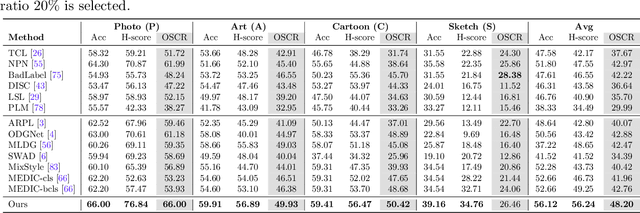

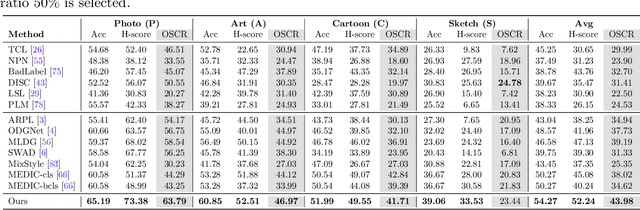
Open-Set Domain Generalization (OSDG) is a challenging task requiring models to accurately predict familiar categories while minimizing confidence for unknown categories to effectively reject them in unseen domains. While the OSDG field has seen considerable advancements, the impact of label noise--a common issue in real-world datasets--has been largely overlooked. Label noise can mislead model optimization, thereby exacerbating the challenges of open-set recognition in novel domains. In this study, we take the first step towards addressing Open-Set Domain Generalization under Noisy Labels (OSDG-NL) by constructing dedicated benchmarks derived from widely used OSDG datasets, including PACS and DigitsDG. We evaluate baseline approaches by integrating techniques from both label denoising and OSDG methodologies, highlighting the limitations of existing strategies in handling label noise effectively. To address these limitations, we propose HyProMeta, a novel framework that integrates hyperbolic category prototypes for label noise-aware meta-learning alongside a learnable new-category agnostic prompt designed to enhance generalization to unseen classes. Our extensive experiments demonstrate the superior performance of HyProMeta compared to state-of-the-art methods across the newly established benchmarks. The source code of this work is released at https://github.com/KPeng9510/HyProMeta.
ObjectFinder: Open-Vocabulary Assistive System for Interactive Object Search by Blind People
Dec 04, 2024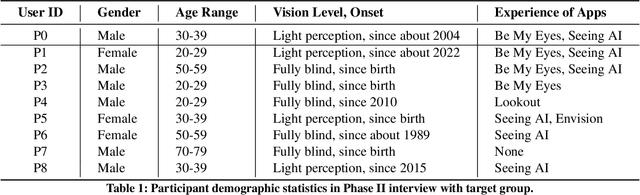

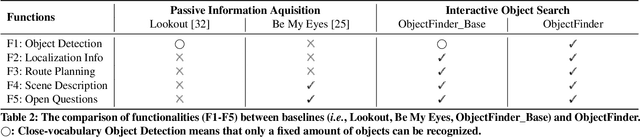

Assistive technology can be leveraged by blind people when searching for objects in their daily lives. We created ObjectFinder, an open-vocabulary interactive object-search prototype, which combines object detection with scene description and navigation. It enables blind persons to detect and navigate to objects of their choice. Our approach used co-design for the development of the prototype. We further conducted need-finding interviews to better understand challenges in object search, followed by a study with the ObjectFinder prototype in a laboratory setting simulating a living room and an office, with eight blind users. Additionally, we compared the prototype with BeMyEyes and Lookout for object search. We found that most participants felt more independent with ObjectFinder and preferred it over the baselines when deployed on more efficient hardware, as it enhances mental mapping and allows for active target definition. Moreover, we identified factors for future directions for the development of object-search systems.