 Add to Chrome
 Add to Firefox
 Add to Edge
A Heterogeneous Long-Micro Scale Cascading Architecture for General Aviation Health Management
Mar 27, 2026
BACKGROUND: General aviation fleet expansion demands intelligent health monitoring under computational constraints. Real-world aircraft health diagnosis requires balancing accuracy with computational constraints under extreme class imbalance and environmental uncertainty. Existing end-to-end approaches suffer from the receptive field paradox: global attention introduces excessive operational heterogeneity noise for fine-grained fault classification, while localized constraints sacrifice critical cross-temporal context essential for anomaly detection. METHODS: This paper presents an AI-driven heterogeneous cascading architecture for general aviation health management. The proposed Long-Micro Scale Diagnostician (LMSD) explicitly decouples global anomaly detection (full-sequence attention) from micro-scale fault classification (restricted receptive fields), resolving the receptive field paradox while minimizing training overhead. A knowledge distillation-based interpretability module provides physically traceable explanations for safety-critical validation. RESULTS: Experiments on the public National General Aviation Flight Information Database (NGAFID) dataset (28,935 flights, 36 categories) demonstrate 4--8% improvement in safety-critical metrics (MCWPM) with 4.2 times training acceleration and 46% model compression compared to end-to-end baselines. CONCLUSIONS: The AI-driven heterogeneous architecture offers deployable solutions for aviation equipment health management, with potential for digital twin integration in future work. The proposed framework substantiates deployability in resource-constrained aviation environments while maintaining stringent safety requirements.

Balancing Safety and Efficiency in Aircraft Health Diagnosis: A Task Decomposition Framework with Heterogeneous Long-Micro Scale Cascading and Knowledge Distillation-based Interpretability
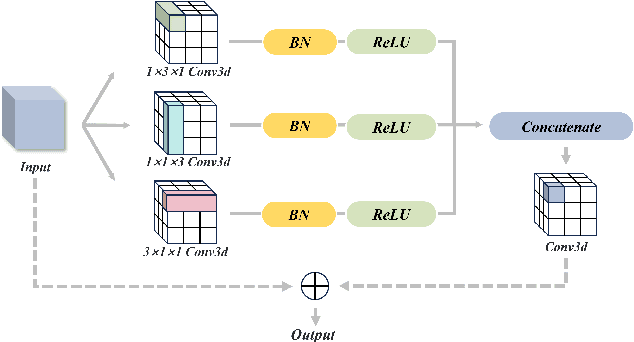
Mar 24, 2026Whole-aircraft diagnosis for general aviation faces threefold challenges: data uncertainty, task heterogeneity, and computational inefficiency. Existing end-to-end approaches uniformly model health discrimination and fault characterization, overlooking intrinsic receptive field conflicts between global context modeling and local feature extraction, while incurring prohibitive training costs under severe class imbalance. To address these, this study proposes the Diagnosis Decomposition Framework (DDF), explicitly decoupling diagnosis into Anomaly Detection (AD) and Fault Classification (FC) subtasks via the Long-Micro Scale Diagnostician (LMSD). Employing a "long-range global screening and micro-scale local precise diagnosis" strategy, LMSD utilizes Convolutional Tokenizer with Multi-Head Self-Attention (ConvTokMHSA) for global operational pattern discrimination and Multi-Micro Kernel Network (MMK Net) for local fault feature extraction. Decoupled training separates "large-sample lightweight" and "small-sample complex" optimization pathways, significantly reducing computational overhead. Concurrently, Keyness Extraction Layer (KEL) via knowledge distillation furnishes physically traceable explanations for two-stage decisions, materializing interpretability-by-design. Experiments on the NGAFID real-world aviation dataset demonstrate approximately 4-8% improvement in Multi-Class Weighted Penalty Metric (MCWPM) over baselines with substantially reduced training time, validating comprehensive advantages in task adaptability, interpretability, and efficiency. This provides a deployable methodology for general aviation health management.
Exposing Weaknesses of Large Reasoning Models through Graph Algorithm Problems
Feb 06, 2026Large Reasoning Models (LRMs) have advanced rapidly; however, existing benchmarks in mathematics, code, and common-sense reasoning remain limited. They lack long-context evaluation, offer insufficient challenge, and provide answers that are difficult to verify programmatically. We introduce GrAlgoBench, a benchmark designed to evaluate LRMs through graph algorithm problems. Such problems are particularly well suited for probing reasoning abilities: they demand long-context reasoning, allow fine-grained control of difficulty levels, and enable standardized, programmatic evaluation. Across nine tasks, our systematic experiments reveal two major weaknesses of current LRMs. First, accuracy deteriorates sharply as context length increases, falling below 50% once graphs exceed 120 nodes. This degradation is driven by frequent execution errors, weak memory, and redundant reasoning. Second, LRMs suffer from an over-thinking phenomenon, primarily caused by extensive yet largely ineffective self-verification, which inflates reasoning traces without improving correctness. By exposing these limitations, GrAlgoBench establishes graph algorithm problems as a rigorous, multidimensional, and practically relevant testbed for advancing the study of reasoning in LRMs. Code is available at https://github.com/Bklight999/GrAlgoBench.
AVAM: Universal Training-free Adaptive Visual Anchoring Embedded into Multimodal Large Language Model for Multi-image Question Answering
Aug 25, 2025The advancement of Multimodal Large Language Models (MLLMs) has driven significant progress in Visual Question Answering (VQA), evolving from Single to Multi Image VQA (MVQA). However, the increased number of images in MVQA inevitably introduces substantial visual redundancy that is irrelevant to question answering, negatively impacting both accuracy and efficiency. To address this issue, existing methods lack flexibility in controlling the number of compressed visual tokens and tend to produce discrete visual fragments, which hinder MLLMs' ability to comprehend images holistically. In this paper, we propose a straightforward yet universal Adaptive Visual Anchoring strategy, which can be seamlessly integrated into existing MLLMs, offering significant accuracy improvements through adaptive compression. Meanwhile, to balance the results derived from both global and compressed visual input, we further introduce a novel collaborative decoding mechanism, enabling optimal performance. Extensive experiments validate the effectiveness of our method, demonstrating consistent performance improvements across various MLLMs. The code will be publicly available.
TS-CGNet: Temporal-Spatial Fusion Meets Centerline-Guided Diffusion for BEV Mapping
Mar 04, 2025Bird's Eye View (BEV) perception technology is crucial for autonomous driving, as it generates top-down 2D maps for environment perception, navigation, and decision-making. Nevertheless, the majority of current BEV map generation studies focusing on visual map generation lack depth-aware reasoning capabilities. They exhibit limited efficacy in managing occlusions and handling complex environments, with a notable decline in perceptual performance under adverse weather conditions or low-light scenarios. Therefore, this paper proposes TS-CGNet, which leverages Temporal-Spatial fusion with Centerline-Guided diffusion. This visual framework, grounded in prior knowledge, is designed for integration into any existing network for building BEV maps. Specifically, this framework is decoupled into three parts: Local mapping system involves the initial generation of semantic maps using purely visual information; The Temporal-Spatial Aligner Module (TSAM) integrates historical information into mapping generation by applying transformation matrices; The Centerline-Guided Diffusion Model (CGDM) is a prediction module based on the diffusion model. CGDM incorporates centerline information through spatial-attention mechanisms to enhance semantic segmentation reconstruction. We construct BEV semantic segmentation maps by our methods on the public nuScenes and the robustness benchmarks under various corruptions. Our method improves 1.90%, 1.73%, and 2.87% for perceived ranges of 60x30m, 120x60m, and 240x60m in the task of BEV HD mapping. TS-CGNet attains an improvement of 1.92% for perceived ranges of 100x100m in the task of BEV semantic mapping. Moreover, TS-CGNet achieves an average improvement of 2.92% in detection accuracy under varying weather conditions and sensor interferences in the perception range of 240x60m. The source code will be publicly available at https://github.com/krabs-H/TS-CGNet.
MambaMOS: LiDAR-based 3D Moving Object Segmentation with Motion-aware State Space Model
Apr 19, 2024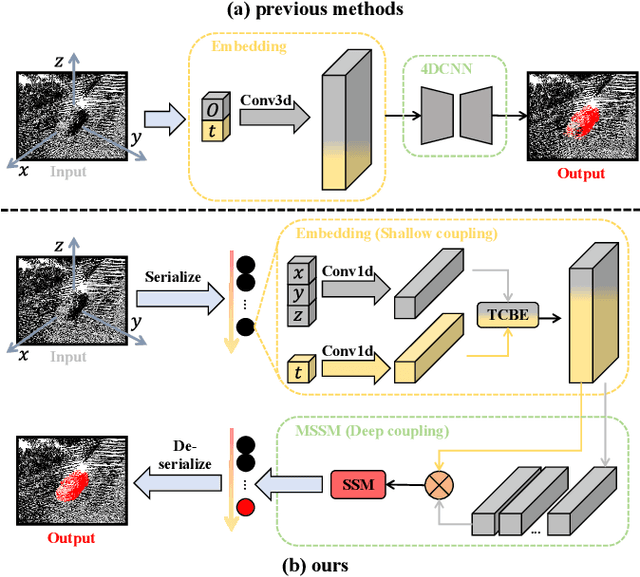

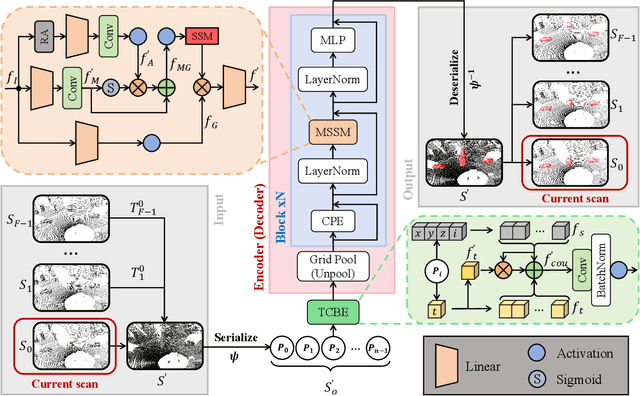

LiDAR-based Moving Object Segmentation (MOS) aims to locate and segment moving objects in point clouds of the current scan using motion information from previous scans. Despite the promising results achieved by previous MOS methods, several key issues, such as the weak coupling of temporal and spatial information, still need further study. In this paper, we propose a novel LiDAR-based 3D Moving Object Segmentation with Motion-aware State Space Model, termed MambaMOS. Firstly, we develop a novel embedding module, the Time Clue Bootstrapping Embedding (TCBE), to enhance the coupling of temporal and spatial information in point clouds and alleviate the issue of overlooked temporal clues. Secondly, we introduce the Motion-aware State Space Model (MSSM) to endow the model with the capacity to understand the temporal correlations of the same object across different time steps. Specifically, MSSM emphasizes the motion states of the same object at different time steps through two distinct temporal modeling and correlation steps. We utilize an improved state space model to represent these motion differences, significantly modeling the motion states. Finally, extensive experiments on the SemanticKITTI-MOS and KITTI-Road benchmarks demonstrate that the proposed MambaMOS achieves state-of-the-art performance. The source code of this work will be made publicly available at https://github.com/Terminal-K/MambaMOS.
MF-MOS: A Motion-Focused Model for Moving Object Segmentation
Jan 30, 2024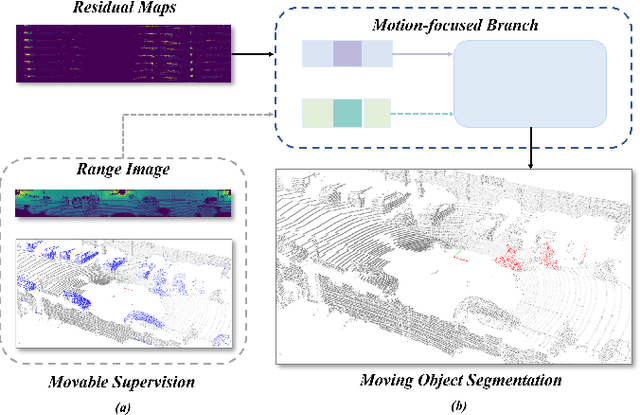
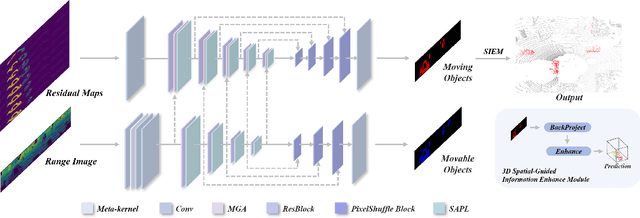

Moving object segmentation (MOS) provides a reliable solution for detecting traffic participants and thus is of great interest in the autonomous driving field. Dynamic capture is always critical in the MOS problem. Previous methods capture motion features from the range images directly. Differently, we argue that the residual maps provide greater potential for motion information, while range images contain rich semantic guidance. Based on this intuition, we propose MF-MOS, a novel motion-focused model with a dual-branch structure for LiDAR moving object segmentation. Novelly, we decouple the spatial-temporal information by capturing the motion from residual maps and generating semantic features from range images, which are used as movable object guidance for the motion branch. Our straightforward yet distinctive solution can make the most use of both range images and residual maps, thus greatly improving the performance of the LiDAR-based MOS task. Remarkably, our MF-MOS achieved a leading IoU of 76.7% on the MOS leaderboard of the SemanticKITTI dataset upon submission, demonstrating the current state-of-the-art performance. The implementation of our MF-MOS has been released at https://github.com/SCNU-RISLAB/MF-MOS.