 Add to Chrome
 Add to Firefox
 Add to Edge
Better Accuracies, Worse Reasoning: A Step-Level Audit of Medical Chain-of-Thought Distillation
May 27, 2026
Chain-of-thought (CoT) distillation trains a smaller model to imitate a teacher's reasoning trace, but it is typically evaluated by final-answer metrics including accuracy. We ask whether gains in answer quality are accompanied by improvements in the trace. In medical QA, where short answer options can leave a richer clinical justification under-specified, a Qwen3-8B student distilled from a DeepSeek-V3-family teacher improves on MedQA-USMLE answer metrics (SC@64 74.7% to 84.4%; expected calibration error (ECE) 0.096 to 0.034). Yet under a Kimi-K2.6 style-blind LLM-judge audit, its error rate over non-abstained steps rises from 30.6% to 50.3%. In this primary medical setting, answer quality and trace factuality move in opposite directions. This before--after pattern persists across evaluators, teacher strengths, student scales and families, medical benchmarks, and style, segmentation, and answer-correctness controls. A 150-step blinded audit by a clinical expert reproduces the same ordering. Boundary checks narrow the scope of the claim: the risk appears when a compact answer under-constrains the rationale and a capable student can imitate expert-like form without reliably grounding each local claim. Standard answer metrics and aggregate hedging rates do not reveal the shift. When such traces are released or reused, answer-level metrics alone are insufficient.

LeHome: A Simulation Environment for Deformable Object Manipulation in Household Scenarios
Apr 24, 2026Household environments present one of the most common, impactful yet challenging application domains for robotics. Within household scenarios, manipulating deformable objects is particularly difficult, both in simulation and real-world execution, due to varied categories and shapes, complex dynamics, and diverse material properties, as well as the lack of reliable deformable-object support in existing simulations. We introduce LeHome, a comprehensive simulation environment designed for deformable object manipulation in household scenarios. LeHome covers a wide spectrum of deformable objects, such as garments and food items, offering high-fidelity dynamics and realistic interactions that existing simulators struggle to simulate accurately. Moreover, LeHome supports multiple robotic embodiments and emphasizes low-cost robots as a core focus, enabling end-to-end evaluation of household tasks on resource-constrained hardware. By bridging the gap between realistic deformable object simulation and practical robotic platforms, LeHome provides a scalable testbed for advancing household robotics. Webpage: https://lehome-web.github.io/ .
IAT: Instance-As-Token Compression for Historical User Sequence Modeling in Industrial Recommender Systems
Apr 10, 2026Although sophisticated sequence modeling paradigms have achieved remarkable success in recommender systems, the information capacity of hand-crafted sequential features constrains the performance upper bound. To better enhance user experience by encoding historical interaction patterns, this paper presents a novel two-stage sequence modeling framework termed Instance-As-Token (IAT). The first stage of IAT compresses all features of each historical interaction instance into a unified instance embedding, which encodes the interaction characteristics in a compact yet informative token. Both temporal-order and user-order compression schemes are proposed, with the latter better aligning with the demands of downstream sequence modeling. The second stage involves the downstream task fetching fixed-length compressed instance tokens via timestamps and adopting standard sequence modeling approaches to learn long-range preferences patterns. Extensive experiments demonstrate that IAT significantly outperforms state-of-the-art methods and exhibits superior in-domain and cross-domain transferability. IAT has been successfully deployed in real-world industrial recommender systems, including e-commerce advertising, shopping mall marketing, and live-streaming e-commerce, delivering substantial improvements in key business metrics.
Panoramic Multimodal Semantic Occupancy Prediction for Quadruped Robots
Mar 13, 2026Panoramic imagery provides holistic 360° visual coverage for perception in quadruped robots. However, existing occupancy prediction methods are mainly designed for wheeled autonomous driving and rely heavily on RGB cues, limiting their robustness in complex environments. To bridge this gap, (1) we present PanoMMOcc, the first real-world panoramic multimodal occupancy dataset for quadruped robots, featuring four sensing modalities across diverse scenes. (2) We propose a panoramic multimodal occupancy perception framework, VoxelHound, tailored for legged mobility and spherical imaging. Specifically, we design (i) a Vertical Jitter Compensation (VJC) module to mitigate severe viewpoint perturbations caused by body pitch and roll during mobility, enabling more consistent spatial reasoning, and (ii) an effective Multimodal Information Prompt Fusion (MIPF) module that jointly leverages panoramic visual cues and auxiliary modalities to enhance volumetric occupancy prediction. (3) We establish a benchmark based on PanoMMOcc and provide detailed data analysis to enable systematic evaluation of perception methods under challenging embodied scenarios. Extensive experiments demonstrate that VoxelHound achieves state-of-the-art performance on PanoMMOcc (+4.16%} in mIoU). The dataset and code will be publicly released to facilitate future research on panoramic multimodal 3D perception for embodied robotic systems at https://github.com/SXDR/PanoMMOcc, along with the calibration tools released at https://github.com/losehu/CameraLiDAR-Calib.
O3N: Omnidirectional Open-Vocabulary Occupancy Prediction
Mar 12, 2026Understanding and reconstructing the 3D world through omnidirectional perception is an inevitable trend in the development of autonomous agents and embodied intelligence. However, existing 3D occupancy prediction methods are constrained by limited perspective inputs and predefined training distribution, making them difficult to apply to embodied agents that require comprehensive and safe perception of scenes in open world exploration. To address this, we present O3N, the first purely visual, end-to-end Omnidirectional Open-vocabulary Occupancy predictioN framework. O3N embeds omnidirectional voxels in a polar-spiral topology via the Polar-spiral Mamba (PsM) module, enabling continuous spatial representation and long-range context modeling across 360°. The Occupancy Cost Aggregation (OCA) module introduces a principled mechanism for unifying geometric and semantic supervision within the voxel space, ensuring consistency between the reconstructed geometry and the underlying semantic structure. Moreover, Natural Modality Alignment (NMA) establishes a gradient-free alignment pathway that harmonizes visual features, voxel embeddings, and text semantics, forming a consistent "pixel-voxel-text" representation triad. Extensive experiments on multiple models demonstrate that our method not only achieves state-of-the-art performance on QuadOcc and Human360Occ benchmarks but also exhibits remarkable cross-scene generalization and semantic scalability, paving the way toward universal 3D world modeling. The source code will be made publicly available at https://github.com/MengfeiD/O3N.
Distribution Shift Is Key to Learning Invariant Prediction
Jan 18, 2026An interesting phenomenon arises: Empirical Risk Minimization (ERM) sometimes outperforms methods specifically designed for out-of-distribution tasks. This motivates an investigation into the reasons behind such behavior beyond algorithmic design. In this study, we find that one such reason lies in the distribution shift across training domains. A large degree of distribution shift can lead to better performance even under ERM. Specifically, we derive several theoretical and empirical findings demonstrating that distribution shift plays a crucial role in model learning and benefits learning invariant prediction. Firstly, the proposed upper bounds indicate that the degree of distribution shift directly affects the prediction ability of the learned models. If it is large, the models' ability can increase, approximating invariant prediction models that make stable predictions under arbitrary known or unseen domains; and vice versa. We also prove that, under certain data conditions, ERM solutions can achieve performance comparable to that of invariant prediction models. Secondly, the empirical validation results demonstrated that the predictions of learned models approximate those of Oracle or Optimal models, provided that the degree of distribution shift in the training data increases.
Hallucinating 360°: Panoramic Street-View Generation via Local Scenes Diffusion and Probabilistic Prompting
Jul 09, 2025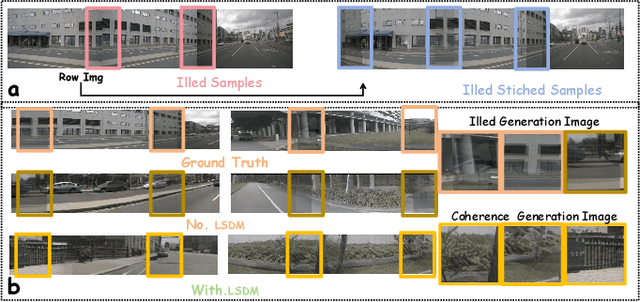
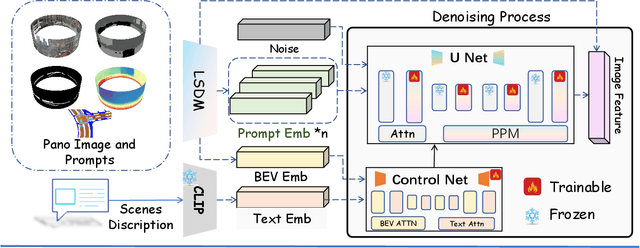
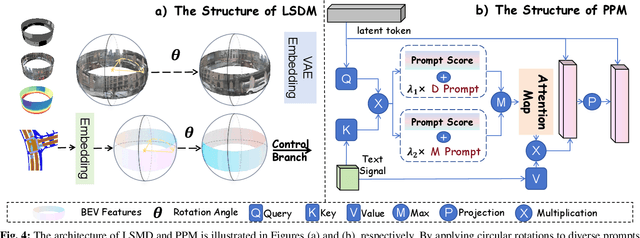
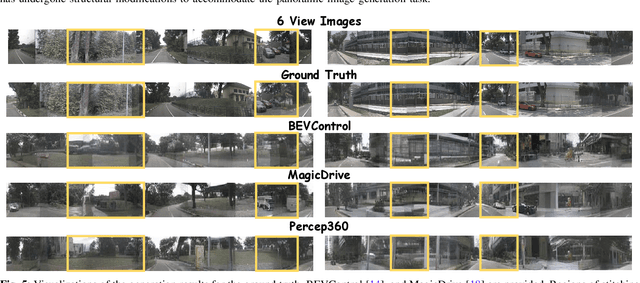
Panoramic perception holds significant potential for autonomous driving, enabling vehicles to acquire a comprehensive 360{\deg} surround view in a single shot. However, autonomous driving is a data-driven task. Complete panoramic data acquisition requires complex sampling systems and annotation pipelines, which are time-consuming and labor-intensive. Although existing street view generation models have demonstrated strong data regeneration capabilities, they can only learn from the fixed data distribution of existing datasets and cannot achieve high-quality, controllable panoramic generation. In this paper, we propose the first panoramic generation method Percep360 for autonomous driving. Percep360 enables coherent generation of panoramic data with control signals based on the stitched panoramic data. Percep360 focuses on two key aspects: coherence and controllability. Specifically, to overcome the inherent information loss caused by the pinhole sampling process, we propose the Local Scenes Diffusion Method (LSDM). LSDM reformulates the panorama generation as a spatially continuous diffusion process, bridging the gaps between different data distributions. Additionally, to achieve the controllable generation of panoramic images, we propose a Probabilistic Prompting Method (PPM). PPM dynamically selects the most relevant control cues, enabling controllable panoramic image generation. We evaluate the effectiveness of the generated images from three perspectives: image quality assessment (i.e., no-reference and with reference), controllability, and their utility in real-world Bird's Eye View (BEV) segmentation. Notably, the generated data consistently outperforms the original stitched images in no-reference quality metrics and enhances downstream perception models. The source code will be publicly available at https://github.com/Bryant-Teng/Percep360.
LAPSO: A Unified Optimization View for Learning-Augmented Power System Operations
May 08, 2025With the high penetration of renewables, traditional model-based power system operation is challenged to deliver economic, stable, and robust decisions. Machine learning has emerged as a powerful modeling tool for capturing complex dynamics to address these challenges. However, its separate design often lacks systematic integration with existing methods. To fill the gap, this paper proposes a holistic framework of Learning-Augmented Power System Operations (LAPSO, pronounced as Lap-So). Adopting a native optimization perspective, LAPSO is centered on the operation stage and aims to break the boundary between temporally siloed power system tasks, such as forecast, operation and control, while unifying the objectives of machine learning and model-based optimizations at both training and inference stages. Systematic analysis and simulations demonstrate the effectiveness of applying LAPSO in designing new integrated algorithms, such as stability-constrained optimization (SCO) and objective-based forecasting (OBF), while enabling end-to-end tracing of different sources of uncertainties. In addition, a dedicated Python package-lapso is introduced to automatically augment existing power system optimization models with learnable components. All code and data are available at https://github.com/xuwkk/lapso_exp.
Panoramic Out-of-Distribution Segmentation
May 06, 2025Panoramic imaging enables capturing 360{\deg} images with an ultra-wide Field-of-View (FoV) for dense omnidirectional perception. However, current panoramic semantic segmentation methods fail to identify outliers, and pinhole Out-of-distribution Segmentation (OoS) models perform unsatisfactorily in the panoramic domain due to background clutter and pixel distortions. To address these issues, we introduce a new task, Panoramic Out-of-distribution Segmentation (PanOoS), achieving OoS for panoramas. Furthermore, we propose the first solution, POS, which adapts to the characteristics of panoramic images through text-guided prompt distribution learning. Specifically, POS integrates a disentanglement strategy designed to materialize the cross-domain generalization capability of CLIP. The proposed Prompt-based Restoration Attention (PRA) optimizes semantic decoding by prompt guidance and self-adaptive correction, while Bilevel Prompt Distribution Learning (BPDL) refines the manifold of per-pixel mask embeddings via semantic prototype supervision. Besides, to compensate for the scarcity of PanOoS datasets, we establish two benchmarks: DenseOoS, which features diverse outliers in complex environments, and QuadOoS, captured by a quadruped robot with a panoramic annular lens system. Extensive experiments demonstrate superior performance of POS, with AuPRC improving by 34.25% and FPR95 decreasing by 21.42% on DenseOoS, outperforming state-of-the-art pinhole-OoS methods. Moreover, POS achieves leading closed-set segmentation capabilities. Code and datasets will be available at https://github.com/MengfeiD/PanOoS.
Out-of-Distribution Generalization in Time Series: A Survey
Mar 18, 2025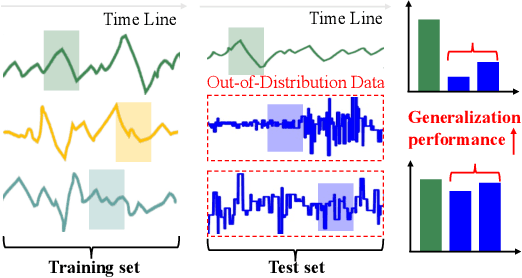
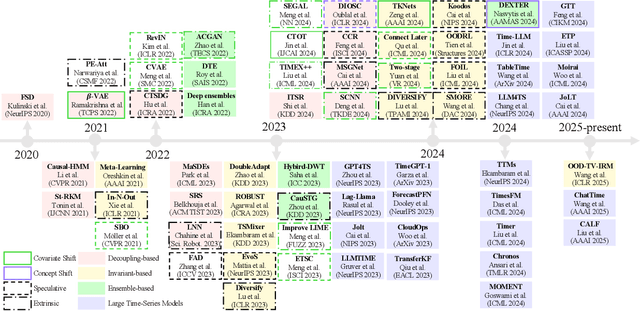
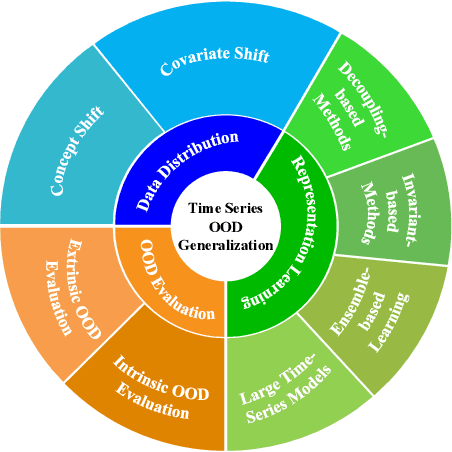
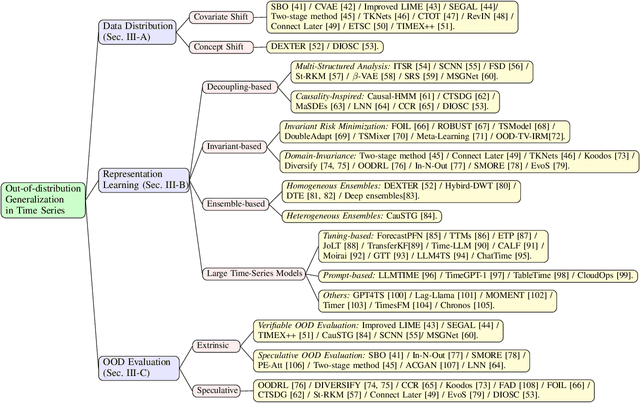
Time series frequently manifest distribution shifts, diverse latent features, and non-stationary learning dynamics, particularly in open and evolving environments. These characteristics pose significant challenges for out-of-distribution (OOD) generalization. While substantial progress has been made, a systematic synthesis of advancements remains lacking. To address this gap, we present the first comprehensive review of OOD generalization methodologies for time series, organized to delineate the field's evolutionary trajectory and contemporary research landscape. We organize our analysis across three foundational dimensions: data distribution, representation learning, and OOD evaluation. For each dimension, we present several popular algorithms in detail. Furthermore, we highlight key application scenarios, emphasizing their real-world impact. Finally, we identify persistent challenges and propose future research directions. A detailed summary of the methods reviewed for the generalization of OOD in time series can be accessed at https://tsood-generalization.com.