 Add to Chrome
 Add to Firefox
 Add to Edge
Controllable Generation via Locally Constrained Resampling
Oct 17, 2024
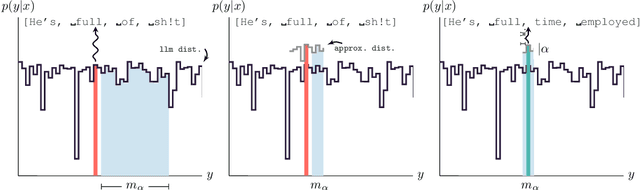

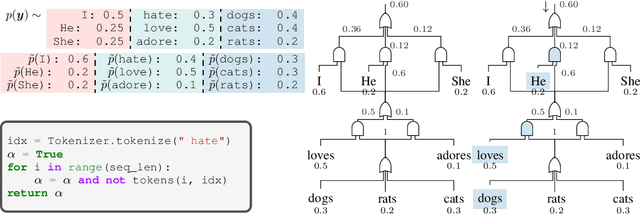

Autoregressive models have demonstrated an unprecedented ability at modeling the intricacies of natural language. However, they continue to struggle with generating complex outputs that adhere to logical constraints. Sampling from a fully-independent distribution subject to a constraint is hard. Sampling from an autoregressive distribution subject to a constraint is doubly hard: We have to contend not only with the hardness of the constraint but also the distribution's lack of structure. We propose a tractable probabilistic approach that performs Bayesian conditioning to draw samples subject to a constraint. Our approach considers the entire sequence, leading to a more globally optimal constrained generation than current greedy methods. Starting from a model sample, we induce a local, factorized distribution which we can tractably condition on the constraint. To generate samples that satisfy the constraint, we sample from the conditional distribution, correct for biases in the samples and resample. The resulting samples closely approximate the target distribution and are guaranteed to satisfy the constraints. We evaluate our approach on several tasks, including LLM detoxification and solving Sudoku puzzles. We show that by disallowing a list of toxic expressions our approach is able to steer the model's outputs away from toxic generations, outperforming similar approaches to detoxification. We conclude by showing that our approach achieves a perfect accuracy on Sudoku compared to <50% for GPT4-o and Gemini 1.5.

LongMemEval: Benchmarking Chat Assistants on Long-Term Interactive Memory
Oct 14, 2024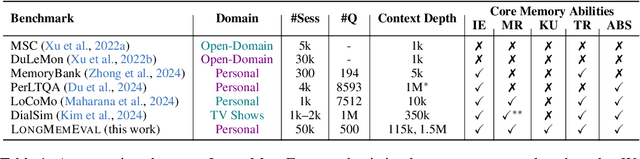
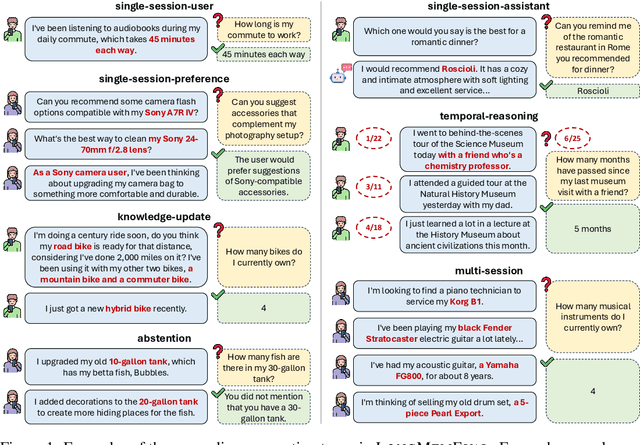
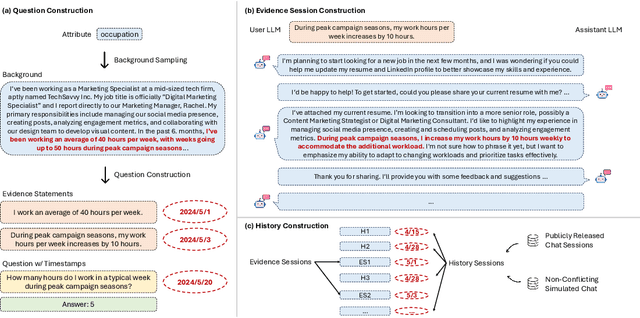
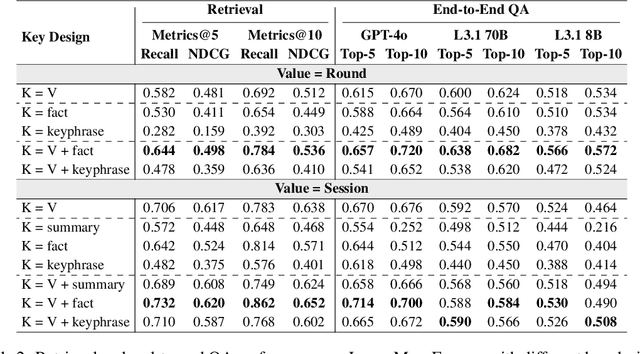
Recent large language model (LLM)-driven chat assistant systems have integrated memory components to track user-assistant chat histories, enabling more accurate and personalized responses. However, their long-term memory capabilities in sustained interactions remain underexplored. This paper introduces LongMemEval, a comprehensive benchmark designed to evaluate five core long-term memory abilities of chat assistants: information extraction, multi-session reasoning, temporal reasoning, knowledge updates, and abstention. With 500 meticulously curated questions embedded within freely scalable user-assistant chat histories, LongMemEval presents a significant challenge to existing long-term memory systems, with commercial chat assistants and long-context LLMs showing 30% accuracy drop on memorizing information across sustained interactions. We then present a unified framework that breaks down the long-term memory design into four design choices across the indexing, retrieval, and reading stages. Built upon key experimental insights, we propose several memory designs including session decomposition for optimizing value granularity, fact-augmented key expansion for enhancing the index structure, and time-aware query expansion for refining the search scope. Experiment results show that these optimizations greatly improve both memory recall and downstream question answering on LongMemEval. Overall, our study provides valuable resources and guidance for advancing the long-term memory capabilities of LLM-based chat assistants, paving the way toward more personalized and reliable conversational AI.
MRAG-Bench: Vision-Centric Evaluation for Retrieval-Augmented Multimodal Models
Oct 10, 2024Existing multimodal retrieval benchmarks primarily focus on evaluating whether models can retrieve and utilize external textual knowledge for question answering. However, there are scenarios where retrieving visual information is either more beneficial or easier to access than textual data. In this paper, we introduce a multimodal retrieval-augmented generation benchmark, MRAG-Bench, in which we systematically identify and categorize scenarios where visually augmented knowledge is better than textual knowledge, for instance, more images from varying viewpoints. MRAG-Bench consists of 16,130 images and 1,353 human-annotated multiple-choice questions across 9 distinct scenarios. With MRAG-Bench, we conduct an evaluation of 10 open-source and 4 proprietary large vision-language models (LVLMs). Our results show that all LVLMs exhibit greater improvements when augmented with images compared to textual knowledge, confirming that MRAG-Bench is vision-centric. Additionally, we conduct extensive analysis with MRAG-Bench, which offers valuable insights into retrieval-augmented LVLMs. Notably, the top-performing model, GPT-4o, faces challenges in effectively leveraging retrieved knowledge, achieving only a 5.82% improvement with ground-truth information, in contrast to a 33.16% improvement observed in human participants. These findings highlight the importance of MRAG-Bench in encouraging the community to enhance LVLMs' ability to utilize retrieved visual knowledge more effectively.
Attribute Controlled Fine-tuning for Large Language Models: A Case Study on Detoxification
Oct 07, 2024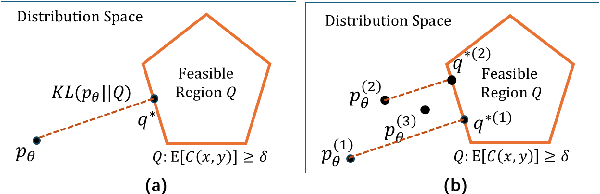


We propose a constraint learning schema for fine-tuning Large Language Models (LLMs) with attribute control. Given a training corpus and control criteria formulated as a sequence-level constraint on model outputs, our method fine-tunes the LLM on the training corpus while enhancing constraint satisfaction with minimal impact on its utility and generation quality. Specifically, our approach regularizes the LLM training by penalizing the KL divergence between the desired output distribution, which satisfies the constraints, and the LLM's posterior. This regularization term can be approximated by an auxiliary model trained to decompose the sequence-level constraints into token-level guidance, allowing the term to be measured by a closed-form formulation. To further improve efficiency, we design a parallel scheme for concurrently updating both the LLM and the auxiliary model. We evaluate the empirical performance of our approach by controlling the toxicity when training an LLM. We show that our approach leads to an LLM that produces fewer inappropriate responses while achieving competitive performance on benchmarks and a toxicity detection task.
Data Advisor: Dynamic Data Curation for Safety Alignment of Large Language Models
Oct 07, 2024


Data is a crucial element in large language model (LLM) alignment. Recent studies have explored using LLMs for efficient data collection. However, LLM-generated data often suffers from quality issues, with underrepresented or absent aspects and low-quality datapoints. To address these problems, we propose Data Advisor, an enhanced LLM-based method for generating data that takes into account the characteristics of the desired dataset. Starting from a set of pre-defined principles in hand, Data Advisor monitors the status of the generated data, identifies weaknesses in the current dataset, and advises the next iteration of data generation accordingly. Data Advisor can be easily integrated into existing data generation methods to enhance data quality and coverage. Experiments on safety alignment of three representative LLMs (i.e., Mistral, Llama2, and Falcon) demonstrate the effectiveness of Data Advisor in enhancing model safety against various fine-grained safety issues without sacrificing model utility.
Control Large Language Models via Divide and Conquer
Oct 06, 2024

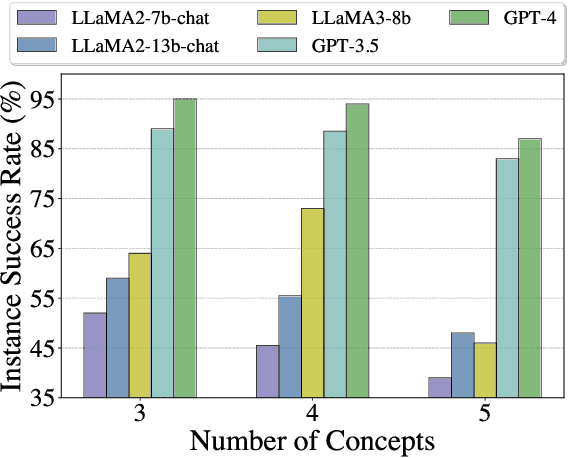

This paper investigates controllable generation for large language models (LLMs) with prompt-based control, focusing on Lexically Constrained Generation (LCG). We systematically evaluate the performance of LLMs on satisfying lexical constraints with prompt-based control, as well as their efficacy in downstream applications. We conclude that LLMs face significant challenges in consistently satisfying lexical constraints with prompt-based control. We identified three key limitations of LLMs for LCG, including (1) position bias, where LLMs tend to satisfy constraints that appear in specific positions within the input; (2) low responsiveness to decoding parameters, which render minimal impact on control of LLMs; and (3) struggle with handling the inherent complexity of certain constraints (e.g., compound words). To address these issues, we introduce a Divide and Conquer Generation strategy, effective for both white-box and black-box LLMs, to enhance LLMs performance in LCG tasks, which demonstrates over 90% improvement on success rate in the most challenging LCG task. Our analysis provides valuable insights into the performance of LLMs in LCG with prompt-based control, and our proposed strategy offers a pathway to more sophisticated and customized text generation applications.
The Hard Positive Truth about Vision-Language Compositionality
Sep 26, 2024Several benchmarks have concluded that our best vision-language models (e.g., CLIP) are lacking in compositionality. Given an image, these benchmarks probe a model's ability to identify its associated caption amongst a set of compositional distractors. In response, a surge of recent proposals show improvements by finetuning CLIP with distractors as hard negatives. Our investigations reveal that these improvements have, in fact, been significantly overstated -- because existing benchmarks do not probe whether finetuned vision-language models remain invariant to hard positives. By curating an evaluation dataset with 112,382 hard negatives and hard positives, we uncover that including hard positives decreases CLIP's performance by 12.9%, while humans perform effortlessly at 99%. CLIP finetuned with hard negatives results in an even larger decrease, up to 38.7%. With this finding, we then produce a 1,775,259 image-text training set with both hard negative and hard positive captions. By training with both, we see improvements on existing benchmarks while simultaneously improving performance on hard positives, indicating a more robust improvement in compositionality. Our work suggests the need for future research to rigorously test and improve CLIP's understanding of semantic relationships between related "positive" concepts.
Con-ReCall: Detecting Pre-training Data in LLMs via Contrastive Decoding
Sep 05, 2024The training data in large language models is key to their success, but it also presents privacy and security risks, as it may contain sensitive information. Detecting pre-training data is crucial for mitigating these concerns. Existing methods typically analyze target text in isolation or solely with non-member contexts, overlooking potential insights from simultaneously considering both member and non-member contexts. While previous work suggested that member contexts provide little information due to the minor distributional shift they induce, our analysis reveals that these subtle shifts can be effectively leveraged when contrasted with non-member contexts. In this paper, we propose Con-ReCall, a novel approach that leverages the asymmetric distributional shifts induced by member and non-member contexts through contrastive decoding, amplifying subtle differences to enhance membership inference. Extensive empirical evaluations demonstrate that Con-ReCall achieves state-of-the-art performance on the WikiMIA benchmark and is robust against various text manipulation techniques.
SpeechPrompt: Prompting Speech Language Models for Speech Processing Tasks
Aug 23, 2024


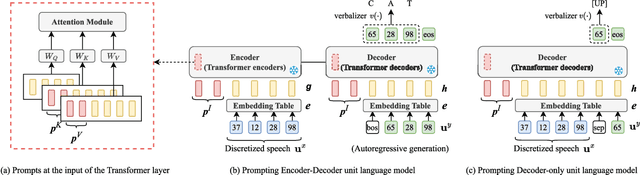
Prompting has become a practical method for utilizing pre-trained language models (LMs). This approach offers several advantages. It allows an LM to adapt to new tasks with minimal training and parameter updates, thus achieving efficiency in both storage and computation. Additionally, prompting modifies only the LM's inputs and harnesses the generative capabilities of language models to address various downstream tasks in a unified manner. This significantly reduces the need for human labor in designing task-specific models. These advantages become even more evident as the number of tasks served by the LM scales up. Motivated by the strengths of prompting, we are the first to explore the potential of prompting speech LMs in the domain of speech processing. Recently, there has been a growing interest in converting speech into discrete units for language modeling. Our pioneer research demonstrates that these quantized speech units are highly versatile within our unified prompting framework. Not only can they serve as class labels, but they also contain rich phonetic information that can be re-synthesized back into speech signals for speech generation tasks. Specifically, we reformulate speech processing tasks into speech-to-unit generation tasks. As a result, we can seamlessly integrate tasks such as speech classification, sequence generation, and speech generation within a single, unified prompting framework. The experiment results show that the prompting method can achieve competitive performance compared to the strong fine-tuning method based on self-supervised learning models with a similar number of trainable parameters. The prompting method also shows promising results in the few-shot setting. Moreover, with the advanced speech LMs coming into the stage, the proposed prompting framework attains great potential.
* Published in IEEE/ACM Transactions on Audio, Speech, and Language Processing (TASLP)
QUDSELECT: Selective Decoding for Questions Under Discussion Parsing
Aug 02, 2024


Question Under Discussion (QUD) is a discourse framework that uses implicit questions to reveal discourse relationships between sentences. In QUD parsing, each sentence is viewed as an answer to a question triggered by an anchor sentence in prior context. The resulting QUD structure is required to conform to several theoretical criteria like answer compatibility (how well the question is answered), making QUD parsing a challenging task. Previous works construct QUD parsers in a pipelined manner (i.e. detect the trigger sentence in context and then generate the question). However, these parsers lack a holistic view of the task and can hardly satisfy all the criteria. In this work, we introduce QUDSELECT, a joint-training framework that selectively decodes the QUD dependency structures considering the QUD criteria. Using instruction-tuning, we train models to simultaneously predict the anchor sentence and generate the associated question. To explicitly incorporate the criteria, we adopt a selective decoding strategy of sampling multiple QUD candidates during inference, followed by selecting the best one with criteria scorers. Our method outperforms the state-of-the-art baseline models by 9% in human evaluation and 4% in automatic evaluation, demonstrating the effectiveness of our framework.