 Add to Chrome
 Add to Firefox
 Add to Edge
Weakly Supervised Lesion Detection and Diagnosis for Breast Cancers with Partially Annotated Ultrasound Images
Jun 12, 2023
Deep learning (DL) has proven highly effective for ultrasound-based computer-aided diagnosis (CAD) of breast cancers. In an automaticCAD system, lesion detection is critical for the following diagnosis. However, existing DL-based methods generally require voluminous manually-annotated region of interest (ROI) labels and class labels to train both the lesion detection and diagnosis models. In clinical practice, the ROI labels, i.e. ground truths, may not always be optimal for the classification task due to individual experience of sonologists, resulting in the issue of coarse annotation that limits the diagnosis performance of a CAD model. To address this issue, a novel Two-Stage Detection and Diagnosis Network (TSDDNet) is proposed based on weakly supervised learning to enhance diagnostic accuracy of the ultrasound-based CAD for breast cancers. In particular, all the ROI-level labels are considered as coarse labels in the first training stage, and then a candidate selection mechanism is designed to identify optimallesion areas for both the fully and partially annotated samples. It refines the current ROI-level labels in the fully annotated images and the detected ROIs in the partially annotated samples with a weakly supervised manner under the guidance of class labels. In the second training stage, a self-distillation strategy further is further proposed to integrate the detection network and classification network into a unified framework as the final CAD model for joint optimization, which then further improves the diagnosis performance. The proposed TSDDNet is evaluated on a B-mode ultrasound dataset, and the experimental results show that it achieves the best performance on both lesion detection and diagnosis tasks, suggesting promising application potential.

Negotiated Reasoning: On Provably Addressing Relative Over-Generalization
Jun 08, 2023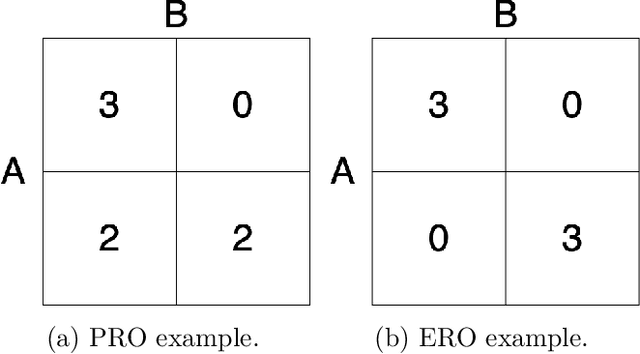
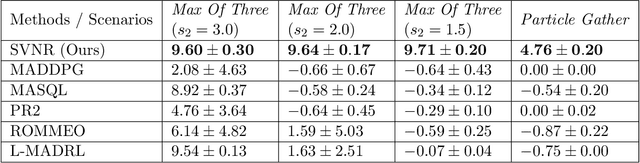
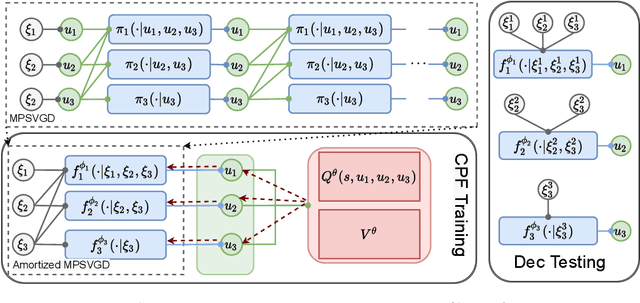
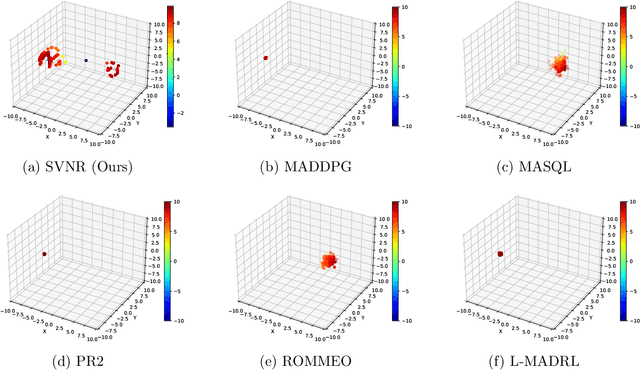
Over-generalization is a thorny issue in cognitive science, where people may become overly cautious due to past experiences. Agents in multi-agent reinforcement learning (MARL) also have been found to suffer relative over-generalization (RO) as people do and stuck to sub-optimal cooperation. Recent methods have shown that assigning reasoning ability to agents can mitigate RO algorithmically and empirically, but there has been a lack of theoretical understanding of RO, let alone designing provably RO-free methods. This paper first proves that RO can be avoided when the MARL method satisfies a consistent reasoning requirement under certain conditions. Then we introduce a novel reasoning framework, called negotiated reasoning, that first builds the connection between reasoning and RO with theoretical justifications. After that, we propose an instantiated algorithm, Stein variational negotiated reasoning (SVNR), which uses Stein variational gradient descent to derive a negotiation policy that provably avoids RO in MARL under maximum entropy policy iteration. The method is further parameterized with neural networks for amortized learning, making computation efficient. Numerical experiments on many RO-challenged environments demonstrate the superiority and efficiency of SVNR compared to state-of-the-art methods in addressing RO.
XSemPLR: Cross-Lingual Semantic Parsing in Multiple Natural Languages and Meaning Representations
Jun 07, 2023Cross-Lingual Semantic Parsing (CLSP) aims to translate queries in multiple natural languages (NLs) into meaning representations (MRs) such as SQL, lambda calculus, and logic forms. However, existing CLSP models are separately proposed and evaluated on datasets of limited tasks and applications, impeding a comprehensive and unified evaluation of CLSP on a diverse range of NLs and MRs. To this end, we present XSemPLR, a unified benchmark for cross-lingual semantic parsing featured with 22 natural languages and 8 meaning representations by examining and selecting 9 existing datasets to cover 5 tasks and 164 domains. We use XSemPLR to conduct a comprehensive benchmark study on a wide range of multilingual language models including encoder-based models (mBERT, XLM-R), encoder-decoder models (mBART, mT5), and decoder-based models (Codex, BLOOM). We design 6 experiment settings covering various lingual combinations (monolingual, multilingual, cross-lingual) and numbers of learning samples (full dataset, few-shot, and zero-shot). Our experiments show that encoder-decoder models (mT5) achieve the highest performance compared with other popular models, and multilingual training can further improve the average performance. Notably, multilingual large language models (e.g., BLOOM) are still inadequate to perform CLSP tasks. We also find that the performance gap between monolingual training and cross-lingual transfer learning is still significant for multilingual models, though it can be mitigated by cross-lingual few-shot training. Our dataset and code are available at https://github.com/psunlpgroup/XSemPLR.
Incorporating Deep Syntactic and Semantic Knowledge for Chinese Sequence Labeling with GCN
Jun 03, 2023


Recently, it is quite common to integrate Chinese sequence labeling results to enhance syntactic and semantic parsing. However, little attention has been paid to the utility of hierarchy and structure information encoded in syntactic and semantic features for Chinese sequence labeling tasks. In this paper, we propose a novel framework to encode syntactic structure features and semantic information for Chinese sequence labeling tasks with graph convolutional networks (GCN). Experiments on five benchmark datasets, including Chinese word segmentation and part-of-speech tagging, demonstrate that our model can effectively improve the performance of Chinese labeling tasks.
GRD: A Generative Approach for Interpretable Reward Redistribution in Reinforcement Learning
May 28, 2023A major challenge in reinforcement learning is to determine which state-action pairs are responsible for future rewards that are delayed. Return Decomposition offers a solution by redistributing rewards from observed sequences while preserving policy invariance. While the majority of current approaches construct the reward redistribution in an uninterpretable manner, we propose to explicitly model the contributions of state and action from a causal perspective, resulting in an interpretable return decomposition. In this paper, we start by studying the role of causal generative models in return decomposition by characterizing the generation of Markovian rewards and trajectory-wise long-term return and further propose a framework, called Generative Return Decomposition (GRD), for policy optimization in delayed reward scenarios. Specifically, GRD first identifies the unobservable Markovian rewards and causal relations in the generative process. Then, GRD makes use of the identified causal generative model to form a compact representation to train policy over the most favorable subspace of the state space of the agent. Theoretically, we show that the unobservable Markovian reward function is identifiable, as well as the underlying causal structure and causal models. Experimental results show that our method outperforms state-of-the-art methods and the provided visualization further demonstrates the interpretability of our method.
Decoupled Rationalization with Asymmetric Learning Rates: A Flexible Lipschitz Restraint
May 26, 2023A self-explaining rationalization model is generally constructed by a cooperative game where a generator selects the most human-intelligible pieces from the input text as rationales, followed by a predictor that makes predictions based on the selected rationales. However, such a cooperative game may incur the degeneration problem where the predictor overfits to the uninformative pieces generated by a not yet well-trained generator and in turn, leads the generator to converge to a sub-optimal model that tends to select senseless pieces. In this paper, we theoretically bridge degeneration with the predictor's Lipschitz continuity. Then, we empirically propose a simple but effective method named DR, which can naturally and flexibly restrain the Lipschitz constant of the predictor, to address the problem of degeneration. The main idea of DR is to decouple the generator and predictor to allocate them with asymmetric learning rates. A series of experiments conducted on two widely used benchmarks have verified the effectiveness of the proposed method. Codes: \href{https://github.com/jugechengzi/Rationalization-DR}{https://github.com/jugechengzi/Rationalization-DR}.
Large language models improve Alzheimer's disease diagnosis using multi-modality data
May 26, 2023In diagnosing challenging conditions such as Alzheimer's disease (AD), imaging is an important reference. Non-imaging patient data such as patient information, genetic data, medication information, cognitive and memory tests also play a very important role in diagnosis. Effect. However, limited by the ability of artificial intelligence models to mine such information, most of the existing models only use multi-modal image data, and cannot make full use of non-image data. We use a currently very popular pre-trained large language model (LLM) to enhance the model's ability to utilize non-image data, and achieved SOTA results on the ADNI dataset.
UNITE: A Unified Benchmark for Text-to-SQL Evaluation
May 26, 2023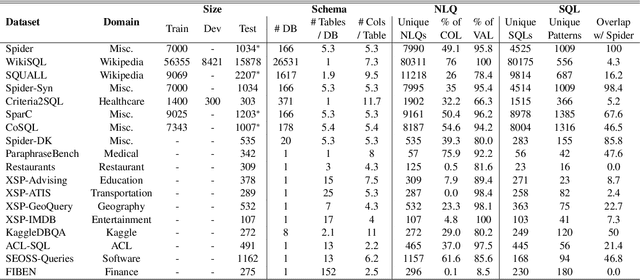
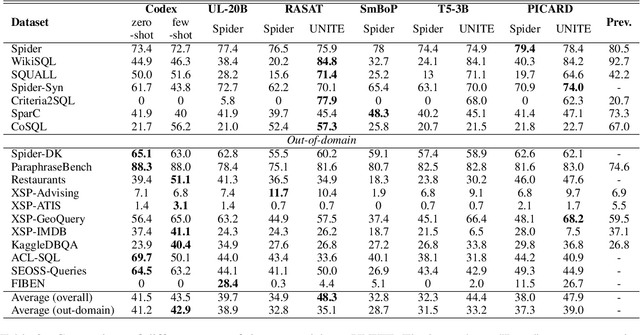
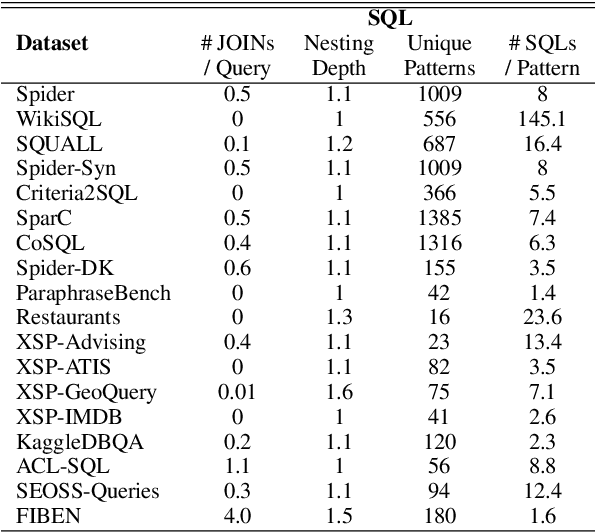
A practical text-to-SQL system should generalize well on a wide variety of natural language questions, unseen database schemas, and novel SQL query structures. To comprehensively evaluate text-to-SQL systems, we introduce a \textbf{UNI}fied benchmark for \textbf{T}ext-to-SQL \textbf{E}valuation (UNITE). It is composed of publicly available text-to-SQL datasets, containing natural language questions from more than 12 domains, SQL queries from more than 3.9K patterns, and 29K databases. Compared to the widely used Spider benchmark \cite{yu-etal-2018-spider}, we introduce $\sim$120K additional examples and a threefold increase in SQL patterns, such as comparative and boolean questions. We conduct a systematic study of six state-of-the-art (SOTA) text-to-SQL parsers on our new benchmark and show that: 1) Codex performs surprisingly well on out-of-domain datasets; 2) specially designed decoding methods (e.g. constrained beam search) can improve performance for both in-domain and out-of-domain settings; 3) explicitly modeling the relationship between questions and schemas further improves the Seq2Seq models. More importantly, our benchmark presents key challenges towards compositional generalization and robustness issues -- which these SOTA models cannot address well. \footnote{Our code and data processing script will be available at \url{https://github.com/XXXX.}}
Multi-scale Efficient Graph-Transformer for Whole Slide Image Classification
May 25, 2023The multi-scale information among the whole slide images (WSIs) is essential for cancer diagnosis. Although the existing multi-scale vision Transformer has shown its effectiveness for learning multi-scale image representation, it still cannot work well on the gigapixel WSIs due to their extremely large image sizes. To this end, we propose a novel Multi-scale Efficient Graph-Transformer (MEGT) framework for WSI classification. The key idea of MEGT is to adopt two independent Efficient Graph-based Transformer (EGT) branches to process the low-resolution and high-resolution patch embeddings (i.e., tokens in a Transformer) of WSIs, respectively, and then fuse these tokens via a multi-scale feature fusion module (MFFM). Specifically, we design an EGT to efficiently learn the local-global information of patch tokens, which integrates the graph representation into Transformer to capture spatial-related information of WSIs. Meanwhile, we propose a novel MFFM to alleviate the semantic gap among different resolution patches during feature fusion, which creates a non-patch token for each branch as an agent to exchange information with another branch by cross-attention. In addition, to expedite network training, a novel token pruning module is developed in EGT to reduce the redundant tokens. Extensive experiments on TCGA-RCC and CAMELYON16 datasets demonstrate the effectiveness of the proposed MEGT.
IMBERT: Making BERT Immune to Insertion-based Backdoor Attacks
May 25, 2023Backdoor attacks are an insidious security threat against machine learning models. Adversaries can manipulate the predictions of compromised models by inserting triggers into the training phase. Various backdoor attacks have been devised which can achieve nearly perfect attack success without affecting model predictions for clean inputs. Means of mitigating such vulnerabilities are underdeveloped, especially in natural language processing. To fill this gap, we introduce IMBERT, which uses either gradients or self-attention scores derived from victim models to self-defend against backdoor attacks at inference time. Our empirical studies demonstrate that IMBERT can effectively identify up to 98.5% of inserted triggers. Thus, it significantly reduces the attack success rate while attaining competitive accuracy on the clean dataset across widespread insertion-based attacks compared to two baselines. Finally, we show that our approach is model-agnostic, and can be easily ported to several pre-trained transformer models.