 Add to Chrome
 Add to Firefox
 Add to Edge
Beyond "To whom it may concern": Tailoring Machine Translation to Audience and Intent
Jun 02, 2026
Translation quality depends on purpose: the same source text demands different translations depending on audience, tone, and communicative intent. Yet MT models and metrics treat translation as a fixed mapping from source to target. LLMs enable users to explicitly specify purpose alongside source text, yet this capability has not been evaluated at scale. We introduce a systematic evaluation of purpose-driven MT across 50 languages, 5 model sizes and 8 text domains. We find that (1) explicit instructions substantially improve translation adaptedness, with larger gains on informal domains (conversation, social media), for larger model sizes and for higher-resource languages; (2) instructions outperform semantically-matched few-shot examples and paragraph-level context; (3) traditional MT metrics fail to capture adaptation quality, often penalizing adapted translations; (4) when curated instructions are unavailable, models can self-generate them from surrounding document context, closing up to 80% of the adaptedness gap to curated instructions. Our results establish that purpose-adapted MT is a viable and measurable capability of LLMs, while highlighting the need for purpose-aware metrics.

Knowledge Localization in Mixture-of-Experts LLMs Using Cross-Lingual Inconsistency
Mar 17, 2026Modern LLMs continue to exhibit significant variance in behavior across languages, such as being able to recall factual information in some languages but not others. While typically studied as a problem to be mitigated, in this work, we propose leveraging this cross-lingual inconsistency as a tool for interpretability in mixture-of-experts (MoE) LLMs. Our knowledge localization framework contrasts routing for sets of languages where the model correctly recalls information from languages where it fails. This allows us to isolate model components that play a functional role in answering about a piece of knowledge. Our method proceeds in two stages: (1) querying the model with difficult factual questions across a diverse set of languages to generate "success" and "failure" activation buckets and then (2) applying a statistical contrastive analysis to the MoE router logits to identify experts important for knowledge. To validate the necessity of this small number of experts for answering a knowledge question, we deactivate them and re-ask the question. We find that despite only deactivating about 20 out of 6000 experts, the model no longer answers correctly in over 40% of cases. Generally, this method provides a realistic and scalable knowledge localization approach to address increasingly complex LLMs.
Large Reasoning Models Struggle to Transfer Parametric Knowledge Across Scripts
Mar 17, 2026In this work, we analyze shortcomings in cross-lingual knowledge transfer in large, modern reasoning LLMs. We demonstrate that the perceived gap in knowledge transfer is primarily a script barrier. First, we conduct an observational data analysis on the performance of thinking models on two datasets with local knowledge from around the world, ECLeKTic and MultiLoKo. Our regression analysis shows that script match - not language or family - is the primary predictor of knowledge transfer failure once model capability and question difficulty are accounted for. We further this finding by providing the LLMs with the key entities of the questions in their source language and find that this disproportionately improves cross-script questions. We then posit that these LLMs could be reasoning better at test-time. To evaluate this, we develop a synthetic generation pipeline to design SFT samples to encourage the model to better reason about transliteration ambiguities when trying to fetch parametric knowledge at inference-time. We show that teaching two models to reason better reduces the cross-script transfer gap. As a result, we conclude that there is potential to improve cross-lingual parametric knowledge transfer during post-training.
Don't Ignore the Tail: Decoupling top-K Probabilities for Efficient Language Model Distillation
Feb 24, 2026The core learning signal used in language model distillation is the standard Kullback-Leibler (KL) divergence between the student and teacher distributions. Traditional KL divergence tends to be dominated by the next tokens with the highest probabilities, i.e., the teacher's modes, thereby diminishing the influence of less probable yet potentially informative components of the output distribution. We propose a new tail-aware divergence that decouples the contribution of the teacher model's top-K predicted probabilities from that of lower-probability predictions, while maintaining the same computational profile as the KL Divergence. Our decoupled approach reduces the impact of the teacher modes and, consequently, increases the contribution of the tail of the distribution. Experimental results demonstrate that our modified distillation method yields competitive performance in both pre-training and supervised distillation of decoder models across various datasets. Furthermore, the distillation process is efficient and can be performed with a modest academic budget for large datasets, eliminating the need for industry-scale computing.
SEA-Guard: Culturally Grounded Multilingual Safeguard for Southeast Asia
Feb 02, 2026Culturally aware safeguards are crucial for AI alignment in real-world settings, where safety extends beyond common sense and encompasses diverse local values, norms, and region-specific regulations. However, building large-scale, culturally grounded datasets is challenging due to limited resources and a scarcity of native annotators. Consequently, many safeguard models rely on machine translation of English datasets, often missing regional and cultural nuances. We present a novel agentic data-generation framework to scalably create authentic, region-specific safety datasets for Southeast Asia (SEA). On this foundation, we introduce the SEA-Guard family, the first multilingual safeguard models grounded in SEA cultural contexts. Evaluated across multiple benchmarks and cultural variants, SEA-Guard consistently outperforms existing safeguards at detecting regionally sensitive or harmful content while maintaining strong general safety performance.
LoraxBench: A Multitask, Multilingual Benchmark Suite for 20 Indonesian Languages
Aug 17, 2025As one of the world's most populous countries, with 700 languages spoken, Indonesia is behind in terms of NLP progress. We introduce LoraxBench, a benchmark that focuses on low-resource languages of Indonesia and covers 6 diverse tasks: reading comprehension, open-domain QA, language inference, causal reasoning, translation, and cultural QA. Our dataset covers 20 languages, with the addition of two formality registers for three languages. We evaluate a diverse set of multilingual and region-focused LLMs and found that this benchmark is challenging. We note a visible discrepancy between performance in Indonesian and other languages, especially the low-resource ones. There is no clear lead when using a region-specific model as opposed to the general multilingual model. Lastly, we show that a change in register affects model performance, especially with registers not commonly found in social media, such as high-level politeness `Krama' Javanese.
TULUN: Transparent and Adaptable Low-resource Machine Translation
May 24, 2025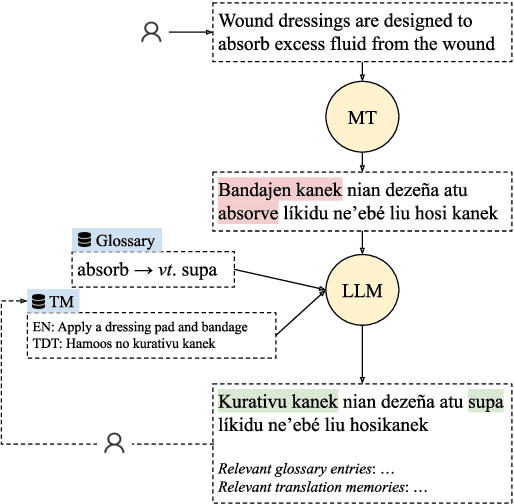
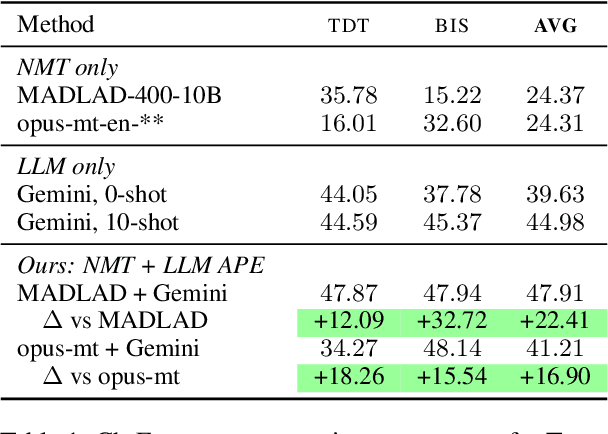
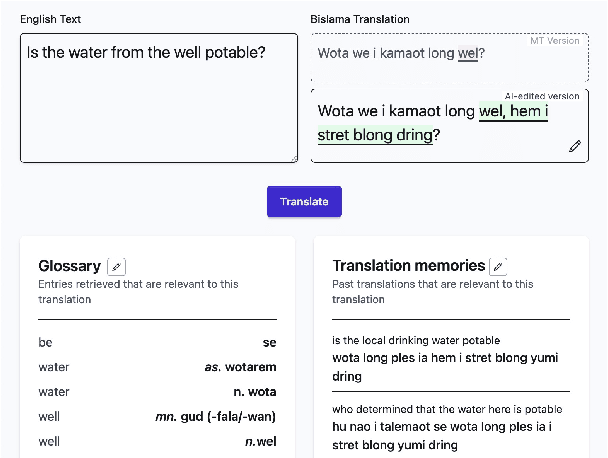
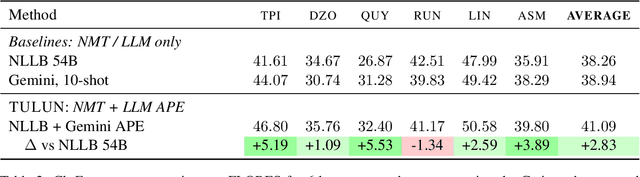
Machine translation (MT) systems that support low-resource languages often struggle on specialized domains. While researchers have proposed various techniques for domain adaptation, these approaches typically require model fine-tuning, making them impractical for non-technical users and small organizations. To address this gap, we propose Tulun, a versatile solution for terminology-aware translation, combining neural MT with large language model (LLM)-based post-editing guided by existing glossaries and translation memories. Our open-source web-based platform enables users to easily create, edit, and leverage terminology resources, fostering a collaborative human-machine translation process that respects and incorporates domain expertise while increasing MT accuracy. Evaluations show effectiveness in both real-world and benchmark scenarios: on medical and disaster relief translation tasks for Tetun and Bislama, our system achieves improvements of 16.90-22.41 ChrF++ points over baseline MT systems. Across six low-resource languages on the FLORES dataset, Tulun outperforms both standalone MT and LLM approaches, achieving an average improvement of 2.8 ChrF points over NLLB-54B.
Bridging Sign and Spoken Languages: Pseudo Gloss Generation for Sign Language Translation
May 21, 2025Sign Language Translation (SLT) aims to map sign language videos to spoken language text. A common approach relies on gloss annotations as an intermediate representation, decomposing SLT into two sub-tasks: video-to-gloss recognition and gloss-to-text translation. While effective, this paradigm depends on expert-annotated gloss labels, which are costly and rarely available in existing datasets, limiting its scalability. To address this challenge, we propose a gloss-free pseudo gloss generation framework that eliminates the need for human-annotated glosses while preserving the structured intermediate representation. Specifically, we prompt a Large Language Model (LLM) with a few example text-gloss pairs using in-context learning to produce draft sign glosses from spoken language text. To enhance the correspondence between LLM-generated pseudo glosses and the sign sequences in video, we correct the ordering in the pseudo glosses for better alignment via a weakly supervised learning process. This reordering facilitates the incorporation of auxiliary alignment objectives, and allows for the use of efficient supervision via a Connectionist Temporal Classification (CTC) loss. We train our SLT mode, which consists of a vision encoder and a translator, through a three-stage pipeline, which progressively narrows the modality gap between sign language and spoken language. Despite its simplicity, our approach outperforms previous state-of-the-art gloss-free frameworks on two SLT benchmarks and achieves competitive results compared to gloss-based methods.
Understanding Cross-Lingual Inconsistency in Large Language Models
May 19, 2025Large language models (LLMs) are demonstrably capable of cross-lingual transfer, but can produce inconsistent output when prompted with the same queries written in different languages. To understand how language models are able to generalize knowledge from one language to the others, we apply the logit lens to interpret the implicit steps taken by LLMs to solve multilingual multi-choice reasoning questions. We find LLMs predict inconsistently and are less accurate because they rely on subspaces of individual languages, rather than working in a shared semantic space. While larger models are more multilingual, we show their hidden states are more likely to dissociate from the shared representation compared to smaller models, but are nevertheless more capable of retrieving knowledge embedded across different languages. Finally, we demonstrate that knowledge sharing can be modulated by steering the models' latent processing towards the shared semantic space. We find reinforcing utilization of the shared space improves the models' multilingual reasoning performance, as a result of more knowledge transfer from, and better output consistency with English.
Few-Shot Multilingual Open-Domain QA from 5 Examples
Feb 27, 2025Recent approaches to multilingual open-domain question answering (MLODQA) have achieved promising results given abundant language-specific training data. However, the considerable annotation cost limits the application of these methods for underrepresented languages. We introduce a \emph{few-shot learning} approach to synthesise large-scale multilingual data from large language models (LLMs). Our method begins with large-scale self-supervised pre-training using WikiData, followed by training on high-quality synthetic multilingual data generated by prompting LLMs with few-shot supervision. The final model, \textsc{FsModQA}, significantly outperforms existing few-shot and supervised baselines in MLODQA and cross-lingual and monolingual retrieval. We further show our method can be extended for effective zero-shot adaptation to new languages through a \emph{cross-lingual prompting} strategy with only English-supervised data, making it a general and applicable solution for MLODQA tasks without costly large-scale annotation.