 Add to Chrome
 Add to Firefox
 Add to Edge
MoRoute: Dynamic Routing for In-Context Multimodal Video Generation
Jul 31, 2026
Multimodal video generation aims to generate and edit videos conditioned on arbitrary combinations of text, images, and videos within a single model, allowing diverse tasks to share complementary data and generative priors. Unifying these tasks requires multimodal understanding of diverse conditions, which is typically provided by a pretrained vision-language model (VLM). A key challenge is how to connect the VLM's hierarchical multimodal representations with a pretrained video diffusion transformer (DiT). Existing methods either inject features from only the final or a few manually selected VLM layers, or jointly train architecture-matched understanding and generation streams, making it difficult to reuse heterogeneous pretrained backbones. We introduce MoRoute, a unified multimodal video generation framework that formulates a frozen VLM and a pretrained video DiT with different architectures as heterogeneous experts connected through dynamic layer routing. For each input, a lightweight block-wise router enables every DiT block to select the VLM layer most relevant to its generation stage, thereby learning an adaptive correspondence between multimodal understanding and video synthesis. MoRoute further incorporates reference images and source videos directly into the DiT token sequence through unified in-context conditioning, preserving fine-grained visual details across diverse generation and editing tasks. Experiments on IntelligentVBench, OpenVE-Bench, and RefVIE-Bench show that MoRoute consistently surpasses the best competing method on each benchmark, improving the average score by 0.15, 0.18, and 0.34 on a 1-5 scale, respectively.

SmartDirector: Keyframe-Conditioned Cinematic Video Generation with Narrative Pacing Control
May 27, 2026The narrative quality of a video fundamentally determines its perceptual value. Although existing video generation methods can produce visually appealing content, they predominantly rely on sparse conditioning signals such as text prompts or first/last frames, which limits precise control over narrative structure and temporal pacing. In this paper, we propose SmartDirector, a framework that enhances the narrative capacity of video generation models through multiple keyframes. SmartDirector supports flexible generation scenarios including single-shot generation, multi-shot narrative synthesis, and video extension. The framework operates in two stages: Director-Gen generates a low-resolution video conditioned on the provided keyframes, and Director-SR refines the output by exploiting high-resolution keyframes as semantic anchors to recover fine-grained details. To enable robust multi-keyframe training, we construct a data pipeline that curates single-shot and multi-shot sequences from movies. Extensive experiments demonstrate that SmartDirector substantially outperforms existing state-of-the-art approaches. We will release the code to facilitate further research.
LAMP-HQ: A Large-Scale Multi-Pose High-Quality Database for NIR-VIS Face Recognition
Dec 17, 2019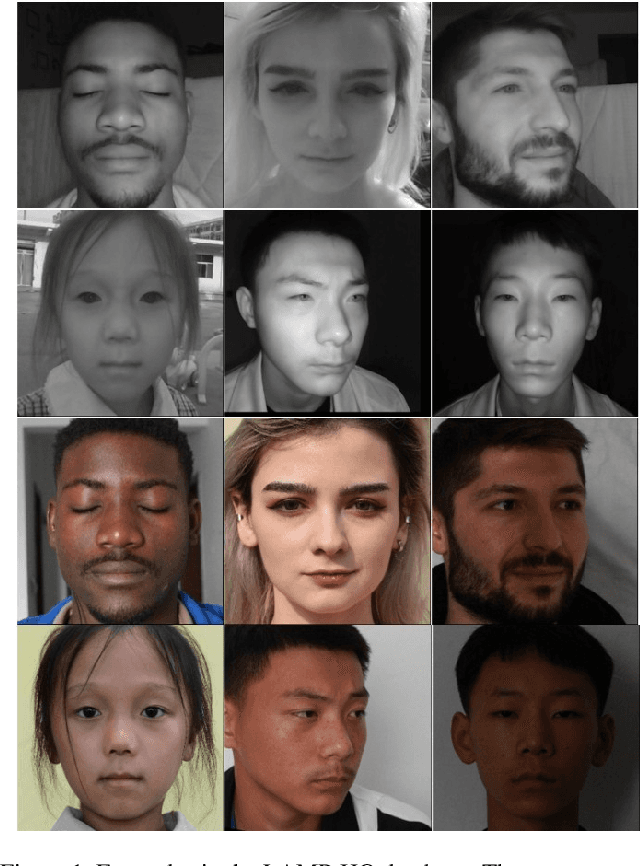
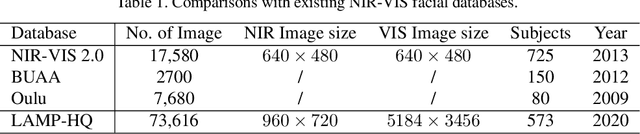

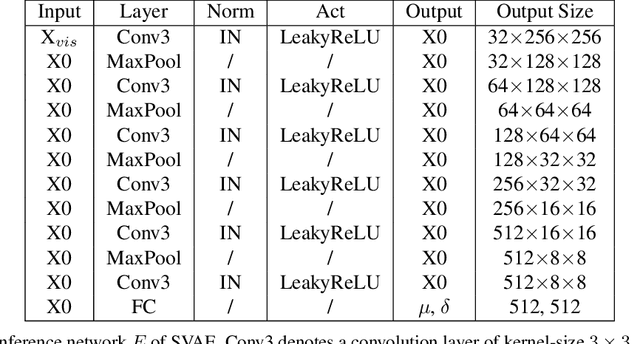
Near-infrared-visible (NIR-VIS) heterogeneous face recognition matches NIR to corresponding VIS face images. However, due to the sensing gap, NIR images often lose some identity information so that the recognition issue is more difficult than conventional VIS face recognition. Recently, NIR-VIS heterogeneous face recognition has attracted considerable attention in the computer vision community because of its convenience and adaptability in practical applications. Various deep learning-based methods have been proposed and substantially increased the recognition performance, but the lack of NIR-VIS training samples leads to the difficulty of the model training process. In this paper, we propose a new Large-Scale Multi-Pose High-Quality NIR-VIS database LAMP-HQ containing 56,788 NIR and 16,828 VIS images of 573 subjects with large diversities in pose, illumination, attribute, scene and accessory. We furnish a benchmark along with the protocol for NIR-VIS face recognition via generation on LAMP-HQ, including Pixel2Pixel, CycleGAN, and ADFL. Furthermore, we propose a novel exemplar-based variational spectral attention network to produce high-fidelity VIS images from NIR data. A spectral conditional attention module is introduced to reduce the domain gap between NIR and VIS data and then improve the performance of NIR-VIS heterogeneous face recognition on various databases including the LAMP-HQ.