 Add to Chrome
 Add to Firefox
 Add to Edge
Local Guidance, Global Impact: Gaussian-Reshaped Trust Region Unlocks Behavior Transitions
Jun 04, 2026
While Proximal Policy Optimization (PPO) demonstrates strong performance in stationary settings, we show that its standard optimization paradigm struggles in continual and non-stationary environments. The failure does not stem from insufficient model capacity or overly restrictive clipping. Instead, PPO performs persistent, directionally inefficient local updates, which indicates a lack of geometry-aware guidance for accumulating meaningful behavioral change and ultimately hindering transitions toward new behavior patterns. Although divergence-based regularization introduces partial geometric awareness, its monotonically increasing penalties implicitly discourage large policy deviations, even when such shifts are necessary for effective adaptation. To address this limitation, we propose Gaussian Trust Region Policy Optimization (GTR), which reshapes the trust region using a Gaussian kernel. The resulting constraint is bounded and non-monotonic, providing strong local stability while progressively relaxing under sustained high-advantage updates. To further improve robustness, we introduce a Mixture Gaussian Anchor that adapts to recent policy trajectories, reducing variance induced by stale references. GTR is architecture-agnostic and achieves strong performance across games, simulated robotic control, open-world exploration, and language model post-training. These results demonstrate that geometry-aware trust-region design can be a promising direction for robust reinforcement learning in complex non-stationary environments. Our code is available at https://anonymous.4open.science/r/GTR_demo/README.md.

Representation Learning Enables Scalable Multitask Deep Reinforcement Learning
Jun 04, 2026Scaling reinforcement learning (RL) to diverse multitask settings remains a central challenge. While recent advances in model-based RL achieve strong performance, they rely on planning and complex training pipelines, making it unclear which components are essential for scalability. We revisit this question and argue that the primary driver of scalable multitask RL is not model-based control, but \emph{representation learning}. In particular, we show that combining predictive, model-based representations with high-capacity value function approximation is sufficient to achieve strong performance, even without planning. We evaluate a simple model-free algorithm, MR.Q, coupled with auxiliary predictive objectives into a scalable actor-critic architecture. This approach outperforms a recent world-model-based method and a range of deep RL baselines across a diverse suite of multitask continuous control tasks, while significantly reducing computational overhead and improving wall-clock efficiency. We observe consistent improvements with increased model capacity and show through ablations that predictive representation learning is critical for performance.
Do Enterprise Systems Need Learned World Models? The Importance of Context to Infer Dynamics
May 12, 2026World models enable agents to anticipate the effects of their actions by internalizing environment dynamics. In enterprise systems, however, these dynamics are often defined by tenant-specific business logic that varies across deployments and evolves over time, making models trained on historical transitions brittle under deployment shift. We ask a question the world-models literature has not addressed: when the rules can be read at inference time, does an agent still need to learn them? We argue, and demonstrate empirically, that in settings where transition dynamics are configurable and readable, runtime discovery complements offline training by grounding predictions in the active system instance. We propose enterprise discovery agents, which recover relevant transition dynamics at runtime by reading the system's configuration rather than relying solely on internalized representations. We introduce CascadeBench, a reasoning-focused benchmark for enterprise cascade prediction that adopts the evaluation methodology of World of Workflows on diverse synthetic environments, and use it together with deployment-shift evaluation to show that offline-trained world models can perform well in-distribution but degrade as dynamics change, whereas discovery-based agents are more robust under shift by grounding their predictions in the current instance. Our findings suggest that, in configurable enterprise environments, agents should not rely solely on fixed internalized dynamics, but should incorporate mechanisms for discovering relevant transition logic at runtime.
A Mechanistic Analysis of Looped Reasoning Language Models
Apr 13, 2026Reasoning has become a central capability in large language models. Recent research has shown that reasoning performance can be improved by looping an LLM's layers in the latent dimension, resulting in looped reasoning language models. Despite promising results, few works have investigated how their internal dynamics differ from those of standard feedforward models. In this paper, we conduct a mechanistic analysis of the latent states in looped language models, focusing in particular on how the stages of inference observed in feedforward models compare to those observed in looped ones. To this end, we analyze cyclic recurrence and show that for many of the studied models each layer in the cycle converges to a distinct fixed point; consequently, the recurrent block follows a consistent cyclic trajectory in the latent space. We provide evidence that as these fixed points are reached, attention-head behavior stabilizes, leading to constant behavior across recurrences. Empirically, we discover that recurrent blocks learn stages of inference that closely mirror those of feedforward models, repeating these stages in depth with each iteration. We study how recurrent block size, input injection, and normalization influence the emergence and stability of these cyclic fixed points. We believe these findings help translate mechanistic insights into practical guidance for architectural design.
Stable Deep Reinforcement Learning via Isotropic Gaussian Representations
Feb 22, 2026Deep reinforcement learning systems often suffer from unstable training dynamics due to non-stationarity, where learning objectives and data distributions evolve over time. We show that under non-stationary targets, isotropic Gaussian embeddings are provably advantageous. In particular, they induce stable tracking of time-varying targets for linear readouts, achieve maximal entropy under a fixed variance budget, and encourage a balanced use of all representational dimensions--all of which enable agents to be more adaptive and stable. Building on this insight, we propose the use of Sketched Isotropic Gaussian Regularization for shaping representations toward an isotropic Gaussian distribution during training. We demonstrate empirically, over a variety of domains, that this simple and computationally inexpensive method improves performance under non-stationarity while reducing representation collapse, neuron dormancy, and training instability.
A Comedy of Estimators: On KL Regularization in RL Training of LLMs
Dec 26, 2025The reasoning performance of large language models (LLMs) can be substantially improved by training them with reinforcement learning (RL). The RL objective for LLM training involves a regularization term, which is the reverse Kullback-Leibler (KL) divergence between the trained policy and the reference policy. Since computing the KL divergence exactly is intractable, various estimators are used in practice to estimate it from on-policy samples. Despite its wide adoption, including in several open-source libraries, there is no systematic study analyzing the numerous ways of incorporating KL estimators in the objective and their effect on the downstream performance of RL-trained models. Recent works show that prevailing practices for incorporating KL regularization do not provide correct gradients for stated objectives, creating a discrepancy between the objective and its implementation. In this paper, we further analyze these practices and study the gradients of several estimators configurations, revealing how design choices shape gradient bias. We substantiate these findings with empirical observations by RL fine-tuning \texttt{Qwen2.5-7B}, \texttt{Llama-3.1-8B-Instruct} and \texttt{Qwen3-4B-Instruct-2507} with different configurations and evaluating their performance on both in- and out-of-distribution tasks. Through our analysis, we observe that, in on-policy settings: (1) estimator configurations with biased gradients can result in training instabilities; and (2) using estimator configurations resulting in unbiased gradients leads to better performance on in-domain as well as out-of-domain tasks. We also investigate the performance resulting from different KL configurations in off-policy settings and observe that KL regularization can help stabilize off-policy RL training resulting from asynchronous setups.
Grounding Computer Use Agents on Human Demonstrations
Nov 10, 2025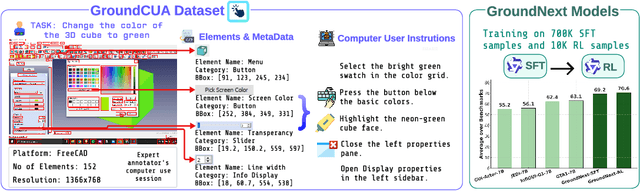
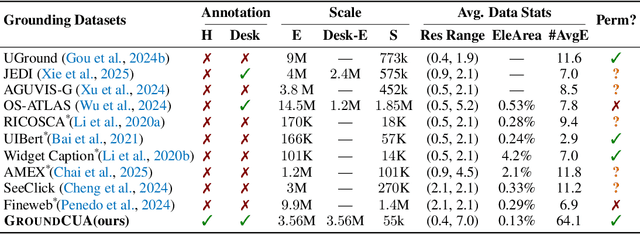
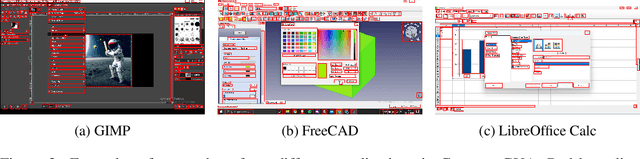
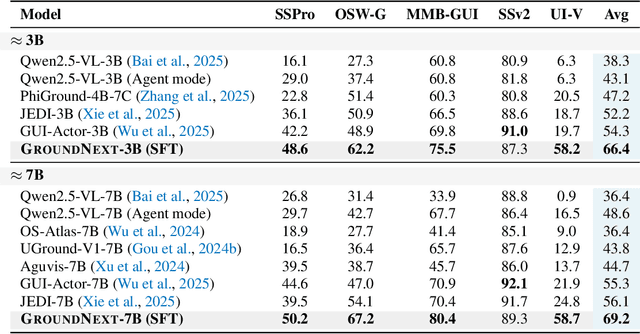
Building reliable computer-use agents requires grounding: accurately connecting natural language instructions to the correct on-screen elements. While large datasets exist for web and mobile interactions, high-quality resources for desktop environments are limited. To address this gap, we introduce GroundCUA, a large-scale desktop grounding dataset built from expert human demonstrations. It covers 87 applications across 12 categories and includes 56K screenshots, with every on-screen element carefully annotated for a total of over 3.56M human-verified annotations. From these demonstrations, we generate diverse instructions that capture a wide range of real-world tasks, providing high-quality data for model training. Using GroundCUA, we develop the GroundNext family of models that map instructions to their target UI elements. At both 3B and 7B scales, GroundNext achieves state-of-the-art results across five benchmarks using supervised fine-tuning, while requiring less than one-tenth the training data of prior work. Reinforcement learning post-training further improves performance, and when evaluated in an agentic setting on the OSWorld benchmark using o3 as planner, GroundNext attains comparable or superior results to models trained with substantially more data,. These results demonstrate the critical role of high-quality, expert-driven datasets in advancing general-purpose computer-use agents.
Asymmetric Proximal Policy Optimization: mini-critics boost LLM reasoning
Oct 02, 2025Most recent RL for LLMs (RL4LLM) methods avoid explicit critics, replacing them with average advantage baselines. This shift is largely pragmatic: conventional value functions are computationally expensive to train at LLM scale and often fail under sparse rewards and long reasoning horizons. We revisit this bottleneck from an architectural perspective and introduce Asymmetric Proximal Policy Optimization (AsyPPO), a simple and scalable framework that restores the critics role while remaining efficient in large-model settings. AsyPPO employs a set of lightweight mini-critics, each trained on disjoint prompt shards. This design encourages diversity while preserving calibration, reducing value-estimation bias. Beyond robust estimation, AsyPPO leverages inter-critic uncertainty to refine the policy update: (i) masking advantages in states where critics agree and gradients add little learning signal, and (ii) filtering high-divergence states from entropy regularization, suppressing spurious exploration. After training on open-source data with only 5,000 samples, AsyPPO consistently improves learning stability and performance across multiple benchmarks over strong baselines, such as GRPO, achieving performance gains of more than six percent on Qwen3-4b-Base and about three percent on Qwen3-8b-Base and Qwen3-14b-Base over classic PPO, without additional tricks. These results highlight the importance of architectural innovations for scalable, efficient algorithms.
Recursive Self-Aggregation Unlocks Deep Thinking in Large Language Models
Sep 30, 2025Test-time scaling methods improve the capabilities of large language models (LLMs) by increasing the amount of compute used during inference to make a prediction. Inference-time compute can be scaled in parallel by choosing among multiple independent solutions or sequentially through self-refinement. We propose Recursive Self-Aggregation (RSA), a test-time scaling method inspired by evolutionary methods that combines the benefits of both parallel and sequential scaling. Each step of RSA refines a population of candidate reasoning chains through aggregation of subsets to yield a population of improved solutions, which are then used as the candidate pool for the next iteration. RSA exploits the rich information embedded in the reasoning chains -- not just the final answers -- and enables bootstrapping from partially correct intermediate steps within different chains of thought. Empirically, RSA delivers substantial performance gains with increasing compute budgets across diverse tasks, model families and sizes. Notably, RSA enables Qwen3-4B-Instruct-2507 to achieve competitive performance with larger reasoning models, including DeepSeek-R1 and o3-mini (high), while outperforming purely parallel and sequential scaling strategies across AIME-25, HMMT-25, Reasoning Gym, LiveCodeBench-v6, and SuperGPQA. We further demonstrate that training the model to combine solutions via a novel aggregation-aware reinforcement learning approach yields significant performance gains. Code available at https://github.com/HyperPotatoNeo/RSA.
Stable Gradients for Stable Learning at Scale in Deep Reinforcement Learning
Jun 18, 2025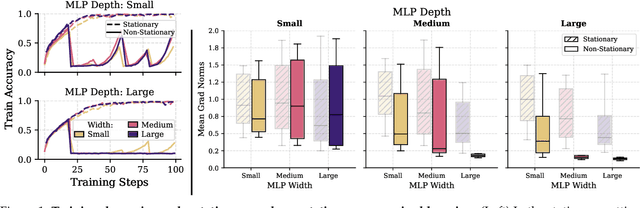
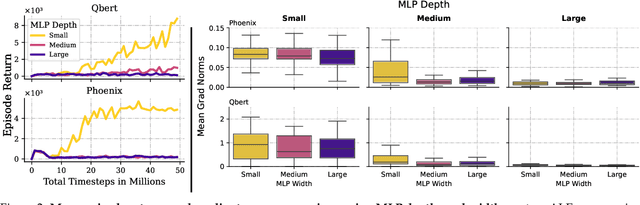
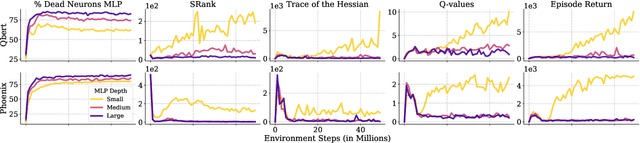
Scaling deep reinforcement learning networks is challenging and often results in degraded performance, yet the root causes of this failure mode remain poorly understood. Several recent works have proposed mechanisms to address this, but they are often complex and fail to highlight the causes underlying this difficulty. In this work, we conduct a series of empirical analyses which suggest that the combination of non-stationarity with gradient pathologies, due to suboptimal architectural choices, underlie the challenges of scale. We propose a series of direct interventions that stabilize gradient flow, enabling robust performance across a range of network depths and widths. Our interventions are simple to implement and compatible with well-established algorithms, and result in an effective mechanism that enables strong performance even at large scales. We validate our findings on a variety of agents and suites of environments.