 Add to Chrome
 Add to Firefox
 Add to Edge
ShotPlan: Cinematic Video Generation with Learnable Planning Token
Jul 20, 2026
Current video generation models achieve impressive results in single-shot generation, yet remain limited in cinematic video generation, where coherent narratives and effective multi-shot composition require explicit shot planning. To address this challenge, we propose ShotPlan, a framework for explicit multi-shot cinematic video generation built upon a video diffusion foundation model. Our method introduces learnable planning tokens that capture shot-level transition cues and can be seamlessly integrated with the original video generation tokens to control transition timestamps. Unlike standard video generation tokens, the proposed planning tokens are equipped with Fractional Temporal Rotary Position Embedding (FRoPE), enabling shot transitions to be modeled at the frame level. Experiments demonstrate that ShotPlan significantly outperforms existing cinematic video generation methods, offering more flexible shot management and stronger inter-shot consistency.

MFSR: Multi-fractal Feature for Super-resolution Reconstruction with Fine Details Recovery
Feb 27, 2025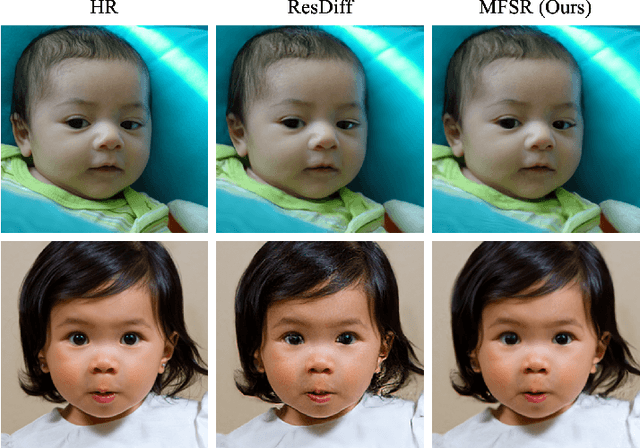
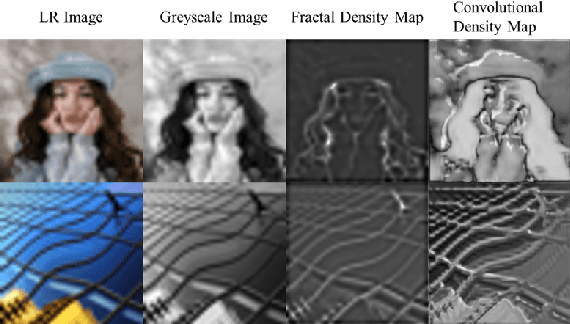

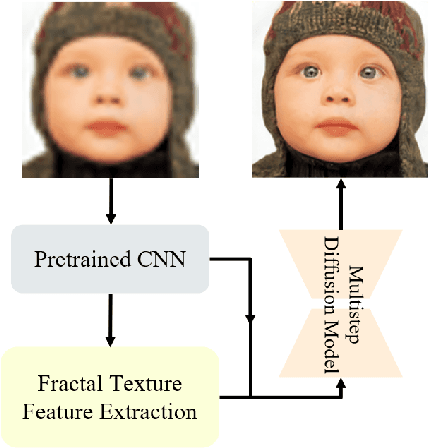
In the process of performing image super-resolution processing, the processing of complex localized information can have a significant impact on the quality of the image generated. Fractal features can capture the rich details of both micro and macro texture structures in an image. Therefore, we propose a diffusion model-based super-resolution method incorporating fractal features of low-resolution images, named MFSR. MFSR leverages these fractal features as reinforcement conditions in the denoising process of the diffusion model to ensure accurate recovery of texture information. MFSR employs convolution as a soft assignment to approximate the fractal features of low-resolution images. This approach is also used to approximate the density feature maps of these images. By using soft assignment, the spatial layout of the image is described hierarchically, encoding the self-similarity properties of the image at different scales. Different processing methods are applied to various types of features to enrich the information acquired by the model. In addition, a sub-denoiser is integrated in the denoising U-Net to reduce the noise in the feature maps during the up-sampling process in order to improve the quality of the generated images. Experiments conducted on various face and natural image datasets demonstrate that MFSR can generate higher quality images.