 Add to Chrome
 Add to Firefox
 Add to Edge
DDIPrompt: Drug-Drug Interaction Event Prediction based on Graph Prompt Learning
Feb 18, 2024
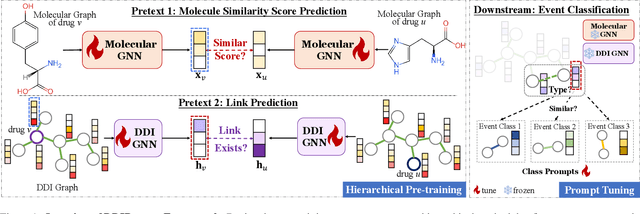
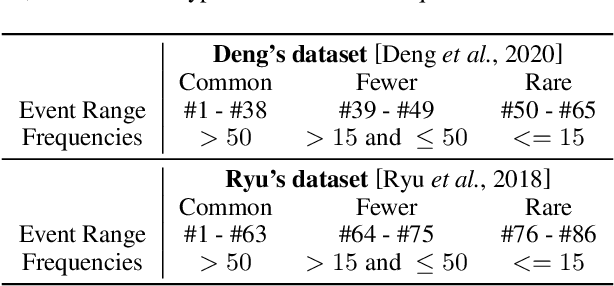
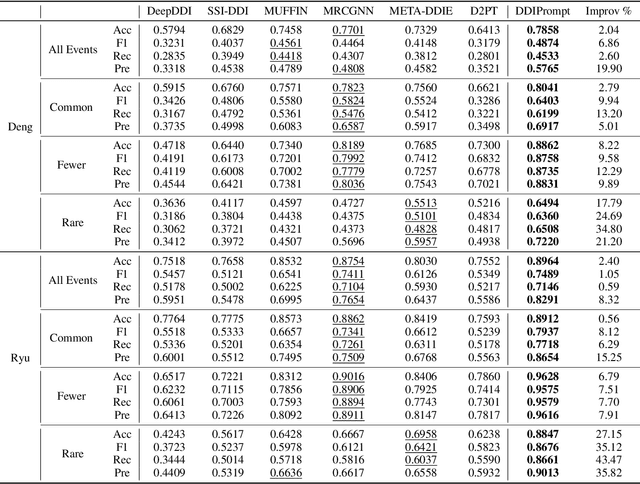
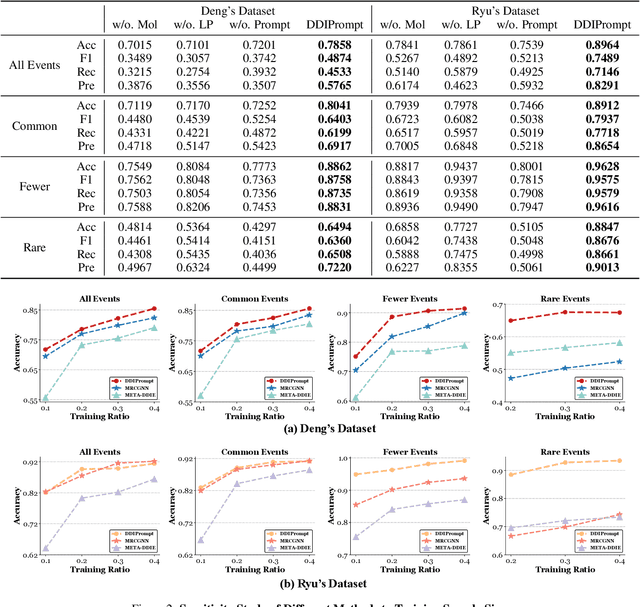
Recently, Graph Neural Networks have become increasingly prevalent in predicting adverse drug-drug interactions (DDI) due to their proficiency in modeling the intricate associations between atoms and functional groups within and across drug molecules. However, they are still hindered by two significant challenges: (1) the issue of highly imbalanced event distribution, which is a common but critical problem in medical datasets where certain interactions are vastly underrepresented. This imbalance poses a substantial barrier to achieving accurate and reliable DDI predictions. (2) the scarcity of labeled data for rare events, which is a pervasive issue in the medical field where rare yet potentially critical interactions are often overlooked or under-studied due to limited available data. In response, we offer DDIPrompt, an innovative panacea inspired by the recent advancements in graph prompting. Our framework aims to address these issues by leveraging the intrinsic knowledge from pre-trained models, which can be efficiently deployed with minimal downstream data. Specifically, to solve the first challenge, DDIPrompt employs augmented links between drugs, considering both structural and interactive proximity. It features a hierarchical pre-training strategy that comprehends intra-molecular structures and inter-molecular interactions, fostering a comprehensive and unbiased understanding of drug properties. For the second challenge, we implement a prototype-enhanced prompting mechanism during inference. This mechanism, refined by few-shot examples from each category, effectively harnesses the rich pre-training knowledge to enhance prediction accuracy, particularly for these rare but crucial interactions. Comprehensive evaluations on two benchmark datasets demonstrate the superiority of DDIPrompt, particularly in predicting rare DDI events.

Prompt Learning on Temporal Interaction Graphs
Feb 09, 2024Temporal Interaction Graphs (TIGs) are widely utilized to represent real-world systems. To facilitate representation learning on TIGs, researchers have proposed a series of TIG models. However, these models are still facing two tough gaps between the pre-training and downstream predictions in their ``pre-train, predict'' training paradigm. First, the temporal discrepancy between the pre-training and inference data severely undermines the models' applicability in distant future predictions on the dynamically evolving data. Second, the semantic divergence between pretext and downstream tasks hinders their practical applications, as they struggle to align with their learning and prediction capabilities across application scenarios. Recently, the ``pre-train, prompt'' paradigm has emerged as a lightweight mechanism for model generalization. Applying this paradigm is a potential solution to solve the aforementioned challenges. However, the adaptation of this paradigm to TIGs is not straightforward. The application of prompting in static graph contexts falls short in temporal settings due to a lack of consideration for time-sensitive dynamics and a deficiency in expressive power. To address this issue, we introduce Temporal Interaction Graph Prompting (TIGPrompt), a versatile framework that seamlessly integrates with TIG models, bridging both the temporal and semantic gaps. In detail, we propose a temporal prompt generator to offer temporally-aware prompts for different tasks. These prompts stand out for their minimalistic design, relying solely on the tuning of the prompt generator with very little supervision data. To cater to varying computational resource demands, we propose an extended ``pre-train, prompt-based fine-tune'' paradigm, offering greater flexibility. Through extensive experiments, the TIGPrompt demonstrates the SOTA performance and remarkable efficiency advantages.
Benchmarking Large Multimodal Models against Common Corruptions
Jan 22, 2024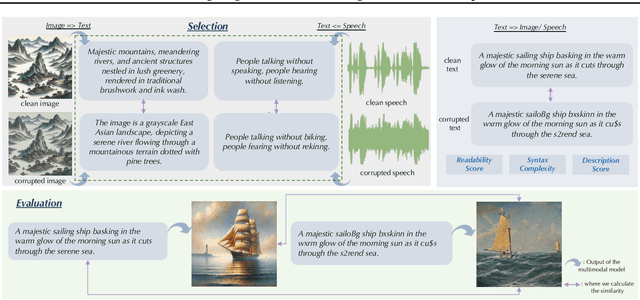
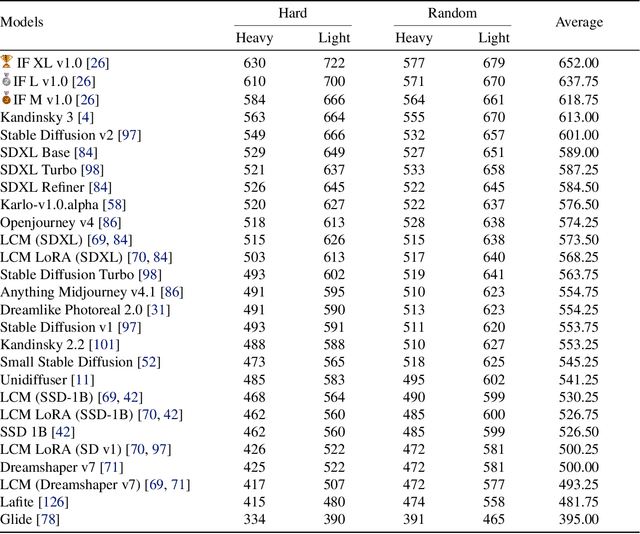
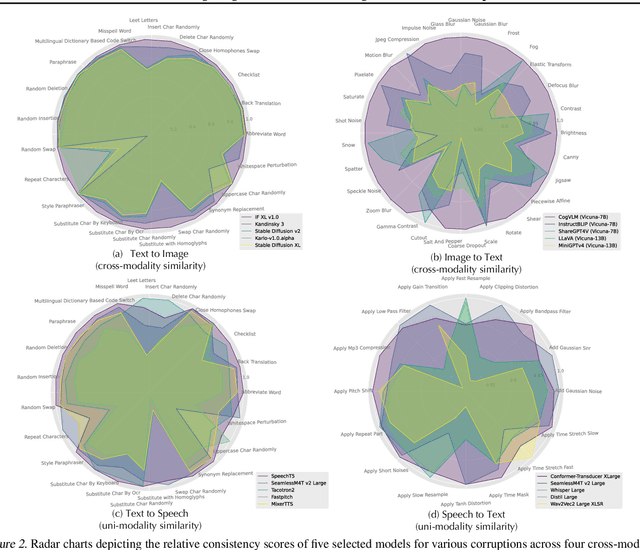
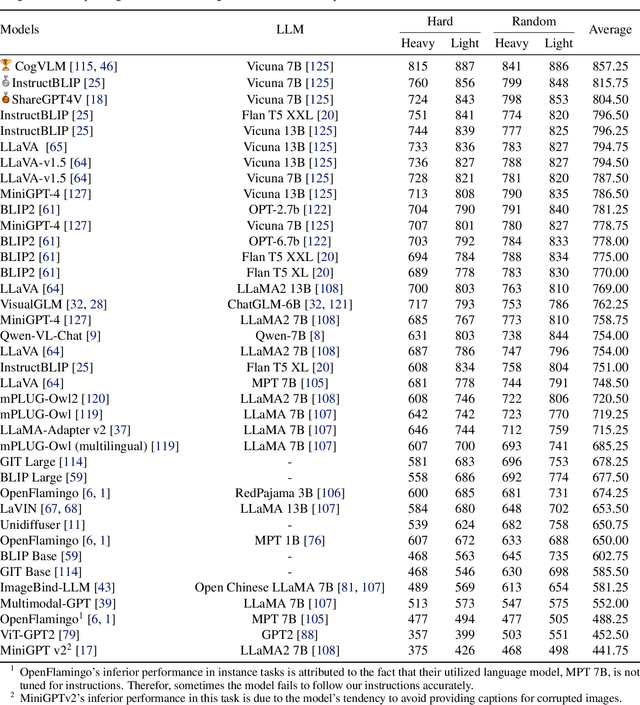
This technical report aims to fill a deficiency in the assessment of large multimodal models (LMMs) by specifically examining the self-consistency of their outputs when subjected to common corruptions. We investigate the cross-modal interactions between text, image, and speech, encompassing four essential generation tasks: text-to-image, image-to-text, text-to-speech, and speech-to-text. We create a comprehensive benchmark, named MMCBench, that covers more than 100 popular LMMs (totally over 150 model checkpoints). A thorough evaluation under common corruptions is critical for practical deployment and facilitates a better understanding of the reliability of cutting-edge LMMs. The benchmarking code is available at https://github.com/sail-sg/MMCBench
Generalized Lagrangian Neural Networks
Jan 09, 2024Incorporating neural networks for the solution of Ordinary Differential Equations (ODEs) represents a pivotal research direction within computational mathematics. Within neural network architectures, the integration of the intrinsic structure of ODEs offers advantages such as enhanced predictive capabilities and reduced data utilization. Among these structural ODE forms, the Lagrangian representation stands out due to its significant physical underpinnings. Building upon this framework, Bhattoo introduced the concept of Lagrangian Neural Networks (LNNs). Then in this article, we introduce a groundbreaking extension (Genralized Lagrangian Neural Networks) to Lagrangian Neural Networks (LNNs), innovatively tailoring them for non-conservative systems. By leveraging the foundational importance of the Lagrangian within Lagrange's equations, we formulate the model based on the generalized Lagrange's equation. This modification not only enhances prediction accuracy but also guarantees Lagrangian representation in non-conservative systems. Furthermore, we perform various experiments, encompassing 1-dimensional and 2-dimensional examples, along with an examination of the impact of network parameters, which proved the superiority of Generalized Lagrangian Neural Networks(GLNNs).
EPA: Neural Collapse Inspired Robust Out-of-Distribution Detector
Jan 03, 2024Out-of-distribution (OOD) detection plays a crucial role in ensuring the security of neural networks. Existing works have leveraged the fact that In-distribution (ID) samples form a subspace in the feature space, achieving state-of-the-art (SOTA) performance. However, the comprehensive characteristics of the ID subspace still leave under-explored. Recently, the discovery of Neural Collapse ($\mathcal{NC}$) sheds light on novel properties of the ID subspace. Leveraging insight from $\mathcal{NC}$, we observe that the Principal Angle between the features and the ID feature subspace forms a superior representation for measuring the likelihood of OOD. Building upon this observation, we propose a novel $\mathcal{NC}$-inspired OOD scoring function, named Entropy-enhanced Principal Angle (EPA), which integrates both the global characteristic of the ID subspace and its inner property. We experimentally compare EPA with various SOTA approaches, validating its superior performance and robustness across different network architectures and OOD datasets.
Contrastive Sequential Interaction Network Learning on Co-Evolving Riemannian Spaces
Jan 02, 2024The sequential interaction network usually find itself in a variety of applications, e.g., recommender system. Herein, inferring future interaction is of fundamental importance, and previous efforts are mainly focused on the dynamics in the classic zero-curvature Euclidean space. Despite the promising results achieved by previous methods, a range of significant issues still largely remains open: On the bipartite nature, is it appropriate to place user and item nodes in one identical space regardless of their inherent difference? On the network dynamics, instead of a fixed curvature space, will the representation spaces evolve when new interactions arrive continuously? On the learning paradigm, can we get rid of the label information costly to acquire? To address the aforementioned issues, we propose a novel Contrastive model for Sequential Interaction Network learning on Co-Evolving RiEmannian spaces, CSINCERE. To the best of our knowledge, we are the first to introduce a couple of co-evolving representation spaces, rather than a single or static space, and propose a co-contrastive learning for the sequential interaction network. In CSINCERE, we formulate a Cross-Space Aggregation for message-passing across representation spaces of different Riemannian geometries, and design a Neural Curvature Estimator based on Ricci curvatures for modeling the space evolvement over time. Thereafter, we present a Reweighed Co-Contrast between the temporal views of the sequential network, so that the couple of Riemannian spaces interact with each other for the interaction prediction without labels. Empirical results on 5 public datasets show the superiority of CSINCERE over the state-of-the-art methods.
A Revisit of Fake News Dataset with Augmented Fact-checking by ChatGPT
Dec 19, 2023The proliferation of fake news has emerged as a critical issue in recent years, requiring significant efforts to detect it. However, the existing fake news detection datasets are sourced from human journalists, which are likely to have inherent bias limitations due to the highly subjective nature of this task. In this paper, we revisit the existing fake news dataset verified by human journalists with augmented fact-checking by large language models (ChatGPT), and we name the augmented fake news dataset ChatGPT-FC. We quantitatively analyze the distinctions and resemblances between human journalists and LLM in assessing news subject credibility, news creator credibility, time-sensitive, and political framing. Our findings highlight LLM's potential to serve as a preliminary screening method, offering a promising avenue to mitigate the inherent biases of human journalists and enhance fake news detection.
Diffusion-based Blind Text Image Super-Resolution
Dec 13, 2023Recovering degraded low-resolution text images is challenging, especially for Chinese text images with complex strokes and severe degradation in real-world scenarios. Ensuring both text fidelity and style realness is crucial for high-quality text image super-resolution. Recently, diffusion models have achieved great success in natural image synthesis and restoration due to their powerful data distribution modeling abilities and data generation capabilities. In this work, we propose an Image Diffusion Model (IDM) to restore text images with realistic styles. For diffusion models, they are not only suitable for modeling realistic image distribution but also appropriate for learning text distribution. Since text prior is important to guarantee the correctness of the restored text structure according to existing arts, we also propose a Text Diffusion Model (TDM) for text recognition which can guide IDM to generate text images with correct structures. We further propose a Mixture of Multi-modality module (MoM) to make these two diffusion models cooperate with each other in all the diffusion steps. Extensive experiments on synthetic and real-world datasets demonstrate that our Diffusion-based Blind Text Image Super-Resolution (DiffTSR) can restore text images with more accurate text structures as well as more realistic appearances simultaneously.
Beyond Text: Unveiling Multimodal Proficiency of Large Language Models with MultiAPI Benchmark
Nov 21, 2023The proliferation of Large Language Models like ChatGPT has significantly advanced language understanding and generation, impacting a broad spectrum of applications. However, these models predominantly excel in text-based tasks, overlooking the complexity of real-world multimodal information. This study introduces MultiAPI, a pioneering comprehensive large-scale API benchmark dataset aimed at expanding LLMs' proficiency in multimodal contexts. Developed collaboratively through ChatGPT, MultiAPI consists of 235 diverse API calls and 2,038 contextual prompts, offering a unique platform evaluation of tool-augmented LLMs handling multimodal tasks. Through comprehensive experiments, our findings reveal that while LLMs demonstrate proficiency in API call decision-making, they face challenges in domain identification, function selection, and argument generation. What's more, we surprisingly notice that auxiliary context can actually impair the performance. An in-depth error analysis paves the way for a new paradigm to address these challenges, suggesting a potential direction for future LLM research.
FusionViT: Hierarchical 3D Object Detection via LiDAR-Camera Vision Transformer Fusion
Nov 07, 2023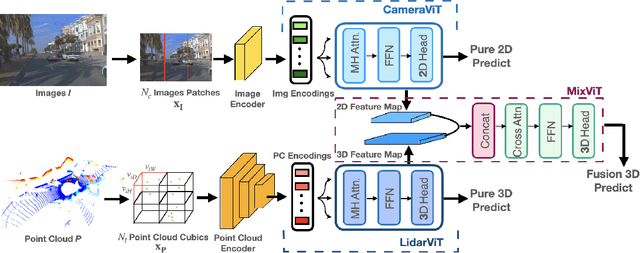
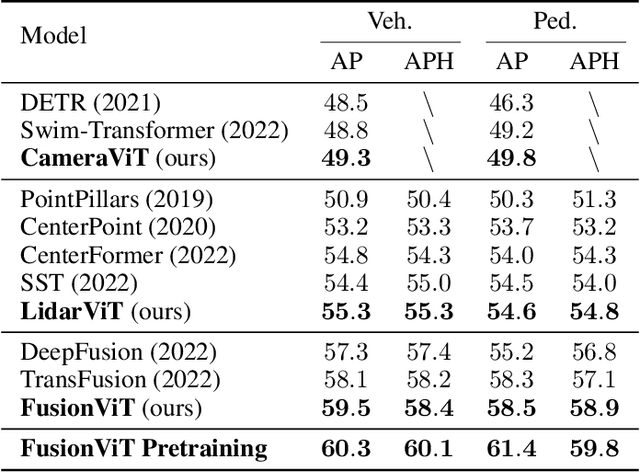
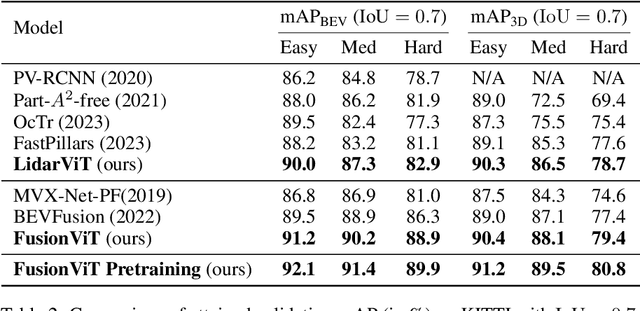
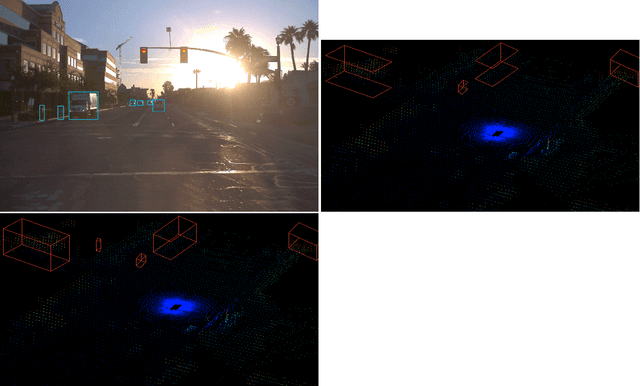
For 3D object detection, both camera and lidar have been demonstrated to be useful sensory devices for providing complementary information about the same scenery with data representations in different modalities, e.g., 2D RGB image vs 3D point cloud. An effective representation learning and fusion of such multi-modal sensor data is necessary and critical for better 3D object detection performance. To solve the problem, in this paper, we will introduce a novel vision transformer-based 3D object detection model, namely FusionViT. Different from the existing 3D object detection approaches, FusionViT is a pure-ViT based framework, which adopts a hierarchical architecture by extending the transformer model to embed both images and point clouds for effective representation learning. Such multi-modal data embedding representations will be further fused together via a fusion vision transformer model prior to feeding the learned features to the object detection head for both detection and localization of the 3D objects in the input scenery. To demonstrate the effectiveness of FusionViT, extensive experiments have been done on real-world traffic object detection benchmark datasets KITTI and Waymo Open. Notably, our FusionViT model can achieve state-of-the-art performance and outperforms not only the existing baseline methods that merely rely on camera images or lidar point clouds, but also the latest multi-modal image-point cloud deep fusion approaches.