 Add to Chrome
 Add to Firefox
 Add to Edge
Improving Retrieval in Theme-specific Applications using a Corpus Topical Taxonomy
Mar 07, 2024
Document retrieval has greatly benefited from the advancements of large-scale pre-trained language models (PLMs). However, their effectiveness is often limited in theme-specific applications for specialized areas or industries, due to unique terminologies, incomplete contexts of user queries, and specialized search intents. To capture the theme-specific information and improve retrieval, we propose to use a corpus topical taxonomy, which outlines the latent topic structure of the corpus while reflecting user-interested aspects. We introduce ToTER (Topical Taxonomy Enhanced Retrieval) framework, which identifies the central topics of queries and documents with the guidance of the taxonomy, and exploits their topical relatedness to supplement missing contexts. As a plug-and-play framework, ToTER can be flexibly employed to enhance various PLM-based retrievers. Through extensive quantitative, ablative, and exploratory experiments on two real-world datasets, we ascertain the benefits of using topical taxonomy for retrieval in theme-specific applications and demonstrate the effectiveness of ToTER.

TELEClass: Taxonomy Enrichment and LLM-Enhanced Hierarchical Text Classification with Minimal Supervision
Feb 29, 2024
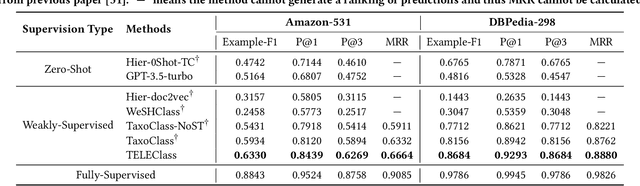


Hierarchical text classification aims to categorize each document into a set of classes in a label taxonomy. Most earlier works focus on fully or semi-supervised methods that require a large amount of human annotated data which is costly and time-consuming to acquire. To alleviate human efforts, in this paper, we work on hierarchical text classification with the minimal amount of supervision: using the sole class name of each node as the only supervision. Recently, large language models (LLM) show competitive performance on various tasks through zero-shot prompting, but this method performs poorly in the hierarchical setting, because it is ineffective to include the large and structured label space in a prompt. On the other hand, previous weakly-supervised hierarchical text classification methods only utilize the raw taxonomy skeleton and ignore the rich information hidden in the text corpus that can serve as additional class-indicative features. To tackle the above challenges, we propose TELEClass, Taxonomy Enrichment and LLM-Enhanced weakly-supervised hierarchical text classification, which (1) automatically enriches the label taxonomy with class-indicative topical terms mined from the corpus to facilitate classifier training and (2) utilizes LLMs for both data annotation and creation tailored for the hierarchical label space. Experiments show that TELEClass can outperform previous weakly-supervised hierarchical text classification methods and LLM-based zero-shot prompting methods on two public datasets.
Multi-LoRA Composition for Image Generation
Feb 26, 2024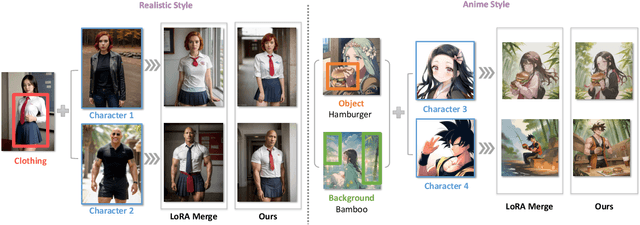
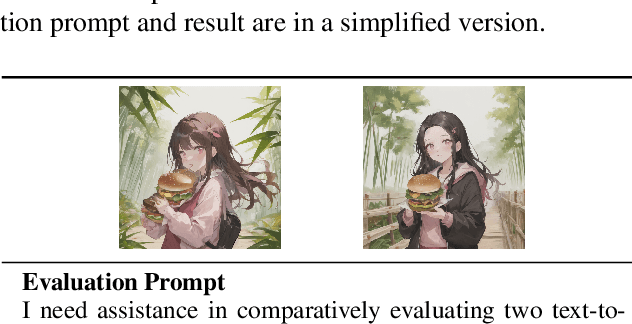

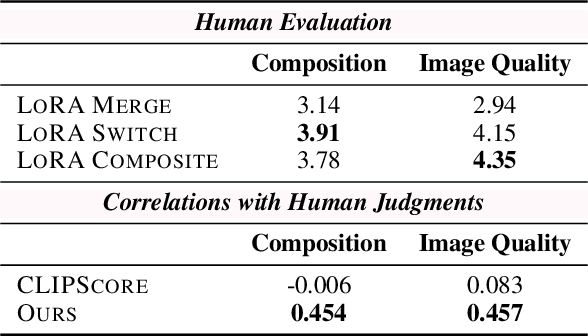
Low-Rank Adaptation (LoRA) is extensively utilized in text-to-image models for the accurate rendition of specific elements like distinct characters or unique styles in generated images. Nonetheless, existing methods face challenges in effectively composing multiple LoRAs, especially as the number of LoRAs to be integrated grows, thus hindering the creation of complex imagery. In this paper, we study multi-LoRA composition through a decoding-centric perspective. We present two training-free methods: LoRA Switch, which alternates between different LoRAs at each denoising step, and LoRA Composite, which simultaneously incorporates all LoRAs to guide more cohesive image synthesis. To evaluate the proposed approaches, we establish ComposLoRA, a new comprehensive testbed as part of this research. It features a diverse range of LoRA categories with 480 composition sets. Utilizing an evaluation framework based on GPT-4V, our findings demonstrate a clear improvement in performance with our methods over the prevalent baseline, particularly evident when increasing the number of LoRAs in a composition.
A Unified Taxonomy-Guided Instruction Tuning Framework for Entity Set Expansion and Taxonomy Expansion
Feb 20, 2024Entity Set Expansion, Taxonomy Expansion, and Seed-Guided Taxonomy Construction are three representative tasks that can be used to automatically populate an existing taxonomy with new entities. However, previous approaches often address these tasks separately with heterogeneous techniques, lacking a unified perspective. To tackle this issue, in this paper, we identify the common key skills needed for these tasks from the view of taxonomy structures -- finding 'siblings' and finding 'parents' -- and propose a unified taxonomy-guided instruction tuning framework to jointly solve the three tasks. To be specific, by leveraging the existing taxonomy as a rich source of entity relationships, we utilize instruction tuning to fine-tune a large language model to generate parent and sibling entities. Extensive experiments on multiple benchmark datasets demonstrate the effectiveness of TaxoInstruct, which outperforms task-specific baselines across all three tasks.
Grasping the Essentials: Tailoring Large Language Models for Zero-Shot Relation Extraction
Feb 17, 2024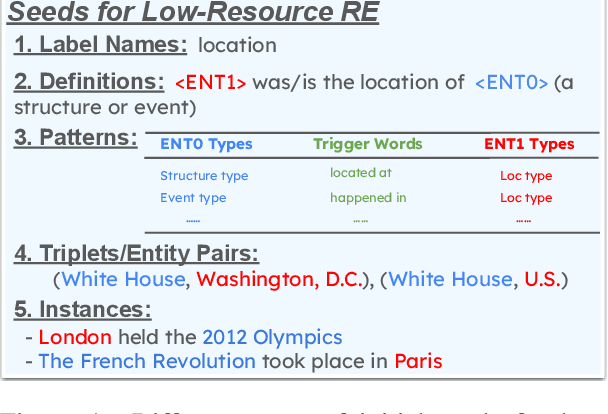
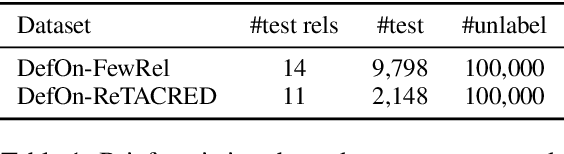
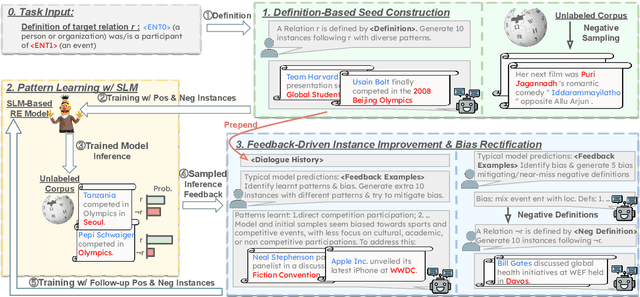
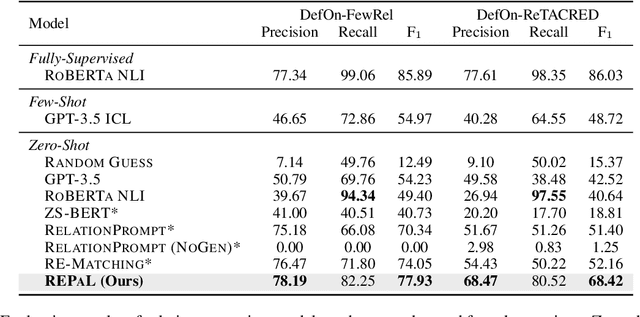
Relation extraction (RE), a crucial task in NLP, aims to identify semantic relationships between entities mentioned in texts. Despite significant advancements in this field, existing models typically rely on extensive annotated data for training, which can be both costly and time-consuming to acquire. Moreover, these models often struggle to adapt to new or unseen relationships. In contrast, few-shot learning settings, which aim to reduce annotation requirements, may offer incomplete and biased supervision for understanding target relation semantics, leading to degraded and unstable performance. To provide the model with accurate and explicit descriptions of the relations types and meanwhile minimize the annotation requirements, we study the definition only zero-shot RE setting where only relation definitions expressed in natural language are used to train a RE model. Motivated by the strong synthetic data generation power of LLMs, we propose a framework REPaL which consists of three stages: (1) We utilize LLMs to generate initial seed instances based on relation definitions and an unlabeled corpora. (2) We fine-tune a bidirectional Small Language Model (SLM) using these initial seeds to learn the relations for the target domain. (3) We enhance pattern coverage and mitigate bias resulting from the limited number of initial seeds by incorporating feedback acquired from SLM's predictions on unlabeled corpora. To accomplish this, we leverage the multi-turn conversation ability of LLMs to generate new instances in follow-up dialogues. Experiments on two datasets show REPaL achieves better zero-shot performance with large margins over baseline methods.
GenRES: Rethinking Evaluation for Generative Relation Extraction in the Era of Large Language Models
Feb 16, 2024
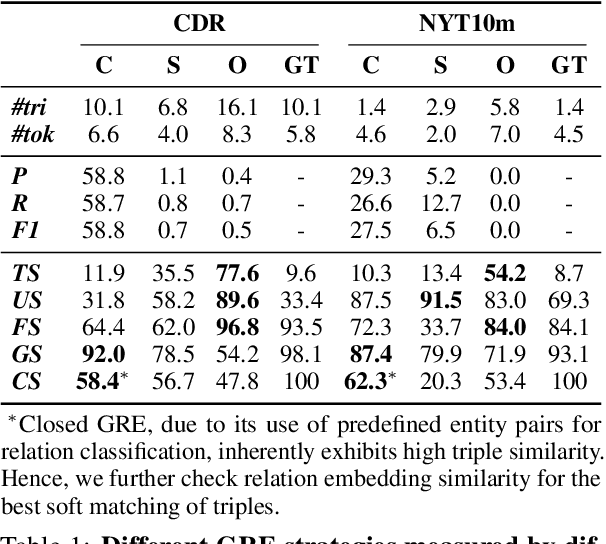

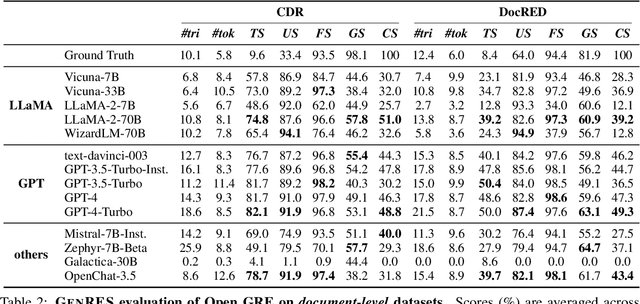
The field of relation extraction (RE) is experiencing a notable shift towards generative relation extraction (GRE), leveraging the capabilities of large language models (LLMs). However, we discovered that traditional relation extraction (RE) metrics like precision and recall fall short in evaluating GRE methods. This shortfall arises because these metrics rely on exact matching with human-annotated reference relations, while GRE methods often produce diverse and semantically accurate relations that differ from the references. To fill this gap, we introduce GenRES for a multi-dimensional assessment in terms of the topic similarity, uniqueness, granularity, factualness, and completeness of the GRE results. With GenRES, we empirically identified that (1) precision/recall fails to justify the performance of GRE methods; (2) human-annotated referential relations can be incomplete; (3) prompting LLMs with a fixed set of relations or entities can cause hallucinations. Next, we conducted a human evaluation of GRE methods that shows GenRES is consistent with human preferences for RE quality. Last, we made a comprehensive evaluation of fourteen leading LLMs using GenRES across document, bag, and sentence level RE datasets, respectively, to set the benchmark for future research in GRE
Similarity-based Neighbor Selection for Graph LLMs
Feb 06, 2024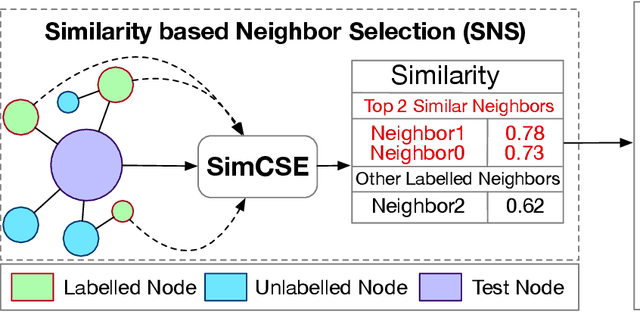

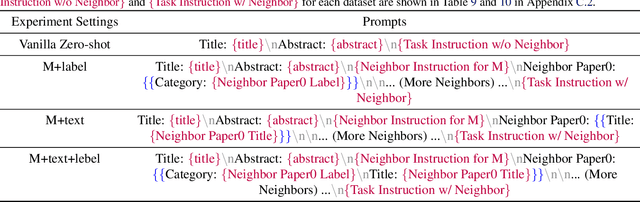
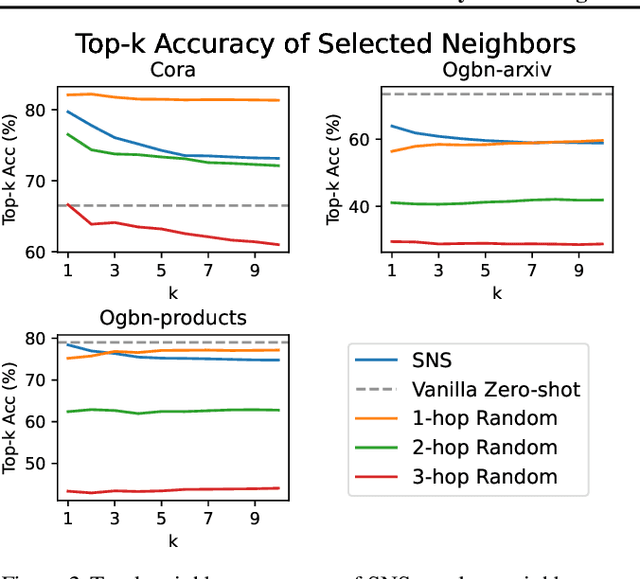
Text-attributed graphs (TAGs) present unique challenges for direct processing by Language Learning Models (LLMs), yet their extensive commonsense knowledge and robust reasoning capabilities offer great promise for node classification in TAGs. Prior research in this field has grappled with issues such as over-squashing, heterophily, and ineffective graph information integration, further compounded by inconsistencies in dataset partitioning and underutilization of advanced LLMs. To address these challenges, we introduce Similarity-based Neighbor Selection (SNS). Using SimCSE and advanced neighbor selection techniques, SNS effectively improves the quality of selected neighbors, thereby improving graph representation and alleviating issues like over-squashing and heterophily. Besides, as an inductive and training-free approach, SNS demonstrates superior generalization and scalability over traditional GNN methods. Our comprehensive experiments, adhering to standard dataset partitioning practices, demonstrate that SNS, through simple prompt interactions with LLMs, consistently outperforms vanilla GNNs and achieves state-of-the-art results on datasets like PubMed in node classification, showcasing LLMs' potential in graph structure understanding. Our research further underscores the significance of graph structure integration in LLM applications and identifies key factors for their success in node classification. Code is available at https://github.com/ruili33/SNS.
TrustLLM: Trustworthiness in Large Language Models
Jan 25, 2024
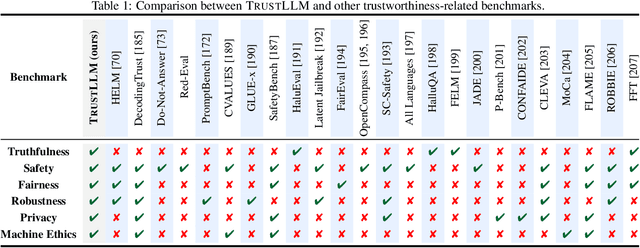
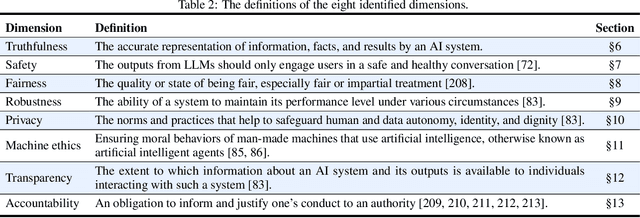

Large language models (LLMs), exemplified by ChatGPT, have gained considerable attention for their excellent natural language processing capabilities. Nonetheless, these LLMs present many challenges, particularly in the realm of trustworthiness. Therefore, ensuring the trustworthiness of LLMs emerges as an important topic. This paper introduces TrustLLM, a comprehensive study of trustworthiness in LLMs, including principles for different dimensions of trustworthiness, established benchmark, evaluation, and analysis of trustworthiness for mainstream LLMs, and discussion of open challenges and future directions. Specifically, we first propose a set of principles for trustworthy LLMs that span eight different dimensions. Based on these principles, we further establish a benchmark across six dimensions including truthfulness, safety, fairness, robustness, privacy, and machine ethics. We then present a study evaluating 16 mainstream LLMs in TrustLLM, consisting of over 30 datasets. Our findings firstly show that in general trustworthiness and utility (i.e., functional effectiveness) are positively related. Secondly, our observations reveal that proprietary LLMs generally outperform most open-source counterparts in terms of trustworthiness, raising concerns about the potential risks of widely accessible open-source LLMs. However, a few open-source LLMs come very close to proprietary ones. Thirdly, it is important to note that some LLMs may be overly calibrated towards exhibiting trustworthiness, to the extent that they compromise their utility by mistakenly treating benign prompts as harmful and consequently not responding. Finally, we emphasize the importance of ensuring transparency not only in the models themselves but also in the technologies that underpin trustworthiness. Knowing the specific trustworthy technologies that have been employed is crucial for analyzing their effectiveness.
Chem-FINESE: Validating Fine-Grained Few-shot Entity Extraction through Text Reconstruction
Jan 25, 2024Fine-grained few-shot entity extraction in the chemical domain faces two unique challenges. First, compared with entity extraction tasks in the general domain, sentences from chemical papers usually contain more entities. Moreover, entity extraction models usually have difficulty extracting entities of long-tailed types. In this paper, we propose Chem-FINESE, a novel sequence-to-sequence (seq2seq) based few-shot entity extraction approach, to address these two challenges. Our Chem-FINESE has two components: a seq2seq entity extractor to extract named entities from the input sentence and a seq2seq self-validation module to reconstruct the original input sentence from extracted entities. Inspired by the fact that a good entity extraction system needs to extract entities faithfully, our new self-validation module leverages entity extraction results to reconstruct the original input sentence. Besides, we design a new contrastive loss to reduce excessive copying during the extraction process. Finally, we release ChemNER+, a new fine-grained chemical entity extraction dataset that is annotated by domain experts with the ChemNER schema. Experiments in few-shot settings with both ChemNER+ and CHEMET datasets show that our newly proposed framework has contributed up to 8.26% and 6.84% absolute F1-score gains respectively.
Seed-Guided Fine-Grained Entity Typing in Science and Engineering Domains
Jan 23, 2024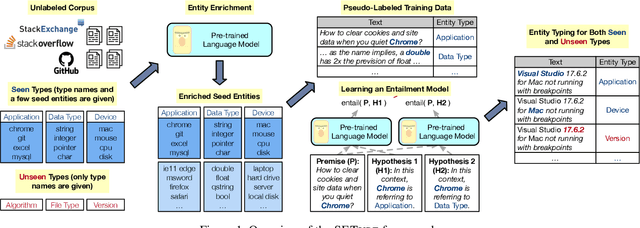
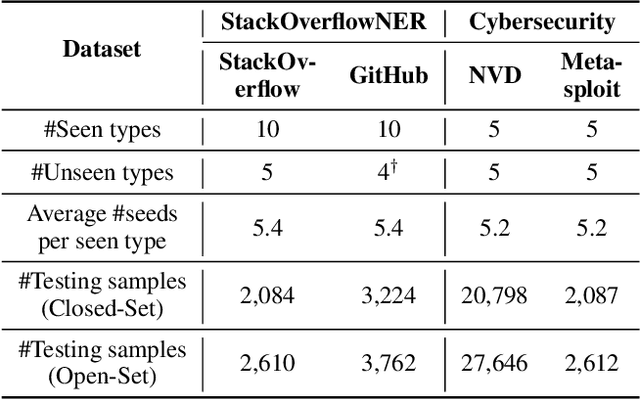
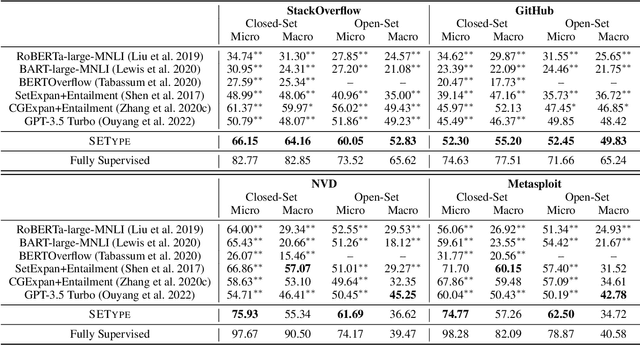
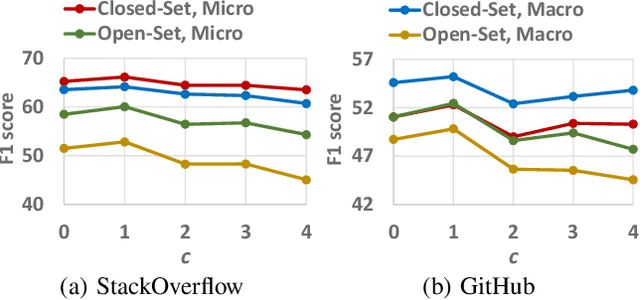
Accurately typing entity mentions from text segments is a fundamental task for various natural language processing applications. Many previous approaches rely on massive human-annotated data to perform entity typing. Nevertheless, collecting such data in highly specialized science and engineering domains (e.g., software engineering and security) can be time-consuming and costly, without mentioning the domain gaps between training and inference data if the model needs to be applied to confidential datasets. In this paper, we study the task of seed-guided fine-grained entity typing in science and engineering domains, which takes the name and a few seed entities for each entity type as the only supervision and aims to classify new entity mentions into both seen and unseen types (i.e., those without seed entities). To solve this problem, we propose SEType which first enriches the weak supervision by finding more entities for each seen type from an unlabeled corpus using the contextualized representations of pre-trained language models. It then matches the enriched entities to unlabeled text to get pseudo-labeled samples and trains a textual entailment model that can make inferences for both seen and unseen types. Extensive experiments on two datasets covering four domains demonstrate the effectiveness of SEType in comparison with various baselines.