 Add to Chrome
 Add to Firefox
 Add to Edge
Beyond Dense Futures: World Models as Structured Planners for Robotic Manipulation
Mar 13, 2026
Recent world-model-based Vision-Language-Action (VLA) architectures have improved robotic manipulation through predictive visual foresight. However, dense future prediction introduces visual redundancy and accumulates errors, causing long-horizon plan drift. Meanwhile, recent sparse methods typically represent visual foresight using high-level semantic subtasks or implicit latent states. These representations often lack explicit kinematic grounding, weakening the alignment between planning and low-level execution. To address this, we propose StructVLA, which reformulates a generative world model into an explicit structured planner for reliable control. Instead of dense rollouts or semantic goals, StructVLA predicts sparse, physically meaningful structured frames. Derived from intrinsic kinematic cues (e.g., gripper transitions and kinematic turning points), these frames capture spatiotemporal milestones closely aligned with task progress. We implement this approach through a two-stage training paradigm with a unified discrete token vocabulary: the world model is first trained to predict structured frames and subsequently optimized to map the structured foresight into low-level actions. This approach provides clear physical guidance and bridges visual planning and motion control. In our experiments, StructVLA achieves strong average success rates of 75.0% on SimplerEnv-WidowX and 94.8% on LIBERO. Real-world deployments further demonstrate reliable task completion and robust generalization across both basic pick-and-place and complex long-horizon tasks.

CogACT: A Foundational Vision-Language-Action Model for Synergizing Cognition and Action in Robotic Manipulation
Nov 29, 2024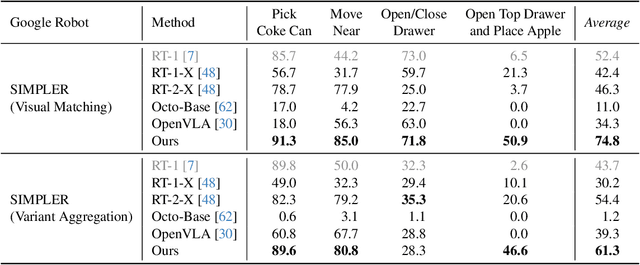

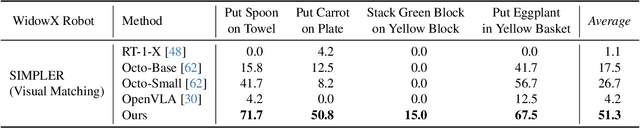

The advancement of large Vision-Language-Action (VLA) models has significantly improved robotic manipulation in terms of language-guided task execution and generalization to unseen scenarios. While existing VLAs adapted from pretrained large Vision-Language-Models (VLM) have demonstrated promising generalizability, their task performance is still unsatisfactory as indicated by the low tasks success rates in different environments. In this paper, we present a new advanced VLA architecture derived from VLM. Unlike previous works that directly repurpose VLM for action prediction by simple action quantization, we propose a omponentized VLA architecture that has a specialized action module conditioned on VLM output. We systematically study the design of the action module and demonstrates the strong performance enhancement with diffusion action transformers for action sequence modeling, as well as their favorable scaling behaviors. We also conduct comprehensive experiments and ablation studies to evaluate the efficacy of our models with varied designs. The evaluation on 5 robot embodiments in simulation and real work shows that our model not only significantly surpasses existing VLAs in task performance and but also exhibits remarkable adaptation to new robots and generalization to unseen objects and backgrounds. It exceeds the average success rates of OpenVLA which has similar model size (7B) with ours by over 35% in simulated evaluation and 55% in real robot experiments. It also outperforms the large RT-2-X model (55B) by 18% absolute success rates in simulation. Code and models can be found on our project page (https://cogact.github.io/).