 Add to Chrome
 Add to Firefox
 Add to Edge
A Continuous-Time Ensemble Kalman-Bucy Smoother for Causal Inference and Model Discovery
Apr 28, 2026
Data assimilation (DA) integrates observational information with model predictions to improve state estimation in complex systems. While filtering provides the basis for online forecasts by using only past and present observations, it can exhibit delays and biases when the underlying dynamics evolve rapidly or undergo regime transitions. Smoothing, which additionally incorporates future observations, provides a natural pipeline for hindcasting and reanalysis that yields an uncertainty reduction beyond the filter. This paper introduces an ensemble Kalman-Bucy smoother (EnKBS) for continuous-time DA of nonlinear dynamical systems, where the smoother's conditional distributions are reconstructed using ensemble moments. The result is a derivative-free framework that does not require explicit computation of tangent-linear or adjoint models, which converges to the exact smoother solution at the infinite-ensemble limit for a wide class of complex systems. Incorporating standard regularization techniques for high-dimensional systems, such as covariance localization and inflation, the skill of the EnKBS is demonstrated in various important scientific problems. By integrating future observations, which reveal the underlying causal mechanisms for retrospective state updates, the EnKBS is used for Bayesian-based inference of causal relationships and their temporal influence range in a dyadic trigger-feedback model and the development of a causality-driven iterative learning algorithm that identifies the structure and recovers the hidden parameters of a nonlinear reduced-order model mimicking midlatitude atmospheric circulation. Notably, both tasks remain effective with an ensemble size of $O(10)$ under partial observations, suggesting that EnKBS can support the instantaneous discovery of high-dimensional complex systems over time.

Non-Contact Health Monitoring During Daily Personal Care Routines
Jun 11, 2025Remote photoplethysmography (rPPG) enables non-contact, continuous monitoring of physiological signals and offers a practical alternative to traditional health sensing methods. Although rPPG is promising for daily health monitoring, its application in long-term personal care scenarios, such as mirror-facing routines in high-altitude environments, remains challenging due to ambient lighting variations, frequent occlusions from hand movements, and dynamic facial postures. To address these challenges, we present LADH (Long-term Altitude Daily Health), the first long-term rPPG dataset containing 240 synchronized RGB and infrared (IR) facial videos from 21 participants across five common personal care scenarios, along with ground-truth PPG, respiration, and blood oxygen signals. Our experiments demonstrate that combining RGB and IR video inputs improves the accuracy and robustness of non-contact physiological monitoring, achieving a mean absolute error (MAE) of 4.99 BPM in heart rate estimation. Furthermore, we find that multi-task learning enhances performance across multiple physiological indicators simultaneously. Dataset and code are open at https://github.com/McJackTang/FusionVitals.
Summit Vitals: Multi-Camera and Multi-Signal Biosensing at High Altitudes
Sep 28, 2024Video photoplethysmography (vPPG) is an emerging method for non-invasive and convenient measurement of physiological signals, utilizing two primary approaches: remote video PPG (rPPG) and contact video PPG (cPPG). Monitoring vitals in high-altitude environments, where heart rates tend to increase and blood oxygen levels often decrease, presents significant challenges. To address these issues, we introduce the SUMS dataset comprising 80 synchronized non-contact facial and contact finger videos from 10 subjects during exercise and oxygen recovery scenarios, capturing PPG, respiration rate (RR), and SpO2. This dataset is designed to validate video vitals estimation algorithms and compare facial rPPG with finger cPPG. Additionally, fusing videos from different positions (i.e., face and finger) reduces the mean absolute error (MAE) of SpO2 predictions by 7.6\% and 10.6\% compared to only face and only finger, respectively. In cross-subject evaluation, we achieve an MAE of less than 0.5 BPM for HR estimation and 2.5\% for SpO2 estimation, demonstrating the precision of our multi-camera fusion techniques. Our findings suggest that simultaneous training on multiple indicators, such as PPG and blood oxygen, can reduce MAE in SpO2 estimation by 17.8\%.
Emergence and Causality in Complex Systems: A Survey on Causal Emergence and Related Quantitative Studies
Dec 28, 2023Emergence and causality are two fundamental concepts for understanding complex systems. They are interconnected. On one hand, emergence refers to the phenomenon where macroscopic properties cannot be solely attributed to the cause of individual properties. On the other hand, causality can exhibit emergence, meaning that new causal laws may arise as we increase the level of abstraction. Causal emergence theory aims to bridge these two concepts and even employs measures of causality to quantify emergence. This paper provides a comprehensive review of recent advancements in quantitative theories and applications of causal emergence. Two key problems are addressed: quantifying causal emergence and identifying it in data. Addressing the latter requires the use of machine learning techniques, thus establishing a connection between causal emergence and artificial intelligence. We highlighted that the architectures used for identifying causal emergence are shared by causal representation learning, causal model abstraction, and world model-based reinforcement learning. Consequently, progress in any of these areas can benefit the others. Potential applications and future perspectives are also discussed in the final section of the review.
Learning to learn with quantum neural networks via classical neural networks
Jul 11, 2019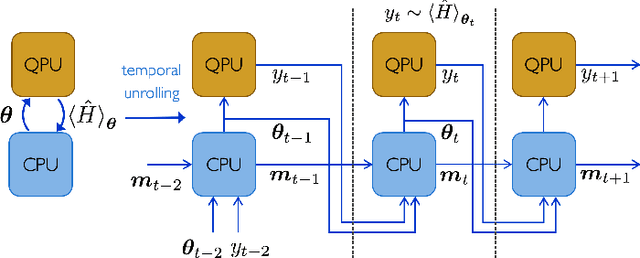
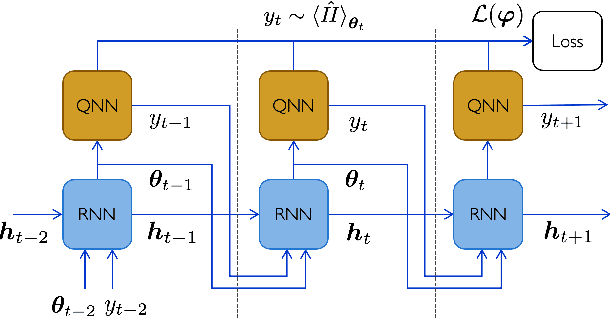
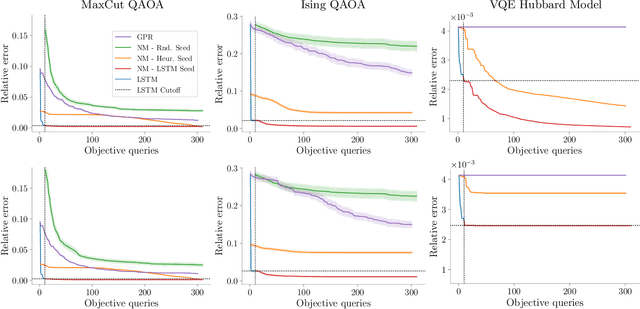
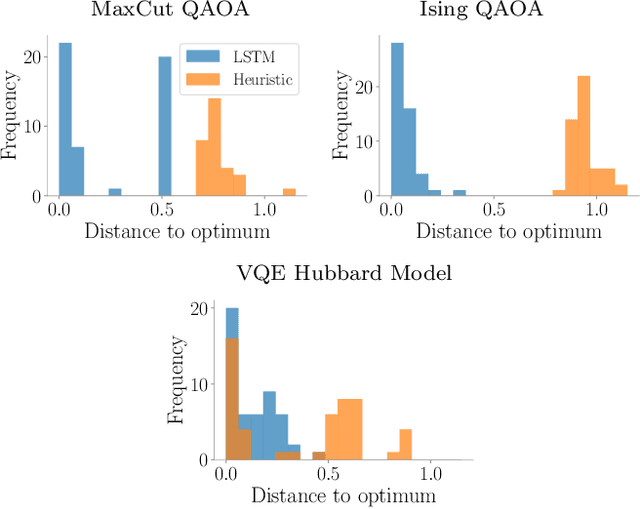
Quantum Neural Networks (QNNs) are a promising variational learning paradigm with applications to near-term quantum processors, however they still face some significant challenges. One such challenge is finding good parameter initialization heuristics that ensure rapid and consistent convergence to local minima of the parameterized quantum circuit landscape. In this work, we train classical neural networks to assist in the quantum learning process, also know as meta-learning, to rapidly find approximate optima in the parameter landscape for several classes of quantum variational algorithms. Specifically, we train classical recurrent neural networks to find approximately optimal parameters within a small number of queries of the cost function for the Quantum Approximate Optimization Algorithm (QAOA) for MaxCut, QAOA for Sherrington-Kirkpatrick Ising model, and for a Variational Quantum Eigensolver for the Hubbard model. By initializing other optimizers at parameter values suggested by the classical neural network, we demonstrate a significant improvement in the total number of optimization iterations required to reach a given accuracy. We further demonstrate that the optimization strategies learned by the neural network generalize well across a range of problem instance sizes. This opens up the possibility of training on small, classically simulatable problem instances, in order to initialize larger, classically intractably simulatable problem instances on quantum devices, thereby significantly reducing the number of required quantum-classical optimization iterations.