 Add to Chrome
 Add to Firefox
 Add to Edge
RADAP: A Robust and Adaptive Defense Against Diverse Adversarial Patches on Face Recognition
Nov 29, 2023
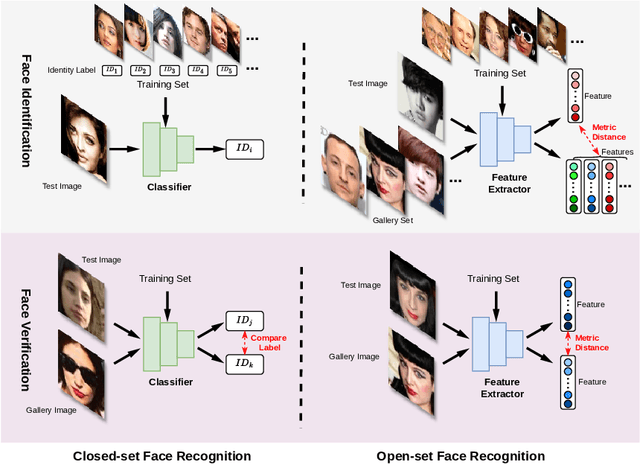
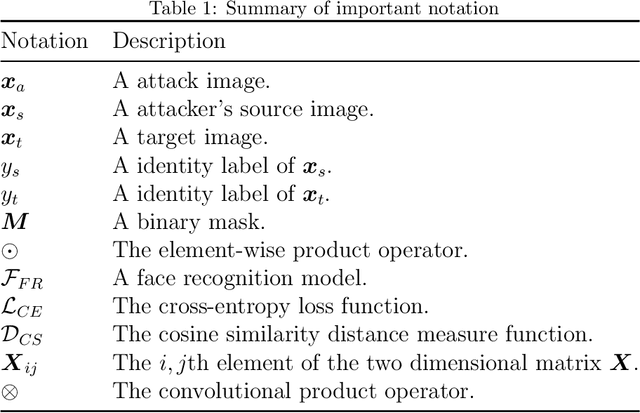
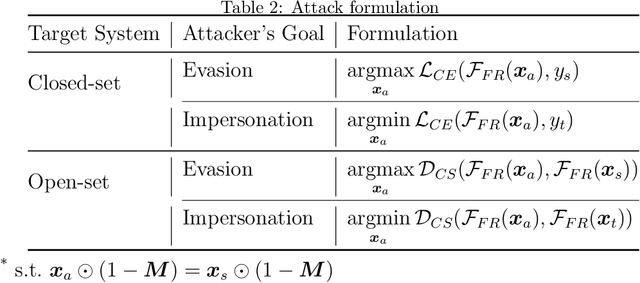
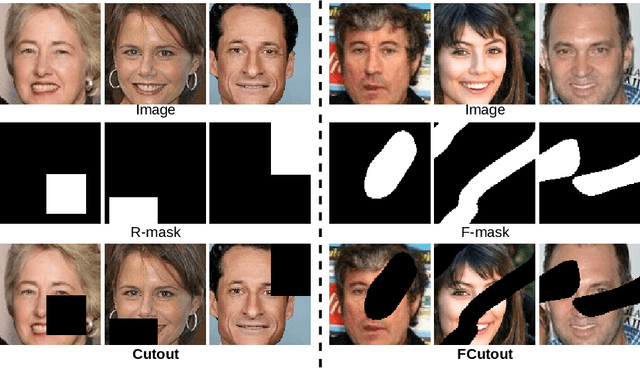
Face recognition (FR) systems powered by deep learning have become widely used in various applications. However, they are vulnerable to adversarial attacks, especially those based on local adversarial patches that can be physically applied to real-world objects. In this paper, we propose RADAP, a robust and adaptive defense mechanism against diverse adversarial patches in both closed-set and open-set FR systems. RADAP employs innovative techniques, such as FCutout and F-patch, which use Fourier space sampling masks to improve the occlusion robustness of the FR model and the performance of the patch segmenter. Moreover, we introduce an edge-aware binary cross-entropy (EBCE) loss function to enhance the accuracy of patch detection. We also present the split and fill (SAF) strategy, which is designed to counter the vulnerability of the patch segmenter to complete white-box adaptive attacks. We conduct comprehensive experiments to validate the effectiveness of RADAP, which shows significant improvements in defense performance against various adversarial patches, while maintaining clean accuracy higher than that of the undefended Vanilla model.

NeRFTAP: Enhancing Transferability of Adversarial Patches on Face Recognition using Neural Radiance Fields
Nov 29, 2023Face recognition (FR) technology plays a crucial role in various applications, but its vulnerability to adversarial attacks poses significant security concerns. Existing research primarily focuses on transferability to different FR models, overlooking the direct transferability to victim's face images, which is a practical threat in real-world scenarios. In this study, we propose a novel adversarial attack method that considers both the transferability to the FR model and the victim's face image, called NeRFTAP. Leveraging NeRF-based 3D-GAN, we generate new view face images for the source and target subjects to enhance transferability of adversarial patches. We introduce a style consistency loss to ensure the visual similarity between the adversarial UV map and the target UV map under a 0-1 mask, enhancing the effectiveness and naturalness of the generated adversarial face images. Extensive experiments and evaluations on various FR models demonstrate the superiority of our approach over existing attack techniques. Our work provides valuable insights for enhancing the robustness of FR systems in practical adversarial settings.
A Simple Geometric-Aware Indoor Positioning Interpolation Algorithm Based on Manifold Learning
Nov 27, 2023Interpolation methodologies have been widely used within the domain of indoor positioning systems. However, existing indoor positioning interpolation algorithms exhibit several inherent limitations, including reliance on complex mathematical models, limited flexibility, and relatively low precision. To enhance the accuracy and efficiency of indoor positioning interpolation techniques, this paper proposes a simple yet powerful geometric-aware interpolation algorithm for indoor positioning tasks. The key to our algorithm is to exploit the geometric attributes of the local topological manifold using manifold learning principles. Therefore, instead of constructing complicated mathematical models, the proposed algorithm facilitates the more precise and efficient estimation of points grounded in the local topological manifold. Moreover, our proposed method can be effortlessly integrated into any indoor positioning system, thereby bolstering its adaptability. Through a systematic array of experiments and comprehensive performance analyses conducted on both simulated and real-world datasets, we demonstrate that the proposed algorithm consistently outperforms the most commonly used and representative interpolation approaches regarding interpolation accuracy and efficiency. Furthermore, the experimental results also underscore the substantial practical utility of our method and its potential applicability in real-time indoor positioning scenarios.
Panda or not Panda? Understanding Adversarial Attacks with Interactive Visualization
Nov 22, 2023Adversarial machine learning (AML) studies attacks that can fool machine learning algorithms into generating incorrect outcomes as well as the defenses against worst-case attacks to strengthen model robustness. Specifically for image classification, it is challenging to understand adversarial attacks due to their use of subtle perturbations that are not human-interpretable, as well as the variability of attack impacts influenced by diverse methodologies, instance differences, and model architectures. Through a design study with AML learners and teachers, we introduce AdvEx, a multi-level interactive visualization system that comprehensively presents the properties and impacts of evasion attacks on different image classifiers for novice AML learners. We quantitatively and qualitatively assessed AdvEx in a two-part evaluation including user studies and expert interviews. Our results show that AdvEx is not only highly effective as a visualization tool for understanding AML mechanisms, but also provides an engaging and enjoyable learning experience, thus demonstrating its overall benefits for AML learners.
UniParser: Multi-Human Parsing with Unified Correlation Representation Learning
Oct 13, 2023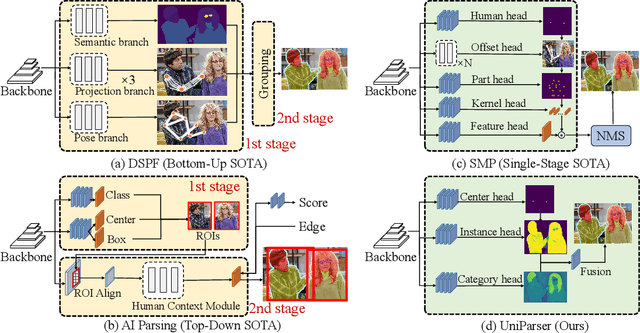

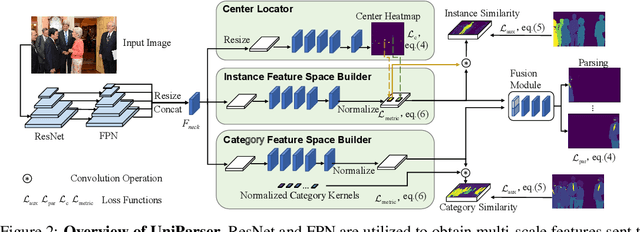
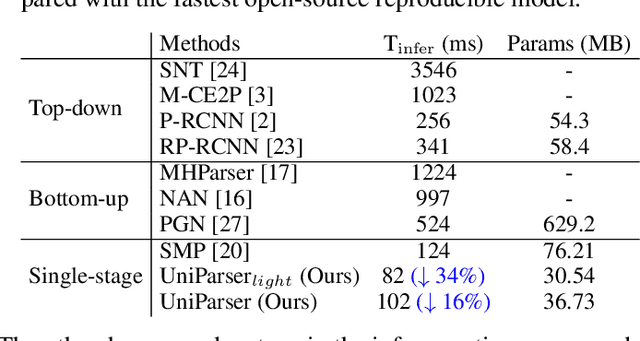
Multi-human parsing is an image segmentation task necessitating both instance-level and fine-grained category-level information. However, prior research has typically processed these two types of information through separate branches and distinct output formats, leading to inefficient and redundant frameworks. This paper introduces UniParser, which integrates instance-level and category-level representations in three key aspects: 1) we propose a unified correlation representation learning approach, allowing our network to learn instance and category features within the cosine space; 2) we unify the form of outputs of each modules as pixel-level segmentation results while supervising instance and category features using a homogeneous label accompanied by an auxiliary loss; and 3) we design a joint optimization procedure to fuse instance and category representations. By virtual of unifying instance-level and category-level output, UniParser circumvents manually designed post-processing techniques and surpasses state-of-the-art methods, achieving 49.3% AP on MHPv2.0 and 60.4% AP on CIHP. We will release our source code, pretrained models, and online demos to facilitate future studies.
Adversarial Attacks on Video Object Segmentation with Hard Region Discovery
Sep 25, 2023Video object segmentation has been applied to various computer vision tasks, such as video editing, autonomous driving, and human-robot interaction. However, the methods based on deep neural networks are vulnerable to adversarial examples, which are the inputs attacked by almost human-imperceptible perturbations, and the adversary (i.e., attacker) will fool the segmentation model to make incorrect pixel-level predictions. This will rise the security issues in highly-demanding tasks because small perturbations to the input video will result in potential attack risks. Though adversarial examples have been extensively used for classification, it is rarely studied in video object segmentation. Existing related methods in computer vision either require prior knowledge of categories or cannot be directly applied due to the special design for certain tasks, failing to consider the pixel-wise region attack. Hence, this work develops an object-agnostic adversary that has adversarial impacts on VOS by first-frame attacking via hard region discovery. Particularly, the gradients from the segmentation model are exploited to discover the easily confused region, in which it is difficult to identify the pixel-wise objects from the background in a frame. This provides a hardness map that helps to generate perturbations with a stronger adversarial power for attacking the first frame. Empirical studies on three benchmarks indicate that our attacker significantly degrades the performance of several state-of-the-art video object segmentation models.
3D Implicit Transporter for Temporally Consistent Keypoint Discovery
Sep 10, 2023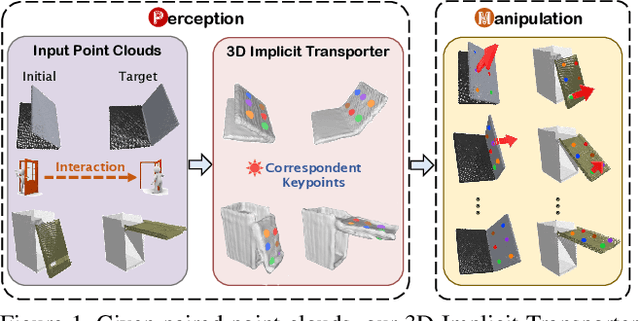
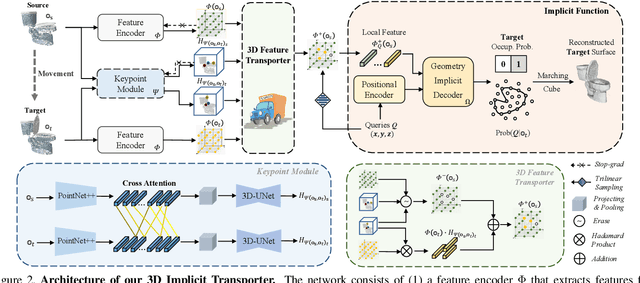
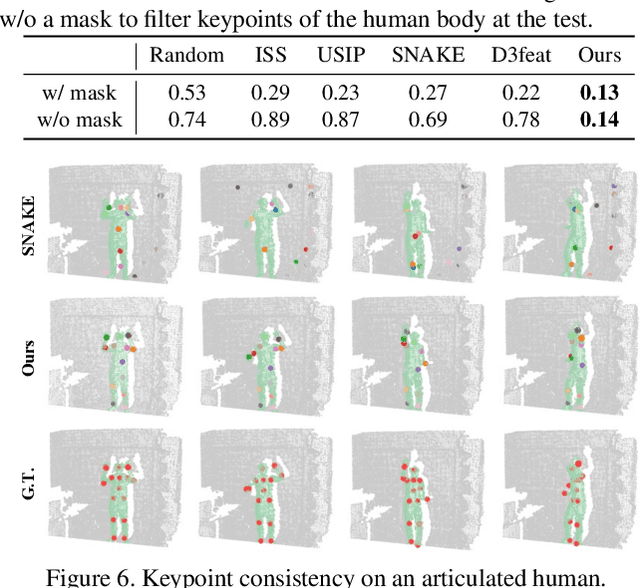
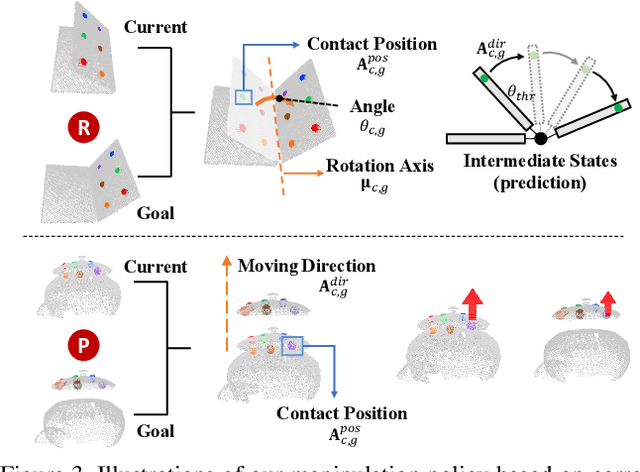
Keypoint-based representation has proven advantageous in various visual and robotic tasks. However, the existing 2D and 3D methods for detecting keypoints mainly rely on geometric consistency to achieve spatial alignment, neglecting temporal consistency. To address this issue, the Transporter method was introduced for 2D data, which reconstructs the target frame from the source frame to incorporate both spatial and temporal information. However, the direct application of the Transporter to 3D point clouds is infeasible due to their structural differences from 2D images. Thus, we propose the first 3D version of the Transporter, which leverages hybrid 3D representation, cross attention, and implicit reconstruction. We apply this new learning system on 3D articulated objects and nonrigid animals (humans and rodents) and show that learned keypoints are spatio-temporally consistent. Additionally, we propose a closed-loop control strategy that utilizes the learned keypoints for 3D object manipulation and demonstrate its superior performance. Codes are available at https://github.com/zhongcl-thu/3D-Implicit-Transporter.
Uncovering the Unseen: Discover Hidden Intentions by Micro-Behavior Graph Reasoning
Aug 29, 2023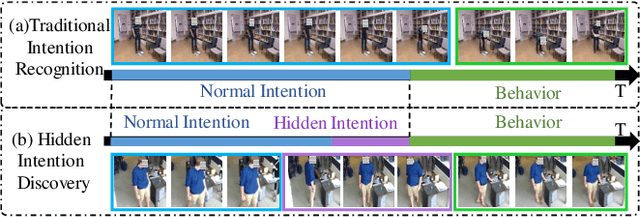
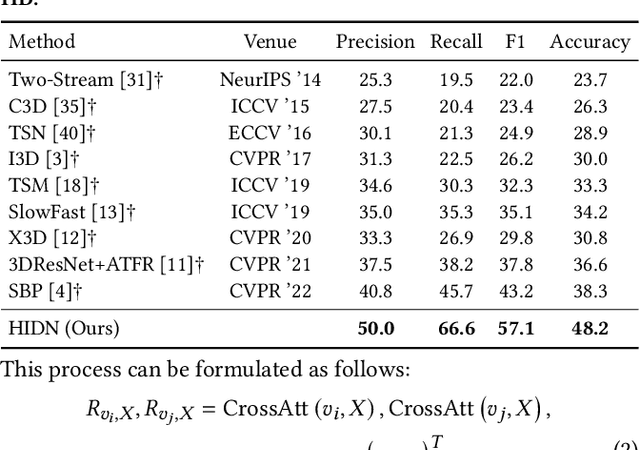
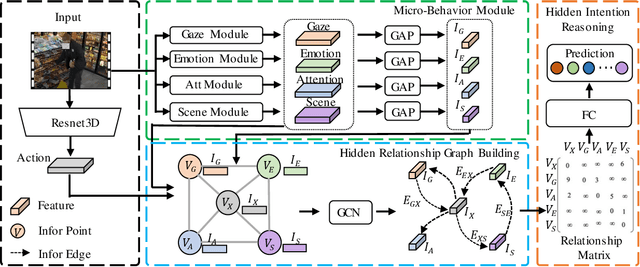
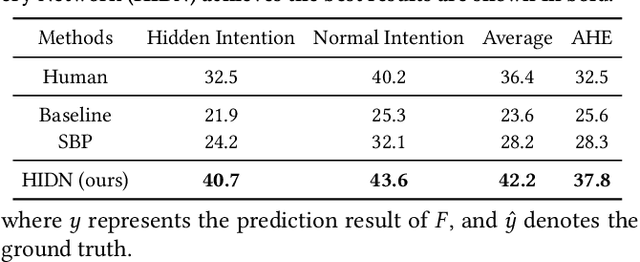
This paper introduces a new and challenging Hidden Intention Discovery (HID) task. Unlike existing intention recognition tasks, which are based on obvious visual representations to identify common intentions for normal behavior, HID focuses on discovering hidden intentions when humans try to hide their intentions for abnormal behavior. HID presents a unique challenge in that hidden intentions lack the obvious visual representations to distinguish them from normal intentions. Fortunately, from a sociological and psychological perspective, we find that the difference between hidden and normal intentions can be reasoned from multiple micro-behaviors, such as gaze, attention, and facial expressions. Therefore, we first discover the relationship between micro-behavior and hidden intentions and use graph structure to reason about hidden intentions. To facilitate research in the field of HID, we also constructed a seminal dataset containing a hidden intention annotation of a typical theft scenario for HID. Extensive experiments show that the proposed network improves performance on the HID task by 9.9\% over the state-of-the-art method SBP.
Unified Single-Stage Transformer Network for Efficient RGB-T Tracking
Aug 26, 2023


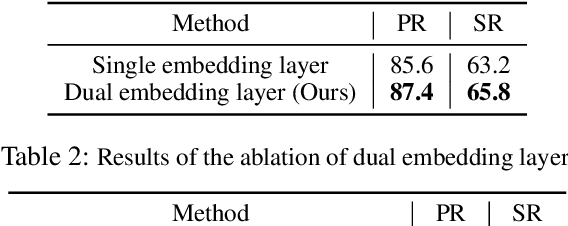
Most existing RGB-T tracking networks extract modality features in a separate manner, which lacks interaction and mutual guidance between modalities. This limits the network's ability to adapt to the diverse dual-modality appearances of targets and the dynamic relationships between the modalities. Additionally, the three-stage fusion tracking paradigm followed by these networks significantly restricts the tracking speed. To overcome these problems, we propose a unified single-stage Transformer RGB-T tracking network, namely USTrack, which unifies the above three stages into a single ViT (Vision Transformer) backbone with a dual embedding layer through self-attention mechanism. With this structure, the network can extract fusion features of the template and search region under the mutual interaction of modalities. Simultaneously, relation modeling is performed between these features, efficiently obtaining the search region fusion features with better target-background discriminability for prediction. Furthermore, we introduce a novel feature selection mechanism based on modality reliability to mitigate the influence of invalid modalities for prediction, further improving the tracking performance. Extensive experiments on three popular RGB-T tracking benchmarks demonstrate that our method achieves new state-of-the-art performance while maintaining the fastest inference speed 84.2FPS. In particular, MPR/MSR on the short-term and long-term subsets of VTUAV dataset increased by 11.1$\%$/11.7$\%$ and 11.3$\%$/9.7$\%$.
Color Prompting for Data-Free Continual Unsupervised Domain Adaptive Person Re-Identification
Aug 21, 2023Unsupervised domain adaptive person re-identification (Re-ID) methods alleviate the burden of data annotation through generating pseudo supervision messages. However, real-world Re-ID systems, with continuously accumulating data streams, simultaneously demand more robust adaptation and anti-forgetting capabilities. Methods based on image rehearsal addresses the forgetting issue with limited extra storage but carry the risk of privacy leakage. In this work, we propose a Color Prompting (CoP) method for data-free continual unsupervised domain adaptive person Re-ID. Specifically, we employ a light-weighted prompter network to fit the color distribution of the current task together with Re-ID training. Then for the incoming new tasks, the learned color distribution serves as color style transfer guidance to transfer the images into past styles. CoP achieves accurate color style recovery for past tasks with adequate data diversity, leading to superior anti-forgetting effects compared with image rehearsal methods. Moreover, CoP demonstrates strong generalization performance for fast adaptation into new domains, given only a small amount of unlabeled images. Extensive experiments demonstrate that after the continual training pipeline the proposed CoP achieves 6.7% and 8.1% average rank-1 improvements over the replay method on seen and unseen domains, respectively. The source code for this work is publicly available in https://github.com/vimar-gu/ColorPromptReID.