 Add to Chrome
 Add to Firefox
 Add to Edge
Toward Real-world Text Image Forgery Localization: Structured and Interpretable Data Synthesis
Nov 16, 2025
Existing Text Image Forgery Localization (T-IFL) methods often suffer from poor generalization due to the limited scale of real-world datasets and the distribution gap caused by synthetic data that fails to capture the complexity of real-world tampering. To tackle this issue, we propose Fourier Series-based Tampering Synthesis (FSTS), a structured and interpretable framework for synthesizing tampered text images. FSTS first collects 16,750 real-world tampering instances from five representative tampering types, using a structured pipeline that records human-performed editing traces via multi-format logs (e.g., video, PSD, and editing logs). By analyzing these collected parameters and identifying recurring behavioral patterns at both individual and population levels, we formulate a hierarchical modeling framework. Specifically, each individual tampering parameter is represented as a compact combination of basis operation-parameter configurations, while the population-level distribution is constructed by aggregating these behaviors. Since this formulation draws inspiration from the Fourier series, it enables an interpretable approximation using basis functions and their learned weights. By sampling from this modeled distribution, FSTS synthesizes diverse and realistic training data that better reflect real-world forgery traces. Extensive experiments across four evaluation protocols demonstrate that models trained with FSTS data achieve significantly improved generalization on real-world datasets. Dataset is available at \href{https://github.com/ZeqinYu/FSTS}{Project Page}.

LLM-Driven Completeness and Consistency Evaluation for Cultural Heritage Data Augmentation in Cross-Modal Retrieval
Nov 09, 2025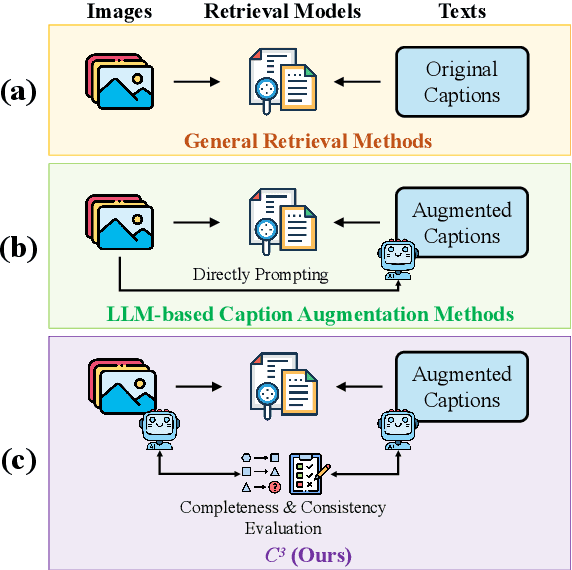
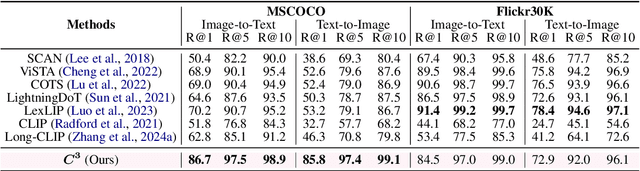
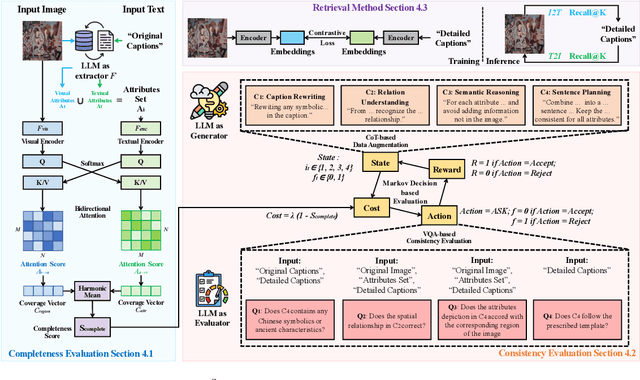
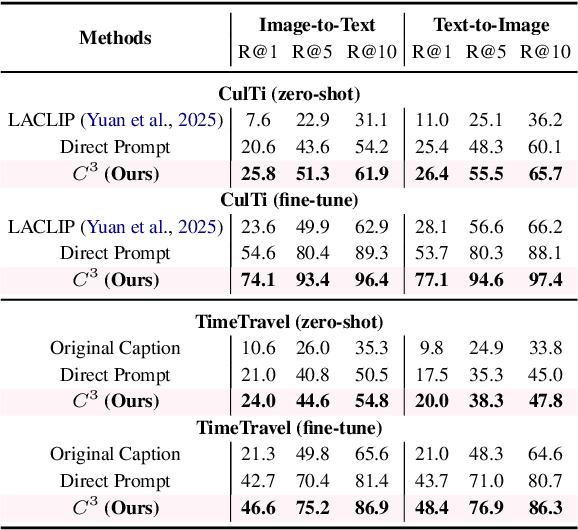
Cross-modal retrieval is essential for interpreting cultural heritage data, but its effectiveness is often limited by incomplete or inconsistent textual descriptions, caused by historical data loss and the high cost of expert annotation. While large language models (LLMs) offer a promising solution by enriching textual descriptions, their outputs frequently suffer from hallucinations or miss visually grounded details. To address these challenges, we propose $C^3$, a data augmentation framework that enhances cross-modal retrieval performance by improving the completeness and consistency of LLM-generated descriptions. $C^3$ introduces a completeness evaluation module to assess semantic coverage using both visual cues and language-model outputs. Furthermore, to mitigate factual inconsistencies, we formulate a Markov Decision Process to supervise Chain-of-Thought reasoning, guiding consistency evaluation through adaptive query control. Experiments on the cultural heritage datasets CulTi and TimeTravel, as well as on general benchmarks MSCOCO and Flickr30K, demonstrate that $C^3$ achieves state-of-the-art performance in both fine-tuned and zero-shot settings.
NVIDIA Nemotron Nano V2 VL
Nov 07, 2025We introduce Nemotron Nano V2 VL, the latest model of the Nemotron vision-language series designed for strong real-world document understanding, long video comprehension, and reasoning tasks. Nemotron Nano V2 VL delivers significant improvements over our previous model, Llama-3.1-Nemotron-Nano-VL-8B, across all vision and text domains through major enhancements in model architecture, datasets, and training recipes. Nemotron Nano V2 VL builds on Nemotron Nano V2, a hybrid Mamba-Transformer LLM, and innovative token reduction techniques to achieve higher inference throughput in long document and video scenarios. We are releasing model checkpoints in BF16, FP8, and FP4 formats and sharing large parts of our datasets, recipes and training code.
A Foundation Model for Chest X-ray Interpretation with Grounded Reasoning via Online Reinforcement Learning
Sep 04, 2025Medical foundation models (FMs) have shown tremendous promise amid the rapid advancements in artificial intelligence (AI) technologies. However, current medical FMs typically generate answers in a black-box manner, lacking transparent reasoning processes and locally grounded interpretability, which hinders their practical clinical deployments. To this end, we introduce DeepMedix-R1, a holistic medical FM for chest X-ray (CXR) interpretation. It leverages a sequential training pipeline: initially fine-tuned on curated CXR instruction data to equip with fundamental CXR interpretation capabilities, then exposed to high-quality synthetic reasoning samples to enable cold-start reasoning, and finally refined via online reinforcement learning to enhance both grounded reasoning quality and generation performance. Thus, the model produces both an answer and reasoning steps tied to the image's local regions for each query. Quantitative evaluation demonstrates substantial improvements in report generation (e.g., 14.54% and 31.32% over LLaVA-Rad and MedGemma) and visual question answering (e.g., 57.75% and 23.06% over MedGemma and CheXagent) tasks. To facilitate robust assessment, we propose Report Arena, a benchmarking framework using advanced language models to evaluate answer quality, further highlighting the superiority of DeepMedix-R1. Expert review of generated reasoning steps reveals greater interpretability and clinical plausibility compared to the established Qwen2.5-VL-7B model (0.7416 vs. 0.2584 overall preference). Collectively, our work advances medical FM development toward holistic, transparent, and clinically actionable modeling for CXR interpretation.
NVIDIA Nemotron Nano 2: An Accurate and Efficient Hybrid Mamba-Transformer Reasoning Model
Aug 21, 2025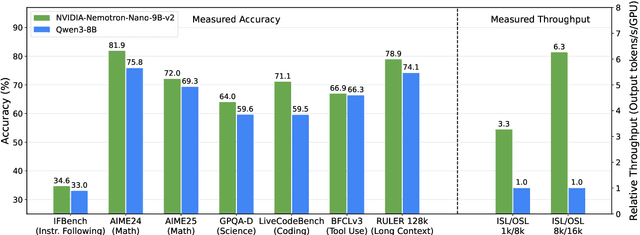

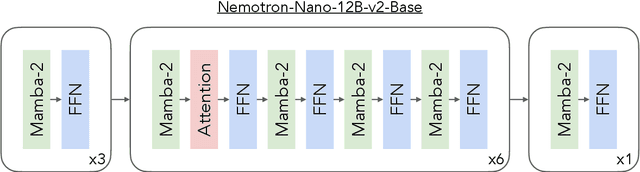
We introduce Nemotron-Nano-9B-v2, a hybrid Mamba-Transformer language model designed to increase throughput for reasoning workloads while achieving state-of-the-art accuracy compared to similarly-sized models. Nemotron-Nano-9B-v2 builds on the Nemotron-H architecture, in which the majority of the self-attention layers in the common Transformer architecture are replaced with Mamba-2 layers, to achieve improved inference speed when generating the long thinking traces needed for reasoning. We create Nemotron-Nano-9B-v2 by first pre-training a 12-billion-parameter model (Nemotron-Nano-12B-v2-Base) on 20 trillion tokens using an FP8 training recipe. After aligning Nemotron-Nano-12B-v2-Base, we employ the Minitron strategy to compress and distill the model with the goal of enabling inference on up to 128k tokens on a single NVIDIA A10G GPU (22GiB of memory, bfloat16 precision). Compared to existing similarly-sized models (e.g., Qwen3-8B), we show that Nemotron-Nano-9B-v2 achieves on-par or better accuracy on reasoning benchmarks while achieving up to 6x higher inference throughput in reasoning settings like 8k input and 16k output tokens. We are releasing Nemotron-Nano-9B-v2, Nemotron-Nano12B-v2-Base, and Nemotron-Nano-9B-v2-Base checkpoints along with the majority of our pre- and post-training datasets on Hugging Face.
Towards Perfection: Building Inter-component Mutual Correction for Retinex-based Low-light Image Enhancement
Aug 12, 2025In low-light image enhancement, Retinex-based deep learning methods have garnered significant attention due to their exceptional interpretability. These methods decompose images into mutually independent illumination and reflectance components, allows each component to be enhanced separately. In fact, achieving perfect decomposition of illumination and reflectance components proves to be quite challenging, with some residuals still existing after decomposition. In this paper, we formally name these residuals as inter-component residuals (ICR), which has been largely underestimated by previous methods. In our investigation, ICR not only affects the accuracy of the decomposition but also causes enhanced components to deviate from the ideal outcome, ultimately reducing the final synthesized image quality. To address this issue, we propose a novel Inter-correction Retinex model (IRetinex) to alleviate ICR during the decomposition and enhancement stage. In the decomposition stage, we leverage inter-component residual reduction module to reduce the feature similarity between illumination and reflectance components. In the enhancement stage, we utilize the feature similarity between the two components to detect and mitigate the impact of ICR within each enhancement unit. Extensive experiments on three low-light benchmark datasets demonstrated that by reducing ICR, our method outperforms state-of-the-art approaches both qualitatively and quantitatively.
Correspondence as Video: Test-Time Adaption on SAM2 for Reference Segmentation in the Wild
Aug 11, 2025Large vision models like the Segment Anything Model (SAM) exhibit significant limitations when applied to downstream tasks in the wild. Consequently, reference segmentation, which leverages reference images and their corresponding masks to impart novel knowledge to the model, emerges as a promising new direction for adapting vision models. However, existing reference segmentation approaches predominantly rely on meta-learning, which still necessitates an extensive meta-training process and brings massive data and computational cost. In this study, we propose a novel approach by representing the inherent correspondence between reference-target image pairs as a pseudo video. This perspective allows the latest version of SAM, known as SAM2, which is equipped with interactive video object segmentation (iVOS) capabilities, to be adapted to downstream tasks in a lightweight manner. We term this approach Correspondence As Video for SAM (CAV-SAM). CAV-SAM comprises two key modules: the Diffusion-Based Semantic Transition (DBST) module employs a diffusion model to construct a semantic transformation sequence, while the Test-Time Geometric Alignment (TTGA) module aligns the geometric changes within this sequence through test-time fine-tuning. We evaluated CAVSAM on widely-used datasets, achieving segmentation performance improvements exceeding 5% over SOTA methods. Implementation is provided in the supplementary materials.
Unsupervised Part Discovery via Descriptor-Based Masked Image Restoration with Optimized Constraints
Jul 16, 2025Part-level features are crucial for image understanding, but few studies focus on them because of the lack of fine-grained labels. Although unsupervised part discovery can eliminate the reliance on labels, most of them cannot maintain robustness across various categories and scenarios, which restricts their application range. To overcome this limitation, we present a more effective paradigm for unsupervised part discovery, named Masked Part Autoencoder (MPAE). It first learns part descriptors as well as a feature map from the inputs and produces patch features from a masked version of the original images. Then, the masked regions are filled with the learned part descriptors based on the similarity between the local features and descriptors. By restoring these masked patches using the part descriptors, they become better aligned with their part shapes, guided by appearance features from unmasked patches. Finally, MPAE robustly discovers meaningful parts that closely match the actual object shapes, even in complex scenarios. Moreover, several looser yet more effective constraints are proposed to enable MPAE to identify the presence of parts across various scenarios and categories in an unsupervised manner. This provides the foundation for addressing challenges posed by occlusion and for exploring part similarity across multiple categories. Extensive experiments demonstrate that our method robustly discovers meaningful parts across various categories and scenarios. The code is available at the project https://github.com/Jiahao-UTS/MPAE.
SWinMamba: Serpentine Window State Space Model for Vascular Segmentation
Jul 02, 2025Vascular segmentation in medical images is crucial for disease diagnosis and surgical navigation. However, the segmented vascular structure is often discontinuous due to its slender nature and inadequate prior modeling. In this paper, we propose a novel Serpentine Window Mamba (SWinMamba) to achieve accurate vascular segmentation. The proposed SWinMamba innovatively models the continuity of slender vascular structures by incorporating serpentine window sequences into bidirectional state space models. The serpentine window sequences enable efficient feature capturing by adaptively guiding global visual context modeling to the vascular structure. Specifically, the Serpentine Window Tokenizer (SWToken) adaptively splits the input image using overlapping serpentine window sequences, enabling flexible receptive fields (RFs) for vascular structure modeling. The Bidirectional Aggregation Module (BAM) integrates coherent local features in the RFs for vascular continuity representation. In addition, dual-domain learning with Spatial-Frequency Fusion Unit (SFFU) is designed to enhance the feature representation of vascular structure. Extensive experiments on three challenging datasets demonstrate that the proposed SWinMamba achieves superior performance with complete and connected vessels.
AssetDropper: Asset Extraction via Diffusion Models with Reward-Driven Optimization
Jun 06, 2025Recent research on generative models has primarily focused on creating product-ready visual outputs; however, designers often favor access to standardized asset libraries, a domain that has yet to be significantly enhanced by generative capabilities. Although open-world scenes provide ample raw materials for designers, efficiently extracting high-quality, standardized assets remains a challenge. To address this, we introduce AssetDropper, the first framework designed to extract assets from reference images, providing artists with an open-world asset palette. Our model adeptly extracts a front view of selected subjects from input images, effectively handling complex scenarios such as perspective distortion and subject occlusion. We establish a synthetic dataset of more than 200,000 image-subject pairs and a real-world benchmark with thousands more for evaluation, facilitating the exploration of future research in downstream tasks. Furthermore, to ensure precise asset extraction that aligns well with the image prompts, we employ a pre-trained reward model to fulfill a closed-loop with feedback. We design the reward model to perform an inverse task that pastes the extracted assets back into the reference sources, which assists training with additional consistency and mitigates hallucination. Extensive experiments show that, with the aid of reward-driven optimization, AssetDropper achieves the state-of-the-art results in asset extraction. Project page: AssetDropper.github.io.