 Add to Chrome
 Add to Firefox
 Add to Edge
Dual-Channel Grounded World Modeling (DCGWM): Structural Prevention of Objective Interference Collapse via Heterogeneous External Grounding with Inward-Only Gradient Flow
Jun 17, 2026
Joint Embedding Predictive Architectures (JEPAs) are a leading approach to world model representation learning. We identify a failure mode in JEPA-based world models grounded against two qualitatively distinct external signals: physical dynamics (sparse, high-magnitude, constraint-satisfying gradient corrections) and social-behavioral dynamics (diffuse, distribution-matching corrections). We term this Objective Interference Collapse (OIC): we argue that joint learning in a shared latent space causes the dominant channel to systematically collapse the subordinate channel's representational subspace, in a manner not resolvable by loss weighting alone. We propose Dual-Channel Grounded World Modeling (DCGWM), designed to structurally prevent OIC through a partitioned latent space (physical subspace Z_p, behavioral subspace Z_b) with inward-only gradient flow. A Physical Grounding Channel updates only Z_p via VICReg-style alignment to physical measurements; a Social-Behavioral Grounding Channel updates only Z_b via alignment to trajectories from an emergent multi-agent simulation. An Inter-Channel Interface Module couples the subspaces at the task level without cross-subspace gradients. An Asymmetric Grounding Adherence Loss penalizes rollout drift with a hard hinge for physical violations and a soft KL for behavioral divergence. A Generative Rendering Layer is architecturally isolated from the latent world model. We present three theoretical results: the partition removes the gradient-interference pathway implicated in OIC; each grounded subspace inherits anti-collapse guarantees from its alignment objective; and generative isolation is necessary under a stated assumption on the generative objective's geometry. This manuscript establishes the problem formulation and architecture; experimental validation is ongoing and will be reported in a future revision.

NVIDIA Nemotron Nano V2 VL
Nov 07, 2025We introduce Nemotron Nano V2 VL, the latest model of the Nemotron vision-language series designed for strong real-world document understanding, long video comprehension, and reasoning tasks. Nemotron Nano V2 VL delivers significant improvements over our previous model, Llama-3.1-Nemotron-Nano-VL-8B, across all vision and text domains through major enhancements in model architecture, datasets, and training recipes. Nemotron Nano V2 VL builds on Nemotron Nano V2, a hybrid Mamba-Transformer LLM, and innovative token reduction techniques to achieve higher inference throughput in long document and video scenarios. We are releasing model checkpoints in BF16, FP8, and FP4 formats and sharing large parts of our datasets, recipes and training code.
NVIDIA Nemotron Nano 2: An Accurate and Efficient Hybrid Mamba-Transformer Reasoning Model
Aug 21, 2025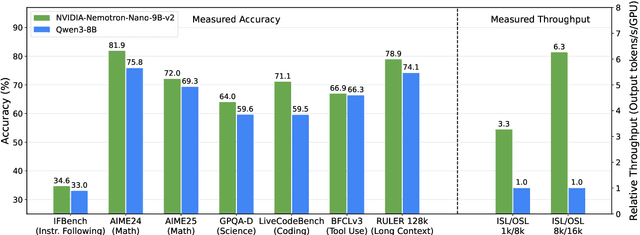

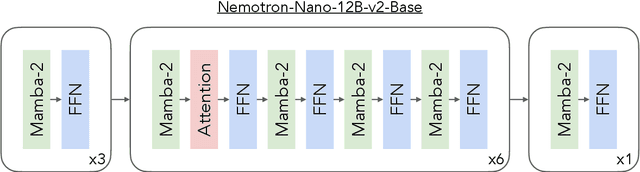
We introduce Nemotron-Nano-9B-v2, a hybrid Mamba-Transformer language model designed to increase throughput for reasoning workloads while achieving state-of-the-art accuracy compared to similarly-sized models. Nemotron-Nano-9B-v2 builds on the Nemotron-H architecture, in which the majority of the self-attention layers in the common Transformer architecture are replaced with Mamba-2 layers, to achieve improved inference speed when generating the long thinking traces needed for reasoning. We create Nemotron-Nano-9B-v2 by first pre-training a 12-billion-parameter model (Nemotron-Nano-12B-v2-Base) on 20 trillion tokens using an FP8 training recipe. After aligning Nemotron-Nano-12B-v2-Base, we employ the Minitron strategy to compress and distill the model with the goal of enabling inference on up to 128k tokens on a single NVIDIA A10G GPU (22GiB of memory, bfloat16 precision). Compared to existing similarly-sized models (e.g., Qwen3-8B), we show that Nemotron-Nano-9B-v2 achieves on-par or better accuracy on reasoning benchmarks while achieving up to 6x higher inference throughput in reasoning settings like 8k input and 16k output tokens. We are releasing Nemotron-Nano-9B-v2, Nemotron-Nano12B-v2-Base, and Nemotron-Nano-9B-v2-Base checkpoints along with the majority of our pre- and post-training datasets on Hugging Face.
Actionable Conversational Quality Indicators for Improving Task-Oriented Dialog Systems
Sep 22, 2021
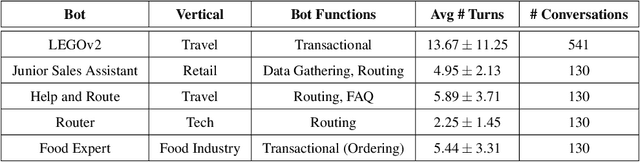
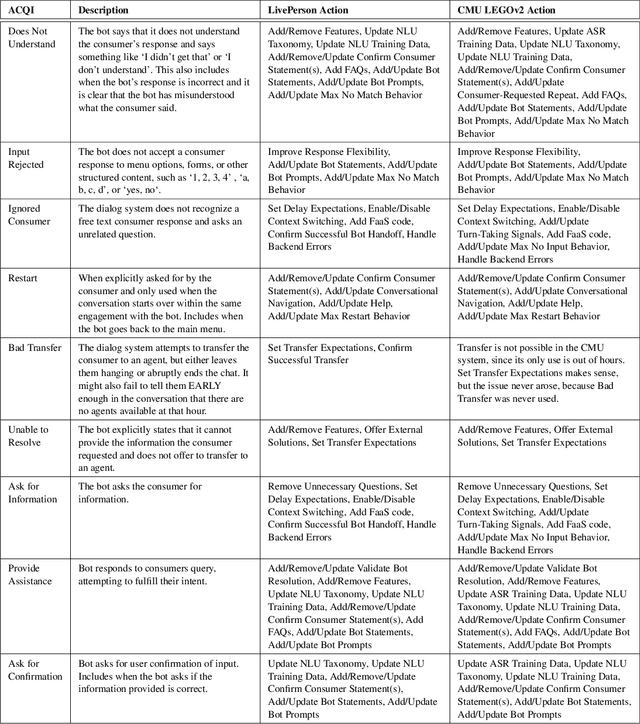
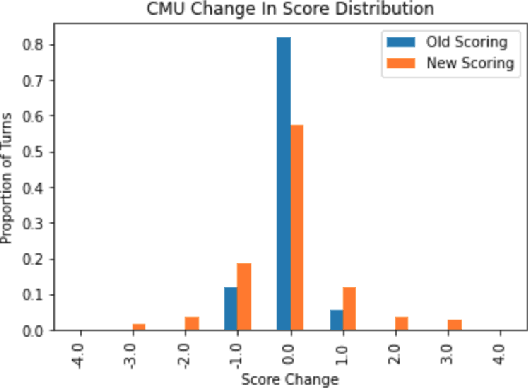
Automatic dialog systems have become a mainstream part of online customer service. Many such systems are built, maintained, and improved by customer service specialists, rather than dialog systems engineers and computer programmers. As conversations between people and machines become commonplace, it is critical to understand what is working, what is not, and what actions can be taken to reduce the frequency of inappropriate system responses. These analyses and recommendations need to be presented in terms that directly reflect the user experience rather than the internal dialog processing. This paper introduces and explains the use of Actionable Conversational Quality Indicators (ACQIs), which are used both to recognize parts of dialogs that can be improved, and to recommend how to improve them. This combines benefits of previous approaches, some of which have focused on producing dialog quality scoring while others have sought to categorize the types of errors the dialog system is making. We demonstrate the effectiveness of using ACQIs on LivePerson internal dialog systems used in commercial customer service applications, and on the publicly available CMU LEGOv2 conversational dataset (Raux et al. 2005). We report on the annotation and analysis of conversational datasets showing which ACQIs are important to fix in various situations. The annotated datasets are then used to build a predictive model which uses a turn-based vector embedding of the message texts and achieves an 79% weighted average f1-measure at the task of finding the correct ACQI for a given conversation. We predict that if such a model worked perfectly, the range of potential improvement actions a bot-builder must consider at each turn could be reduced by an average of 81%.