 Add to Chrome
 Add to Firefox
 Add to Edge
ChainClaw: A Layered Agent Framework for Reliable On-Chain Execution
Aug 06, 2026
General-purpose large language model agents have achieved strong performance on tool-augmented tasks, yet they rely on assumptions break down in blockchain environments. On-chain execution is stateful, adversarial, and economically irreversible, exposing three fundamental gaps: Reactivity, Irreversibility, and Observability. We propose ChainClaw, a blockchain-native agent framework built on OpenClaw, that addresses all three gaps through a layered architecture comprising an event-driven orchestration layer, a simulation-based safety intelligence layer, and an on-chain monitoring runtime layer, unified by a cross-layer memory subsystem. ChainClaw closes the Reactivity gap via event ingestion and simulation feedback, the Irreversibility gap via a pre-execution safety pipeline with transaction simulation and action guard, and the Observability gap via an on-chain read adapter and transaction monitor. We evaluate ChainClaw on a purpose-built benchmark covering seven tasks across four categories and five dimensions. ChainClaw consistently outperforms representative baselines on both safety and task completion.

EditVerse3D: High-Quality 3D Object Editing with Region-Aware Learning
Jul 08, 2026Local editing of 3D objects remains a long-standing challenge. When interacting with 3D content, humans naturally tend to specify a coarse region of interest for modification rather than defining precise editing boundaries. However, previous methods rely on fully edited 2D images, precise 3D masks, or redundant pipelines, which present a gap. To bridge this gap, we propose EditVerse3D, a novel 3D editing framework that enables high-quality object editing under such coarse guidance. Our approach takes as input a 3D object to be edited, a coarse 3D bounding box indicating the target region, and a reference 2D image describing the desired modification. It produces a coherent, high-fidelity edited 3D object. To facilitate this editing, we introduce a novel region-aware adaptive loss that emphasizes hard-to-learn regions and balances the objective between target and preserved areas. Complementing our loss function, we enhance model robustness and generalization through targeted data augmentations, such as training with scaled 3D masks and filtering out unrealistic editing pairs. We construct a large-scale 3D editing dataset derived from parts information. Extensive experiments demonstrate that EditVerse3D achieves superior visual quality and quantitative performance compared to existing 3D editing approaches. Please visit our project page at https://editverse3d.github.io.
Towards Compositional Generalization in LLMs for Smart Contract Security: A Case Study on Reentrancy Vulnerabilities
Jan 11, 2026Large language models (LLMs) demonstrate remarkable capabilities in natural language understanding and generation. Despite being trained on large-scale, high-quality data, LLMs still fail to outperform traditional static analysis tools in specialized domains like smart contract vulnerability detection. To address this issue, this paper proposes a post-training algorithm based on atomic task decomposition and fusion. This algorithm aims to achieve combinatorial generalization under limited data by decomposing complex reasoning tasks. Specifically, we decompose the reentrancy vulnerability detection task into four linearly independent atomic tasks: identifying external calls, identifying state updates, identifying data dependencies between external calls and state updates, and determining their data flow order. These tasks form the core components of our approach. By training on synthetic datasets, we generate three compiler-verified datasets. We then employ the Slither tool to extract structural information from the control flow graph and data flow graph, which is used to fine-tune the LLM's adapter. Experimental results demonstrate that low-rank normalization fusion with the LoRA adapter improves the LLM's reentrancy vulnerability detection accuracy to 98.2%, surpassing state-of-the-art methods. On 31 real-world contracts, the algorithm achieves a 20% higher recall than traditional analysis tools.
Puppeteer: Rig and Animate Your 3D Models
Aug 14, 2025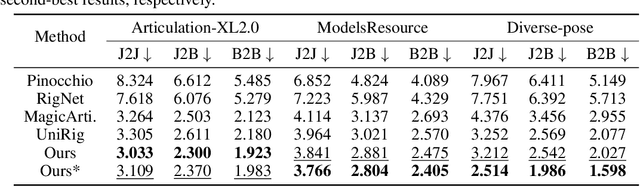
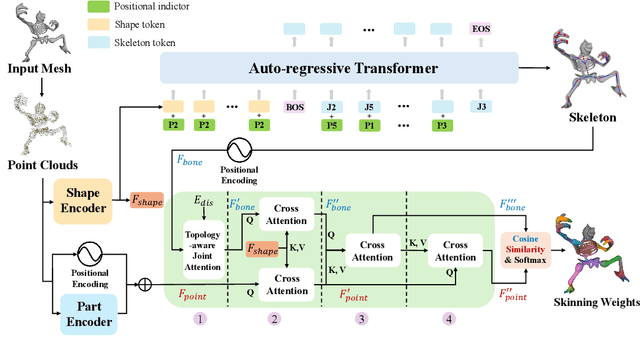
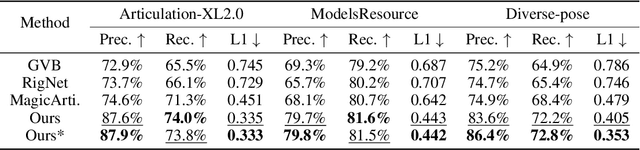
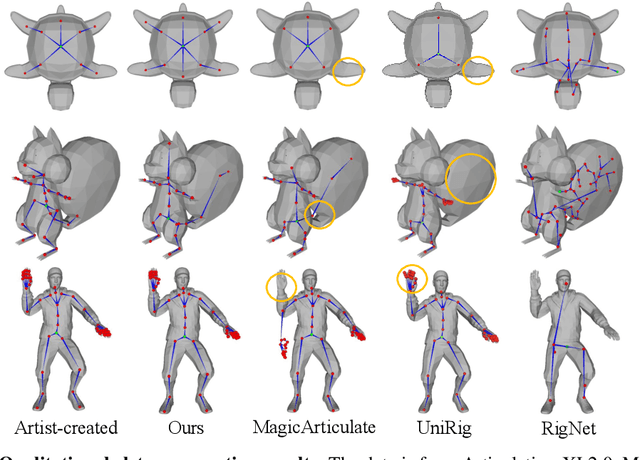
Modern interactive applications increasingly demand dynamic 3D content, yet the transformation of static 3D models into animated assets constitutes a significant bottleneck in content creation pipelines. While recent advances in generative AI have revolutionized static 3D model creation, rigging and animation continue to depend heavily on expert intervention. We present Puppeteer, a comprehensive framework that addresses both automatic rigging and animation for diverse 3D objects. Our system first predicts plausible skeletal structures via an auto-regressive transformer that introduces a joint-based tokenization strategy for compact representation and a hierarchical ordering methodology with stochastic perturbation that enhances bidirectional learning capabilities. It then infers skinning weights via an attention-based architecture incorporating topology-aware joint attention that explicitly encodes inter-joint relationships based on skeletal graph distances. Finally, we complement these rigging advances with a differentiable optimization-based animation pipeline that generates stable, high-fidelity animations while being computationally more efficient than existing approaches. Extensive evaluations across multiple benchmarks demonstrate that our method significantly outperforms state-of-the-art techniques in both skeletal prediction accuracy and skinning quality. The system robustly processes diverse 3D content, ranging from professionally designed game assets to AI-generated shapes, producing temporally coherent animations that eliminate the jittering issues common in existing methods.
OccLE: Label-Efficient 3D Semantic Occupancy Prediction
May 27, 2025
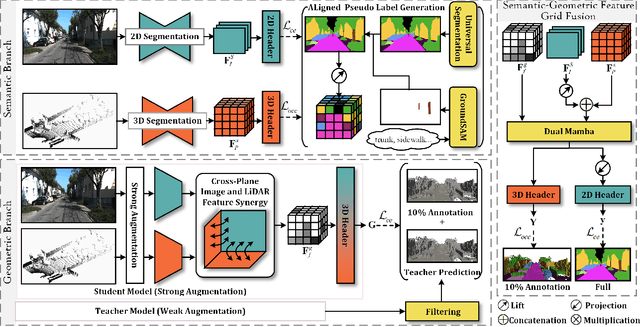
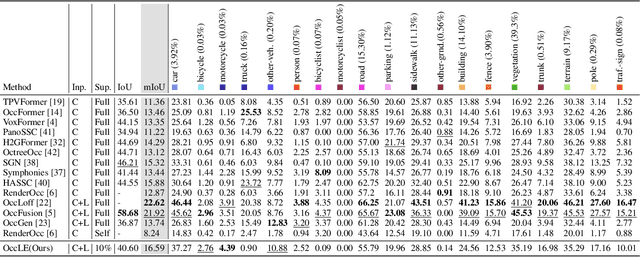
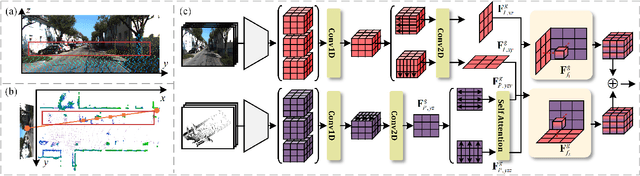
3D semantic occupancy prediction offers an intuitive and efficient scene understanding and has attracted significant interest in autonomous driving perception. Existing approaches either rely on full supervision, which demands costly voxel-level annotations, or on self-supervision, which provides limited guidance and yields suboptimal performance. To address these challenges, we propose OccLE, a Label-Efficient 3D Semantic Occupancy Prediction that takes images and LiDAR as inputs and maintains high performance with limited voxel annotations. Our intuition is to decouple the semantic and geometric learning tasks and then fuse the learned feature grids from both tasks for the final semantic occupancy prediction. Therefore, the semantic branch distills 2D foundation model to provide aligned pseudo labels for 2D and 3D semantic learning. The geometric branch integrates image and LiDAR inputs in cross-plane synergy based on their inherency, employing semi-supervision to enhance geometry learning. We fuse semantic-geometric feature grids through Dual Mamba and incorporate a scatter-accumulated projection to supervise unannotated prediction with aligned pseudo labels. Experiments show that OccLE achieves competitive performance with only 10% of voxel annotations, reaching a mIoU of 16.59% on the SemanticKITTI validation set.
CADCrafter: Generating Computer-Aided Design Models from Unconstrained Images
Apr 10, 2025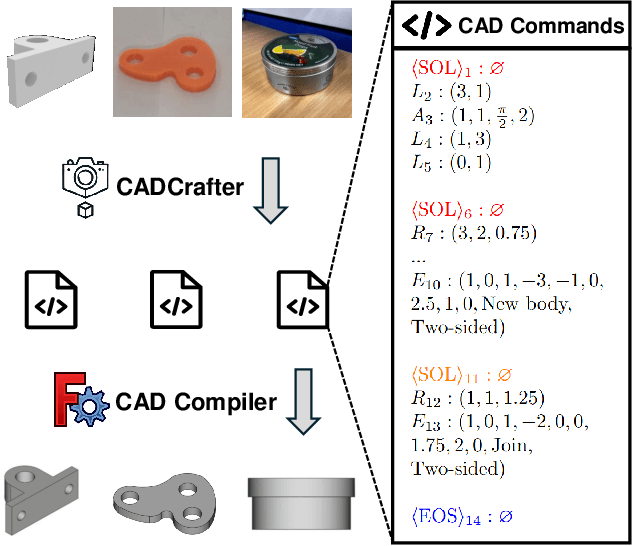
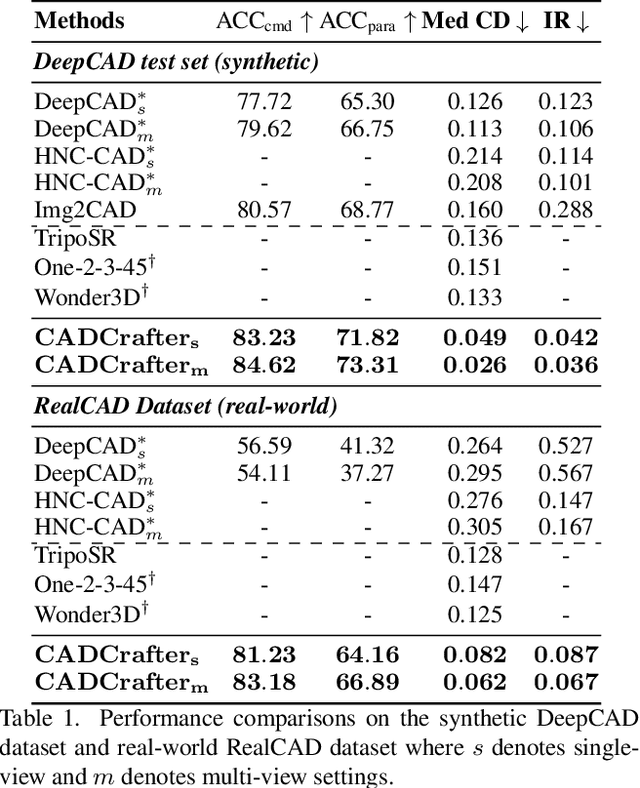
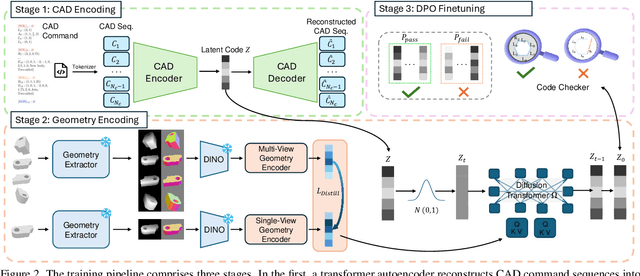
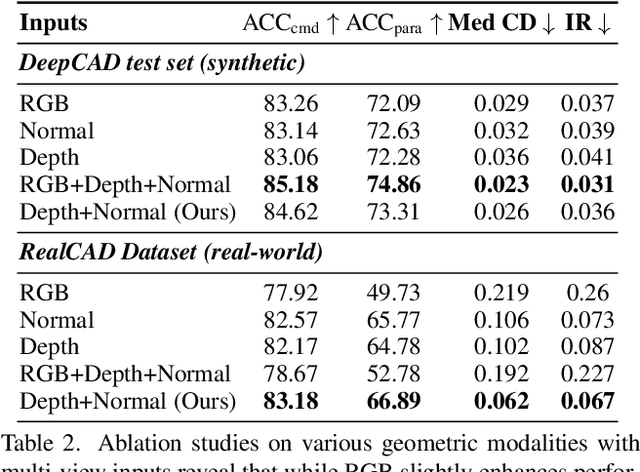
Creating CAD digital twins from the physical world is crucial for manufacturing, design, and simulation. However, current methods typically rely on costly 3D scanning with labor-intensive post-processing. To provide a user-friendly design process, we explore the problem of reverse engineering from unconstrained real-world CAD images that can be easily captured by users of all experiences. However, the scarcity of real-world CAD data poses challenges in directly training such models. To tackle these challenges, we propose CADCrafter, an image-to-parametric CAD model generation framework that trains solely on synthetic textureless CAD data while testing on real-world images. To bridge the significant representation disparity between images and parametric CAD models, we introduce a geometry encoder to accurately capture diverse geometric features. Moreover, the texture-invariant properties of the geometric features can also facilitate the generalization to real-world scenarios. Since compiling CAD parameter sequences into explicit CAD models is a non-differentiable process, the network training inherently lacks explicit geometric supervision. To impose geometric validity constraints, we employ direct preference optimization (DPO) to fine-tune our model with the automatic code checker feedback on CAD sequence quality. Furthermore, we collected a real-world dataset, comprised of multi-view images and corresponding CAD command sequence pairs, to evaluate our method. Experimental results demonstrate that our approach can robustly handle real unconstrained CAD images, and even generalize to unseen general objects.
Prim2Room: Layout-Controllable Room Mesh Generation from Primitives
Sep 09, 2024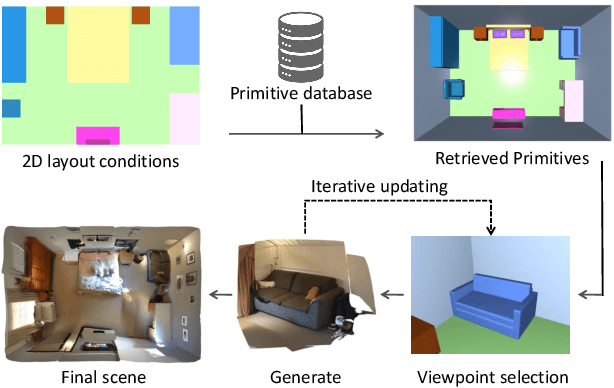
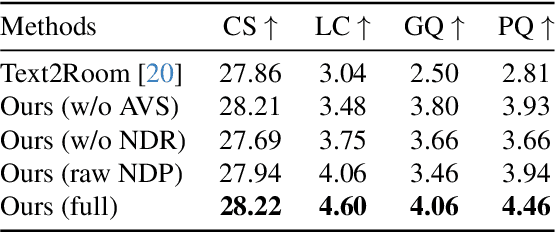
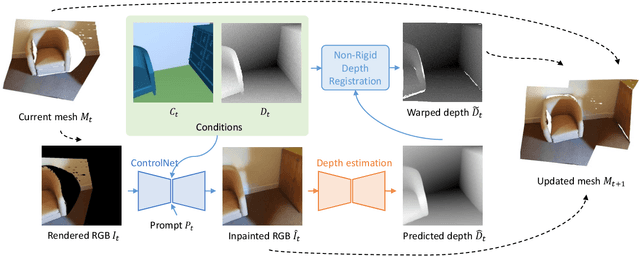
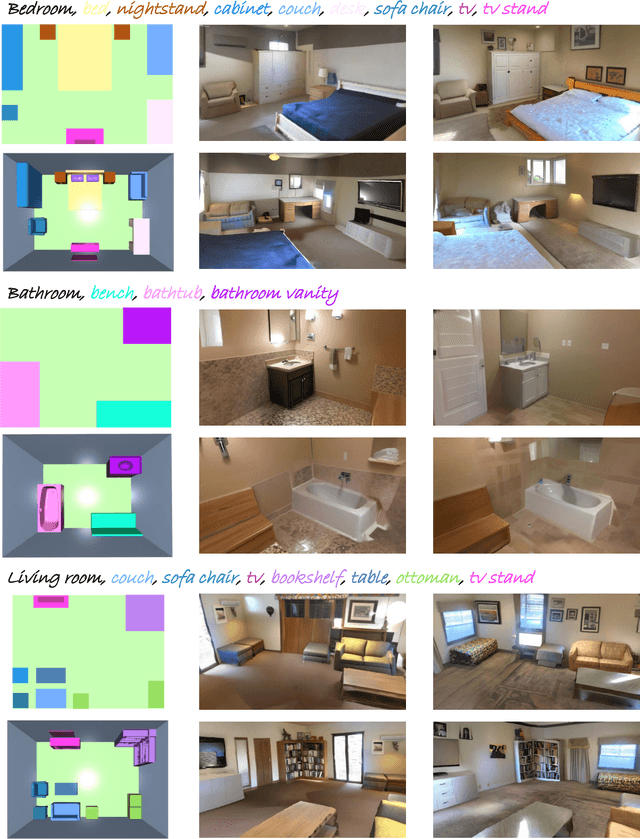
We propose Prim2Room, a novel framework for controllable room mesh generation leveraging 2D layout conditions and 3D primitive retrieval to facilitate precise 3D layout specification. Diverging from existing methods that lack control and precision, our approach allows for detailed customization of room-scale environments. To overcome the limitations of previous methods, we introduce an adaptive viewpoint selection algorithm that allows the system to generate the furniture texture and geometry from more favorable views than predefined camera trajectories. Additionally, we employ non-rigid depth registration to ensure alignment between generated objects and their corresponding primitive while allowing for shape variations to maintain diversity. Our method not only enhances the accuracy and aesthetic appeal of generated 3D scenes but also provides a user-friendly platform for detailed room design.
Sync4D: Video Guided Controllable Dynamics for Physics-Based 4D Generation
May 27, 2024
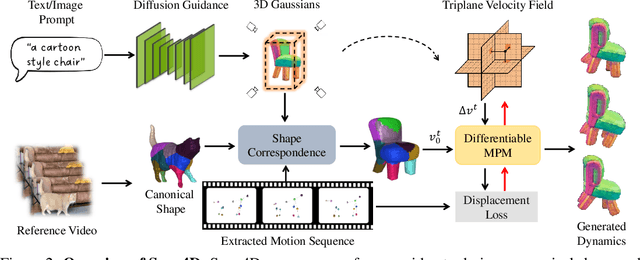


In this work, we introduce a novel approach for creating controllable dynamics in 3D-generated Gaussians using casually captured reference videos. Our method transfers the motion of objects from reference videos to a variety of generated 3D Gaussians across different categories, ensuring precise and customizable motion transfer. We achieve this by employing blend skinning-based non-parametric shape reconstruction to extract the shape and motion of reference objects. This process involves segmenting the reference objects into motion-related parts based on skinning weights and establishing shape correspondences with generated target shapes. To address shape and temporal inconsistencies prevalent in existing methods, we integrate physical simulation, driving the target shapes with matched motion. This integration is optimized through a displacement loss to ensure reliable and genuine dynamics. Our approach supports diverse reference inputs, including humans, quadrupeds, and articulated objects, and can generate dynamics of arbitrary length, providing enhanced fidelity and applicability. Unlike methods heavily reliant on diffusion video generation models, our technique offers specific and high-quality motion transfer, maintaining both shape integrity and temporal consistency.
REACTO: Reconstructing Articulated Objects from a Single Video
Apr 17, 2024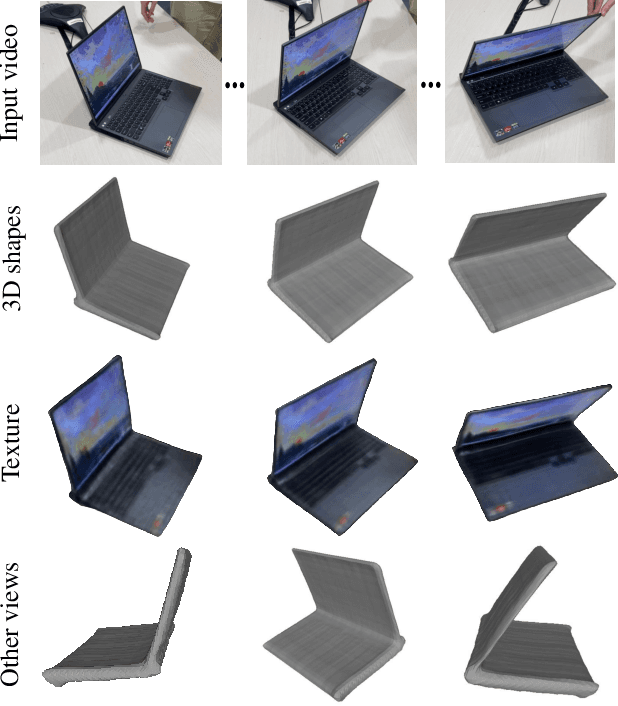

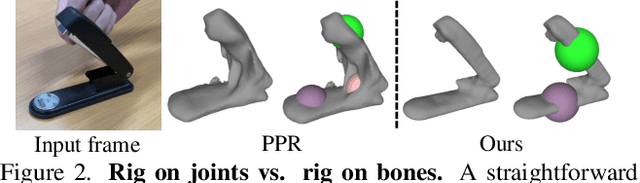
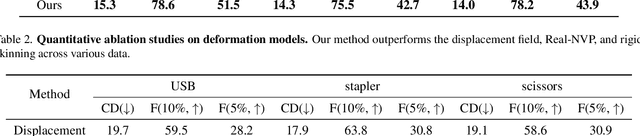
In this paper, we address the challenge of reconstructing general articulated 3D objects from a single video. Existing works employing dynamic neural radiance fields have advanced the modeling of articulated objects like humans and animals from videos, but face challenges with piece-wise rigid general articulated objects due to limitations in their deformation models. To tackle this, we propose Quasi-Rigid Blend Skinning, a novel deformation model that enhances the rigidity of each part while maintaining flexible deformation of the joints. Our primary insight combines three distinct approaches: 1) an enhanced bone rigging system for improved component modeling, 2) the use of quasi-sparse skinning weights to boost part rigidity and reconstruction fidelity, and 3) the application of geodesic point assignment for precise motion and seamless deformation. Our method outperforms previous works in producing higher-fidelity 3D reconstructions of general articulated objects, as demonstrated on both real and synthetic datasets. Project page: https://chaoyuesong.github.io/REACTO.
Learning-Based Biharmonic Augmentation for Point Cloud Classification
Nov 10, 2023
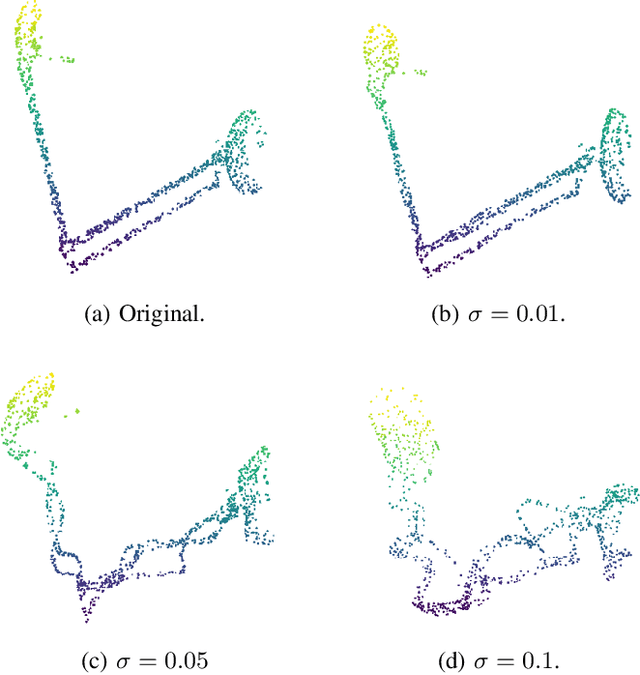
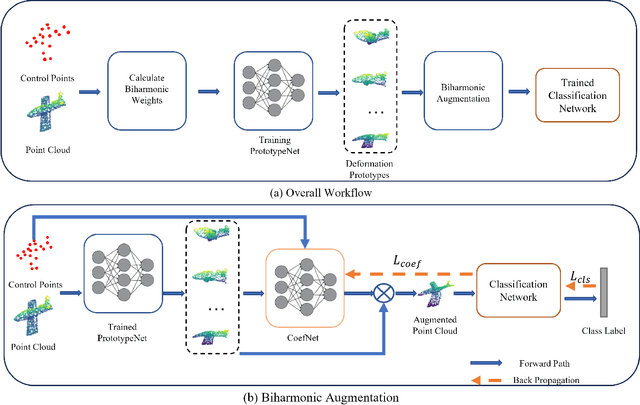
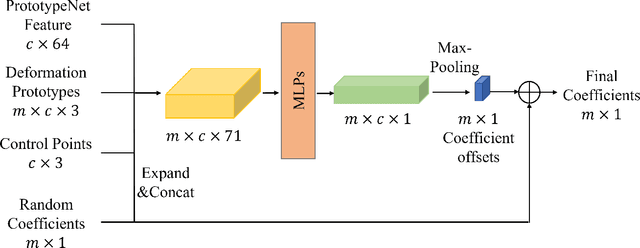
Point cloud datasets often suffer from inadequate sample sizes in comparison to image datasets, making data augmentation challenging. While traditional methods, like rigid transformations and scaling, have limited potential in increasing dataset diversity due to their constraints on altering individual sample shapes, we introduce the Biharmonic Augmentation (BA) method. BA is a novel and efficient data augmentation technique that diversifies point cloud data by imposing smooth non-rigid deformations on existing 3D structures. This approach calculates biharmonic coordinates for the deformation function and learns diverse deformation prototypes. Utilizing a CoefNet, our method predicts coefficients to amalgamate these prototypes, ensuring comprehensive deformation. Moreover, we present AdvTune, an advanced online augmentation system that integrates adversarial training. This system synergistically refines the CoefNet and the classification network, facilitating the automated creation of adaptive shape deformations contingent on the learner status. Comprehensive experimental analysis validates the superiority of Biharmonic Augmentation, showcasing notable performance improvements over prevailing point cloud augmentation techniques across varied network designs.