 Add to Chrome
 Add to Firefox
 Add to Edge
TRCA: Transition-wise Rubric Credit Assignment for Long-horizon LLM Agents
Aug 17, 2026
Long-horizon large language model (LLM) agents are typically optimized with sparse terminal outcomes, making fine-grained credit assignment across multi-step interactions difficult. Existing approaches either rely on process evaluators, which incur annotation and inference costs, or derive step-level credit from successful trajectories. However, successful trajectories are extremely scarce during early-stage reinforcement learning, substantially weakening anchor-based methods. We propose Transition-wise Rubric Credit Assignment (TRCA), which derives step-level supervision directly from action-induced transitions without learned evaluators or successful anchors. TRCA evaluates each transition using Evidence, Execution, and Invalidity rubrics to capture task-relevant information acquisition, valid task execution, and invalid or regressive behavior. From these judgments, Foundational Rubric Reward measures local transition quality, while Breakthrough Rubric Reward tracks newly covered Evidence and Execution conditions to reward incremental task progress. Combined with terminal outcomes, these signals produce fine-grained step-level advantages for policy optimization. Experiments on ALFWorld, WebShop, and seven search-augmented question-answering benchmarks show consistent improvements over the evaluated baselines. With Qwen2.5-7B-Instruct, TRCA improves the WebShop score by 6.0%-12.6%; with Qwen2.5-3B-Instruct, it improves the average SearchQA score by 1.9%-18.3%. These results demonstrate the effectiveness of transition-wise rubric credit assignment for long-horizon tasks with sparse successful anchors.

ChainClaw: A Layered Agent Framework for Reliable On-Chain Execution
Aug 06, 2026General-purpose large language model agents have achieved strong performance on tool-augmented tasks, yet they rely on assumptions break down in blockchain environments. On-chain execution is stateful, adversarial, and economically irreversible, exposing three fundamental gaps: Reactivity, Irreversibility, and Observability. We propose ChainClaw, a blockchain-native agent framework built on OpenClaw, that addresses all three gaps through a layered architecture comprising an event-driven orchestration layer, a simulation-based safety intelligence layer, and an on-chain monitoring runtime layer, unified by a cross-layer memory subsystem. ChainClaw closes the Reactivity gap via event ingestion and simulation feedback, the Irreversibility gap via a pre-execution safety pipeline with transaction simulation and action guard, and the Observability gap via an on-chain read adapter and transaction monitor. We evaluate ChainClaw on a purpose-built benchmark covering seven tasks across four categories and five dimensions. ChainClaw consistently outperforms representative baselines on both safety and task completion.
PACT: Learning Diverse Diagnostic Strategies via Privileged Synthesis and Branch Consensus
Jun 08, 2026Clinical diagnosis requires flexible use of multiple reasoning paradigms under incomplete patient information. Existing LLM-based medical agents show strong medical reasoning ability, but single-paradigm or naively mixed dialogue supervision makes these paradigms difficult to learn without interference. We propose \textbf{PACT} (Periodic Anchor Consensus Training), a framework that couples supervised multi-paradigm dialogue synthesis with consensus-based Branch training. At the data level, \textbf{DPS} (Doctor-Patient-Supervisor) uses complete electronic medical records (EMRs) for quality control while keeping the doctor agent restricted to patient-visible information. This produces validated dialogues under four diagnostic reasoning paradigms without leaking hidden clinical answers. At the training level, PACT trains one paradigm-specific LoRA Branch per paradigm and periodically aggregates Branches into a shared Anchor through sign consensus. We further construct a dynamic multi-turn Chinese medical diagnosis benchmark for interactive consultation. Experiments show that PACT achieves state-of-the-art performance among compared proprietary, medical-specialized, and task-adapted baselines on diagnostic outcome and consultation-process metrics.
METRO: Towards Strategy Induction from Expert Dialogue Transcripts for Non-collaborative Dialogues
Apr 14, 2026Developing non-collaborative dialogue agents traditionally requires the manual, unscalable codification of expert strategies. We propose \ours, a method that leverages large language models to autonomously induce both strategy actions and planning logic directly from raw transcripts. METRO formalizes expert knowledge into a Strategy Forest, a hierarchical structure that captures both short-term responses (nodes) and long-term strategic foresight (branches). Experimental results across two benchmarks show that METRO demonstrates promising performance, outperforming existing methods by an average of 9%-10%. Our further analysis not only reveals the success behind METRO (strategic behavioral diversity and foresight), but also demonstrates its robust cross-task transferability. This offers new insights into building non-collaborative agents in a cost-effective and scalable way. Our code is available at https://github.com/Humphrey-0125/METRO.
Mosaic: Multimodal Jailbreak against Closed-Source VLMs via Multi-View Ensemble Optimization
Apr 10, 2026Vision-Language Models (VLMs) are powerful but remain vulnerable to multimodal jailbreak attacks. Existing attacks mainly rely on either explicit visual prompt attacks or gradient-based adversarial optimization. While the former is easier to detect, the latter produces subtle perturbations that are less perceptible, but is usually optimized and evaluated under homogeneous open-source surrogate-target settings, leaving its effectiveness on commercial closed-source VLMs under heterogeneous settings unclear. To examine this issue, we study different surrogate-target settings and observe a consistent gap between homogeneous and heterogeneous settings, a phenomenon we term surrogate dependency. Motivated by this finding, we propose Mosaic, a Multi-view ensemble optimization framework for multimodal jailbreak against closed-source VLMs, which alleviates surrogate dependency under heterogeneous surrogate-target settings by reducing over-reliance on any single surrogate model and visual view. Specifically, Mosaic incorporates three core components: a Text-Side Transformation module, which perturbs refusal-sensitive lexical patterns; a Multi-View Image Optimization module, which updates perturbations under diverse cropped views to avoid overfitting to a single visual view; and a Surrogate Ensemble Guidance module, which aggregates optimization signals from multiple surrogate VLMs to reduce surrogate-specific bias. Extensive experiments on safety benchmarks demonstrate that Mosaic achieves state-of-the-art Attack Success Rate and Average Toxicity against commercial closed-source VLMs.
Z-Erase: Enabling Concept Erasure in Single-Stream Diffusion Transformers
Mar 26, 2026Concept erasure serves as a vital safety mechanism for removing unwanted concepts from text-to-image (T2I) models. While extensively studied in U-Net and dual-stream architectures (e.g., Flux), this task remains under-explored in the recent emerging paradigm of single-stream diffusion transformers (e.g., Z-Image). In this new paradigm, text and image tokens are processed as a single unified sequence via shared parameters. Consequently, directly applying prior erasure methods typically leads to generation collapse. To bridge this gap, we introduce Z-Erase, the first concept erasure method tailored for single-stream T2I models. To guarantee stable image generation, Z-Erase first proposes a Stream Disentangled Concept Erasure Framework that decouples updates and enables existing methods on single-stream models. Subsequently, within this framework, we introduce Lagrangian-Guided Adaptive Erasure Modulation, a constrained algorithm that further balances the sensitive erasure-preservation trade-off. Moreover, we provide a rigorous convergence analysis proving that Z-Erase can converge to a Pareto stationary point. Experiments demonstrate that Z-Erase successfully overcomes the generation collapse issue, achieving state-of-the-art performance across a wide range of tasks.
Towards Compositional Generalization in LLMs for Smart Contract Security: A Case Study on Reentrancy Vulnerabilities
Jan 11, 2026Large language models (LLMs) demonstrate remarkable capabilities in natural language understanding and generation. Despite being trained on large-scale, high-quality data, LLMs still fail to outperform traditional static analysis tools in specialized domains like smart contract vulnerability detection. To address this issue, this paper proposes a post-training algorithm based on atomic task decomposition and fusion. This algorithm aims to achieve combinatorial generalization under limited data by decomposing complex reasoning tasks. Specifically, we decompose the reentrancy vulnerability detection task into four linearly independent atomic tasks: identifying external calls, identifying state updates, identifying data dependencies between external calls and state updates, and determining their data flow order. These tasks form the core components of our approach. By training on synthetic datasets, we generate three compiler-verified datasets. We then employ the Slither tool to extract structural information from the control flow graph and data flow graph, which is used to fine-tune the LLM's adapter. Experimental results demonstrate that low-rank normalization fusion with the LoRA adapter improves the LLM's reentrancy vulnerability detection accuracy to 98.2%, surpassing state-of-the-art methods. On 31 real-world contracts, the algorithm achieves a 20% higher recall than traditional analysis tools.
Offline RL with Smooth OOD Generalization in Convex Hull and its Neighborhood
Jun 10, 2025Offline Reinforcement Learning (RL) struggles with distributional shifts, leading to the $Q$-value overestimation for out-of-distribution (OOD) actions. Existing methods address this issue by imposing constraints; however, they often become overly conservative when evaluating OOD regions, which constrains the $Q$-function generalization. This over-constraint issue results in poor $Q$-value estimation and hinders policy improvement. In this paper, we introduce a novel approach to achieve better $Q$-value estimation by enhancing $Q$-function generalization in OOD regions within Convex Hull and its Neighborhood (CHN). Under the safety generalization guarantees of the CHN, we propose the Smooth Bellman Operator (SBO), which updates OOD $Q$-values by smoothing them with neighboring in-sample $Q$-values. We theoretically show that SBO approximates true $Q$-values for both in-sample and OOD actions within the CHN. Our practical algorithm, Smooth Q-function OOD Generalization (SQOG), empirically alleviates the over-constraint issue, achieving near-accurate $Q$-value estimation. On the D4RL benchmarks, SQOG outperforms existing state-of-the-art methods in both performance and computational efficiency.
Preference-Guided Reinforcement Learning for Efficient Exploration
Jul 09, 2024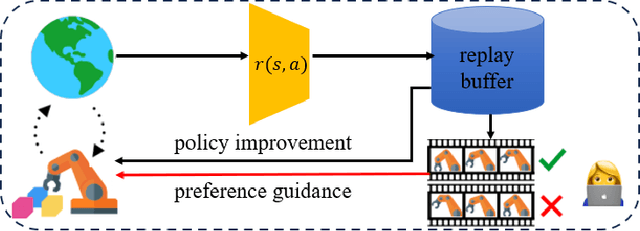
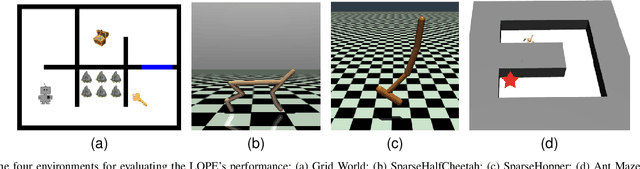
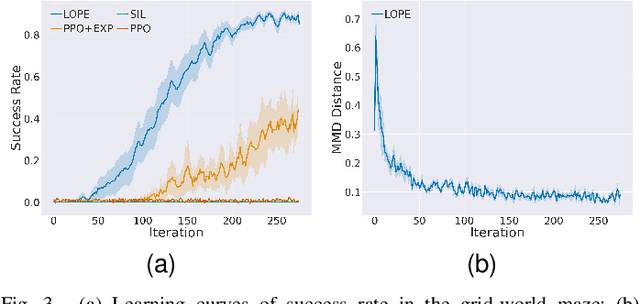
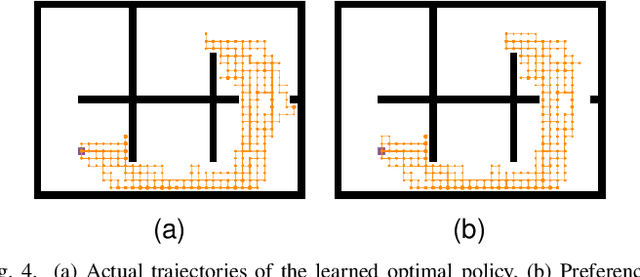
In this paper, we investigate preference-based reinforcement learning (PbRL) that allows reinforcement learning (RL) agents to learn from human feedback. This is particularly valuable when defining a fine-grain reward function is not feasible. However, this approach is inefficient and impractical for promoting deep exploration in hard-exploration tasks with long horizons and sparse rewards. To tackle this issue, we introduce LOPE: Learning Online with trajectory Preference guidancE, an end-to-end preference-guided RL framework that enhances exploration efficiency in hard-exploration tasks. Our intuition is that LOPE directly adjusts the focus of online exploration by considering human feedback as guidance, avoiding learning a separate reward model from preferences. Specifically, LOPE includes a two-step sequential policy optimization process consisting of trust-region-based policy improvement and preference guidance steps. We reformulate preference guidance as a novel trajectory-wise state marginal matching problem that minimizes the maximum mean discrepancy distance between the preferred trajectories and the learned policy. Furthermore, we provide a theoretical analysis to characterize the performance improvement bound and evaluate the LOPE's effectiveness. When assessed in various challenging hard-exploration environments, LOPE outperforms several state-of-the-art methods regarding convergence rate and overall performance. The code used in this study is available at \url{https://github.com/buaawgj/LOPE}.
Learning Diverse Policies with Soft Self-Generated Guidance
Feb 07, 2024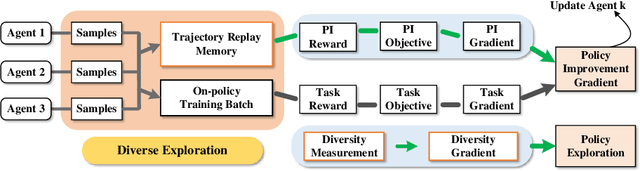
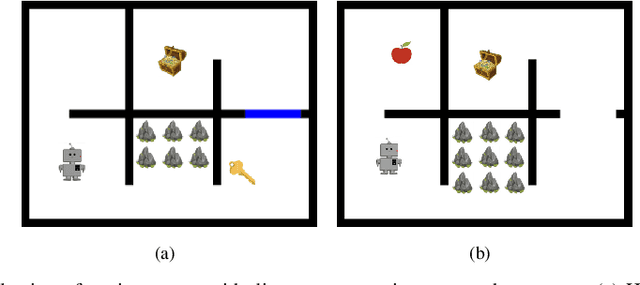
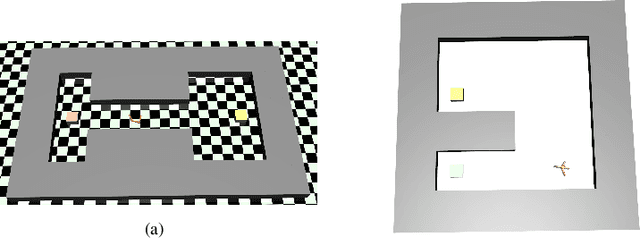
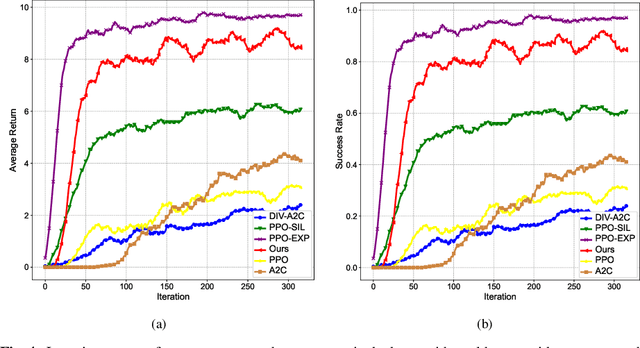
Reinforcement learning (RL) with sparse and deceptive rewards is challenging because non-zero rewards are rarely obtained. Hence, the gradient calculated by the agent can be stochastic and without valid information. Recent studies that utilize memory buffers of previous experiences can lead to a more efficient learning process. However, existing methods often require these experiences to be successful and may overly exploit them, which can cause the agent to adopt suboptimal behaviors. This paper develops an approach that uses diverse past trajectories for faster and more efficient online RL, even if these trajectories are suboptimal or not highly rewarded. The proposed algorithm combines a policy improvement step with an additional exploration step using offline demonstration data. The main contribution of this paper is that by regarding diverse past trajectories as guidance, instead of imitating them, our method directs its policy to follow and expand past trajectories while still being able to learn without rewards and approach optimality. Furthermore, a novel diversity measurement is introduced to maintain the team's diversity and regulate exploration. The proposed algorithm is evaluated on discrete and continuous control tasks with sparse and deceptive rewards. Compared with the existing RL methods, the experimental results indicate that our proposed algorithm is significantly better than the baseline methods regarding diverse exploration and avoiding local optima.
* 23 pages, 19 figures