 Add to Chrome
 Add to Firefox
 Add to Edge
Where Does the Answer Come From? Benchmarking View-Level Visual Evidence Identification in Multi-View MLLMs for Autonomous Driving
Jun 08, 2026
Multimodal large language models (MLLMs) achieve strong results on visual reasoning benchmarks, but answer accuracy alone does not indicate whether a model relied on the correct visual evidence. This gap is particularly important in multi-view driving scenes used for autonomous driving, where a model can produce a plausible answer while grounding it in the wrong camera view. We introduce a multi-view visual question answering benchmark for evaluating evidence-source identification: given six synchronized NuScenes views and a question, the model must identify the supporting camera view and answer the question. The benchmark contains 122 conflict-centric question-answer pairs from 73 scenes, spanning causality, counterfactual reasoning, and intent prediction. View labels are proposed by an automatic conflict-mining pipeline and manually verified by annotators. We evaluate three settings: camera-view selection, oracle QA given the golden view, and joint prediction in which the model selects a view and answers in one pass. Answers are evaluated in both multiple-choice and free-form formats, using exact match for structured predictions and an LLM judge for free-form responses. By explicitly separating visual-source identification from answer correctness, the benchmark exposes grounding failures that answer-only evaluation misses.

HardTests: Synthesizing High-Quality Test Cases for LLM Coding
May 30, 2025Verifiers play a crucial role in large language model (LLM) reasoning, needed by post-training techniques such as reinforcement learning. However, reliable verifiers are hard to get for difficult coding problems, because a well-disguised wrong solution may only be detected by carefully human-written edge cases that are difficult to synthesize. To address this issue, we propose HARDTESTGEN, a pipeline for high-quality test synthesis using LLMs. With this pipeline, we curate a comprehensive competitive programming dataset HARDTESTS with 47k problems and synthetic high-quality tests. Compared with existing tests, HARDTESTGEN tests demonstrate precision that is 11.3 percentage points higher and recall that is 17.5 percentage points higher when evaluating LLM-generated code. For harder problems, the improvement in precision can be as large as 40 points. HARDTESTS also proves to be more effective for model training, measured by downstream code generation performance. We will open-source our dataset and synthesis pipeline at https://leililab.github.io/HardTests/.
Hire a Linguist!: Learning Endangered Languages with In-Context Linguistic Descriptions
Feb 28, 2024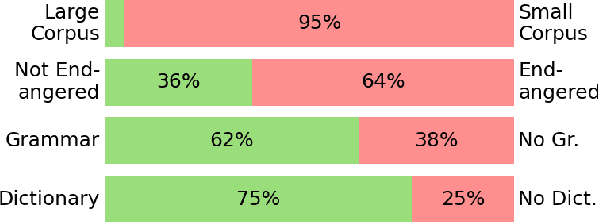
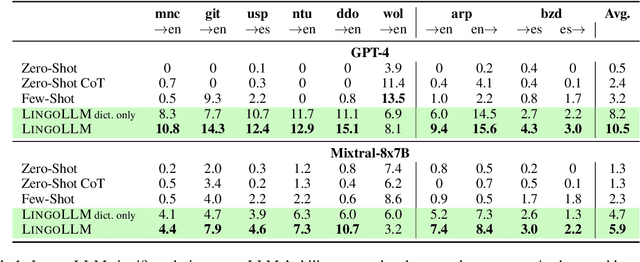
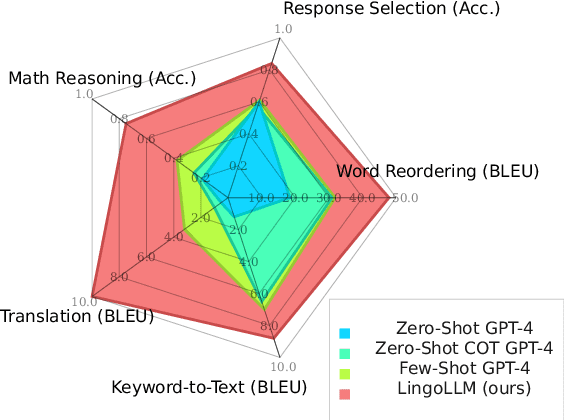
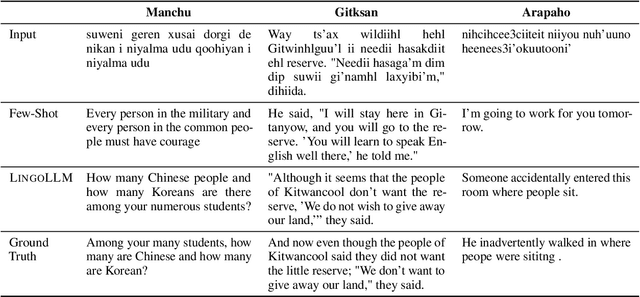
How can large language models (LLMs) process and translate endangered languages? Many languages lack a large corpus to train a decent LLM; therefore existing LLMs rarely perform well in unseen, endangered languages. On the contrary, we observe that 2000 endangered languages, though without a large corpus, have a grammar book or a dictionary. We propose LINGOLLM, a training-free approach to enable an LLM to process unseen languages that hardly occur in its pre-training. Our key insight is to demonstrate linguistic knowledge of an unseen language in an LLM's prompt, including a dictionary, a grammar book, and morphologically analyzed input text. We implement LINGOLLM on top of two models, GPT-4 and Mixtral, and evaluate their performance on 5 tasks across 8 endangered or low-resource languages. Our results show that LINGOLLM elevates translation capability from GPT-4's 0 to 10.5 BLEU for 10 language directions. Our findings demonstrate the tremendous value of linguistic knowledge in the age of LLMs for endangered languages. Our data, code, and model generations can be found at https://github.com/LLiLab/llm4endangeredlang.