 Add to Chrome
 Add to Firefox
 Add to Edge
Practical Online KV Cache Compaction for LLM Agents: An Empirical Study
Aug 02, 2026
LLM agents accumulate long trajectories of reasoning steps, tool calls, and environment feedback, making the KV cache a major inference bottleneck. KV cache compaction can reduce this cost, but most prior methods assume a static context where future queries are known or can be approximated offline. Agents instead require online compaction: new information must be compressed before future relevance is known, using proxy queries cheap enough for the inference path. We study online compaction across token eviction (TE) and attention matching (AM), adapting both to compact agent turns and comparing cheap proxy sources such as boundary, repeat-prefill, and delayed future-generation queries. Experiments on BrowseComp-Plus and WideSearch show that immediate compaction often hurts performance, whereas delaying compaction to use the agent's future queries recovers much of the gap. Moreover, TE is often more robust than AM under imperfect proxies. Across models at different scales, TE preserves most of the accuracy while reducing KV cache by 80%, and can improve throughput over the no compaction baseline. These results position proxy-query selection as a core design choice for practical online KV compaction.

Speculate While You Reason: Teaching Agents to Predict Their Next Tool Call via Joint Agent-Speculator RL
Jul 28, 2026Large language model agents often spend substantial wall-clock time waiting for tool call results. Tool-call speculation can hide this latency by predicting and pre-executing an agent's next tool call if the prediction matches the agent's eventual tool call, but existing speculators are typically separate draft models or cached traces that are poorly aligned with the deployed agent's own behavior. We identify this speculator-agent gap and show that the target agent itself is a strong next-call speculator. This points to a simpler design: unifying the agent and speculator within the same model. In this paper, we introduce the self-speculating agent, a single model that both solves tasks in agent mode and predicts its next tool call from partial trajectories in speculator mode, fully reusing prefix KV cache. To enable this dual-mode agent without degrading performance, we propose a joint agent-speculator reinforcement learning method, which derives speculation targets from the agent's own rollouts and alternates agent and speculator updates. Across agentic search QA and conversational tool-use agentic tasks, our method improves average next tool-call Hit@1 from 44.1 to 61.2 for Qwen3-4B and from 48.9 to 66.3 for Qwen3.5-4B, while preserving agent task success.
VISUALSKILL: Multimodal Skills for Computer-Use Agents
Jun 16, 2026Computer-use agents (CUAs) approach human-level performance on standardised benchmarks but still struggle on long-horizon tasks and unseen software. Existing skill libraries address this with reusable skills, but represent the skill artifact as text only, despite the visual nature of GUI interaction. We propose VISUALSKILL: a hierarchical multimodal skill, tailored to each target application and organised as a central index over per-topic files, which the agent consumes through a load_topic MCP tool that fetches the relevant topic's text and figures on demand. We construct each skill with a two-stage pipeline that combines authored documentation with live-application UI exploration. On two CUA benchmarks, CUA-World and OSExpert-Eval, a Claude Code CLI agent backed by Claude Opus 4.6 reaches an average score of 0.456 with VISUALSKILL, a +15.3 point absolute lift over the no-skill baseline (0.303). Against a matched text-only skill that is generated from the same source content and differs from VISUALSKILL only in modality, VISUALSKILL yields a further +8.3 point absolute gain over the matched text-only skill (0.373 vs. 0.456), providing direct evidence that retaining visual figures in the skill artifact, rather than verbalizing them away, helps the agent both identify UI elements and verify workflow state after each action. Our code is available at https://github.com/XMHZZ2018/VisualSkills.
Lightweight Multimodal Adaptation of Vision Language Models for Species Recognition and Habitat Context Interpretation in Drone Thermal Imagery
Apr 07, 2026This study proposes a lightweight multimodal adaptation framework to bridge the representation gap between RGB-pretrained VLMs and thermal infrared imagery, and demonstrates its practical utility using a real drone-collected dataset. A thermal dataset was developed from drone-collected imagery and was used to fine-tune VLMs through multimodal projector alignment, enabling the transfer of information from RGB-based visual representations to thermal radiometric inputs. Three representative models, including InternVL3-8B-Instruct, Qwen2.5-VL-7B-Instruct, and Qwen3-VL-8B-Instruct, were benchmarked under both closed-set and open-set prompting conditions for species recognition and instance enumeration. Among the tested models, Qwen3-VL-8B-Instruct with open-set prompting achieved the best overall performance, with F1 scores of 0.935 for deer, 0.915 for rhino, and 0.968 for elephant, and within-1 enumeration accuracies of 0.779, 0.982, and 1.000, respectively. In addition, combining thermal imagery with simultaneously collected RGB imagery enabled the model to generate habitat-context information, including land-cover characteristics, key landscape features, and visible human disturbance. Overall, the findings demonstrate that lightweight projector-based adaptation provides an effective and practical route for transferring RGB-pretrained VLMs to thermal drone imagery, expanding their utility from object-level recognition to habitat-context interpretation in ecological monitoring.
How Well Do Agentic Skills Work in the Wild: Benchmarking LLM Skill Usage in Realistic Settings
Apr 06, 2026Agent skills, which are reusable, domain-specific knowledge artifacts, have become a popular mechanism for extending LLM-based agents, yet formally benchmarking skill usage performance remains scarce. Existing skill benchmarking efforts focus on overly idealized conditions, where LLMs are directly provided with hand-crafted, narrowly-tailored task-specific skills for each task, whereas in many realistic settings, the LLM agent may have to search for and select relevant skills on its own, and even the closest matching skills may not be well-tailored for the task. In this paper, we conduct the first comprehensive study of skill utility under progressively challenging realistic settings, where agents must retrieve skills from a large collection of 34k real-world skills and may not have access to any hand-curated skills. Our findings reveal that the benefits of skills are fragile: performance gains degrade consistently as settings become more realistic, with pass rates approaching no-skill baselines in the most challenging scenarios. To narrow this gap, we study skill refinement strategies, including query-specific and query-agnostic approaches, and we show that query-specific refinement substantially recovers lost performance when the initial skills are of reasonable relevance and quality. We further demonstrate the generality of retrieval and refinement on Terminal-Bench 2.0, where they improve the pass rate of Claude Opus 4.6 from 57.7% to 65.5%. Our results, consistent across multiple models, highlight both the promise and the current limitations of skills for LLM-based agents. Our code is available at https://github.com/UCSB-NLP-Chang/Skill-Usage.
Defending LLM Watermarking Against Spoofing Attacks with Contrastive Representation Learning
Apr 10, 2025Watermarking has emerged as a promising technique for detecting texts generated by LLMs. Current research has primarily focused on three design criteria: high quality of the watermarked text, high detectability, and robustness against removal attack. However, the security against spoofing attacks remains relatively understudied. For example, a piggyback attack can maliciously alter the meaning of watermarked text-transforming it into hate speech-while preserving the original watermark, thereby damaging the reputation of the LLM provider. We identify two core challenges that make defending against spoofing difficult: (1) the need for watermarks to be both sensitive to semantic-distorting changes and insensitive to semantic-preserving edits, and (2) the contradiction between the need to detect global semantic shifts and the local, auto-regressive nature of most watermarking schemes. To address these challenges, we propose a semantic-aware watermarking algorithm that post-hoc embeds watermarks into a given target text while preserving its original meaning. Our method introduces a semantic mapping model, which guides the generation of a green-red token list, contrastively trained to be sensitive to semantic-distorting changes and insensitive to semantic-preserving changes. Experiments on two standard benchmarks demonstrate strong robustness against removal attacks and security against spoofing attacks, including sentiment reversal and toxic content insertion, while maintaining high watermark detectability. Our approach offers a significant step toward more secure and semantically aware watermarking for LLMs. Our code is available at https://github.com/UCSB-NLP-Chang/contrastive-watermark.
Towards Chapter-to-Chapter Context-Aware Literary Translation via Large Language Models
Jul 12, 2024
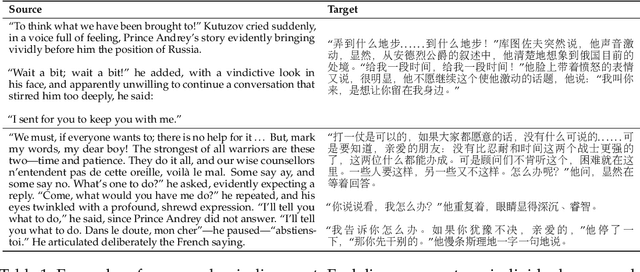
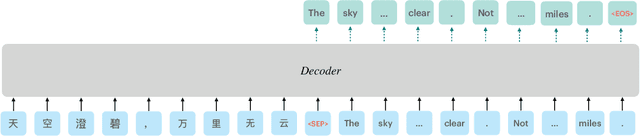
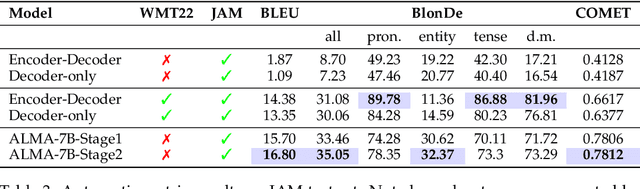
Discourse phenomena in existing document-level translation datasets are sparse, which has been a fundamental obstacle in the development of context-aware machine translation models. Moreover, most existing document-level corpora and context-aware machine translation methods rely on an unrealistic assumption on sentence-level alignments. To mitigate these issues, we first curate a novel dataset of Chinese-English literature, which consists of 160 books with intricate discourse structures. Then, we propose a more pragmatic and challenging setting for context-aware translation, termed chapter-to-chapter (Ch2Ch) translation, and investigate the performance of commonly-used machine translation models under this setting. Furthermore, we introduce a potential approach of finetuning large language models (LLMs) within the domain of Ch2Ch literary translation, yielding impressive improvements over baselines. Through our comprehensive analysis, we unveil that literary translation under the Ch2Ch setting is challenging in nature, with respect to both model learning methods and translation decoding algorithms.