 Add to Chrome
 Add to Firefox
 Add to Edge
CrossFuse: A Novel Cross Attention Mechanism based Infrared and Visible Image Fusion Approach
Jun 15, 2024
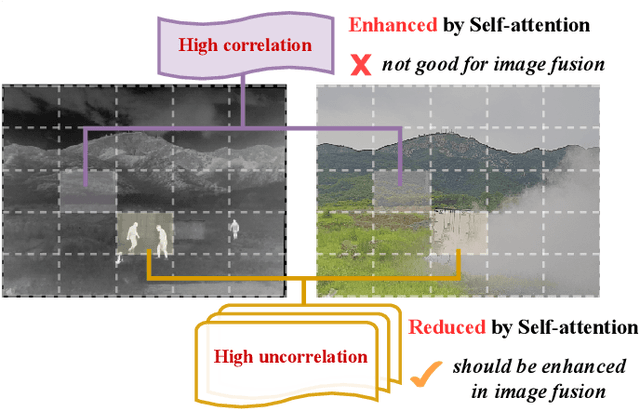
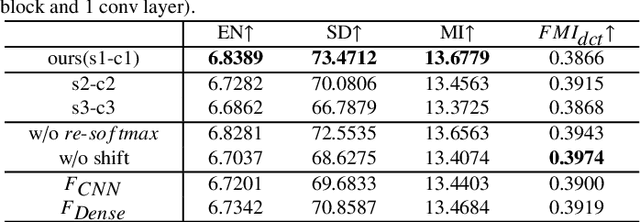
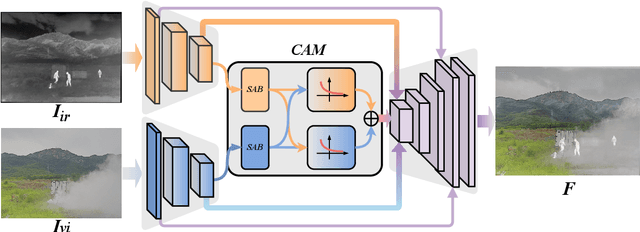

Multimodal visual information fusion aims to integrate the multi-sensor data into a single image which contains more complementary information and less redundant features. However the complementary information is hard to extract, especially for infrared and visible images which contain big similarity gap between these two modalities. The common cross attention modules only consider the correlation, on the contrary, image fusion tasks need focus on complementarity (uncorrelation). Hence, in this paper, a novel cross attention mechanism (CAM) is proposed to enhance the complementary information. Furthermore, a two-stage training strategy based fusion scheme is presented to generate the fused images. For the first stage, two auto-encoder networks with same architecture are trained for each modality. Then, with the fixed encoders, the CAM and a decoder are trained in the second stage. With the trained CAM, features extracted from two modalities are integrated into one fused feature in which the complementary information is enhanced and the redundant features are reduced. Finally, the fused image can be generated by the trained decoder. The experimental results illustrate that our proposed fusion method obtains the SOTA fusion performance compared with the existing fusion networks. The codes are available at https://github.com/hli1221/CrossFuse

CDeFuse: Continuous Decomposition for Infrared and Visible Image Fusion
Jun 07, 2024As a common image processing technique, image decomposition is often used to extract complementary information between modalities. In current decomposition-based image fusion methods, typically, source images are decomposed into three parts at single scale (i.e., visible-exclusive part, infrared-exclusive part, and common part) and lacking interaction between modalities during the decomposition process. These results in the inability of fusion images to effectively focus on finer complementary information between modalities at various scales. To address the above issue, a novel decomposition mechanism, Continuous Decomposition Fusion (CDeFuse), is proposed. Firstly, CDeFuse extends the original three-part decomposition to a more general K-part decomposition at each scale through similarity constraints to fuse multi-scale information and achieve a finer representation of decomposition features. Secondly, a Continuous Decomposition Module (CDM) is introduced to assist K-part decomposition. Its core component, State Transformer (ST), efficiently captures complementary information between modalities by utilizing multi-head self-attention mechanism. Finally, a novel decomposition loss function and the corresponding computational optimization strategy are utilized to ensure the smooth progress of the decomposition process while maintaining linear growth in time complexity with the number of decomposition results K. Extensive experiments demonstrate that our CDeFuse achieves comparable performance compared to previous methods. The code will be publicly available.
Seed-TTS: A Family of High-Quality Versatile Speech Generation Models
Jun 04, 2024


We introduce Seed-TTS, a family of large-scale autoregressive text-to-speech (TTS) models capable of generating speech that is virtually indistinguishable from human speech. Seed-TTS serves as a foundation model for speech generation and excels in speech in-context learning, achieving performance in speaker similarity and naturalness that matches ground truth human speech in both objective and subjective evaluations. With fine-tuning, we achieve even higher subjective scores across these metrics. Seed-TTS offers superior controllability over various speech attributes such as emotion and is capable of generating highly expressive and diverse speech for speakers in the wild. Furthermore, we propose a self-distillation method for speech factorization, as well as a reinforcement learning approach to enhance model robustness, speaker similarity, and controllability. We additionally present a non-autoregressive (NAR) variant of the Seed-TTS model, named $\text{Seed-TTS}_\text{DiT}$, which utilizes a fully diffusion-based architecture. Unlike previous NAR-based TTS systems, $\text{Seed-TTS}_\text{DiT}$ does not depend on pre-estimated phoneme durations and performs speech generation through end-to-end processing. We demonstrate that this variant achieves comparable performance to the language model-based variant and showcase its effectiveness in speech editing. We encourage readers to listen to demos at \url{https://bytedancespeech.github.io/seedtts_tech_report}.
S4Fusion: Saliency-aware Selective State Space Model for Infrared Visible Image Fusion
Jun 03, 2024As one of the tasks in Image Fusion, Infrared and Visible Image Fusion aims to integrate complementary information captured by sensors of different modalities into a single image. The Selective State Space Model (SSSM), known for its ability to capture long-range dependencies, has demonstrated its potential in the field of computer vision. However, in image fusion, current methods underestimate the potential of SSSM in capturing the global spatial information of both modalities. This limitation prevents the simultaneous consideration of the global spatial information from both modalities during interaction, leading to a lack of comprehensive perception of salient targets. Consequently, the fusion results tend to bias towards one modality instead of adaptively preserving salient targets. To address this issue, we propose the Saliency-aware Selective State Space Fusion Model (S4Fusion). In our S4Fusion, the designed Cross-Modal Spatial Awareness Module (CMSA) can simultaneously focus on global spatial information from both modalities while facilitating their interaction, thereby comprehensively capturing complementary information. Additionally, S4Fusion leverages a pre-trained network to perceive uncertainty in the fused images. By minimizing this uncertainty, S4Fusion adaptively highlights salient targets from both images. Extensive experiments demonstrate that our approach produces high-quality images and enhances performance in downstream tasks.
DreamPhysics: Learning Physical Properties of Dynamic 3D Gaussians with Video Diffusion Priors
Jun 03, 2024Dynamic 3D interaction has witnessed great interest in recent works, while creating such 4D content remains challenging. One solution is to animate 3D scenes with physics-based simulation, and the other is to learn the deformation of static 3D objects with the distillation of video generative models. The former one requires assigning precise physical properties to the target object, otherwise the simulated results would become unnatural. The latter tends to formulate the video with minor motions and discontinuous frames, due to the absence of physical constraints in deformation learning. We think that video generative models are trained with real-world captured data, capable of judging physical phenomenon in simulation environments. To this end, we propose DreamPhysics in this work, which estimates physical properties of 3D Gaussian Splatting with video diffusion priors. DreamPhysics supports both image- and text-conditioned guidance, optimizing physical parameters via score distillation sampling with frame interpolation and log gradient. Based on a material point method simulator with proper physical parameters, our method can generate 4D content with realistic motions. Experimental results demonstrate that, by distilling the prior knowledge of video diffusion models, inaccurate physical properties can be gradually refined for high-quality simulation. Codes are released at: https://github.com/tyhuang0428/DreamPhysics.
CoMoFusion: Fast and High-quality Fusion of Infrared and Visible Image with Consistency Model
May 31, 2024Generative models are widely utilized to model the distribution of fused images in the field of infrared and visible image fusion. However, current generative models based fusion methods often suffer from unstable training and slow inference speed. To tackle this problem, a novel fusion method based on consistency model is proposed, termed as CoMoFusion, which can generate the high-quality images and achieve fast image inference speed. In specific, the consistency model is used to construct multi-modal joint features in the latent space with the forward and reverse process. Then, the infrared and visible features extracted by the trained consistency model are fed into fusion module to generate the final fused image. In order to enhance the texture and salient information of fused images, a novel loss based on pixel value selection is also designed. Extensive experiments on public datasets illustrate that our method obtains the SOTA fusion performance compared with the existing fusion methods.
Enhancing Security and Privacy in Federated Learning using Update Digests and Voting-Based Defense
May 29, 2024


Federated Learning (FL) is a promising privacy-preserving machine learning paradigm that allows data owners to collaboratively train models while keeping their data localized. Despite its potential, FL faces challenges related to the trustworthiness of both clients and servers, especially in the presence of curious or malicious adversaries. In this paper, we introduce a novel framework named \underline{\textbf{F}}ederated \underline{\textbf{L}}earning with \underline{\textbf{U}}pdate \underline{\textbf{D}}igest (FLUD), which addresses the critical issues of privacy preservation and resistance to Byzantine attacks within distributed learning environments. FLUD utilizes an innovative approach, the $\mathsf{LinfSample}$ method, allowing clients to compute the $l_{\infty}$ norm across sliding windows of updates as an update digest. This digest enables the server to calculate a shared distance matrix, significantly reducing the overhead associated with Secure Multi-Party Computation (SMPC) by three orders of magnitude while effectively distinguishing between benign and malicious updates. Additionally, FLUD integrates a privacy-preserving, voting-based defense mechanism that employs optimized SMPC protocols to minimize communication rounds. Our comprehensive experiments demonstrate FLUD's effectiveness in countering Byzantine adversaries while incurring low communication and runtime overhead. FLUD offers a scalable framework for secure and reliable FL in distributed environments, facilitating its application in scenarios requiring robust data management and security.
Real-Time and Accurate: Zero-shot High-Fidelity Singing Voice Conversion with Multi-Condition Flow Synthesis
May 23, 2024Singing voice conversion is to convert the source sing voice into the target sing voice except for the content. Currently, flow-based models can complete the task of voice conversion, but they struggle to effectively extract latent variables in the more rhythmically rich and emotionally expressive task of singing voice conversion, while also facing issues with low efficiency in speech processing. In this paper, we propose a high-fidelity flow-based model based on multi-decoupling feature constraints, which enhances the capture of vocal details by integrating multiple encoders. We also use iSTFT to enhance the speed of speech processing by replacing some layers of the Vocoder. We compare the synthesized singing voice with other models from multiple dimensions, and our proposed model is highly consistent with the current state-of-the-art, with the demo which is available at \url{https://lazycat1119.github.io/RASVC-demo/}
decoupleQ: Towards 2-bit Post-Training Uniform Quantization via decoupling Parameters into Integer and Floating Points
Apr 19, 2024

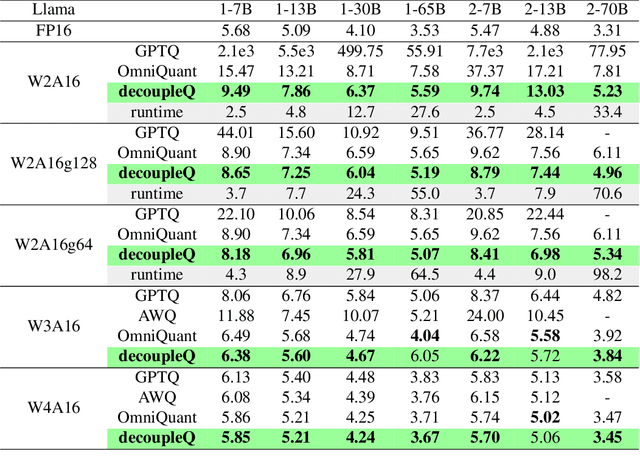

Quantization emerges as one of the most promising compression technologies for deploying efficient large models for various real time application in recent years. Considering that the storage and IO of weights take up the vast majority of the overhead inside a large model, weight only quantization can lead to large gains. However, existing quantization schemes suffer from significant accuracy degradation at very low bits, or require some additional computational overhead when deployed, making it difficult to be applied to large-scale applications in industry. In this paper, we propose decoupleQ, achieving a substantial increase in model accuracy, especially at very low bits. decoupleQ abandons the traditional heuristic quantization paradigm and decouples the model parameters into integer and floating-point parts, thus transforming the quantization problem into a traditional mathematical optimization problem with constraints, which is then solved alternatively by off-the-shelf optimization methods. Quantization via decoupleQ is linear and uniform, making it hardware-friendlier than non-uniform counterpart, and enabling the idea to be migrated to high-bit quantization to enhance its robustness. Our method has achieved well on-line accuracy near fp16/bf16 on the 2-bit quantization of large speech models in ByteDance. The code is available at https://github.com/bytedance/decoupleQ
Gemini 1.5: Unlocking multimodal understanding across millions of tokens of context
Mar 08, 2024In this report, we present the latest model of the Gemini family, Gemini 1.5 Pro, a highly compute-efficient multimodal mixture-of-experts model capable of recalling and reasoning over fine-grained information from millions of tokens of context, including multiple long documents and hours of video and audio. Gemini 1.5 Pro achieves near-perfect recall on long-context retrieval tasks across modalities, improves the state-of-the-art in long-document QA, long-video QA and long-context ASR, and matches or surpasses Gemini 1.0 Ultra's state-of-the-art performance across a broad set of benchmarks. Studying the limits of Gemini 1.5 Pro's long-context ability, we find continued improvement in next-token prediction and near-perfect retrieval (>99%) up to at least 10M tokens, a generational leap over existing models such as Claude 2.1 (200k) and GPT-4 Turbo (128k). Finally, we highlight surprising new capabilities of large language models at the frontier; when given a grammar manual for Kalamang, a language with fewer than 200 speakers worldwide, the model learns to translate English to Kalamang at a similar level to a person who learned from the same content.