 Add to Chrome
 Add to Firefox
 Add to Edge
CPI-Bench: A Comprehensive,Practical and Intelligent Benchmark for Real-World Image Editing
Aug 14, 2026
With the rapid advancement of image editing models and their widespread application across various domains, there is an increasingly urgent need to deploy these model capabilities directly into real-world scenarios. However, existing benchmarks remain confined to simple single-image tasks, suffering from limited coverage dimensions and an inability to effectively differentiate performance among diverse models. Consequently, they fail to reliably evaluate model performance in complex multi-image editing, highly demanding reasoning instructions, and practical deployment settings. To address these limitations, we propose CPI-Bench, a Comprehensive, Practical andIntelligent benchmark for real-world image editing. CPI-Bench comprises three core subsets: CPI-General-Bench, which comprehensively covers diverse editing tasks and pioneers the inclusion of multi-image editing evaluation; CPI-Practical-Bench, which focuses on high-frequency real-user application scenarios; and CPI-Intelligent-Bench, which is dedicated to evaluating capabilities in highly demanding reasoning-based editing. Evaluation results of mainstream image editing models based on CPI-Bench demonstrate that CPI-Bench enhances performance differentiation among models. It provides a comprehensive and reliable quantification of gaps in general editing capabilities, practical deployment efficacy, and advanced reasoning-based editing, offering invaluable guidance for the future optimization of image editing models. Crucially, our ranking analysis reveals that CPI-Bench achieves the highest alignment with the Arena Image Edit Leaderboard, indicating it faithfully captures the preferences and perceptual judgments of human evaluators, serving as a robust proxy for real-world user experience.

Instruction-based Image Editing: A Survey on Data, Models, Evaluation, and Applications
Jul 28, 2026Instruction-based Image Editing (IIE) aims to transform a given image into a new one based on textual instructions. Advances in Large Language Models (LLMs) and Vision-Language Models (VLMs) have accelerated progress toward practical ``one-sentence image editing" systems. This survey presents a systematic taxonomy and comprehensive review of IIE research, structured around five core dimensions: (1) task definition and hierarchical categorization of editing operations, (2) methodologies for training data construction, (3) architectural evolution from GAN-based to diffusion and autoregressive paradigms, (4) standardized evaluation metrics and benchmark development, and (5) introduction of commercial solutions. Our analysis shows critical technological milestones across model generations. We further propose a Comprehensive, in-Depth, and Diagnostic benchmark for IIE task (CDD-IIE Bench), which can rigorously assess the multiple aspects of model performance. Through empirical comparisons of open-source solutions, we highlight their respective capabilities and limitations. Finally, we discuss future research directions to advance the field.
* 33 pages, 7 figures, Vicinagearth
DataEvolver: Let Your Data Build and Improve Itself via Goal-Driven Loop Agents
May 03, 2026Constructing controllable visual data is a major bottleneck for image editing and multimodal understanding. Useful supervision is rarely produced by a single rendering pass; instead it emerges through iterative generation, inspection, correction, filtering, and export. We present DataEvolver, a closed-loop visual data engine that organizes this process around explicit goals, persistent artifacts, bounded corrective actions, and acceptance decisions. DataEvolver supports multiple artifact types, including RGB images, masks, depth maps, normal maps, meshes, poses, trajectories, and review traces. In the current release, the system operates through two coupled loops: generation-time self-correction within each sample and validation-time self-expansion across dataset rounds. We validate the framework on an image-level object-rotation setting. With a fixed Qwen-Edit LoRA probe, our final Ours+DualGate model outperforms both the unadapted base model and a public multi-angle LoRA on SpatialEdit and a held-out evaluation set. Ablations show a consistent improvement path from scene-aware generation to feedback-driven correction and dual-gated validation. Beyond the released rotation data, our main contribution is a reusable framework for building visual datasets through explicit goal tracking, review, correction, and acceptance loops.
LLM-Guided Safety Agent for Edge Robotics with an ISO-Compliant Perception-Compute-Control Architecture
Apr 22, 2026Ensuring functional safety in human-robot interaction is challenging because AI perception is inherently probabilistic, whereas industrial standards require deterministic behavior. We present an LLM-guided safety agent for edge robotics, built on an ISO-compliant low-latency perception-compute-control architecture. Our method translates natural-language safety regulations into executable predicates and deploys them through a redundant heterogeneous edge runtime. For fault-tolerant closed-loop execution under edge constraints, we adopt a symmetric dual-modular redundancy design with parallel independent execution for low-latency perception, computation, and control. We prototype the system on a dual-RK3588 platform and evaluate it in representative human-robot interaction scenarios. The results demonstrate a practical edge implementation path toward ISO 13849 Category 3 and PL d using cost-effective hardware, supporting practical deployment of safety-critical embodied AI.
Geometric Image Editing via Effects-Sensitive In-Context Inpainting with Diffusion Transformers
Feb 09, 2026Recent advances in diffusion models have significantly improved image editing. However, challenges persist in handling geometric transformations, such as translation, rotation, and scaling, particularly in complex scenes. Existing approaches suffer from two main limitations: (1) difficulty in achieving accurate geometric editing of object translation, rotation, and scaling; (2) inadequate modeling of intricate lighting and shadow effects, leading to unrealistic results. To address these issues, we propose GeoEdit, a framework that leverages in-context generation through a diffusion transformer module, which integrates geometric transformations for precise object edits. Moreover, we introduce Effects-Sensitive Attention, which enhances the modeling of intricate lighting and shadow effects for improved realism. To further support training, we construct RS-Objects, a large-scale geometric editing dataset containing over 120,000 high-quality image pairs, enabling the model to learn precise geometric editing while generating realistic lighting and shadows. Extensive experiments on public benchmarks demonstrate that GeoEdit consistently outperforms state-of-the-art methods in terms of visual quality, geometric accuracy, and realism.
Everything-Grasping (EG) Gripper: A Universal Gripper with Synergistic Suction-Grasping Capabilities for Cross-Scale and Cross-State Manipulation
Oct 06, 2025Grasping objects across vastly different sizes and physical states-including both solids and liquids-with a single robotic gripper remains a fundamental challenge in soft robotics. We present the Everything-Grasping (EG) Gripper, a soft end-effector that synergistically integrates distributed surface suction with internal granular jamming, enabling cross-scale and cross-state manipulation without requiring airtight sealing at the contact interface with target objects. The EG Gripper can handle objects with surface areas ranging from sub-millimeter scale 0.2 mm2 (glass bead) to over 62,000 mm2 (A4 sized paper and woven bag), enabling manipulation of objects nearly 3,500X smaller and 88X larger than its own contact area (approximated at 707 mm2 for a 30 mm-diameter base). We further introduce a tactile sensing framework that combines liquid detection and pressure-based suction feedback, enabling real-time differentiation between solid and liquid targets. Guided by the actile-Inferred Grasping Mode Selection (TIGMS) algorithm, the gripper autonomously selects grasping modes based on distributed pressure and voltage signals. Experiments across diverse tasks-including underwater grasping, fragile object handling, and liquid capture-demonstrate robust and repeatable performance. To our knowledge, this is the first soft gripper to reliably grasp both solid and liquid objects across scales using a unified compliant architecture.
FairHuman: Boosting Hand and Face Quality in Human Image Generation with Minimum Potential Delay Fairness in Diffusion Models
Jul 03, 2025Image generation has achieved remarkable progress with the development of large-scale text-to-image models, especially diffusion-based models. However, generating human images with plausible details, such as faces or hands, remains challenging due to insufficient supervision of local regions during training. To address this issue, we propose FairHuman, a multi-objective fine-tuning approach designed to enhance both global and local generation quality fairly. Specifically, we first construct three learning objectives: a global objective derived from the default diffusion objective function and two local objectives for hands and faces based on pre-annotated positional priors. Subsequently, we derive the optimal parameter updating strategy under the guidance of the Minimum Potential Delay (MPD) criterion, thereby attaining fairness-ware optimization for this multi-objective problem. Based on this, our proposed method can achieve significant improvements in generating challenging local details while maintaining overall quality. Extensive experiments showcase the effectiveness of our method in improving the performance of human image generation under different scenarios.
Adverse Event Extraction from Discharge Summaries: A New Dataset, Annotation Scheme, and Initial Findings
Jun 17, 2025In this work, we present a manually annotated corpus for Adverse Event (AE) extraction from discharge summaries of elderly patients, a population often underrepresented in clinical NLP resources. The dataset includes 14 clinically significant AEs-such as falls, delirium, and intracranial haemorrhage, along with contextual attributes like negation, diagnosis type, and in-hospital occurrence. Uniquely, the annotation schema supports both discontinuous and overlapping entities, addressing challenges rarely tackled in prior work. We evaluate multiple models using FlairNLP across three annotation granularities: fine-grained, coarse-grained, and coarse-grained with negation. While transformer-based models (e.g., BERT-cased) achieve strong performance on document-level coarse-grained extraction (F1 = 0.943), performance drops notably for fine-grained entity-level tasks (e.g., F1 = 0.675), particularly for rare events and complex attributes. These results demonstrate that despite high-level scores, significant challenges remain in detecting underrepresented AEs and capturing nuanced clinical language. Developed within a Trusted Research Environment (TRE), the dataset is available upon request via DataLoch and serves as a robust benchmark for evaluating AE extraction methods and supporting future cross-dataset generalisation.
MP-Mat: A 3D-and-Instance-Aware Human Matting and Editing Framework with Multiplane Representation
Apr 20, 2025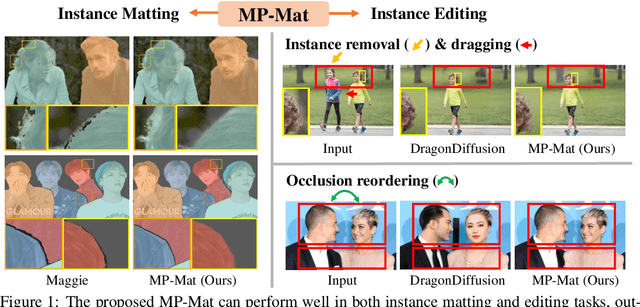
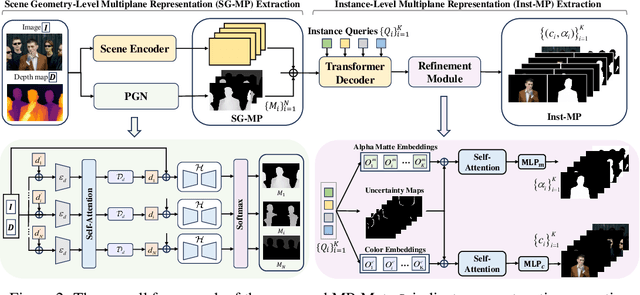
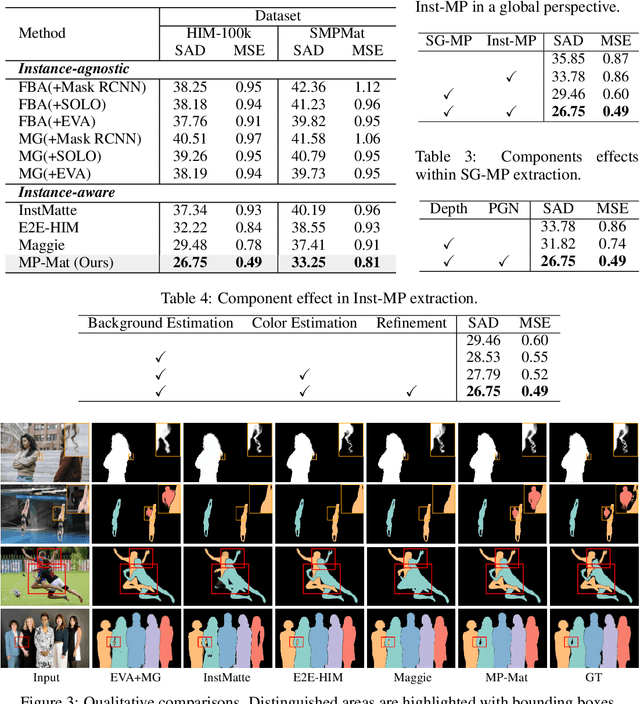
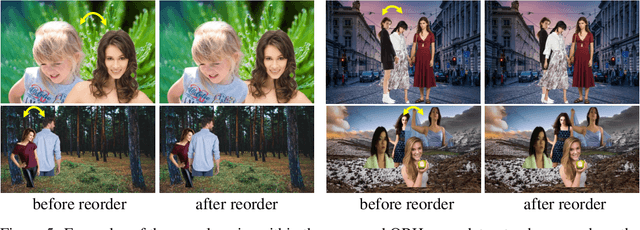
Human instance matting aims to estimate an alpha matte for each human instance in an image, which is challenging as it easily fails in complex cases requiring disentangling mingled pixels belonging to multiple instances along hairy and thin boundary structures. In this work, we address this by introducing MP-Mat, a novel 3D-and-instance-aware matting framework with multiplane representation, where the multiplane concept is designed from two different perspectives: scene geometry level and instance level. Specifically, we first build feature-level multiplane representations to split the scene into multiple planes based on depth differences. This approach makes the scene representation 3D-aware, and can serve as an effective clue for splitting instances in different 3D positions, thereby improving interpretability and boundary handling ability especially in occlusion areas. Then, we introduce another multiplane representation that splits the scene in an instance-level perspective, and represents each instance with both matte and color. We also treat background as a special instance, which is often overlooked by existing methods. Such an instance-level representation facilitates both foreground and background content awareness, and is useful for other down-stream tasks like image editing. Once built, the representation can be reused to realize controllable instance-level image editing with high efficiency. Extensive experiments validate the clear advantage of MP-Mat in matting task. We also demonstrate its superiority in image editing tasks, an area under-explored by existing matting-focused methods, where our approach under zero-shot inference even outperforms trained specialized image editing techniques by large margins. Code is open-sourced at https://github.com/JiaoSiyi/MPMat.git}.
Object-Aware Video Matting with Cross-Frame Guidance
Mar 03, 2025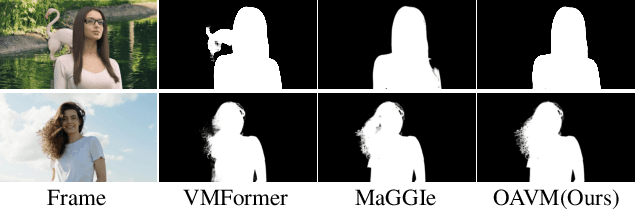
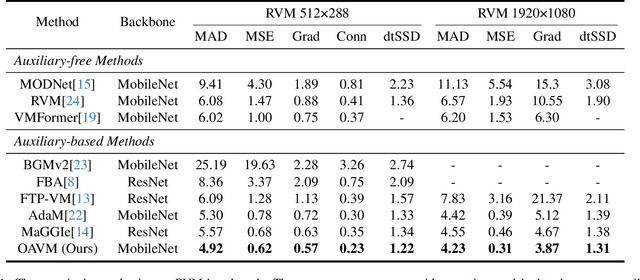
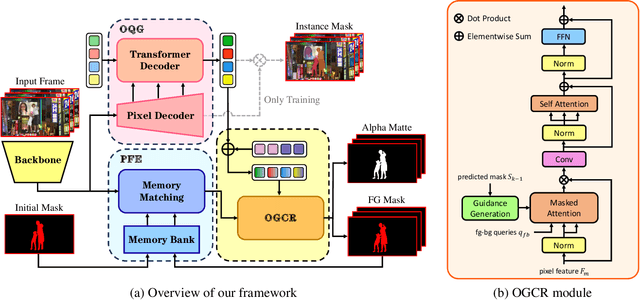
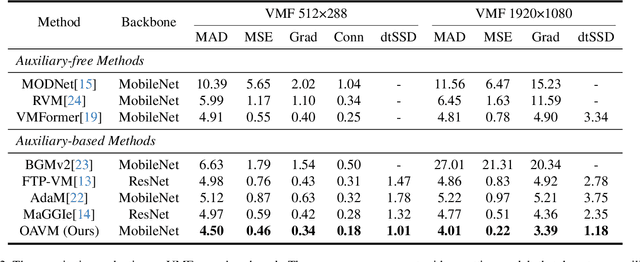
Recently, trimap-free methods have drawn increasing attention in human video matting due to their promising performance. Nevertheless, these methods still suffer from the lack of deterministic foreground-background cues, which impairs their ability to consistently identify and locate foreground targets over time and mine fine-grained details. In this paper, we present a trimap-free Object-Aware Video Matting (OAVM) framework, which can perceive different objects, enabling joint recognition of foreground objects and refinement of edge details. Specifically, we propose an Object-Guided Correction and Refinement (OGCR) module, which employs cross-frame guidance to aggregate object-level instance information into pixel-level detail features, thereby promoting their synergy. Furthermore, we design a Sequential Foreground Merging augmentation strategy to diversify sequential scenarios and enhance capacity of the network for object discrimination. Extensive experiments on recent widely used synthetic and real-world benchmarks demonstrate the state-of-the-art performance of our OAVM with only an initial coarse mask. The code and model will be available.