 Add to Chrome
 Add to Firefox
 Add to Edge
Engram-E2VID: Reference-Based Event-to-Video Reconstruction via Generative Activation of Appearance Engrams
Aug 06, 2026
Reference-based event-to-video reconstruction aims to recover target RGB frames from a reference frame and the event stream captured over the reference-to-target interval. Although events provide fine-grained temporal cues, they encode sparse and asynchronous log-intensity changes rather than absolute appearance, making faithful reconstruction intrinsically challenging. The central challenge lies in associating event-derived target-time structures with relevant appearance information from the reference frame, especially under complex motion and long temporal intervals. In this work, we propose Engram-E2VID, a structure-guided framework that reconstructs target frames through the generative activation of appearance engrams. Specifically, the reference frame is encoded into token-space appearance engrams, while the event stream and reference context are transformed into a target-time motion-structure scaffold that captures motion boundaries and event-induced structural changes. Within a one-step diffusion backbone, scaffold-derived structural tokens progressively interact with and activate relevant appearance engrams across layers. This token-space association allows target structures to access reference appearance without relying on direct pixel-wise correspondence, while the diffusion prior complements uncertain or newly revealed regions. Across three benchmarks, Engram-E2VID improves PSNR by up to 3.29 dB and reduces LPIPS by up to 0.08 over the strongest same-input baseline, while degrading more slowly as the reconstruction interval increases.

BeyondFusion: Self-Aligned Latent Diffusion for Calibration-Free Infrared Super-Resolution and Infrared-Visible Fusion
Jul 27, 2026Mobile infrared-visible imaging typically pairs a compact infrared sensor with a high-resolution visible camera for complementary perception. While cross-sensor misalignment caused by different optics, viewpoints, fields of view, and exposure timings hinders practical deployment. In this paper, we propose BeyondFusion, a unified latent diffusion framework for calibration-free visible-guided infrared super-resolution and infrared-visible fusion tasks. The proposed framework supports both task-specific training and joint training where two tasks are optimized and executed as two readouts of the same generative process. Instead of relying on explicit registration or geometric warping, BeyondFusion introduces a cross-modal self-aligning (CMSA) module into the denoising U-Net. CMSA reorganizes infrared and visible latent tokens into a shared attention space to learn content-adaptive cross-modal correspondence during the denoising process. Together with misalignment augmentation module, the model is facilitated to exploit visible structural and semantic cues while preserving thermal consistency, enabling high-frequency infrared reconstruction and informative fused-image generation under uncalibrated conditions. Extensive experiments on public benchmarks and a mobile infrared-visible imaging system show strong performance across aligned inputs, low-resolution infrared observations, synthetic misalignments, and real mobile captures with unsynchronized sensors. Ablation studies, unified training analysis, and downstream pedestrian detection further validate the effectiveness of BeyondFusion for calibration-free multimodal imaging.
FS-DVS: A Frequency-Selective Dynamic Visual Sensing Paradigm for Enhancing Information Completeness
Jun 05, 2026Dynamic vision sensors (DVS) offer exceptional temporal resolution and dynamic range by asynchronously reporting pixel-level intensity changes. However, conventional DVS rely on a per-pixel independent triggering mechanism, ignoring the spatial integration performed by biological retinal ganglion cells (RGCs). Consequently, they lack the contrast sensitivity function (CSF) and its inherent sensitivity to mid-spatial frequencies, which inevitably leads to information incompleteness due to sub-threshold signal loss. To bridge this gap, we propose FS-DVS (Frequency-Selective Dynamic Vision Sensor), a novel paradigm that integrates a learnable spatial filter strictly preceding the event triggering process to mimic the RGC aggregation mechanism. By developing a differentiable event simulation framework, the spatial filter can be optimized end-to-end with downstream tasks. Our study reveals that starting from a delta function, the learned spatial filters spontaneously evolve into center-surround patterns that emphasize mid-frequency components, consistently aligning with human CSF. Beyond achieving substantial performance gains in object detection and action recognition, the consistent convergence to human-like CSF characteristics across different tasks underscores the universality of this mid-frequency selective mechanism. Compared to naively increasing sensor sensitivity or relying on post-processing, our paradigm achieves selective information enhancement with high noise resilience, providing a robust, biologically plausible blueprint for next-generation neuromorphic sensors.
LUCID: Learning Unified Control for Image Deflaring and Exposure Mastery in Nighttime Photography
Jun 05, 2026Photography is the art of painting with light, yet nighttime scenes are shaped by competing degradations: intense flares obscure scene structure, while photon-limited regions collapse into noise. Conventional approaches address these factors in isolation, overlooking the fact that these degradations are fundamentally entangled. To bridge this gap, we introduce LUCID, a unified framework that reframes nighttime restoration as a continuous and controllable process rather than a fixed correction. We decompose nighttime restoration into two cooperative components: a flare disentanglement module that lifts the 'curtain' of optical artifacts to provide reliable structural guidance, and a diffusion-driven module that leverages generative priors to reconstruct clean and well-exposed imagery. Crucially, LUCID introduces explicit controllability through a novel four-mode training strategy, enabling users to steer the restoration process via classifier-free guidance (CFG) and allowing selective control over light sources and their associated flare and ghosting artifacts, while also supporting high dynamic range (HDR) reconstruction through continuous exposure control. Extensive experiments demonstrate that LUCID consistently outperforms state-of-the-art methods across diverse real-world nighttime scenarios.
LLM-Guided Safety Agent for Edge Robotics with an ISO-Compliant Perception-Compute-Control Architecture
Apr 22, 2026Ensuring functional safety in human-robot interaction is challenging because AI perception is inherently probabilistic, whereas industrial standards require deterministic behavior. We present an LLM-guided safety agent for edge robotics, built on an ISO-compliant low-latency perception-compute-control architecture. Our method translates natural-language safety regulations into executable predicates and deploys them through a redundant heterogeneous edge runtime. For fault-tolerant closed-loop execution under edge constraints, we adopt a symmetric dual-modular redundancy design with parallel independent execution for low-latency perception, computation, and control. We prototype the system on a dual-RK3588 platform and evaluate it in representative human-robot interaction scenarios. The results demonstrate a practical edge implementation path toward ISO 13849 Category 3 and PL d using cost-effective hardware, supporting practical deployment of safety-critical embodied AI.
ShareVerse: Multi-Agent Consistent Video Generation for Shared World Modeling
Mar 03, 2026This paper presents ShareVerse, a video generation framework enabling multi-agent shared world modeling, addressing the gap in existing works that lack support for unified shared world construction with multi-agent interaction. ShareVerse leverages the generation capability of large video models and integrates three key innovations: 1) A dataset for large-scale multi-agent interactive world modeling is built on the CARLA simulation platform, featuring diverse scenes, weather conditions, and interactive trajectories with paired multi-view videos (front/ rear/ left/ right views per agent) and camera data. 2) We propose a spatial concatenation strategy for four-view videos of independent agents to model a broader environment and to ensure internal multi-view geometric consistency. 3) We integrate cross-agent attention blocks into the pretrained video model, which enable interactive transmission of spatial-temporal information across agents, guaranteeing shared world consistency in overlapping regions and reasonable generation in non-overlapping regions. ShareVerse, which supports 49-frame large-scale video generation, accurately perceives the position of dynamic agents and achieves consistent shared world modeling.
Topology-Aware Revival for Efficient Sparse Training
Feb 04, 2026Static sparse training is a promising route to efficient learning by committing to a fixed mask pattern, yet the constrained structure reduces robustness. Early pruning decisions can lock the network into a brittle structure that is difficult to escape, especially in deep reinforcement learning (RL) where the evolving policy continually shifts the training distribution. We propose Topology-Aware Revival (TAR), a lightweight one-shot post-pruning procedure that improves static sparsity without dynamic rewiring. After static pruning, TAR performs a single revival step by allocating a small reserve budget across layers according to topology needs, randomly uniformly reactivating a few previously pruned connections within each layer, and then keeping the resulting connectivity fixed for the remainder of training. Across multiple continuous-control tasks with SAC and TD3, TAR improves final return over static sparse baselines by up to +37.9% and also outperforms dynamic sparse training baselines with a median gain of +13.5%.
GBR: Generative Bundle Refinement for High-fidelity Gaussian Splatting and Meshing
Dec 08, 2024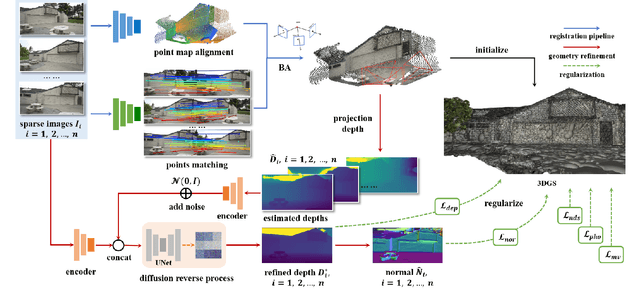
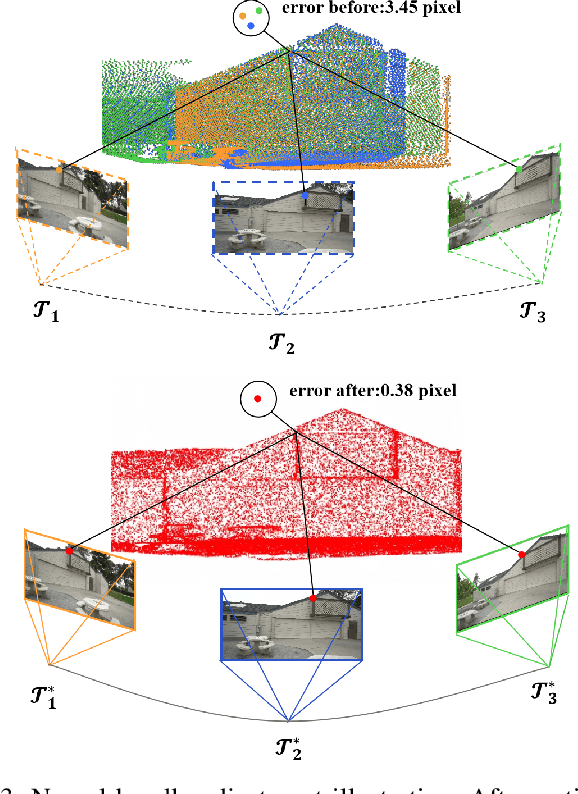
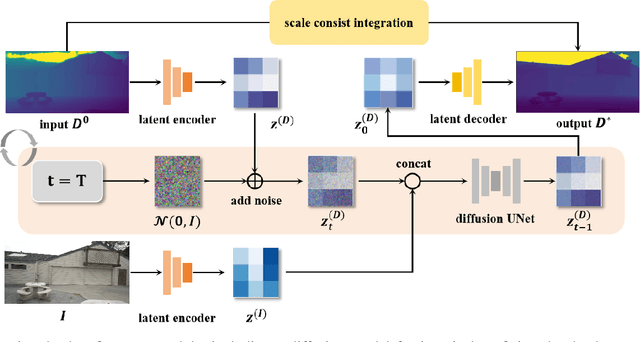
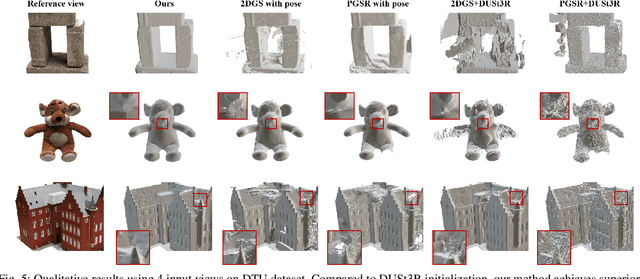
Gaussian splatting has gained attention for its efficient representation and rendering of 3D scenes using continuous Gaussian primitives. However, it struggles with sparse-view inputs due to limited geometric and photometric information, causing ambiguities in depth, shape, and texture. we propose GBR: Generative Bundle Refinement, a method for high-fidelity Gaussian splatting and meshing using only 4-6 input views. GBR integrates a neural bundle adjustment module to enhance geometry accuracy and a generative depth refinement module to improve geometry fidelity. More specifically, the neural bundle adjustment module integrates a foundation network to produce initial 3D point maps and point matches from unposed images, followed by bundle adjustment optimization to improve multiview consistency and point cloud accuracy. The generative depth refinement module employs a diffusion-based strategy to enhance geometric details and fidelity while preserving the scale. Finally, for Gaussian splatting optimization, we propose a multimodal loss function incorporating depth and normal consistency, geometric regularization, and pseudo-view supervision, providing robust guidance under sparse-view conditions. Experiments on widely used datasets show that GBR significantly outperforms existing methods under sparse-view inputs. Additionally, GBR demonstrates the ability to reconstruct and render large-scale real-world scenes, such as the Pavilion of Prince Teng and the Great Wall, with remarkable details using only 6 views.
Zoom in to the details of human-centric videos
May 27, 2020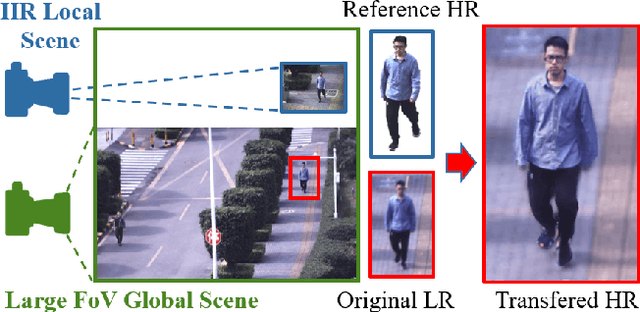
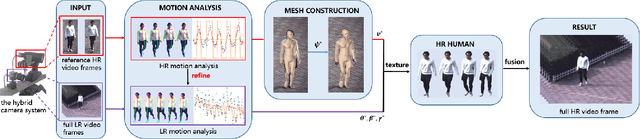
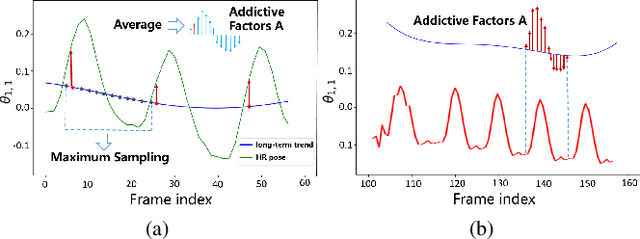
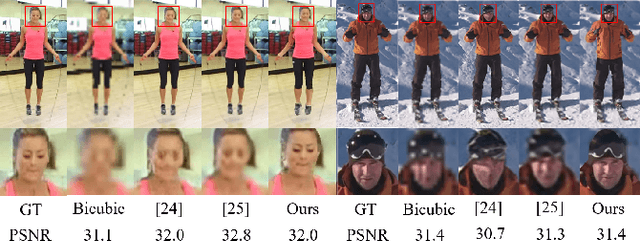
Presenting high-resolution (HR) human appearance is always critical for the human-centric videos. However, current imagery equipment can hardly capture HR details all the time. Existing super-resolution algorithms barely mitigate the problem by only considering universal and low-level priors of im-age patches. In contrast, our algorithm is under bias towards the human body super-resolution by taking advantage of high-level prior defined by HR human appearance. Firstly, a motion analysis module extracts inherent motion pattern from the HR reference video to refine the pose estimation of the low-resolution (LR) sequence. Furthermore, a human body reconstruction module maps the HR texture in the reference frames onto a 3D mesh model. Consequently, the input LR videos get super-resolved HR human sequences are generated conditioned on the original LR videos as well as few HR reference frames. Experiments on an existing dataset and real-world data captured by hybrid cameras show that our approach generates superior visual quality of human body compared with the traditional method.
PANDA: A Gigapixel-level Human-centric Video Dataset
Mar 10, 2020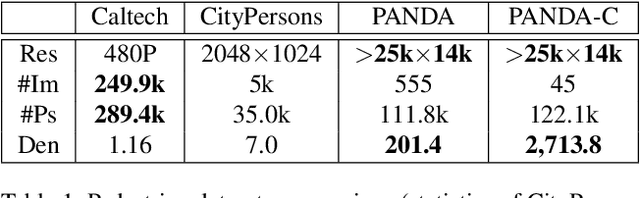

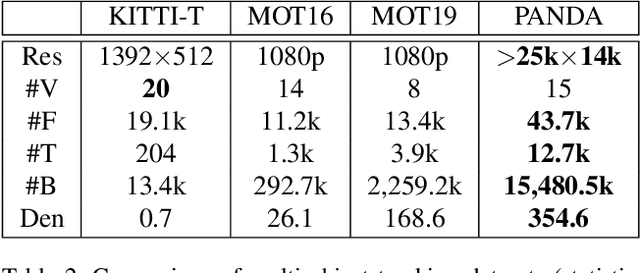
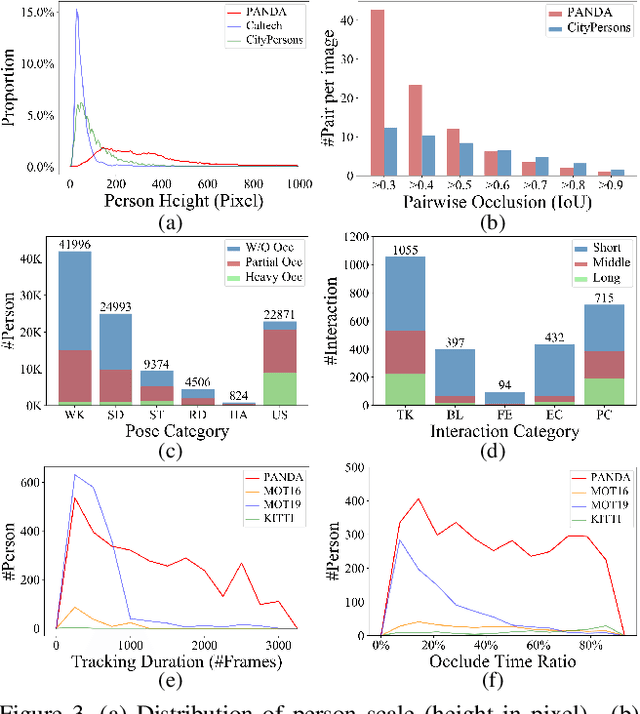
We present PANDA, the first gigaPixel-level humAN-centric viDeo dAtaset, for large-scale, long-term, and multi-object visual analysis. The videos in PANDA were captured by a gigapixel camera and cover real-world scenes with both wide field-of-view (~1 square kilometer area) and high-resolution details (~gigapixel-level/frame). The scenes may contain 4k head counts with over 100x scale variation. PANDA provides enriched and hierarchical ground-truth annotations, including 15,974.6k bounding boxes, 111.8k fine-grained attribute labels, 12.7k trajectories, 2.2k groups and 2.9k interactions. We benchmark the human detection and tracking tasks. Due to the vast variance of pedestrian pose, scale, occlusion and trajectory, existing approaches are challenged by both accuracy and efficiency. Given the uniqueness of PANDA with both wide FoV and high resolution, a new task of interaction-aware group detection is introduced. We design a 'global-to-local zoom-in' framework, where global trajectories and local interactions are simultaneously encoded, yielding promising results. We believe PANDA will contribute to the community of artificial intelligence and praxeology by understanding human behaviors and interactions in large-scale real-world scenes. PANDA Website: http://www.panda-dataset.com.