 Add to Chrome
 Add to Firefox
 Add to Edge
DataEvolver: Let Your Data Build and Improve Itself via Goal-Driven Loop Agents
May 03, 2026
Constructing controllable visual data is a major bottleneck for image editing and multimodal understanding. Useful supervision is rarely produced by a single rendering pass; instead it emerges through iterative generation, inspection, correction, filtering, and export. We present DataEvolver, a closed-loop visual data engine that organizes this process around explicit goals, persistent artifacts, bounded corrective actions, and acceptance decisions. DataEvolver supports multiple artifact types, including RGB images, masks, depth maps, normal maps, meshes, poses, trajectories, and review traces. In the current release, the system operates through two coupled loops: generation-time self-correction within each sample and validation-time self-expansion across dataset rounds. We validate the framework on an image-level object-rotation setting. With a fixed Qwen-Edit LoRA probe, our final Ours+DualGate model outperforms both the unadapted base model and a public multi-angle LoRA on SpatialEdit and a held-out evaluation set. Ablations show a consistent improvement path from scene-aware generation to feedback-driven correction and dual-gated validation. Beyond the released rotation data, our main contribution is a reusable framework for building visual datasets through explicit goal tracking, review, correction, and acceptance loops.

Geometric Image Editing via Effects-Sensitive In-Context Inpainting with Diffusion Transformers
Feb 09, 2026Recent advances in diffusion models have significantly improved image editing. However, challenges persist in handling geometric transformations, such as translation, rotation, and scaling, particularly in complex scenes. Existing approaches suffer from two main limitations: (1) difficulty in achieving accurate geometric editing of object translation, rotation, and scaling; (2) inadequate modeling of intricate lighting and shadow effects, leading to unrealistic results. To address these issues, we propose GeoEdit, a framework that leverages in-context generation through a diffusion transformer module, which integrates geometric transformations for precise object edits. Moreover, we introduce Effects-Sensitive Attention, which enhances the modeling of intricate lighting and shadow effects for improved realism. To further support training, we construct RS-Objects, a large-scale geometric editing dataset containing over 120,000 high-quality image pairs, enabling the model to learn precise geometric editing while generating realistic lighting and shadows. Extensive experiments on public benchmarks demonstrate that GeoEdit consistently outperforms state-of-the-art methods in terms of visual quality, geometric accuracy, and realism.
Physics Informed Constrained Learning of Dynamics from Static Data
Apr 22, 2025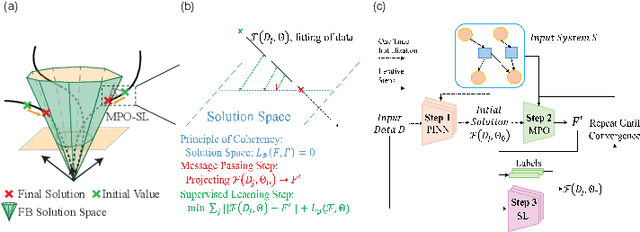
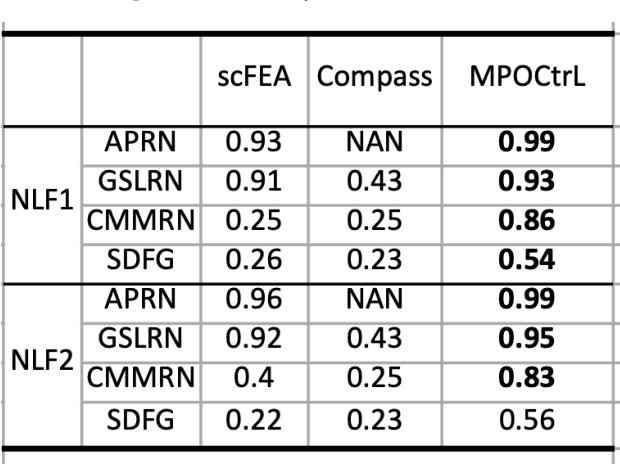
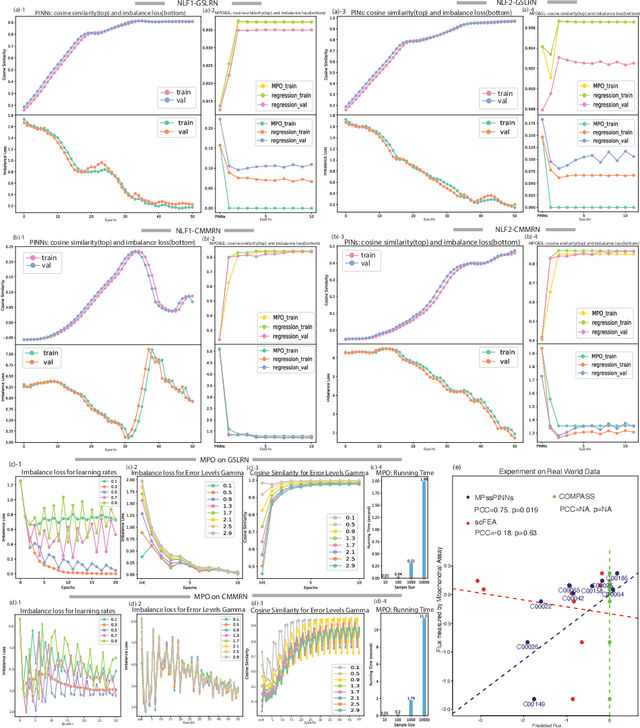
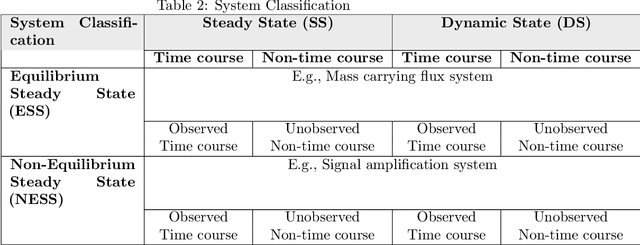
A physics-informed neural network (PINN) models the dynamics of a system by integrating the governing physical laws into the architecture of a neural network. By enforcing physical laws as constraints, PINN overcomes challenges with data scarsity and potentially high dimensionality. Existing PINN frameworks rely on fully observed time-course data, the acquisition of which could be prohibitive for many systems. In this study, we developed a new PINN learning paradigm, namely Constrained Learning, that enables the approximation of first-order derivatives or motions using non-time course or partially observed data. Computational principles and a general mathematical formulation of Constrained Learning were developed. We further introduced MPOCtrL (Message Passing Optimization-based Constrained Learning) an optimization approach tailored for the Constrained Learning framework that strives to balance the fitting of physical models and observed data. Its code is available at github link: https://github.com/ptdang1001/MPOCtrL Experiments on synthetic and real-world data demonstrated that MPOCtrL can effectively detect the nonlinear dependency between observed data and the underlying physical properties of the system. In particular, on the task of metabolic flux analysis, MPOCtrL outperforms all existing data-driven flux estimators.
Active Multi-Object Exploration and Recognition via Tactile Whiskers
Sep 08, 2021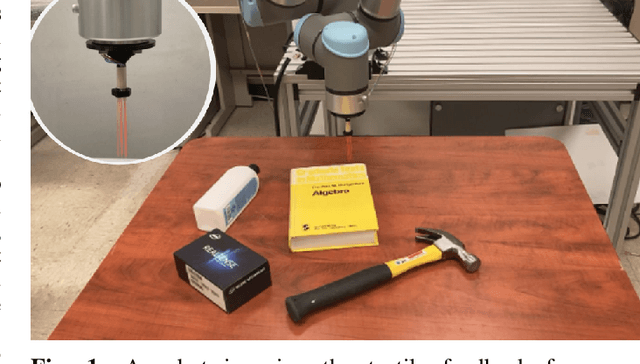
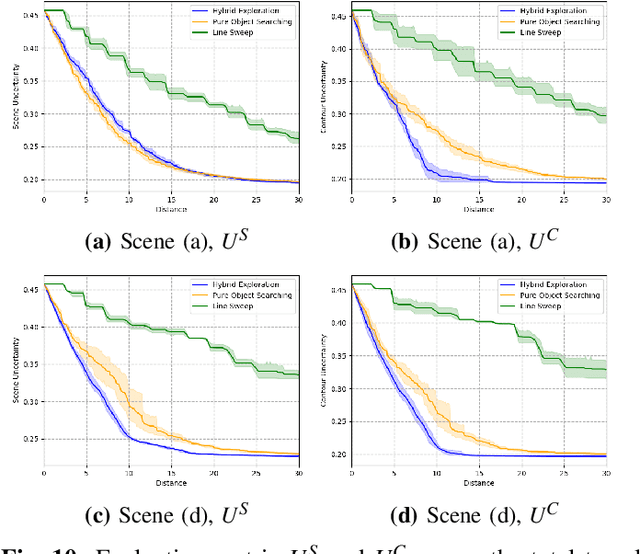
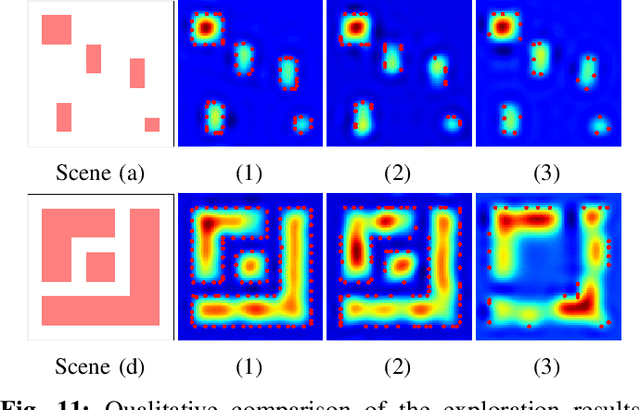
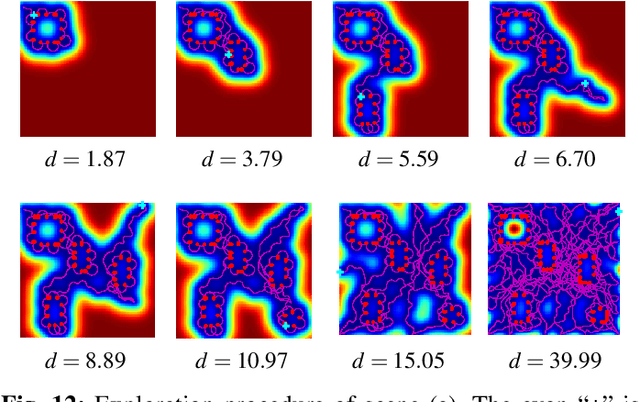
Robotic exploration under uncertain environments is challenging when optical information is not available. In this paper, we propose an autonomous solution of exploring an unknown task space based on tactile sensing alone. We first designed a whisker sensor based on MEMS barometer devices. This sensor can acquire contact information by interacting with the environment non-intrusively. This sensor is accompanied by a planning technique to generate exploration trajectories by using mere tactile perception. This technique relies on a hybrid policy for tactile exploration, which includes a proactive informative path planner for object searching, and a reactive Hopf oscillator for contour tracing. Results indicate that the hybrid exploration policy can increase the efficiency of object discovery. Last, scene understanding was facilitated by segmenting objects and classification. A classifier was developed to recognize the object categories based on the geometric features collected by the whisker sensor. Such an approach demonstrates the whisker sensor, together with the tactile intelligence, can provide sufficiently discriminative features to distinguish objects.