 Add to Chrome
 Add to Firefox
 Add to Edge
Instruction-based Image Editing: A Survey on Data, Models, Evaluation, and Applications
Jul 28, 2026
Instruction-based Image Editing (IIE) aims to transform a given image into a new one based on textual instructions. Advances in Large Language Models (LLMs) and Vision-Language Models (VLMs) have accelerated progress toward practical ``one-sentence image editing" systems. This survey presents a systematic taxonomy and comprehensive review of IIE research, structured around five core dimensions: (1) task definition and hierarchical categorization of editing operations, (2) methodologies for training data construction, (3) architectural evolution from GAN-based to diffusion and autoregressive paradigms, (4) standardized evaluation metrics and benchmark development, and (5) introduction of commercial solutions. Our analysis shows critical technological milestones across model generations. We further propose a Comprehensive, in-Depth, and Diagnostic benchmark for IIE task (CDD-IIE Bench), which can rigorously assess the multiple aspects of model performance. Through empirical comparisons of open-source solutions, we highlight their respective capabilities and limitations. Finally, we discuss future research directions to advance the field.
* 33 pages, 7 figures, Vicinagearth

Geometric Image Editing via Effects-Sensitive In-Context Inpainting with Diffusion Transformers
Feb 09, 2026Recent advances in diffusion models have significantly improved image editing. However, challenges persist in handling geometric transformations, such as translation, rotation, and scaling, particularly in complex scenes. Existing approaches suffer from two main limitations: (1) difficulty in achieving accurate geometric editing of object translation, rotation, and scaling; (2) inadequate modeling of intricate lighting and shadow effects, leading to unrealistic results. To address these issues, we propose GeoEdit, a framework that leverages in-context generation through a diffusion transformer module, which integrates geometric transformations for precise object edits. Moreover, we introduce Effects-Sensitive Attention, which enhances the modeling of intricate lighting and shadow effects for improved realism. To further support training, we construct RS-Objects, a large-scale geometric editing dataset containing over 120,000 high-quality image pairs, enabling the model to learn precise geometric editing while generating realistic lighting and shadows. Extensive experiments on public benchmarks demonstrate that GeoEdit consistently outperforms state-of-the-art methods in terms of visual quality, geometric accuracy, and realism.
Unveiling Incomplete Modality Brain Tumor Segmentation: Leveraging Masked Predicted Auto-Encoder and Divergence Learning
Jun 12, 2024

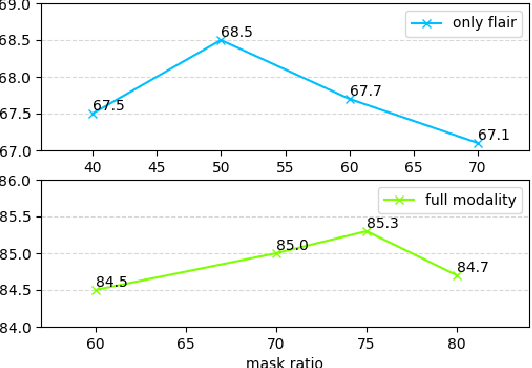

Brain tumor segmentation remains a significant challenge, particularly in the context of multi-modal magnetic resonance imaging (MRI) where missing modality images are common in clinical settings, leading to reduced segmentation accuracy. To address this issue, we propose a novel strategy, which is called masked predicted pre-training, enabling robust feature learning from incomplete modality data. Additionally, in the fine-tuning phase, we utilize a knowledge distillation technique to align features between complete and missing modality data, simultaneously enhancing model robustness. Notably, we leverage the Holder pseudo-divergence instead of the KLD for distillation loss, offering improve mathematical interpretability and properties. Extensive experiments on the BRATS2018 and BRATS2020 datasets demonstrate significant performance enhancements compared to existing state-of-the-art methods.