 Add to Chrome
 Add to Firefox
 Add to Edge
LLM360: Towards Fully Transparent Open-Source LLMs
Dec 11, 2023


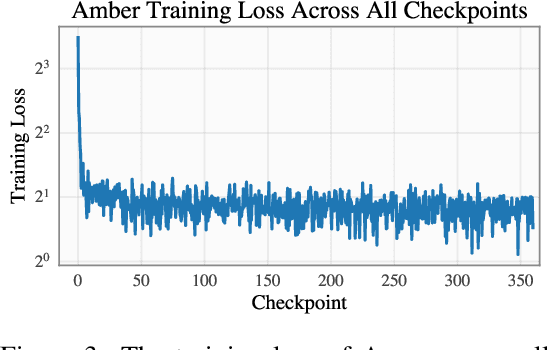

The recent surge in open-source Large Language Models (LLMs), such as LLaMA, Falcon, and Mistral, provides diverse options for AI practitioners and researchers. However, most LLMs have only released partial artifacts, such as the final model weights or inference code, and technical reports increasingly limit their scope to high-level design choices and surface statistics. These choices hinder progress in the field by degrading transparency into the training of LLMs and forcing teams to rediscover many details in the training process. We present LLM360, an initiative to fully open-source LLMs, which advocates for all training code and data, model checkpoints, and intermediate results to be made available to the community. The goal of LLM360 is to support open and collaborative AI research by making the end-to-end LLM training process transparent and reproducible by everyone. As a first step of LLM360, we release two 7B parameter LLMs pre-trained from scratch, Amber and CrystalCoder, including their training code, data, intermediate checkpoints, and analyses (at https://www.llm360.ai). We are committed to continually pushing the boundaries of LLMs through this open-source effort. More large-scale and stronger models are underway and will be released in the future.

Rethinking Multiple Instance Learning for Whole Slide Image Classification: A Bag-Level Classifier is a Good Instance-Level Teacher
Dec 02, 2023Multiple Instance Learning (MIL) has demonstrated promise in Whole Slide Image (WSI) classification. However, a major challenge persists due to the high computational cost associated with processing these gigapixel images. Existing methods generally adopt a two-stage approach, comprising a non-learnable feature embedding stage and a classifier training stage. Though it can greatly reduce the memory consumption by using a fixed feature embedder pre-trained on other domains, such scheme also results in a disparity between the two stages, leading to suboptimal classification accuracy. To address this issue, we propose that a bag-level classifier can be a good instance-level teacher. Based on this idea, we design Iteratively Coupled Multiple Instance Learning (ICMIL) to couple the embedder and the bag classifier at a low cost. ICMIL initially fix the patch embedder to train the bag classifier, followed by fixing the bag classifier to fine-tune the patch embedder. The refined embedder can then generate better representations in return, leading to a more accurate classifier for the next iteration. To realize more flexible and more effective embedder fine-tuning, we also introduce a teacher-student framework to efficiently distill the category knowledge in the bag classifier to help the instance-level embedder fine-tuning. Thorough experiments were conducted on four distinct datasets to validate the effectiveness of ICMIL. The experimental results consistently demonstrate that our method significantly improves the performance of existing MIL backbones, achieving state-of-the-art results. The code is available at: https://github.com/Dootmaan/ICMIL/tree/confidence_based
PolyThrottle: Energy-efficient Neural Network Inference on Edge Devices
Oct 30, 2023As neural networks (NN) are deployed across diverse sectors, their energy demand correspondingly grows. While several prior works have focused on reducing energy consumption during training, the continuous operation of ML-powered systems leads to significant energy use during inference. This paper investigates how the configuration of on-device hardware-elements such as GPU, memory, and CPU frequency, often neglected in prior studies, affects energy consumption for NN inference with regular fine-tuning. We propose PolyThrottle, a solution that optimizes configurations across individual hardware components using Constrained Bayesian Optimization in an energy-conserving manner. Our empirical evaluation uncovers novel facets of the energy-performance equilibrium showing that we can save up to 36 percent of energy for popular models. We also validate that PolyThrottle can quickly converge towards near-optimal settings while satisfying application constraints.
Redco: A Lightweight Tool to Automate Distributed Training of LLMs on Any GPU/TPUs
Oct 25, 2023The recent progress of AI can be largely attributed to large language models (LLMs). However, their escalating memory requirements introduce challenges for machine learning (ML) researchers and engineers. Addressing this requires developers to partition a large model to distribute it across multiple GPUs or TPUs. This necessitates considerable coding and intricate configuration efforts with existing model parallel tools, such as Megatron-LM, DeepSpeed, and Alpa. These tools require users' expertise in machine learning systems (MLSys), creating a bottleneck in LLM development, particularly for developers without MLSys background. In this work, we present Redco, a lightweight and user-friendly tool crafted to automate distributed training and inference for LLMs, as well as to simplify ML pipeline development. The design of Redco emphasizes two key aspects. Firstly, to automate model parallism, our study identifies two straightforward rules to generate tensor parallel strategies for any given LLM. Integrating these rules into Redco facilitates effortless distributed LLM training and inference, eliminating the need of additional coding or complex configurations. We demonstrate the effectiveness by applying Redco on a set of LLM architectures, such as GPT-J, LLaMA, T5, and OPT, up to the size of 66B. Secondly, we propose a mechanism that allows for the customization of diverse ML pipelines through the definition of merely three functions, eliminating redundant and formulaic code like multi-host related processing. This mechanism proves adaptable across a spectrum of ML algorithms, from foundational language modeling to complex algorithms like meta-learning and reinforcement learning. Consequently, Redco implementations exhibit much fewer code lines compared to their official counterparts.
FedNAR: Federated Optimization with Normalized Annealing Regularization
Oct 04, 2023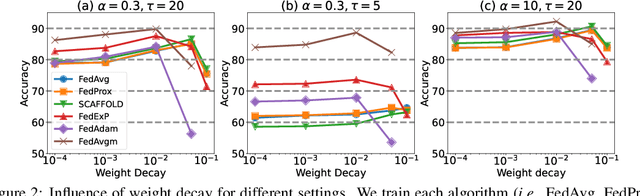
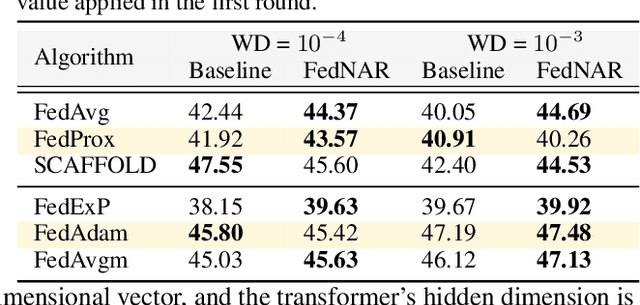
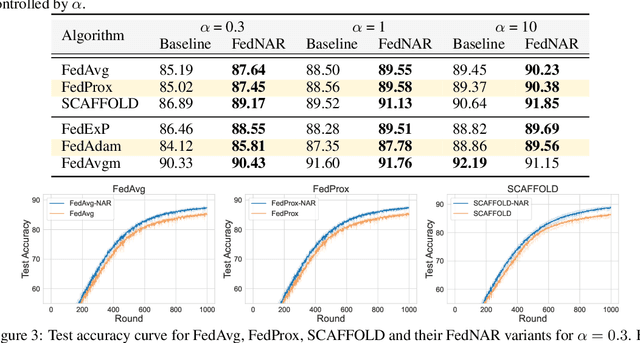
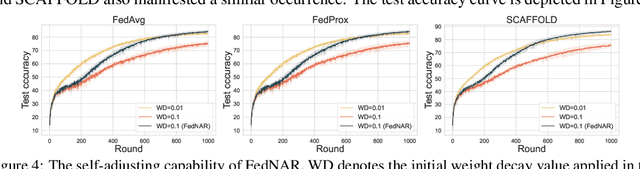
Weight decay is a standard technique to improve generalization performance in modern deep neural network optimization, and is also widely adopted in federated learning (FL) to prevent overfitting in local clients. In this paper, we first explore the choices of weight decay and identify that weight decay value appreciably influences the convergence of existing FL algorithms. While preventing overfitting is crucial, weight decay can introduce a different optimization goal towards the global objective, which is further amplified in FL due to multiple local updates and heterogeneous data distribution. To address this challenge, we develop {\it Federated optimization with Normalized Annealing Regularization} (FedNAR), a simple yet effective and versatile algorithmic plug-in that can be seamlessly integrated into any existing FL algorithms. Essentially, we regulate the magnitude of each update by performing co-clipping of the gradient and weight decay. We provide a comprehensive theoretical analysis of FedNAR's convergence rate and conduct extensive experiments on both vision and language datasets with different backbone federated optimization algorithms. Our experimental results consistently demonstrate that incorporating FedNAR into existing FL algorithms leads to accelerated convergence and heightened model accuracy. Moreover, FedNAR exhibits resilience in the face of various hyperparameter configurations. Specifically, FedNAR has the ability to self-adjust the weight decay when the initial specification is not optimal, while the accuracy of traditional FL algorithms would markedly decline. Our codes are released at \href{https://github.com/ljb121002/fednar}{https://github.com/ljb121002/fednar}.
Fusing Models with Complementary Expertise
Oct 02, 2023Training AI models that generalize across tasks and domains has long been among the open problems driving AI research. The emergence of Foundation Models made it easier to obtain expert models for a given task, but the heterogeneity of data that may be encountered at test time often means that any single expert is insufficient. We consider the Fusion of Experts (FoE) problem of fusing outputs of expert models with complementary knowledge of the data distribution and formulate it as an instance of supervised learning. Our method is applicable to both discriminative and generative tasks and leads to significant performance improvements in image and text classification, text summarization, multiple-choice QA, and automatic evaluation of generated text. We also extend our method to the "frugal" setting where it is desired to reduce the number of expert model evaluations at test time.
GridFormer: Towards Accurate Table Structure Recognition via Grid Prediction
Sep 26, 2023


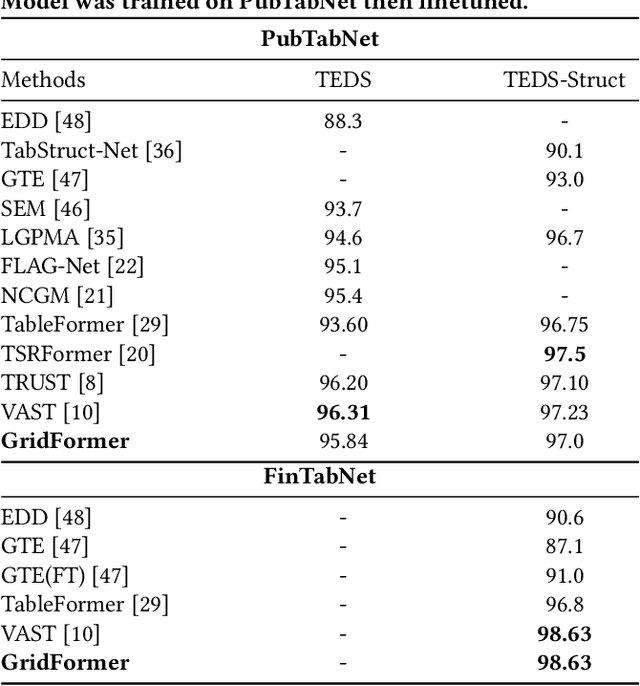
All tables can be represented as grids. Based on this observation, we propose GridFormer, a novel approach for interpreting unconstrained table structures by predicting the vertex and edge of a grid. First, we propose a flexible table representation in the form of an MXN grid. In this representation, the vertexes and edges of the grid store the localization and adjacency information of the table. Then, we introduce a DETR-style table structure recognizer to efficiently predict this multi-objective information of the grid in a single shot. Specifically, given a set of learned row and column queries, the recognizer directly outputs the vertexes and edges information of the corresponding rows and columns. Extensive experiments on five challenging benchmarks which include wired, wireless, multi-merge-cell, oriented, and distorted tables demonstrate the competitive performance of our model over other methods.
Maestro: Uncovering Low-Rank Structures via Trainable Decomposition
Aug 28, 2023Deep Neural Networks (DNNs) have been a large driver and enabler for AI breakthroughs in recent years. These models have been getting larger in their attempt to become more accurate and tackle new upcoming use-cases, including AR/VR and intelligent assistants. However, the training process of such large models is a costly and time-consuming process, which typically yields a single model to fit all targets. To mitigate this, various techniques have been proposed in the literature, including pruning, sparsification or quantization of the model weights and updates. While able to achieve high compression rates, they often incur computational overheads or accuracy penalties. Alternatively, factorization methods have been leveraged to incorporate low-rank compression in the training process. Similarly, such techniques (e.g.,~SVD) frequently rely on the computationally expensive decomposition of layers and are potentially sub-optimal for non-linear models, such as DNNs. In this work, we take a further step in designing efficient low-rank models and propose Maestro, a framework for trainable low-rank layers. Instead of regularly applying a priori decompositions such as SVD, the low-rank structure is built into the training process through a generalized variant of Ordered Dropout. This method imposes an importance ordering via sampling on the decomposed DNN structure. Our theoretical analysis demonstrates that our method recovers the SVD decomposition of linear mapping on uniformly distributed data and PCA for linear autoencoders. We further apply our technique on DNNs and empirically illustrate that Maestro enables the extraction of lower footprint models that preserve model performance while allowing for graceful accuracy-latency tradeoff for the deployment to devices of different capabilities.
A reconfigurable multiple-format coherent-dual-band signal generator based on a single optoelectronic oscillation cavity
Aug 06, 2023An optoelectronic oscillation method with reconfigurable multiple formats for simultaneous generation of coherent dual-band signals is proposed and experimentally demonstrated. By introducing a compatible filtering mechanism based on stimulated Brillouin scattering (SBS) effect into a typical Phase-shifted grating Bragg fiber (PS-FBG) notch filtering cavity, dual mode-selection mechanisms which have independent frequency and time tuning mechanism can be constructed. By regulating three controllers, the proposed scheme can work in different states, named mode 1, mode 2 and mode 3. At mode 1 state, a dual single-frequency hopping signals is achieved with 50 ns hopping speed and flexible central frequency and pulse duration ratio. The mode 2 state is realized by applying the Fourier domain mode-locked (FDML) technology into the proposed optoelectrical oscillator, in which dual coherent pulsed single-frequency signal and broadband signal is generated simultaneously. The adjustability of the time duration of the single-frequency signal and the bandwidth of the broadband signal are shown and discussed. The mode 3 state is a dual broadband signal generator which is realized by injecting a triangular wave into the signal laser. The detection performance of the generated broadband signals has also been evaluated by the pulse compression and the phase noise figure. The proposed method may provide a multifunctional radar system signal generator based on the simply external controllers, which can realize low-phase-noise or multifunctional detection with high resolution imaging ability, especially in a complex interference environment.
Cuttlefish: Low-Rank Model Training without All the Tuning
May 05, 2023Recent research has shown that training low-rank neural networks can effectively reduce the total number of trainable parameters without sacrificing predictive accuracy, resulting in end-to-end speedups. However, low-rank model training necessitates adjusting several additional factorization hyperparameters, such as the rank of the factorization at each layer. In this paper, we tackle this challenge by introducing Cuttlefish, an automated low-rank training approach that eliminates the need for tuning factorization hyperparameters. Cuttlefish leverages the observation that after a few epochs of full-rank training, the stable rank (i.e., an approximation of the true rank) of each layer stabilizes at a constant value. Cuttlefish switches from full-rank to low-rank training once the stable ranks of all layers have converged, setting the dimension of each factorization to its corresponding stable rank. Our results show that Cuttlefish generates models up to 5.6 times smaller than full-rank models, and attains up to a 1.2 times faster end-to-end training process while preserving comparable accuracy. Moreover, Cuttlefish outperforms state-of-the-art low-rank model training methods and other prominent baselines. The source code for our implementation can be found at: https://github.com/hwang595/Cuttlefish.