 Add to Chrome
 Add to Firefox
 Add to Edge
ACID: Adaptive Caching for vIDeo generation
Jul 14, 2026
Video diffusion models produce high-quality generations but remain slow at inference due to their sequential denoising procedure. Caching-based acceleration methods address this by reusing intermediate model outputs: leading dynamic approaches such as TeaCache, EasyCache, and DiCache accumulate a drift signal and skip expensive model evaluations when accumulated drift stays below a fixed threshold τ. This threshold controls an apparent tradeoff - raising it yields faster generation at the cost of visual quality, while lowering it preserves quality but sacrifices speed. We show this tradeoff is not fundamental; it is an artifact of holding τ constant throughout denoising. We identify the existence of critical steps - timesteps where the drift signal changes rapidly - and show that applying a low threshold selectively at these steps while caching aggressively elsewhere recovers most of the quality of conservative caching at substantially higher inference speeds. Building on this insight, we propose ACID, a lightweight, training-free wrapper that monitors the rate of change of each method's existing drift signal to dynamically switch between a low and a high threshold. ACID is signal-agnostic and modular: it requires no retraining and plugs directly into existing dynamic caching methods without modifying their core mechanisms. Evaluated across three caching methods (TeaCache, EasyCache, DiCache) and three open-source video diffusion models (HunyuanVideo, Wan 2.1, CogVideoX), ACID consistently expands the Pareto frontier of visual quality versus inference speed beyond what any fixed threshold achieves. In particular, on TeaCache and HunyuanVideo, ACID achieves up to 2.16x speedup over the no-caching baseline, and up to 38% additional speedup over the conservative fixed-threshold baseline with negligible (<0.3 dB PSNR, <0.01 SSIM, <0.01 LPIPS) quality degradation.

Sangam: Efficiently Serving Diffusion LLMs with the AR Stack
Jul 05, 2026Diffusion language models (dLLMs) generate text by iteratively denoising a masked response and can commit multiple output positions per model invocation. Their bidirectional attention prevents exact autoregressive-style KV caching, since committing one position shifts the KV activations of all others. Approximate caching techniques such as Fast-dLLM and dKV-Cache refresh KV activations repeatedly and reuse them across intervening decodes, inducing a repeated prefill/decode structure. This makes AR serving mechanisms relevant to dLLMs, but not directly applicable. dLLM decodes are block-sized rather than token-sized, prefills recur, and bidirectional attention precludes the chunked prefill mechanism used for stall-free colocated serving. We present Sangam, a serving system for cached dLLM inference. Sangam introduces a deficit token-budget scheduler that admits in-flight decodes first, admits whole indivisible prefills only when the accumulated token budget allows, and carries unused budget forward. This achieves amortized stall-free scheduling. Disaggregated serving avoids prefill-decode interference but suffers from prefill/decode resource partitioning problem. Sangam adopts a hybrid serving strategy, overflowing prefills onto decode workers to relieve prefill under-provisioning, and uses the same deficit-budget scheduler to protect those workers' decodes from the overflow. We show that like AR serving, dLLM serving design space is governed by prefill-decode interference and prefill/decode partitioning. Colocated serving is most effective on decode-heavy workloads, cutting mean latency by 9-20% over hybrid execution on LLaDA-8B ShareGPT; while hybrid execution is most effective on prefill-heavy workloads, cutting mean latency by 8-20% over colocated execution on Dream-7B arXiv. Sangam is available at https://github.com/UT-InfraAI/sangam.
RL-ACRGNet: Reinforcement Learning-Based Chest Radiology Report Generation Network
Jun 01, 2026Medical imaging interpretation is a foundational pillar of modern clinical diagnostics, yet the manual generation of radiology reports remains a time-consuming process prone to interpretation inconsistencies. Within the field of medical AI, automating these descriptions through deep learning promises to streamline clinical workflows and standardise diagnostic output. However, accurate disease detection and precise report generation remain significant challenges due to limitations in capturing fine-grained visual features and ensuring clinical coherence. To address these issues, we propose RL-ACRGNet, an improved encoder-decoder model that integrates a pre-trained DenseNet encoder with a multilevel LSTM decoder within an off-policy reinforcement learning framework. Using a dual-network approach to refine visual-semantic embeddings through a metric-based reward mechanism, we demonstrate that RL-ACRGNet consistently outperforms state-of-the-art baselines on the IU-Xray dataset, achieving quantitative improvements in BLEU-4 (0.47%), METEOR (0.17%) and ROUGE-L (0.518). Furthermore, comprehensive evaluations on the large-scale MIMIC-CXR data set confirm the robust generalisation of the model and its ability to generate high-quality, clinically relevant reports
CUCo: An Agentic Framework for Compute and Communication Co-design
Mar 02, 2026Custom CUDA kernel development is essential for maximizing GPU utilization in large-scale distributed LLM training and inference, yet manually writing kernels that jointly leverage both computation and communication remains a labor-intensive and error-prone process. Prior work on kernel optimization has focused almost exclusively on computation, leaving communication kernels largely untouched even though they constitute a significant share of total execution time. We introduce CUCo, a training-free agent-driven workflow that automatically generates high-performance CUDA kernels that jointly orchestrate computation and communication. By co-optimizing these traditionally disjoint components, CUCo unlocks new optimization opportunities unavailable to existing approaches, outperforming state-of-the-art baselines and reducing end-to-end latency by up to $1.57\times$.
SuperGen: An Efficient Ultra-high-resolution Video Generation System with Sketching and Tiling
Aug 25, 2025Diffusion models have recently achieved remarkable success in generative tasks (e.g., image and video generation), and the demand for high-quality content (e.g., 2K/4K videos) is rapidly increasing across various domains. However, generating ultra-high-resolution videos on existing standard-resolution (e.g., 720p) platforms remains challenging due to the excessive re-training requirements and prohibitively high computational and memory costs. To this end, we introduce SuperGen, an efficient tile-based framework for ultra-high-resolution video generation. SuperGen features a novel training-free algorithmic innovation with tiling to successfully support a wide range of resolutions without additional training efforts while significantly reducing both memory footprint and computational complexity. Moreover, SuperGen incorporates a tile-tailored, adaptive, region-aware caching strategy that accelerates video generation by exploiting redundancy across denoising steps and spatial regions. SuperGen also integrates cache-guided, communication-minimized tile parallelism for enhanced throughput and minimized latency. Evaluations demonstrate that SuperGen harvests the maximum performance gains while achieving high output quality across various benchmarks.
Tesserae: Scalable Placement Policies for Deep Learning Workloads
Aug 07, 2025Training deep learning (DL) models has become a dominant workload in data-centers and improving resource utilization is a key goal of DL cluster schedulers. In order to do this, schedulers typically incorporate placement policies that govern where jobs are placed on the cluster. Existing placement policies are either designed as ad-hoc heuristics or incorporated as constraints within a complex optimization problem and thus either suffer from suboptimal performance or poor scalability. Our key insight is that many placement constraints can be formulated as graph matching problems and based on that we design novel placement policies for minimizing job migration overheads and job packing. We integrate these policies into Tesserae and describe how our design leads to a scalable and effective GPU cluster scheduler. Our experimental results show that Tesserae improves average JCT by up to 1.62x and the Makespan by up to 1.15x compared with the existing schedulers.
Everything Everywhere All at Once: LLMs can In-Context Learn Multiple Tasks in Superposition
Oct 08, 2024



Large Language Models (LLMs) have demonstrated remarkable in-context learning (ICL) capabilities. In this study, we explore a surprising phenomenon related to ICL: LLMs can perform multiple, computationally distinct ICL tasks simultaneously, during a single inference call, a capability we term "task superposition". We provide empirical evidence of this phenomenon across various LLM families and scales and show that this phenomenon emerges even if we train the model to in-context learn one task at a time. We offer theoretical explanations that this capability is well within the expressive power of transformers. We also explore how LLMs internally compose task vectors during superposition. Furthermore, we show that larger models can solve more ICL tasks in parallel, and better calibrate their output distribution. Our findings offer insights into the latent capabilities of LLMs, further substantiate the perspective of "LLMs as superposition of simulators", and raise questions about the mechanisms enabling simultaneous task execution.
LayerSkip: Enabling Early Exit Inference and Self-Speculative Decoding
Apr 29, 2024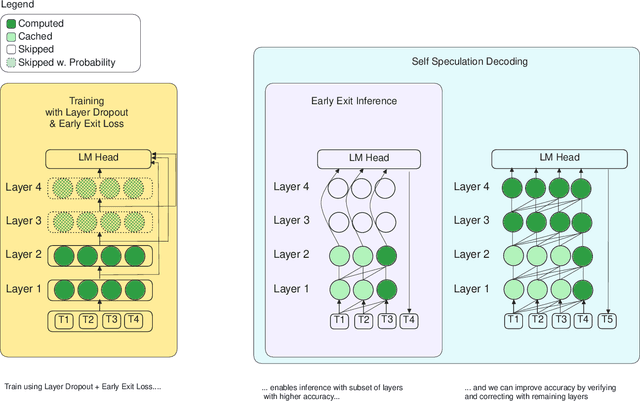
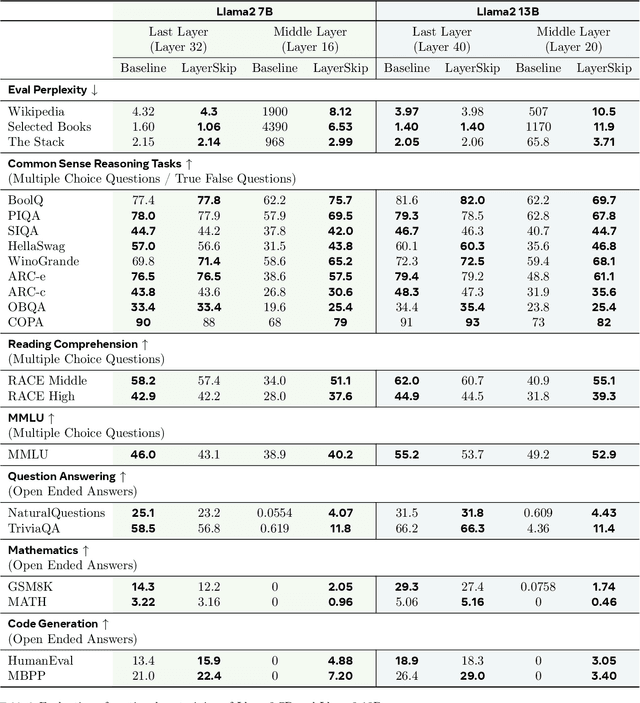
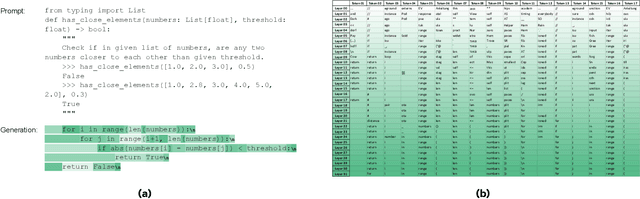
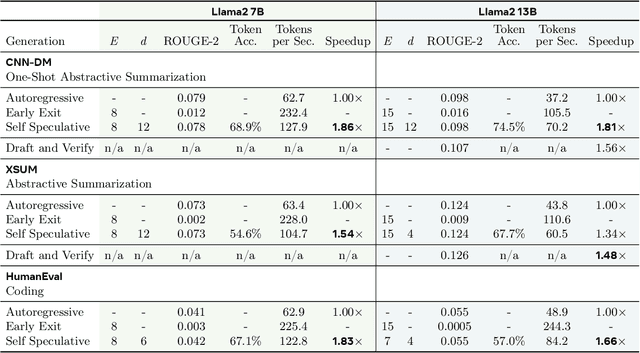
We present LayerSkip, an end-to-end solution to speed-up inference of large language models (LLMs). First, during training we apply layer dropout, with low dropout rates for earlier layers and higher dropout rates for later layers, and an early exit loss where all transformer layers share the same exit. Second, during inference, we show that this training recipe increases the accuracy of early exit at earlier layers, without adding any auxiliary layers or modules to the model. Third, we present a novel self-speculative decoding solution where we exit at early layers and verify and correct with remaining layers of the model. Our proposed self-speculative decoding approach has less memory footprint than other speculative decoding approaches and benefits from shared compute and activations of the draft and verification stages. We run experiments on different Llama model sizes on different types of training: pretraining from scratch, continual pretraining, finetuning on specific data domain, and finetuning on specific task. We implement our inference solution and show speedups of up to 2.16x on summarization for CNN/DM documents, 1.82x on coding, and 2.0x on TOPv2 semantic parsing task.
CHAI: Clustered Head Attention for Efficient LLM Inference
Mar 12, 2024
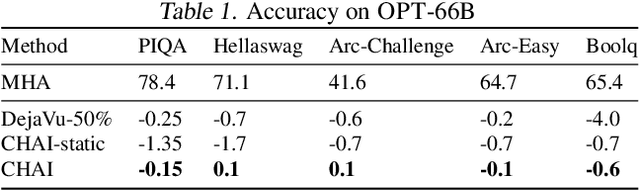
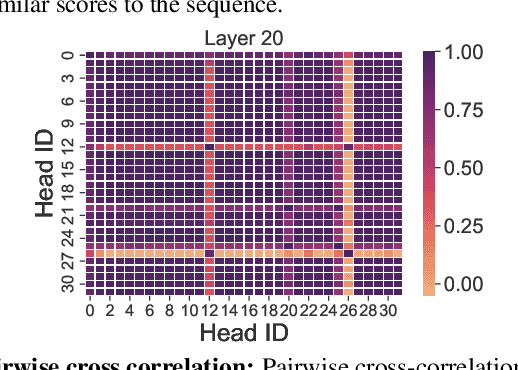
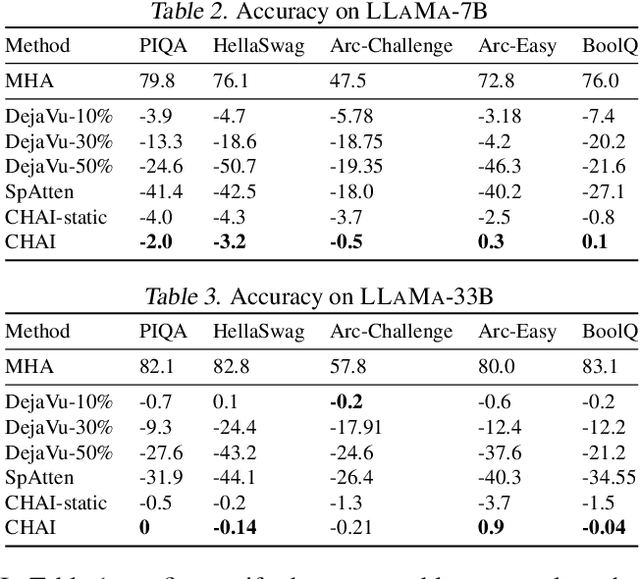
Large Language Models (LLMs) with hundreds of billions of parameters have transformed the field of machine learning. However, serving these models at inference time is both compute and memory intensive, where a single request can require multiple GPUs and tens of Gigabytes of memory. Multi-Head Attention is one of the key components of LLMs, which can account for over 50% of LLMs memory and compute requirement. We observe that there is a high amount of redundancy across heads on which tokens they pay attention to. Based on this insight, we propose Clustered Head Attention (CHAI). CHAI combines heads with a high amount of correlation for self-attention at runtime, thus reducing both memory and compute. In our experiments, we show that CHAI is able to reduce the memory requirements for storing K,V cache by up to 21.4% and inference time latency by up to 1.73x without any fine-tuning required. CHAI achieves this with a maximum 3.2% deviation in accuracy across 3 different models (i.e. OPT-66B, LLAMA-7B, LLAMA-33B) and 5 different evaluation datasets.
Decoding Speculative Decoding
Feb 02, 2024

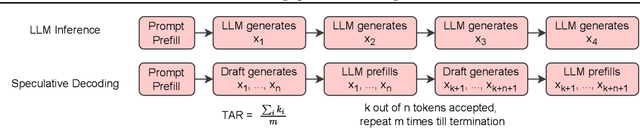
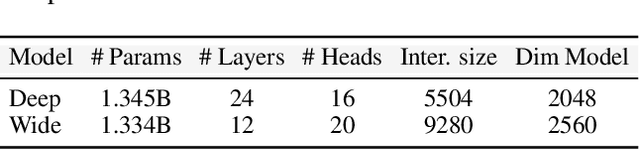
Speculative Decoding is a widely used technique to speed up inference for Large Language Models (LLMs) without modifying its outcome. When performing inference on an LLM, speculative decoding uses a smaller draft model which generates speculative tokens and then uses the target LLM to verify those draft tokens. The speedup provided by speculative decoding heavily depends on the choice of the draft model. It has been widely suggested to select a draft model that provides a high probability of the generated token being accepted by the LLM to achieve the highest throughput. However, our experiments indicate the contrary with throughput diminishing as the probability of generated tokens to be accepted by the target model increases. To understand this phenomenon, we perform extensive experiments to characterize the different factors that affect speculative decoding and how those factors interact and affect the speedups. Based on our experiments we describe an analytical model which can be used to decide the right draft model for a given workload. Further, using our insights we design a new draft model for LLaMA-65B which can provide 30% higher throughput than existing draft models.