 Add to Chrome
 Add to Firefox
 Add to Edge
Establishing Knowledge Preference in Language Models
Jul 17, 2024
Language models are known to encode a great amount of factual knowledge through pretraining. However, such knowledge might be insufficient to cater to user requests, requiring the model to integrate external knowledge sources and adhere to user-provided specifications. When answering questions about ongoing events, the model should use recent news articles to update its response; when asked to provide recommendations, the model should prioritize user specifications over retrieved product reviews; when some facts are edited in the model, the updated facts should override all prior knowledge learned by the model even if they are conflicting. In all of the cases above, the model faces a decision between its own parametric knowledge, (retrieved) contextual knowledge, and user instruction knowledge. In this paper, we (1) unify such settings into the problem of knowledge preference and define a three-level preference hierarchy over these knowledge sources; (2) compile a collection of existing datasets IfQA, MQuAKE, and MRQA covering a combination of settings (with/without user specifications, with/without context documents) to systematically evaluate how well models obey the intended knowledge preference; and (3) propose a dataset synthesis method that composes diverse question-answer pairs with user assumptions and related context to directly fine-tune LMs for instilling the hierarchy of knowledge. We demonstrate that a 7B model, fine-tuned on only a few thousand examples automatically generated by our proposed method, effectively achieves superior performance (more than 18% improvement across all evaluation benchmarks) in adhering to the desired knowledge preference hierarchy.

Knowledge Overshadowing Causes Amalgamated Hallucination in Large Language Models
Jul 10, 2024Hallucination is often regarded as a major impediment for using large language models (LLMs), especially for knowledge-intensive tasks. Even when the training corpus consists solely of true statements, language models still generate hallucinations in the form of amalgamations of multiple facts. We coin this phenomenon as ``knowledge overshadowing'': when we query knowledge from a language model with multiple conditions, some conditions overshadow others, leading to hallucinated outputs. This phenomenon partially stems from training data imbalance, which we verify on both pretrained models and fine-tuned models, over a wide range of LM model families and sizes.From a theoretical point of view, knowledge overshadowing can be interpreted as over-generalization of the dominant conditions (patterns). We show that the hallucination rate grows with both the imbalance ratio (between the popular and unpopular condition) and the length of dominant condition description, consistent with our derived generalization bound. Finally, we propose to utilize overshadowing conditions as a signal to catch hallucination before it is produced, along with a training-free self-contrastive decoding method to alleviate hallucination during inference. Our proposed approach showcases up to 82% F1 for hallucination anticipation and 11.2% to 39.4% hallucination control, with different models and datasets.
A Single Transformer for Scalable Vision-Language Modeling
Jul 08, 2024We present SOLO, a single transformer for Scalable visiOn-Language mOdeling. Current large vision-language models (LVLMs) such as LLaVA mostly employ heterogeneous architectures that connect pre-trained visual encoders with large language models (LLMs) to facilitate visual recognition and complex reasoning. Although achieving remarkable performance with relatively lightweight training, we identify four primary scalability limitations: (1) The visual capacity is constrained by pre-trained visual encoders, which are typically an order of magnitude smaller than LLMs. (2) The heterogeneous architecture complicates the use of established hardware and software infrastructure. (3) Study of scaling laws on such architecture must consider three separate components - visual encoder, connector, and LLMs, which complicates the analysis. (4) The use of existing visual encoders typically requires following a pre-defined specification of image inputs pre-processing, for example, by reshaping inputs to fixed-resolution square images, which presents difficulties in processing and training on high-resolution images or those with unusual aspect ratio. A unified single Transformer architecture, like SOLO, effectively addresses these scalability concerns in LVLMs; however, its limited adoption in the modern context likely stems from the absence of reliable training recipes that balance both modalities and ensure stable training for billion-scale models. In this paper, we introduce the first open-source training recipe for developing SOLO, an open-source 7B LVLM using moderate academic resources. The training recipe involves initializing from LLMs, sequential pre-training on ImageNet and web-scale data, and instruction fine-tuning on our curated high-quality datasets. On extensive evaluation, SOLO demonstrates performance comparable to LLaVA-v1.5-7B, particularly excelling in visual mathematical reasoning.
Eliminating Position Bias of Language Models: A Mechanistic Approach
Jul 01, 2024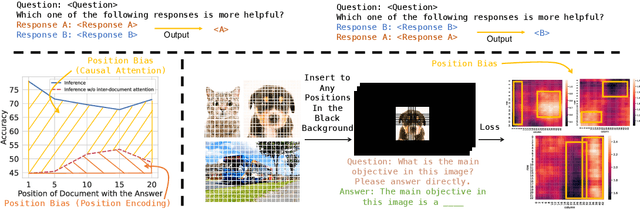
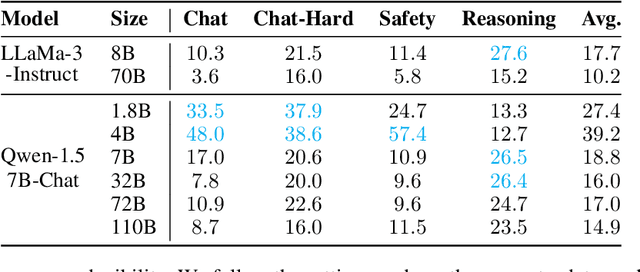
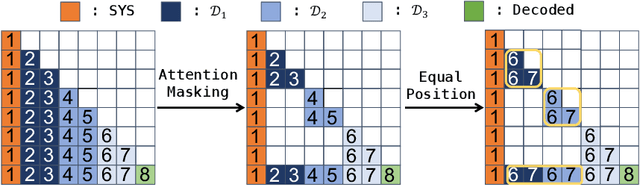
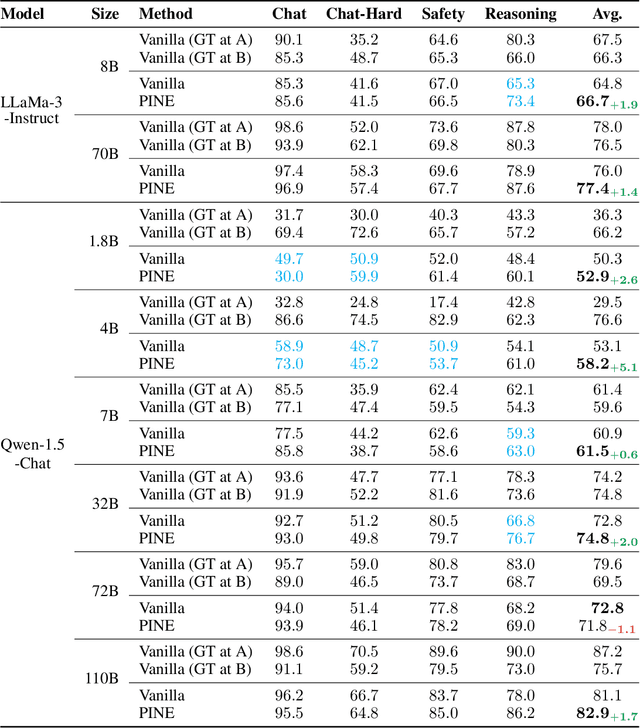
Position bias has proven to be a prevalent issue of modern language models (LMs), where the models prioritize content based on its position within the given context. This bias often leads to unexpected model failures and hurts performance, robustness, and reliability across various applications. Our mechanistic analysis attributes the position bias to two components employed in nearly all state-of-the-art LMs: causal attention and relative positional encodings. Specifically, we find that causal attention generally causes models to favor distant content, while relative positional encodings like RoPE prefer nearby ones based on the analysis of retrieval-augmented question answering (QA). Further, our empirical study on object detection reveals that position bias is also present in vision-language models (VLMs). Based on the above analyses, we propose to ELIMINATE position bias caused by different input segment orders (e.g., options in LM-as-a-judge, retrieved documents in QA) in a TRAINING-FREE ZERO-SHOT manner. Our method changes the causal attention to bidirectional attention between segments and utilizes model attention values to decide the relative orders of segments instead of using the order provided in input prompts, therefore enabling Position-INvariant inferencE (PINE) at the segment level. By eliminating position bias, models achieve better performance and reliability in downstream tasks where position bias widely exists, such as LM-as-a-judge and retrieval-augmented QA. Notably, PINE is especially useful when adapting LMs for evaluating reasoning pairs: it consistently provides 8 to 10 percentage points performance gains in most cases, and makes Llama-3-70B-Instruct perform even better than GPT-4-0125-preview on the RewardBench reasoning subset.
FIRST: Faster Improved Listwise Reranking with Single Token Decoding
Jun 21, 2024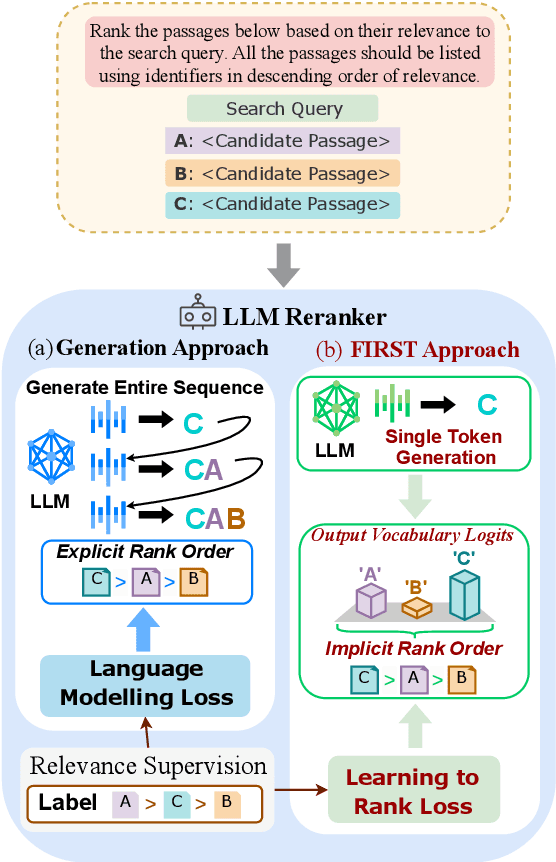
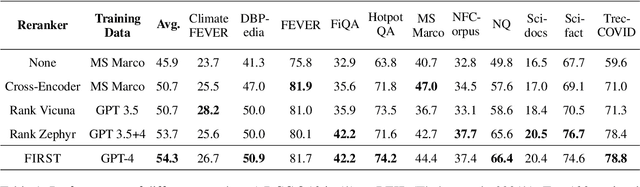
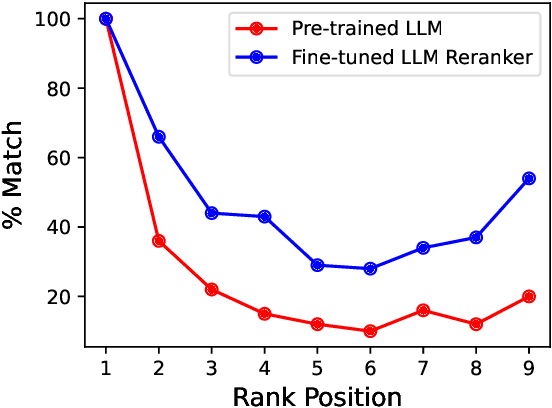
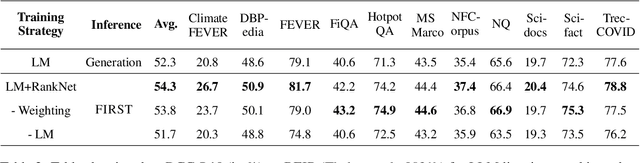
Large Language Models (LLMs) have significantly advanced the field of information retrieval, particularly for reranking. Listwise LLM rerankers have showcased superior performance and generalizability compared to existing supervised approaches. However, conventional listwise LLM reranking methods lack efficiency as they provide ranking output in the form of a generated ordered sequence of candidate passage identifiers. Further, they are trained with the typical language modeling objective, which treats all ranking errors uniformly--potentially at the cost of misranking highly relevant passages. Addressing these limitations, we introduce FIRST, a novel listwise LLM reranking approach leveraging the output logits of the first generated identifier to directly obtain a ranked ordering of the candidates. Further, we incorporate a learning-to-rank loss during training, prioritizing ranking accuracy for the more relevant passages. Empirical results demonstrate that FIRST accelerates inference by 50% while maintaining a robust ranking performance with gains across the BEIR benchmark. Finally, to illustrate the practical effectiveness of listwise LLM rerankers, we investigate their application in providing relevance feedback for retrievers during inference. Our results show that LLM rerankers can provide a stronger distillation signal compared to cross-encoders, yielding substantial improvements in retriever recall after relevance feedback.
MACAROON: Training Vision-Language Models To Be Your Engaged Partners
Jun 20, 2024Large vision-language models (LVLMs), while proficient in following instructions and responding to diverse questions, invariably generate detailed responses even when questions are ambiguous or unanswerable, leading to hallucinations and bias issues. Thus, it is essential for LVLMs to proactively engage with humans to ask for clarifications or additional information for better responses. In this study, we aim to shift LVLMs from passive answer providers to proactive engaged partners. We begin by establishing a three-tiered hierarchy for questions of invalid, ambiguous, and personalizable nature to measure the proactive engagement capabilities of LVLMs. Utilizing this hierarchy, we create PIE, (ProactIve Engagement Evaluation) through GPT-4o and human annotators, consisting of 853 questions across six distinct, fine-grained question types that are verified by human annotators and accompanied with well-defined metrics. Our evaluations on \benchmark indicate poor performance of existing LVLMs, with the best-performing open-weights model only achieving an Aggregate Align Rate (AAR) of 0.28. In response, we introduce MACAROON, self-iMaginAtion for ContrAstive pReference OptimizatiON, which instructs LVLMs to autonomously generate contrastive response pairs for unlabeled questions given the task description and human-crafted criteria. Then, the self-imagined data is formatted for conditional reinforcement learning. Experimental results show MACAROON effectively improves LVLMs' capabilities to be proactively engaged (0.84 AAR) while maintaining comparable performance on general tasks.
GLaD: Synergizing Molecular Graphs and Language Descriptors for Enhanced Power Conversion Efficiency Prediction in Organic Photovoltaic Devices
May 23, 2024This paper presents a novel approach for predicting Power Conversion Efficiency (PCE) of Organic Photovoltaic (OPV) devices, called GLaD: synergizing molecular Graphs and Language Descriptors for enhanced PCE prediction. Due to the lack of high-quality experimental data, we collect a dataset consisting of 500 pairs of OPV donor and acceptor molecules along with their corresponding PCE values, which we utilize as the training data for our predictive model. In this low-data regime, GLaD leverages properties learned from large language models (LLMs) pretrained on extensive scientific literature to enrich molecular structural representations, allowing for a multimodal representation of molecules. GLaD achieves precise predictions of PCE, thereby facilitating the synthesis of new OPV molecules with improved efficiency. Furthermore, GLaD showcases versatility, as it applies to a range of molecular property prediction tasks (BBBP, BACE, ClinTox, and SIDER), not limited to those concerning OPV materials. Especially, GLaD proves valuable for tasks in low-data regimes within the chemical space, as it enriches molecular representations by incorporating molecular property descriptions learned from large-scale pretraining. This capability is significant in real-world scientific endeavors like drug and material discovery, where access to comprehensive data is crucial for informed decision-making and efficient exploration of the chemical space.
AGRaME: Any-Granularity Ranking with Multi-Vector Embeddings
May 23, 2024

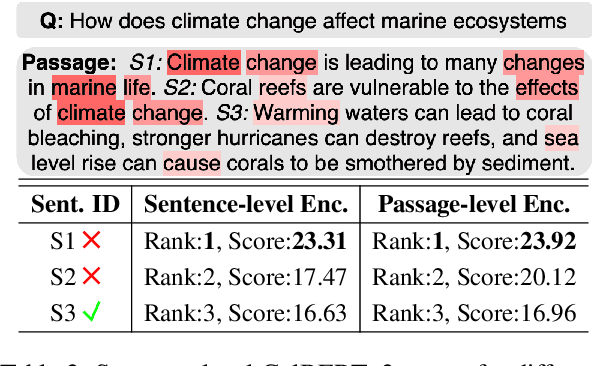

Ranking is a fundamental and popular problem in search. However, existing ranking algorithms usually restrict the granularity of ranking to full passages or require a specific dense index for each desired level of granularity. Such lack of flexibility in granularity negatively affects many applications that can benefit from more granular ranking, such as sentence-level ranking for open-domain question-answering, or proposition-level ranking for attribution. In this work, we introduce the idea of any-granularity ranking, which leverages multi-vector embeddings to rank at varying levels of granularity while maintaining encoding at a single (coarser) level of granularity. We propose a multi-granular contrastive loss for training multi-vector approaches, and validate its utility with both sentences and propositions as ranking units. Finally, we demonstrate the application of proposition-level ranking to post-hoc citation addition in retrieval-augmented generation, surpassing the performance of prompt-driven citation generation.
Weak-to-Strong Extrapolation Expedites Alignment
Apr 25, 2024


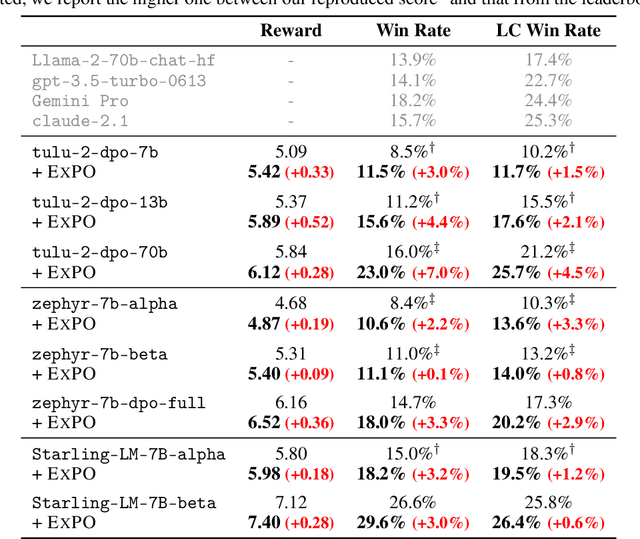
Although the capabilities of large language models (LLMs) ideally scale up with increasing data and compute, they are inevitably constrained by limited resources in reality. Suppose we have a moderately trained LLM (e.g., trained to align with human preference) in hand, can we further exploit its potential and cheaply acquire a stronger model? In this paper, we propose a simple method called ExPO to boost LLMs' alignment with human preference. ExPO assumes that a medium-aligned model can be interpolated between a less-aligned (weaker) model, e.g., the initial SFT model, and a better-aligned (stronger) one, thereby directly obtaining this stronger model by extrapolating from the weights of the former two relatively weaker models. On the AlpacaEval 2.0 benchmark, we show that ExPO pushes models trained with less preference data (e.g., 10% or 20%) to reach and even surpass the fully-trained one, without any additional training. Furthermore, ExPO also significantly improves off-the-shelf DPO/RLHF models and exhibits decent scalability across model sizes from 7B to 70B. Our work demonstrates the efficacy of model extrapolation in exploiting LLMs' capabilities, suggesting a promising direction that deserves future exploration.
Text-Based Reasoning About Vector Graphics
Apr 10, 2024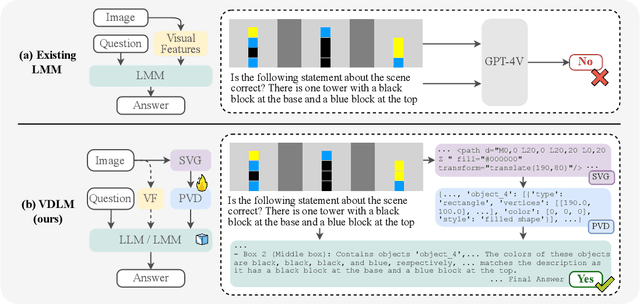
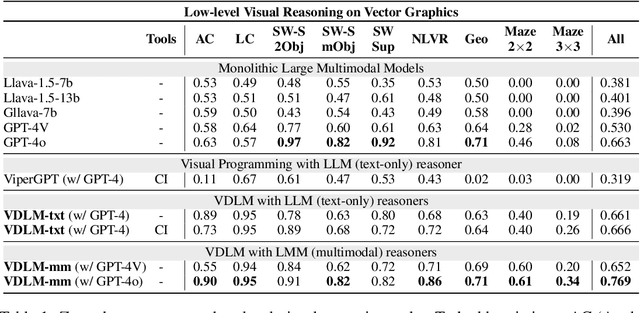
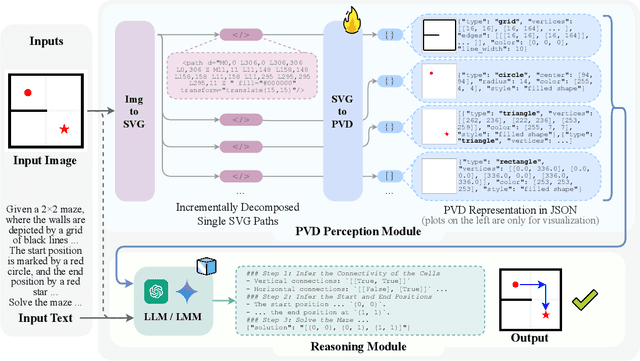
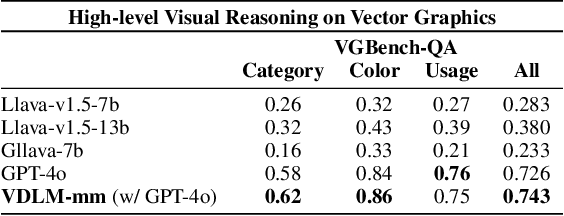
While large multimodal models excel in broad vision-language benchmarks, they often struggle with tasks requiring precise perception of low-level visual details, such as comparing line lengths or solving simple mazes. In particular, this failure mode persists in question-answering tasks about vector graphics -- images composed purely of 2D objects and shapes. To address this challenge, we propose the Visually Descriptive Language Model (VDLM), which performs text-based reasoning about vector graphics. VDLM leverages Scalable Vector Graphics (SVG) for a more precise visual description and first uses an off-the-shelf raster-to-SVG algorithm for encoding. Since existing language models cannot understand raw SVGs in a zero-shot setting, VDLM then bridges SVG with pretrained language models through a newly introduced intermediate symbolic representation, Primal Visual Description (PVD), comprising primitive attributes (e.g., shape, position, measurement) with their corresponding predicted values. PVD is task-agnostic and represents visual primitives that are universal across all vector graphics. It can be learned with procedurally generated (SVG, PVD) pairs and also enables the direct use of LLMs for generalization to complex reasoning tasks. By casting an image to a text-based representation, we can leverage the power of language models to learn alignment from SVG to visual primitives and generalize to unseen question-answering tasks. Empirical results show that VDLM achieves stronger zero-shot performance compared to state-of-the-art LMMs, such as GPT-4V, in various low-level multimodal perception and reasoning tasks on vector graphics. We additionally present extensive analyses on VDLM's performance, demonstrating that our framework offers better interpretability due to its disentangled perception and reasoning processes. Project page: https://mikewangwzhl.github.io/VDLM/