 Add to Chrome
 Add to Firefox
 Add to Edge
Learning and Generating Diverse Residential Load Patterns Using GAN with Weakly-Supervised Training and Weight Selection
Apr 19, 2025
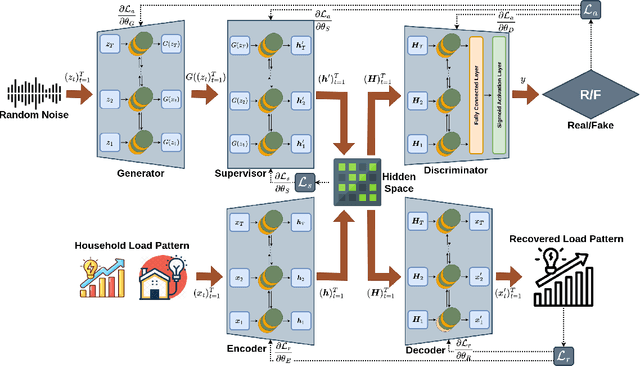
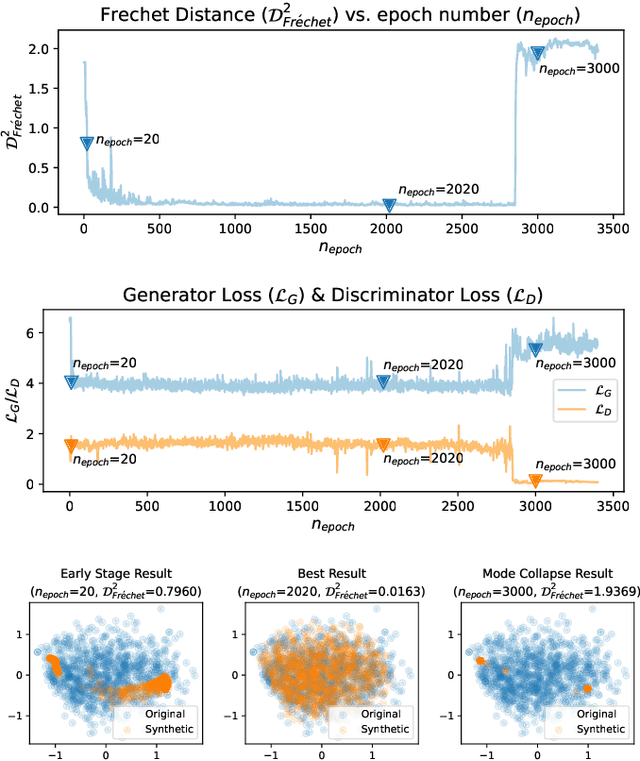
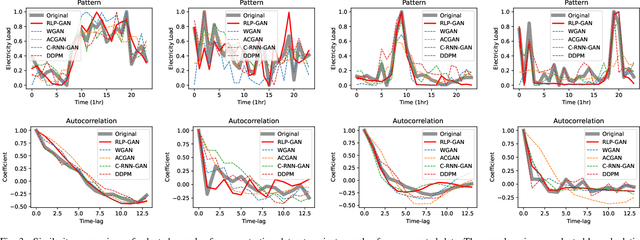
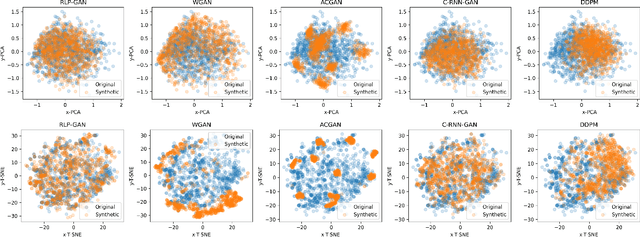
The scarcity of high-quality residential load data can pose obstacles for decarbonizing the residential sector as well as effective grid planning and operation. The above challenges have motivated research into generating synthetic load data, but existing methods faced limitations in terms of scalability, diversity, and similarity. This paper proposes a Generative Adversarial Network-based Synthetic Residential Load Pattern (RLP-GAN) generation model, a novel weakly-supervised GAN framework, leveraging an over-complete autoencoder to capture dependencies within complex and diverse load patterns and learn household-level data distribution at scale. We incorporate a model weight selection method to address the mode collapse problem and generate load patterns with high diversity. We develop a holistic evaluation method to validate the effectiveness of RLP-GAN using real-world data of 417 households. The results demonstrate that RLP-GAN outperforms state-of-the-art models in capturing temporal dependencies and generating load patterns with higher similarity to real data. Furthermore, we have publicly released the RLP-GAN generated synthetic dataset, which comprises one million synthetic residential load pattern profiles.
* 12 pages

EG-Gaussian: Epipolar Geometry and Graph Network Enhanced 3D Gaussian Splatting
Apr 18, 2025In this paper, we explore an open research problem concerning the reconstruction of 3D scenes from images. Recent methods have adopt 3D Gaussian Splatting (3DGS) to produce 3D scenes due to its efficient training process. However, these methodologies may generate incomplete 3D scenes or blurred multiviews. This is because of (1) inaccurate 3DGS point initialization and (2) the tendency of 3DGS to flatten 3D Gaussians with the sparse-view input. To address these issues, we propose a novel framework EG-Gaussian, which utilizes epipolar geometry and graph networks for 3D scene reconstruction. Initially, we integrate epipolar geometry into the 3DGS initialization phase to enhance initial 3DGS point construction. Then, we specifically design a graph learning module to refine 3DGS spatial features, in which we incorporate both spatial coordinates and angular relationships among neighboring points. Experiments on indoor and outdoor benchmark datasets demonstrate that our approach significantly improves reconstruction accuracy compared to 3DGS-based methods.
Climbing the Ladder of Reasoning: What LLMs Can-and Still Can't-Solve after SFT?
Apr 16, 2025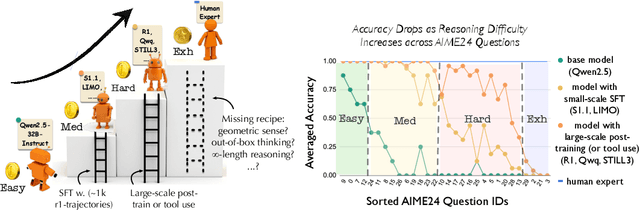
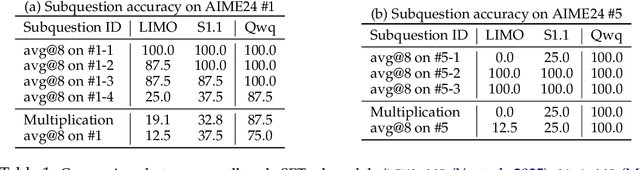
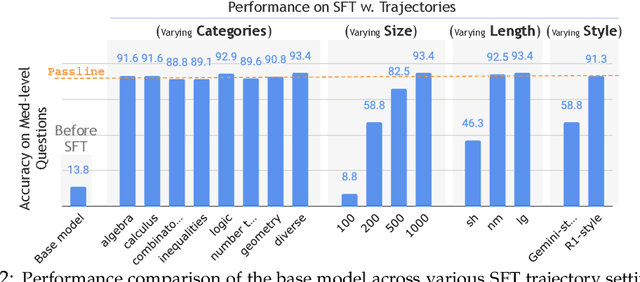
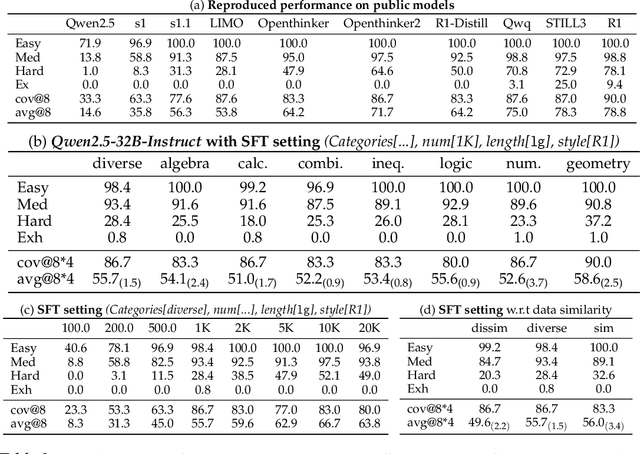
Recent supervised fine-tuning (SFT) approaches have significantly improved language models' performance on mathematical reasoning tasks, even when models are trained at a small scale. However, the specific capabilities enhanced through such fine-tuning remain poorly understood. In this paper, we conduct a detailed analysis of model performance on the AIME24 dataset to understand how reasoning capabilities evolve. We discover a ladder-like structure in problem difficulty, categorize questions into four tiers (Easy, Medium, Hard, and Extremely Hard (Exh)), and identify the specific requirements for advancing between tiers. We find that progression from Easy to Medium tier requires adopting an R1 reasoning style with minimal SFT (500-1K instances), while Hard-level questions suffer from frequent model's errors at each step of the reasoning chain, with accuracy plateauing at around 65% despite logarithmic scaling. Exh-level questions present a fundamentally different challenge; they require unconventional problem-solving skills that current models uniformly struggle with. Additional findings reveal that carefully curated small-scale datasets offer limited advantage-scaling dataset size proves far more effective. Our analysis provides a clearer roadmap for advancing language model capabilities in mathematical reasoning.
Bregman Linearized Augmented Lagrangian Method for Nonconvex Constrained Stochastic Zeroth-order Optimization
Apr 13, 2025In this paper, we study nonconvex constrained stochastic zeroth-order optimization problems, for which we have access to exact information of constraints and noisy function values of the objective. We propose a Bregman linearized augmented Lagrangian method that utilizes stochastic zeroth-order gradient estimators combined with a variance reduction technique. We analyze its oracle complexity, in terms of the total number of stochastic function value evaluations required to achieve an \(\epsilon\)-KKT point in \(\ell_p\)-norm metrics with \(p \ge 2\), where \(p\) is a parameter associated with the selected Bregman distance. In particular, starting from a near-feasible initial point and using Rademacher smoothing, the oracle complexity is in order \(O(p d^{2/p} \epsilon^{-3})\) for \(p \in [2, 2 \ln d]\), and \(O(\ln d \cdot \epsilon^{-3})\) for \(p > 2 \ln d\), where \(d\) denotes the problem dimension. Those results show that the complexity of the proposed method can achieve a dimensional dependency lower than \(O(d)\) without requiring additional assumptions, provided that a Bregman distance is chosen properly. This offers a significant improvement in the high-dimensional setting over existing work, and matches the lowest complexity order with respect to the tolerance \(\epsilon\) reported in the literature. Numerical experiments on constrained Lasso and black-box adversarial attack problems highlight the promising performances of the proposed method.
EmbodiedOcc++: Boosting Embodied 3D Occupancy Prediction with Plane Regularization and Uncertainty Sampler
Apr 13, 2025Online 3D occupancy prediction provides a comprehensive spatial understanding of embodied environments. While the innovative EmbodiedOcc framework utilizes 3D semantic Gaussians for progressive indoor occupancy prediction, it overlooks the geometric characteristics of indoor environments, which are primarily characterized by planar structures. This paper introduces EmbodiedOcc++, enhancing the original framework with two key innovations: a Geometry-guided Refinement Module (GRM) that constrains Gaussian updates through plane regularization, along with a Semantic-aware Uncertainty Sampler (SUS) that enables more effective updates in overlapping regions between consecutive frames. GRM regularizes the position update to align with surface normals. It determines the adaptive regularization weight using curvature-based and depth-based constraints, allowing semantic Gaussians to align accurately with planar surfaces while adapting in complex regions. To effectively improve geometric consistency from different views, SUS adaptively selects proper Gaussians to update. Comprehensive experiments on the EmbodiedOcc-ScanNet benchmark demonstrate that EmbodiedOcc++ achieves state-of-the-art performance across different settings. Our method demonstrates improved edge accuracy and retains more geometric details while ensuring computational efficiency, which is essential for online embodied perception. The code will be released at: https://github.com/PKUHaoWang/EmbodiedOcc2.
Type-Constrained Code Generation with Language Models
Apr 12, 2025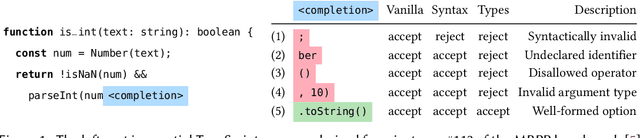
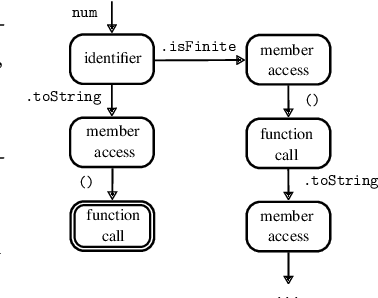
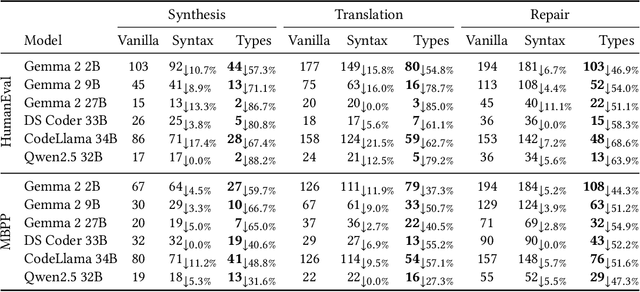
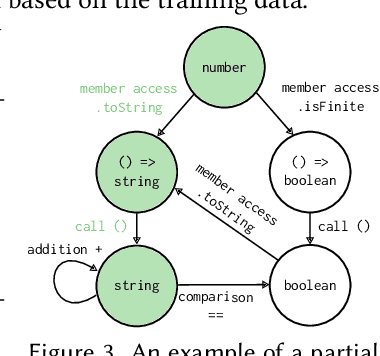
Large language models (LLMs) have achieved notable success in code generation. However, they still frequently produce uncompilable output because their next-token inference procedure does not model formal aspects of code. Although constrained decoding is a promising approach to alleviate this issue, it has only been applied to handle either domain-specific languages or syntactic language features. This leaves typing errors, which are beyond the domain of syntax and generally hard to adequately constrain. To address this challenge, we introduce a type-constrained decoding approach that leverages type systems to guide code generation. We develop novel prefix automata for this purpose and introduce a sound approach to enforce well-typedness based on type inference and a search over inhabitable types. We formalize our approach on a simply-typed language and extend it to TypeScript to demonstrate practicality. Our evaluation on HumanEval shows that our approach reduces compilation errors by more than half and increases functional correctness in code synthesis, translation, and repair tasks across LLMs of various sizes and model families, including SOTA open-weight models with more than 30B parameters.
Sculpting Subspaces: Constrained Full Fine-Tuning in LLMs for Continual Learning
Apr 09, 2025Continual learning in large language models (LLMs) is prone to catastrophic forgetting, where adapting to new tasks significantly degrades performance on previously learned ones. Existing methods typically rely on low-rank, parameter-efficient updates that limit the model's expressivity and introduce additional parameters per task, leading to scalability issues. To address these limitations, we propose a novel continual full fine-tuning approach leveraging adaptive singular value decomposition (SVD). Our method dynamically identifies task-specific low-rank parameter subspaces and constrains updates to be orthogonal to critical directions associated with prior tasks, thus effectively minimizing interference without additional parameter overhead or storing previous task gradients. We evaluate our approach extensively on standard continual learning benchmarks using both encoder-decoder (T5-Large) and decoder-only (LLaMA-2 7B) models, spanning diverse tasks including classification, generation, and reasoning. Empirically, our method achieves state-of-the-art results, up to 7% higher average accuracy than recent baselines like O-LoRA, and notably maintains the model's general linguistic capabilities, instruction-following accuracy, and safety throughout the continual learning process by reducing forgetting to near-negligible levels. Our adaptive SVD framework effectively balances model plasticity and knowledge retention, providing a practical, theoretically grounded, and computationally scalable solution for continual learning scenarios in large language models.
HGFormer: Topology-Aware Vision Transformer with HyperGraph Learning
Apr 03, 2025


The computer vision community has witnessed an extensive exploration of vision transformers in the past two years. Drawing inspiration from traditional schemes, numerous works focus on introducing vision-specific inductive biases. However, the implicit modeling of permutation invariance and fully-connected interaction with individual tokens disrupts the regional context and spatial topology, further hindering higher-order modeling. This deviates from the principle of perceptual organization that emphasizes the local groups and overall topology of visual elements. Thus, we introduce the concept of hypergraph for perceptual exploration. Specifically, we propose a topology-aware vision transformer called HyperGraph Transformer (HGFormer). Firstly, we present a Center Sampling K-Nearest Neighbors (CS-KNN) algorithm for semantic guidance during hypergraph construction. Secondly, we present a topology-aware HyperGraph Attention (HGA) mechanism that integrates hypergraph topology as perceptual indications to guide the aggregation of global and unbiased information during hypergraph messaging. Using HGFormer as visual backbone, we develop an effective and unitive representation, achieving distinct and detailed scene depictions. Empirical experiments show that the proposed HGFormer achieves competitive performance compared to the recent SoTA counterparts on various visual benchmarks. Extensive ablation and visualization studies provide comprehensive explanations of our ideas and contributions.
3DBonsai: Structure-Aware Bonsai Modeling Using Conditioned 3D Gaussian Splatting
Apr 02, 2025Recent advancements in text-to-3D generation have shown remarkable results by leveraging 3D priors in combination with 2D diffusion. However, previous methods utilize 3D priors that lack detailed and complex structural information, limiting them to generating simple objects and presenting challenges for creating intricate structures such as bonsai. In this paper, we propose 3DBonsai, a novel text-to-3D framework for generating 3D bonsai with complex structures. Technically, we first design a trainable 3D space colonization algorithm to produce bonsai structures, which are then enhanced through random sampling and point cloud augmentation to serve as the 3D Gaussian priors. We introduce two bonsai generation pipelines with distinct structural levels: fine structure conditioned generation, which initializes 3D Gaussians using a 3D structure prior to produce detailed and complex bonsai, and coarse structure conditioned generation, which employs a multi-view structure consistency module to align 2D and 3D structures. Moreover, we have compiled a unified 2D and 3D Chinese-style bonsai dataset. Our experimental results demonstrate that 3DBonsai significantly outperforms existing methods, providing a new benchmark for structure-aware 3D bonsai generation.
Enhanced Cross-modal 3D Retrieval via Tri-modal Reconstruction
Apr 02, 2025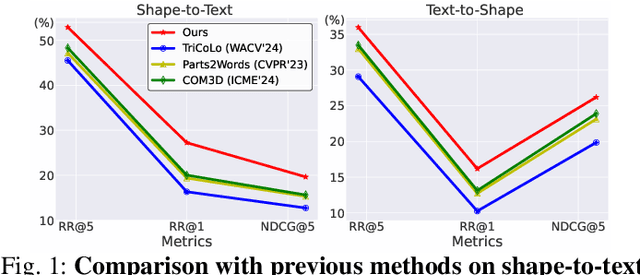
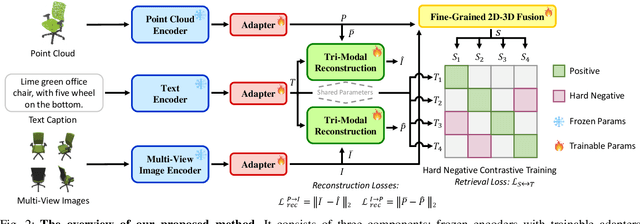
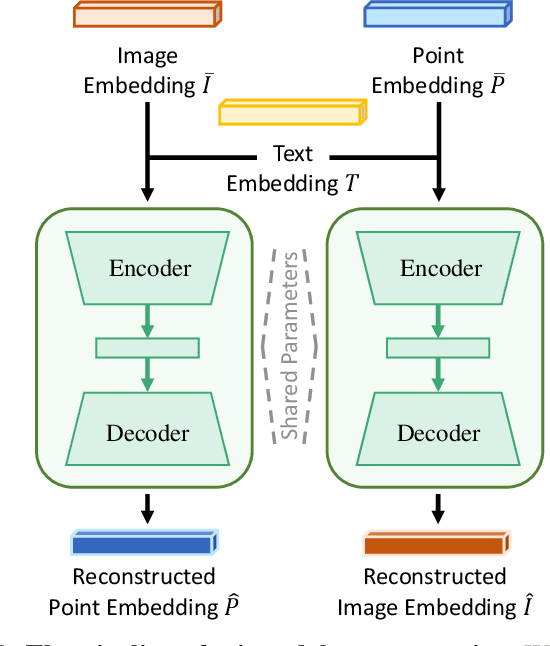
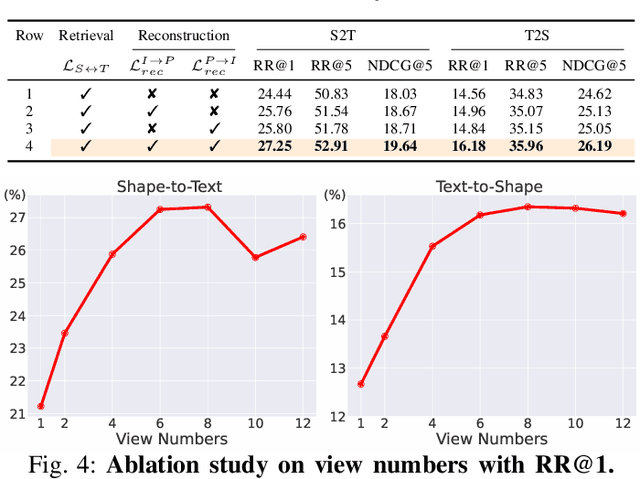
Cross-modal 3D retrieval is a critical yet challenging task, aiming to achieve bi-directional retrieval between 3D and text modalities. Current methods predominantly rely on a certain 3D representation (e.g., point cloud), with few exploiting the 2D-3D consistency and complementary relationships, which constrains their performance. To bridge this gap, we propose to adopt multi-view images and point clouds to jointly represent 3D shapes, facilitating tri-modal alignment (i.e., image, point, text) for enhanced cross-modal 3D retrieval. Notably, we introduce tri-modal reconstruction to improve the generalization ability of encoders. Given point features, we reconstruct image features under the guidance of text features, and vice versa. With well-aligned point cloud and multi-view image features, we aggregate them as multimodal embeddings through fine-grained 2D-3D fusion to enhance geometric and semantic understanding. Recognizing the significant noise in current datasets where many 3D shapes and texts share similar semantics, we employ hard negative contrastive training to emphasize harder negatives with greater significance, leading to robust discriminative embeddings. Extensive experiments on the Text2Shape dataset demonstrate that our method significantly outperforms previous state-of-the-art methods in both shape-to-text and text-to-shape retrieval tasks by a substantial margin.