 Add to Chrome
 Add to Firefox
 Add to Edge
CHILDES-Aligned: A Curated Children's Speech Dataset via Multi-Model Timestamp Ensembling
Jul 04, 2026
CHILDES is a large-scale child speech corpus containing long-form recordings of naturalistic child-adult interactions, making it a valuable resource for studying child speech and language development. However, utterance-level timestamps provided in this corpus are often noisy, incomplete, or misaligned with the audio. As a result, utterances cannot always be reliably localized within long recordings, which limits the direct use of these data for training and evaluating speech models. In this work, we propose BEACON (Boundary Estimation via Alignment CONsensus), an ensemble timestamp-curation framework that refines utterance-level timestamps by aggregating knowledge from multiple off-the-shelf ASR models. Specifically, each model's word-level timestamp predictions are first aligned to provided human transcripts, and the final utterance time boundaries are determined by a consensus voting strategy. The framework is corpus-agnostic and applies to any long-form recording paired with a trusted transcript whose timestamps are unreliable or missing, offering a general recipe for timestamp curation. Leveraging this pipeline, we curate and release a 413-hour general-purpose child-speech dataset with corrected utterance-level timestamps, together with a 283-hour quality-controlled subset for ASR training. Fine-tuning on this subset yields up to an average 19.5% relative WER reduction on four out-of-domain child-speech benchmarks.

FlexiSLM: A Dynamic and Controllable Frame Rate Spoken Language Model
Jun 30, 2026Spoken language models (SLMs) extend LLMs to speech input and output. Existing SLMs represent speech at fixed frame rates (e.g., 25 or 12.5 Hz), ignoring the time-varying information density of speech and offering no flexibility to trade off quality for speed at inference time. Recent audio tokenizer research has proposed dynamic frame rate speech coding, which exploits this non-uniformity and enables two new capabilities: very low average frame rates and frame rate controllability. However, this technique has not yet been applied to SLMs. We introduce Flexible Spoken Language Model (FlexiSLM), the first SLM that supports dynamic and controllable frame rates on both speech input and output. Using dynamic frame rate representations, FlexiSLM outperforms fixed-frame-rate 7B models including Qwen2.5-Omni and Kimi-Audio at its high-quality operating points. We further verify that FlexiSLM can be accurately steered down to 4.0 Hz; at 6.25 Hz, it roughly halves inference time relative to 12.5 Hz while retaining strong speech-to-speech quality. Audio samples are available at https://flexislm.github.io .
DNSMOS-C: Improving End-to-end Speech Quality Models via Contrastive Learning
Jun 25, 2026We introduce DNSMOS-C, a compact end-to-end speech quality assessment model that extends the DNSMOS Pro framework by integrating a MOS-guided triplet-based contrastive loss. Applied directly to the intermediate embeddings, this contrastive supervision encourages the latent space to be better organized with respect to perceptual quality while preserving the simplicity and efficiency of DNSMOS Pro. Unlike prior methods that depend on large pre-trained self-supervised learning (SSL) encoders and multi-stage training, DNSMOS-C jointly learns speech representations and MOS regression within a single, unified framework. Experiments on multiple datasets show that DNSMOS-C consistently improves correlation metrics over DNSMOS Pro and achieves better generalization on challenging out-of-domain test sets. Furthermore, latent space analyses indicate that our approach learns representations that exhibit an emergent low-dimensional quality ordering, which enhances interpretability and improves training stability. These findings demonstrate that MOS-guided contrastive learning enables more robust and accurate quality predictions without incurring additional computational overhead.
SA-SSL-MOS: Self-supervised Learning MOS Prediction with Spectral Augmentation for Generalized Multi-Rate Speech Assessment
Feb 16, 2026Designing a speech quality assessment (SQA) system for estimating mean-opinion-score (MOS) of multi-rate speech with varying sampling frequency (16-48 kHz) is a challenging task. The challenge arises due to the limited availability of a MOS-labeled training dataset comprising multi-rate speech samples. While self-supervised learning (SSL) models have been widely adopted in SQA to boost performance, a key limitation is that they are pretrained on 16 kHz speech and therefore discard high-frequency information present in higher sampling rates. To address this issue, we propose a spectrogram-augmented SSL method that incorporates high-frequency features (up to 48 kHz sampling rate) through a parallel-branch architecture. We further introduce a two-step training scheme: the model is first pre-trained on a large 48 kHz dataset and then fine-tuned on a smaller multi-rate dataset. Experimental results show that leveraging high-frequency information overlooked by SSL features is crucial for accurate multi-rate SQA, and that the proposed two-step training substantially improves generalization when multi-rate data is limited.
Selection of Layers from Self-supervised Learning Models for Predicting Mean-Opinion-Score of Speech
Aug 12, 2025Self-supervised learning (SSL) models like Wav2Vec2, HuBERT, and WavLM have been widely used in speech processing. These transformer-based models consist of multiple layers, each capturing different levels of representation. While prior studies explored their layer-wise representations for efficiency and performance, speech quality assessment (SQA) models predominantly rely on last-layer features, leaving intermediate layers underexamined. In this work, we systematically evaluate different layers of multiple SSL models for predicting mean-opinion-score (MOS). Features from each layer are fed into a lightweight regression network to assess effectiveness. Our experiments consistently show early-layers features outperform or match those from the last layer, leading to significant improvements over conventional approaches and state-of-the-art MOS prediction models. These findings highlight the advantages of early-layer selection, offering enhanced performance and reduced system complexity.
Leveraging LLMs for Scalable Non-intrusive Speech Quality Assessment
Aug 08, 2025Non-intrusive speech quality assessment (SQA) systems suffer from limited training data and costly human annotations, hindering their generalization to real-time conferencing calls. In this work, we propose leveraging large language models (LLMs) as pseudo-raters for speech quality to address these data bottlenecks. We construct LibriAugmented, a dataset consisting of 101,129 speech clips with simulated degradations labeled by a fine-tuned auditory LLM (Vicuna-7b-v1.5). We compare three training strategies: using human-labeled data, using LLM-labeled data, and a two-stage approach (pretraining on LLM labels, then fine-tuning on human labels), using both DNSMOS Pro and DeePMOS. We test on several datasets across languages and quality degradations. While LLM-labeled training yields mixed results compared to human-labeled training, we provide empirical evidence that the two-stage approach improves the generalization performance (e.g., DNSMOS Pro achieves 0.63 vs. 0.55 PCC on NISQA_TEST_LIVETALK and 0.73 vs. 0.65 PCC on Tencent with reverb). Our findings demonstrate the potential of using LLMs as scalable pseudo-raters for speech quality assessment, offering a cost-effective solution to the data limitation problem.
Multivariate Probabilistic Assessment of Speech Quality
Jun 05, 2025The mean opinion score (MOS) is a standard metric for assessing speech quality, but its singular focus fails to identify specific distortions when low scores are observed. The NISQA dataset addresses this limitation by providing ratings across four additional dimensions: noisiness, coloration, discontinuity, and loudness, alongside MOS. In this paper, we extend the explored univariate MOS estimation to a multivariate framework by modeling these dimensions jointly using a multivariate Gaussian distribution. Our approach utilizes Cholesky decomposition to predict covariances without imposing restrictive assumptions and extends probabilistic affine transformations to a multivariate context. Experimental results show that our model performs on par with state-of-the-art methods in point estimation, while uniquely providing uncertainty and correlation estimates across speech quality dimensions. This enables better diagnosis of poor speech quality and informs targeted improvements.
Human-in-the-Loop AI for HVAC Management Enhancing Comfort and Energy Efficiency
May 09, 2025Heating, Ventilation, and Air Conditioning (HVAC) systems account for approximately 38% of building energy consumption globally, making them one of the most energy-intensive services. The increasing emphasis on energy efficiency and sustainability, combined with the need for enhanced occupant comfort, presents a significant challenge for traditional HVAC systems. These systems often fail to dynamically adjust to real-time changes in electricity market rates or individual comfort preferences, leading to increased energy costs and reduced comfort. In response, we propose a Human-in-the-Loop (HITL) Artificial Intelligence framework that optimizes HVAC performance by incorporating real-time user feedback and responding to fluctuating electricity prices. Unlike conventional systems that require predefined information about occupancy or comfort levels, our approach learns and adapts based on ongoing user input. By integrating the occupancy prediction model with reinforcement learning, the system improves operational efficiency and reduces energy costs in line with electricity market dynamics, thereby contributing to demand response initiatives. Through simulations, we demonstrate that our method achieves significant cost reductions compared to baseline approaches while maintaining or enhancing occupant comfort. This feedback-driven approach ensures personalized comfort control without the need for predefined settings, offering a scalable solution that balances individual preferences with economic and environmental goals.
Impairments are Clustered in Latents of Deep Neural Network-based Speech Quality Models
Apr 30, 2025In this article, we provide an experimental observation: Deep neural network (DNN) based speech quality assessment (SQA) models have inherent latent representations where many types of impairments are clustered. While DNN-based SQA models are not trained for impairment classification, our experiments show good impairment classification results in an appropriate SQA latent representation. We investigate the clustering of impairments using various kinds of audio degradations that include different types of noises, waveform clipping, gain transition, pitch shift, compression, reverberation, etc. To visualize the clusters we perform classification of impairments in the SQA-latent representation domain using a standard k-nearest neighbor (kNN) classifier. We also develop a new DNN-based SQA model, named DNSMOS+, to examine whether an improvement in SQA leads to an improvement in impairment classification. The classification accuracy is 94% for LibriAugmented dataset with 16 types of impairments and 54% for ESC-50 dataset with 50 types of real noises.
Learning and Generating Diverse Residential Load Patterns Using GAN with Weakly-Supervised Training and Weight Selection
Apr 19, 2025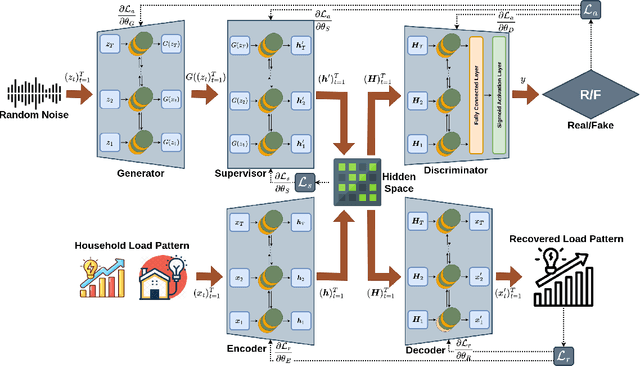
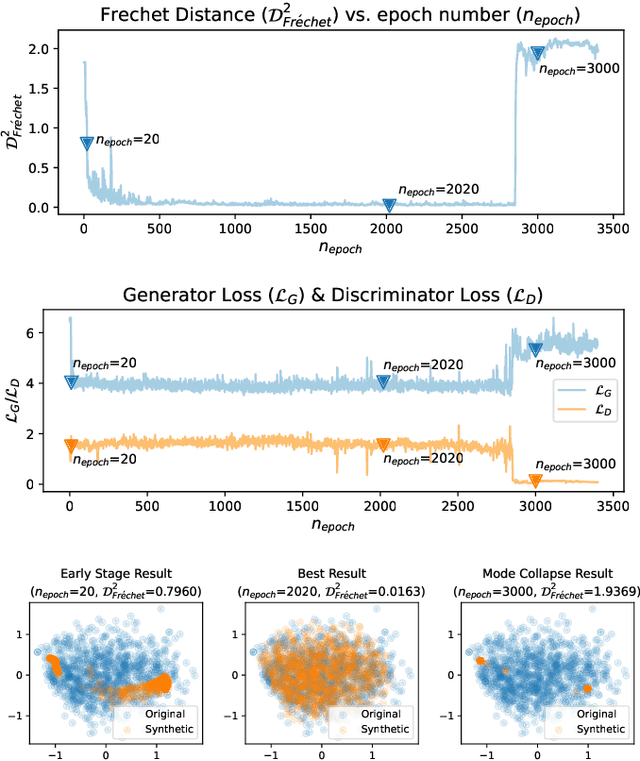
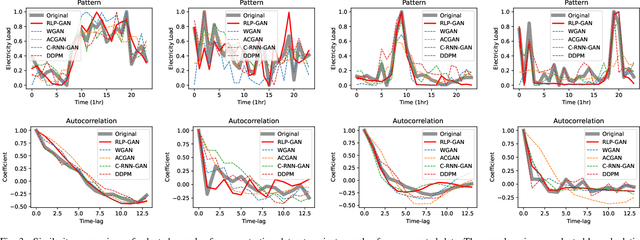
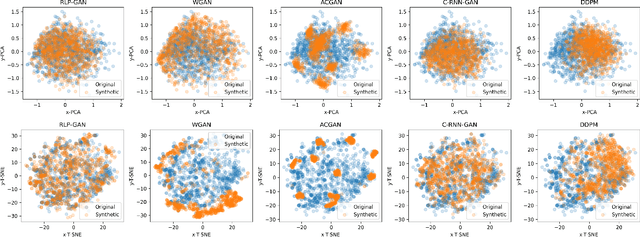
The scarcity of high-quality residential load data can pose obstacles for decarbonizing the residential sector as well as effective grid planning and operation. The above challenges have motivated research into generating synthetic load data, but existing methods faced limitations in terms of scalability, diversity, and similarity. This paper proposes a Generative Adversarial Network-based Synthetic Residential Load Pattern (RLP-GAN) generation model, a novel weakly-supervised GAN framework, leveraging an over-complete autoencoder to capture dependencies within complex and diverse load patterns and learn household-level data distribution at scale. We incorporate a model weight selection method to address the mode collapse problem and generate load patterns with high diversity. We develop a holistic evaluation method to validate the effectiveness of RLP-GAN using real-world data of 417 households. The results demonstrate that RLP-GAN outperforms state-of-the-art models in capturing temporal dependencies and generating load patterns with higher similarity to real data. Furthermore, we have publicly released the RLP-GAN generated synthetic dataset, which comprises one million synthetic residential load pattern profiles.
* 12 pages