 Add to Chrome
 Add to Firefox
 Add to Edge
QPO: Query-dependent Prompt Optimization via Multi-Loop Offline Reinforcement Learning
Aug 20, 2024
Prompt engineering has demonstrated remarkable success in enhancing the performance of large language models (LLMs) across diverse tasks. However, most existing prompt optimization methods only focus on the task-level performance, overlooking the importance of query-preferred prompts, which leads to suboptimal performances. Additionally, these methods rely heavily on frequent interactions with LLMs to obtain feedback for guiding the optimization process, incurring substantial redundant interaction costs. In this paper, we introduce Query-dependent Prompt Optimization (QPO), which leverages multi-loop offline reinforcement learning to iteratively fine-tune a small pretrained language model to generate optimal prompts tailored to the input queries, thus significantly improving the prompting effect on the large target LLM. We derive insights from offline prompting demonstration data, which already exists in large quantities as a by-product of benchmarking diverse prompts on open-sourced tasks, thereby circumventing the expenses of online interactions. Furthermore, we continuously augment the offline dataset with the generated prompts in each loop, as the prompts from the fine-tuned model are supposed to outperform the source prompts in the original dataset. These iterative loops bootstrap the model towards generating optimal prompts. Experiments on various LLM scales and diverse NLP and math tasks demonstrate the efficacy and cost-efficiency of our method in both zero-shot and few-shot scenarios.

Beyond Local Views: Global State Inference with Diffusion Models for Cooperative Multi-Agent Reinforcement Learning
Aug 18, 2024
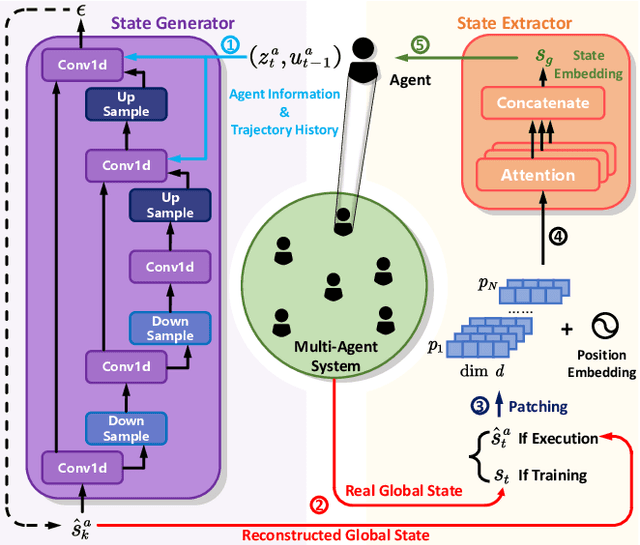


In partially observable multi-agent systems, agents typically only have access to local observations. This severely hinders their ability to make precise decisions, particularly during decentralized execution. To alleviate this problem and inspired by image outpainting, we propose State Inference with Diffusion Models (SIDIFF), which uses diffusion models to reconstruct the original global state based solely on local observations. SIDIFF consists of a state generator and a state extractor, which allow agents to choose suitable actions by considering both the reconstructed global state and local observations. In addition, SIDIFF can be effortlessly incorporated into current multi-agent reinforcement learning algorithms to improve their performance. Finally, we evaluated SIDIFF on different experimental platforms, including Multi-Agent Battle City (MABC), a novel and flexible multi-agent reinforcement learning environment we developed. SIDIFF achieved desirable results and outperformed other popular algorithms.
GuideLight: "Industrial Solution" Guidance for More Practical Traffic Signal Control Agents
Jul 15, 2024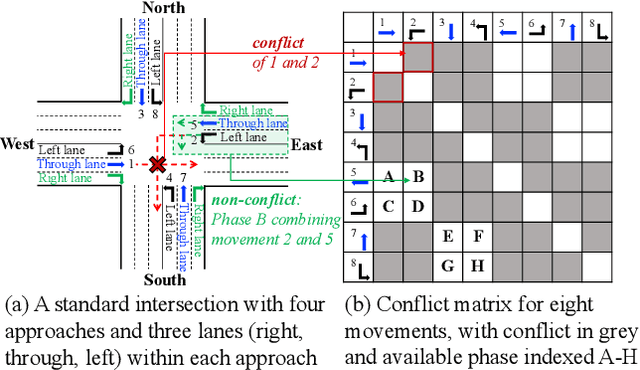
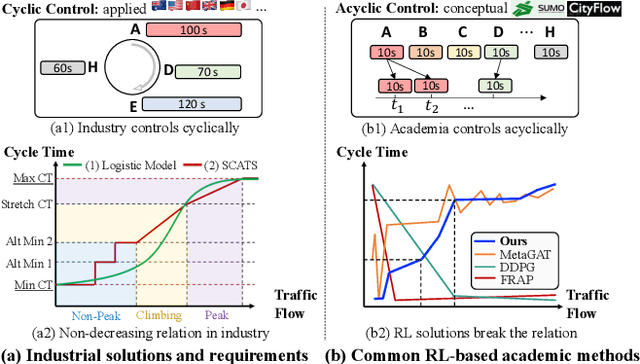
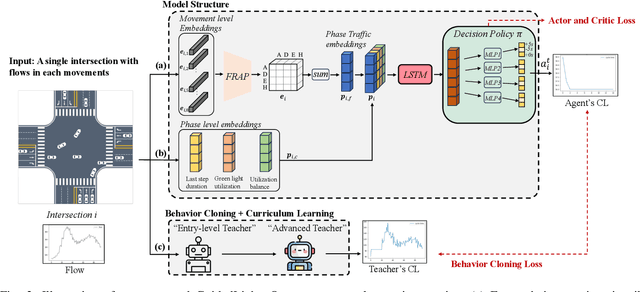
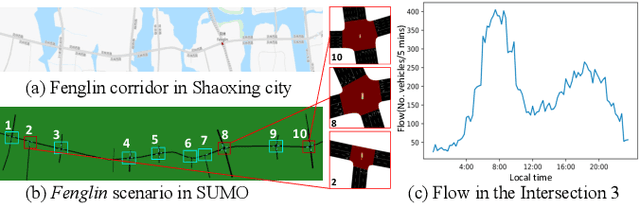
Currently, traffic signal control (TSC) methods based on reinforcement learning (RL) have proven superior to traditional methods. However, most RL methods face difficulties when applied in the real world due to three factors: input, output, and the cycle-flow relation. The industry's observable input is much more limited than simulation-based RL methods. For real-world solutions, only flow can be reliably collected, whereas common RL methods need more. For the output action, most RL methods focus on acyclic control, which real-world signal controllers do not support. Most importantly, industry standards require a consistent cycle-flow relationship: non-decreasing and different response strategies for low, medium, and high-level flows, which is ignored by the RL methods. To narrow the gap between RL methods and industry standards, we innovatively propose to use industry solutions to guide the RL agent. Specifically, we design behavior cloning and curriculum learning to guide the agent to mimic and meet industry requirements and, at the same time, leverage the power of exploration and exploitation in RL for better performance. We theoretically prove that such guidance can largely decrease the sample complexity to polynomials in the horizon when searching for an optimal policy. Our rigid experiments show that our method has good cycle-flow relation and superior performance.
CoSLight: Co-optimizing Collaborator Selection and Decision-making to Enhance Traffic Signal Control
May 27, 2024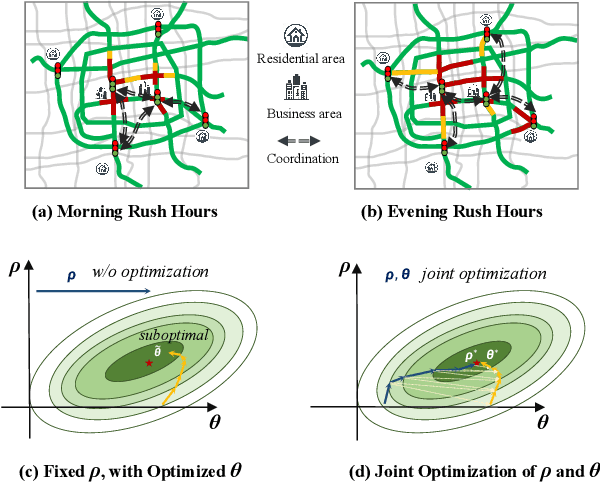
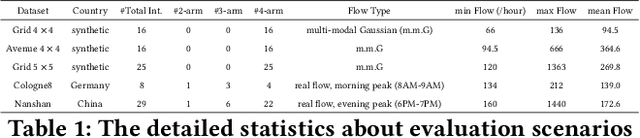
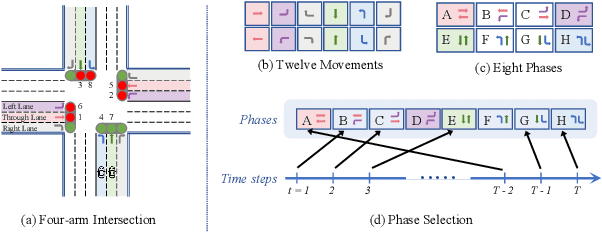
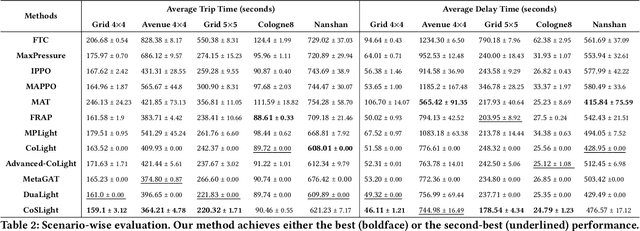
Effective multi-intersection collaboration is pivotal for reinforcement-learning-based traffic signal control to alleviate congestion. Existing work mainly chooses neighboring intersections as collaborators. However, quite an amount of congestion, even some wide-range congestion, is caused by non-neighbors failing to collaborate. To address these issues, we propose to separate the collaborator selection as a second policy to be learned, concurrently being updated with the original signal-controlling policy. Specifically, the selection policy in real-time adaptively selects the best teammates according to phase- and intersection-level features. Empirical results on both synthetic and real-world datasets provide robust validation for the superiority of our approach, offering significant improvements over existing state-of-the-art methods. The code is available at https://github.com/AnonymousAccountss/CoSLight.
SQL-to-Schema Enhances Schema Linking in Text-to-SQL
May 15, 2024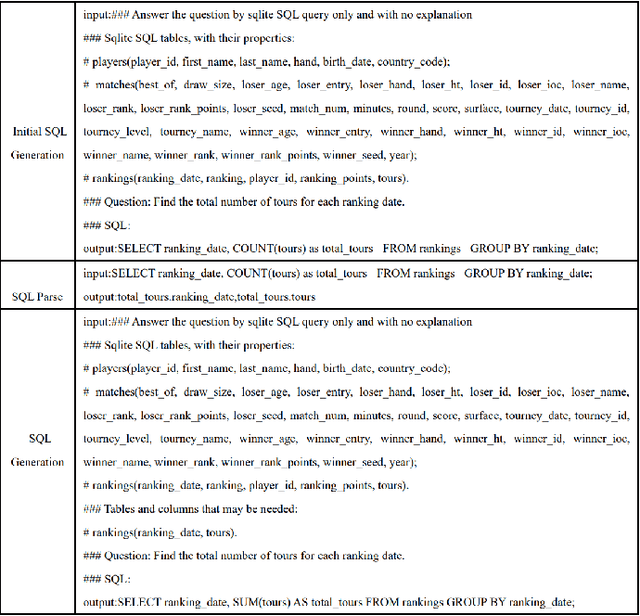
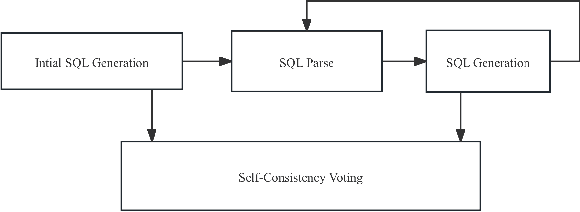
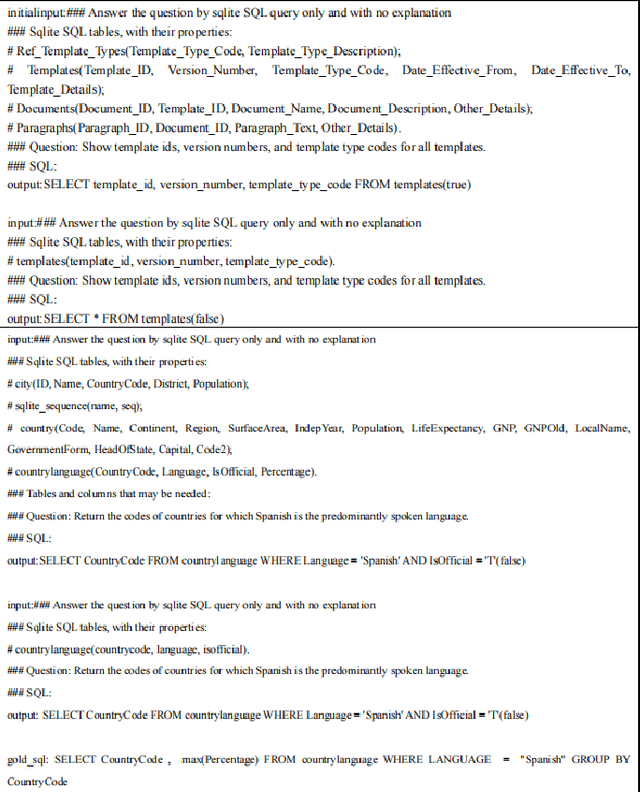
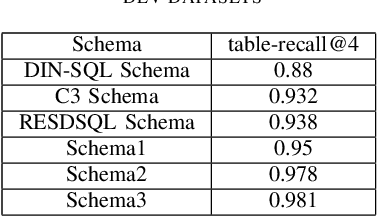
In sophisticated existing Text-to-SQL methods exhibit errors in various proportions, including schema-linking errors (incorrect columns, tables, or extra columns), join errors, nested errors, and group-by errors. Consequently, there is a critical need to filter out unnecessary tables and columns, directing the language models attention to relevant tables and columns with schema-linking, to reduce errors during SQL generation. Previous approaches have involved sorting tables and columns based on their relevance to the question, selecting the top-ranked ones for sorting, or directly identifying the necessary tables and columns for SQL generation. However, these methods face challenges such as lengthy model training times, high consumption of expensive GPT-4 tokens in few-shot prompts, or suboptimal performance in schema linking. Therefore, we propose an inventive schema linking method in two steps: Firstly, generate an initial SQL query by utilizing the complete database schema. Subsequently, extract tables and columns from the initial SQL query to create a concise schema. Using CodeLlama-34B, when comparing the schemas obtained by mainstream methods with ours for SQL generation, our schema performs optimally. Leveraging GPT4, our SQL generation method achieved results that are comparable to mainstream Text-to-SQL methods on the Spider dataset.
X-Light: Cross-City Traffic Signal Control Using Transformer on Transformer as Meta Multi-Agent Reinforcement Learner
Apr 18, 2024


The effectiveness of traffic light control has been significantly improved by current reinforcement learning-based approaches via better cooperation among multiple traffic lights. However, a persisting issue remains: how to obtain a multi-agent traffic signal control algorithm with remarkable transferability across diverse cities? In this paper, we propose a Transformer on Transformer (TonT) model for cross-city meta multi-agent traffic signal control, named as X-Light: We input the full Markov Decision Process trajectories, and the Lower Transformer aggregates the states, actions, rewards among the target intersection and its neighbors within a city, and the Upper Transformer learns the general decision trajectories across different cities. This dual-level approach bolsters the model's robust generalization and transferability. Notably, when directly transferring to unseen scenarios, ours surpasses all baseline methods with +7.91% on average, and even +16.3% in some cases, yielding the best results.
PET-SQL: A Prompt-enhanced Two-stage Text-to-SQL Framework with Cross-consistency
Mar 18, 2024
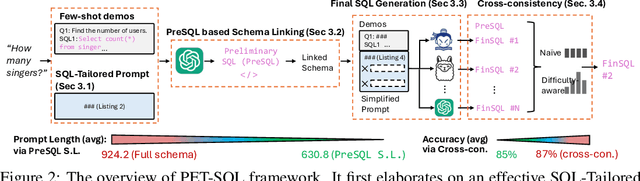
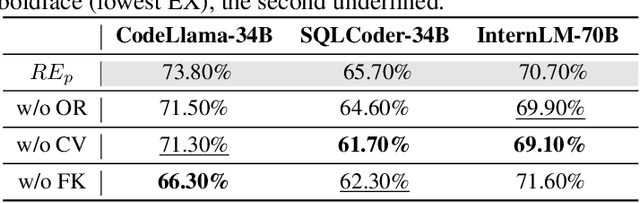
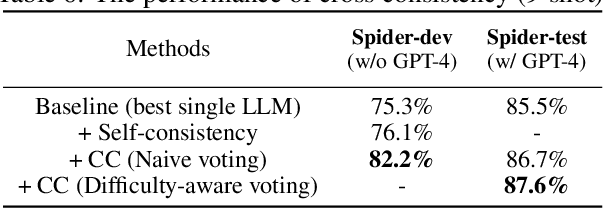
Recent advancements in Text-to-SQL (Text2SQL) emphasize stimulating the large language models (LLM) on in-context learning, achieving significant results. Nevertheless, they face challenges when dealing with verbose database information and complex user intentions. This paper presents a two-stage framework to enhance the performance of current LLM-based natural language to SQL systems. We first introduce a novel prompt representation, called reference-enhanced representation, which includes schema information and randomly sampled cell values from tables to instruct LLMs in generating SQL queries. Then, in the first stage, question-SQL pairs are retrieved as few-shot demonstrations, prompting the LLM to generate a preliminary SQL (PreSQL). After that, the mentioned entities in PreSQL are parsed to conduct schema linking, which can significantly compact the useful information. In the second stage, with the linked schema, we simplify the prompt's schema information and instruct the LLM to produce the final SQL. Finally, as the post-refinement module, we propose using cross-consistency across different LLMs rather than self-consistency within a particular LLM. Our methods achieve new SOTA results on the Spider benchmark, with an execution accuracy of 87.6%.
Benchmarking the Text-to-SQL Capability of Large Language Models: A Comprehensive Evaluation
Mar 06, 2024


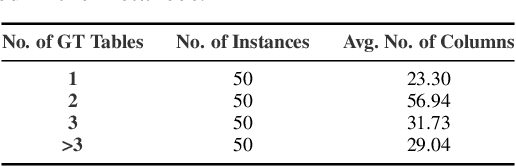
Large Language Models (LLMs) have emerged as a powerful tool in advancing the Text-to-SQL task, significantly outperforming traditional methods. Nevertheless, as a nascent research field, there is still no consensus on the optimal prompt templates and design frameworks. Additionally, existing benchmarks inadequately explore the performance of LLMs across the various sub-tasks of the Text-to-SQL process, which hinders the assessment of LLMs' cognitive capabilities and the optimization of LLM-based solutions. To address the aforementioned issues, we firstly construct a new dataset designed to mitigate the risk of overfitting in LLMs. Then we formulate five evaluation tasks to comprehensively assess the performance of diverse methods across various LLMs throughout the Text-to-SQL process.Our study highlights the performance disparities among LLMs and proposes optimal in-context learning solutions tailored to each task. These findings offer valuable insights for enhancing the development of LLM-based Text-to-SQL systems.
PDiT: Interleaving Perception and Decision-making Transformers for Deep Reinforcement Learning
Dec 26, 2023Designing better deep networks and better reinforcement learning (RL) algorithms are both important for deep RL. This work studies the former. Specifically, the Perception and Decision-making Interleaving Transformer (PDiT) network is proposed, which cascades two Transformers in a very natural way: the perceiving one focuses on \emph{the environmental perception} by processing the observation at the patch level, whereas the deciding one pays attention to \emph{the decision-making} by conditioning on the history of the desired returns, the perceiver's outputs, and the actions. Such a network design is generally applicable to a lot of deep RL settings, e.g., both the online and offline RL algorithms under environments with either image observations, proprioception observations, or hybrid image-language observations. Extensive experiments show that PDiT can not only achieve superior performance than strong baselines in different settings but also extract explainable feature representations. Our code is available at \url{https://github.com/maohangyu/PDiT}.
DuaLight: Enhancing Traffic Signal Control by Leveraging Scenario-Specific and Scenario-Shared Knowledge
Dec 22, 2023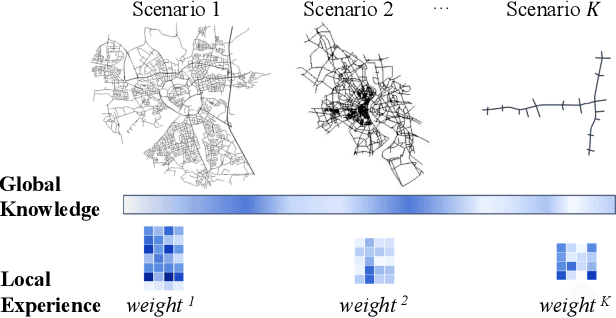

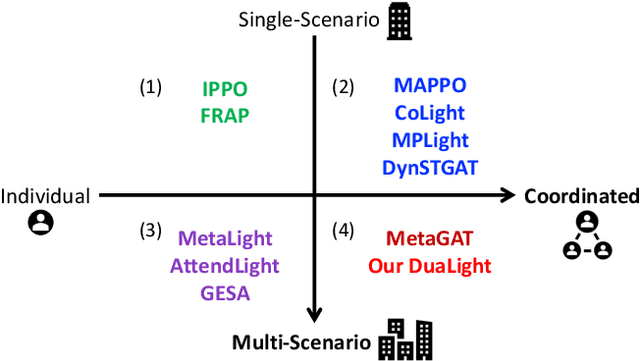
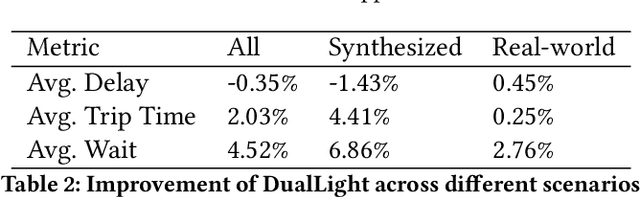
Reinforcement learning has been revolutionizing the traditional traffic signal control task, showing promising power to relieve congestion and improve efficiency. However, the existing methods lack effective learning mechanisms capable of absorbing dynamic information inherent to a specific scenario and universally applicable dynamic information across various scenarios. Moreover, within each specific scenario, they fail to fully capture the essential empirical experiences about how to coordinate between neighboring and target intersections, leading to sub-optimal system-wide outcomes. Viewing these issues, we propose DuaLight, which aims to leverage both the experiential information within a single scenario and the generalizable information across various scenarios for enhanced decision-making. Specifically, DuaLight introduces a scenario-specific experiential weight module with two learnable parts: Intersection-wise and Feature-wise, guiding how to adaptively utilize neighbors and input features for each scenario, thus providing a more fine-grained understanding of different intersections. Furthermore, we implement a scenario-shared Co-Train module to facilitate the learning of generalizable dynamics information across different scenarios. Empirical results on both real-world and synthetic scenarios show DuaLight achieves competitive performance across various metrics, offering a promising solution to alleviate traffic congestion, with 3-7\% improvements. The code is available under: https://github.com/lujiaming-12138/DuaLight.