 Add to Chrome
 Add to Firefox
 Add to Edge
A hierarchical spatial-aware algorithm with efficient reinforcement learning for human-robot task planning and allocation in production
Apr 14, 2026
In advanced manufacturing systems, humans and robots collaborate to conduct the production process. Effective task planning and allocation (TPA) is crucial for achieving high production efficiency, yet it remains challenging in complex and dynamic manufacturing environments. The dynamic nature of humans and robots, particularly the need to consider spatial information (e.g., humans' real-time position and the distance they need to move to complete a task), substantially complicates TPA. To address the above challenges, we decompose production tasks into manageable subtasks. We then implement a real-time hierarchical human-robot TPA algorithm, including a high-level agent for task planning and a low-level agent for task allocation. For the high-level agent, we propose an efficient buffer-based deep Q-learning method (EBQ), which reduces training time and enhances performance in production problems with long-term and sparse reward challenges. For the low-level agent, a path planning-based spatially aware method (SAP) is designed to allocate tasks to the appropriate human-robot resources, thereby achieving the corresponding sequential subtasks. We conducted experiments on a complex real-time production process in a 3D simulator. The results demonstrate that our proposed EBQ&SAP method effectively addresses human-robot TPA problems in complex and dynamic production processes.
* This is the accepted manuscript of a journal article accepted for publication in Robotics and Computer-Integrated Manufacturing (Elsevier)

Safe reinforcement learning with online filtering for fatigue-predictive human-robot task planning and allocation in production
Apr 14, 2026Human-robot collaborative manufacturing, a core aspect of Industry 5.0, emphasizes ergonomics to enhance worker well-being. This paper addresses the dynamic human-robot task planning and allocation (HRTPA) problem, which involves determining when to perform tasks and who should execute them to maximize efficiency while ensuring workers' physical fatigue remains within safe limits. The inclusion of fatigue constraints, combined with production dynamics, significantly increases the complexity of the HRTPA problem. Traditional fatigue-recovery models in HRTPA often rely on static, predefined hyperparameters. However, in practice, human fatigue sensitivity varies daily due to factors such as changed work conditions and insufficient sleep. To better capture this uncertainty, we treat fatigue-related parameters as inaccurate and estimate them online based on observed fatigue progression during production. To address these challenges, we propose PF-CD3Q, a safe reinforcement learning (safe RL) approach that integrates the particle filter with constrained dueling double deep Q-learning for real-time fatigue-predictive HRTPA. Specifically, we first develop PF-based estimators to track human fatigue and update fatigue model parameters in real-time. These estimators are then integrated into CD3Q by making task-level fatigue predictions during decision-making and excluding tasks that exceed fatigue limits, thereby constraining the action space and formulating the problem as a constrained Markov decision process (CMDP).
* This is the accepted manuscript of an article accepted for publication in \textit{Journal of Manufacturing Systems (Elsevier)
Beyond Local Views: Global State Inference with Diffusion Models for Cooperative Multi-Agent Reinforcement Learning
Aug 18, 2024
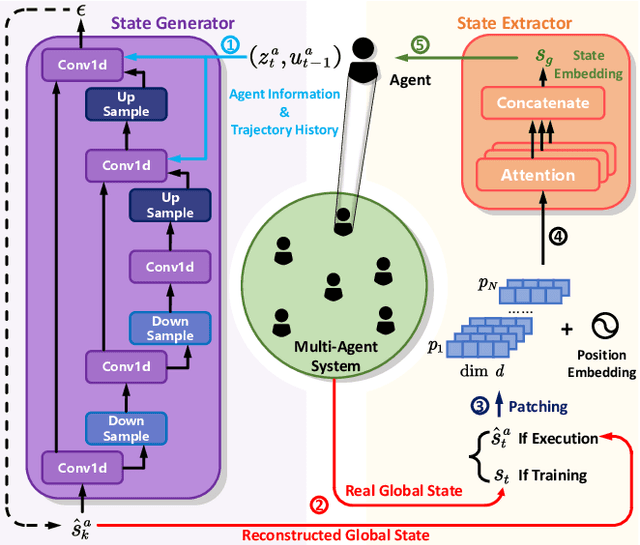


In partially observable multi-agent systems, agents typically only have access to local observations. This severely hinders their ability to make precise decisions, particularly during decentralized execution. To alleviate this problem and inspired by image outpainting, we propose State Inference with Diffusion Models (SIDIFF), which uses diffusion models to reconstruct the original global state based solely on local observations. SIDIFF consists of a state generator and a state extractor, which allow agents to choose suitable actions by considering both the reconstructed global state and local observations. In addition, SIDIFF can be effortlessly incorporated into current multi-agent reinforcement learning algorithms to improve their performance. Finally, we evaluated SIDIFF on different experimental platforms, including Multi-Agent Battle City (MABC), a novel and flexible multi-agent reinforcement learning environment we developed. SIDIFF achieved desirable results and outperformed other popular algorithms.