 Add to Chrome
 Add to Firefox
 Add to Edge
SG-WAM: Self-Guided World Modeling in Geometry-Aware Policy Space
Aug 02, 2026
World Action Models (WAMs) couple action generation with prediction of future states. Their effectiveness depends on whether future dynamics are modeled in a space that is both aligned with action generation and sufficiently geometry-aware to capture where and how actions change the scene. Existing WAMs typically satisfy only part of this requirement, relying on either perceptually heavy observation-space targets or auxiliary latent spaces that are not jointly structured for action relevance and geometry. We propose SG-WAM, a self-guided framework that learns geometry-aware action-conditioned dynamics directly in the policy-derived representation space. SG-WAM introduces learnable dynamics tokens and a Self-Guided World Predictor that forecasts their future latent states conditioned on intervening robot actions. Prediction targets are generated by an exponential moving average copy of the same policy backbone, providing stable supervision within the representation family used by the action expert. Geometric supervision further structures the policy image-token representations, providing spatially grounded context for the dynamics tokens and yielding a future-alignment space that is both action-relevant and geometry-aware. Latent future prediction, geometric grounding, and flow-matching action generation are jointly optimized end-to-end in a unified framework. Built on a 0.9B model without large-scale embodied pretraining, SG-WAM achieves 98.5% average success on LIBERO and 73% on LIBERO-Plus, while outperforming strong baselines in both in-distribution and out-of-distribution real-world evaluations.

Physics-Guided Biomechanical Gait Adaptation for Humanoid Locomotion on Extreme Sloped Terrains
Jul 08, 2026Model-free reinforcement learning has enabled impressive humanoid locomotion; however, control on steep slopes remains largely unexplored. Unlike flat or discrete terrains, sloped terrains impose a persistent gravitational bias that demands simultaneous stability and posture control. Consequently, under generic reward formulations, policies can converge to slow, conservative low-center-of-mass (CoM) crouched gaits. In this work, we propose a novel two-stage physics-guided framework, dubbed HumoSlope, dedicated to robust humanoid locomotion on diverse sloped terrains. Specifically, Stage I establishes a terrain-consistent balance prior by introducing a slope-adaptive Zero Moment Point (ZMP) regularizer evaluated directly on the local inclined support plane rather than a world-horizontal reference. To prevent the resulting policy from defaulting to a crouched posture, Stage II introduces the Biomechanical Slope Gait Adapter (BSGA). Utilizing extracted macroscopic terrain descriptors as privileged, training-only signals, BSGA dynamically gates soft reward priors to modulate CoM height and lower-limb coordination based on the estimated slope geometry -- encouraging hip-dominant uphill propulsion and knee-oriented downhill braking. Crucially, the deployed actor remains entirely proprioceptive, requiring no online exteroceptive sensing. Extensive Sim-to-Real experiments demonstrate that our framework effectively mitigates posture degeneration and enables blind, continuous traversal of outdoor grass slopes up to 62.7% ($32.1^\circ$), validating a physics-guided approach to challenging slope terrain adaptation.
CoRDE: Concept-Prior Routed Diffusion Experts for Structural Generalization in Robot Manipulation
Jun 20, 2026Diffusion models excel at capturing multi-modal action distributions in robot imitation learning. However, in multi-task and long-horizon scenarios, monolithic architectures lack structural generalization capabilities, suffering from gradient conflicts between distinct semantic sub-stages. While pure data-driven Mixture-of-Experts (MoE) methods introduce labor division, they frequently trigger routing collapse, and instantiating full-scale experts causes parameter explosion and high expansion costs. To address these issues, we propose Concept-prior Routed Diffusion Experts (CoRDE), a structure-guided variational distillation framework. CoRDE extracts semantic distributions from a frozen concept encoder to guide the variational posterior responsibility via a learnable soft mapping matrix. This mechanism introduces an entropy-controlled responsibility inference process that encourages confident routing under reliable semantic predictions while preserving the stochastic diffusion term for behavioral diversity. To overcome parameter inflation, CoRDE employs a parameter-efficient expert pool using Low-Rank Adaptation (LoRA) on a shared frozen backbone. Theoretical analysis shows that the mixture score discrepancy is bounded by responsibility-weighted local expert errors, supporting high-fidelity generation under low-rank expert adaptation. Empirical evaluations confirm that, compared to existing baselines, CoRDE systematically reduces routing collapse, forming robust, semantically aligned expert allocations while achieving superior action quality and incremental learning efficiency.
RoCo Challenge at AAAI 2026: Benchmarking Robotic Collaborative Manipulation for Assembly Towards Industrial Automation
Mar 16, 2026Embodied Artificial Intelligence (EAI) is rapidly developing, gradually subverting previous autonomous systems' paradigms from isolated perception to integrated, continuous action. This transition is highly significant for industrial robotic manipulation, promising to free human workers from repetitive, dangerous daily labor. To benchmark and advance this capability, we introduce the Robotic Collaborative Assembly Assistance (RoCo) Challenge with a dataset towards simulation and real-world assembly manipulation. Set against the backdrop of human-centered manufacturing, this challenge focuses on a high-precision planetary gearbox assembly task, a demanding yet highly representative operation in modern industry. Built upon a self-developed data collection, training, and evaluation system in Isaac Sim, and utilizing a dual-arm robot for real-world deployment, the challenge operates in two phases. The Simulation Round defines fine-grained task phases for step-wise scoring to handle the long-horizon nature of the assembly. The Real-World Round mirrors this evaluation with physical gearbox components and high-quality teleoperated datasets. The core tasks require assembling an epicyclic gearbox from scratch, including mounting three planet gears, a sun gear, and a ring gear. Attracting over 60 teams and 170+ participants from more than 10 countries, the challenge yielded highly effective solutions, most notably ARC-VLA and RoboCola. Results demonstrate that a dual-model framework for long-horizon multi-task learning is highly effective, and the strategic utilization of recovery-from-failure curriculum data is a critical insight for successful deployment. This report outlines the competition setup, evaluation approach, key findings, and future directions for industrial EAI. Our dataset, CAD files, code, and evaluation results can be found at: https://rocochallenge.github.io/RoCo2026/.
FD-VLA: Force-Distilled Vision-Language-Action Model for Contact-Rich Manipulation
Feb 02, 2026Force sensing is a crucial modality for Vision-Language-Action (VLA) frameworks, as it enables fine-grained perception and dexterous manipulation in contact-rich tasks. We present Force-Distilled VLA (FD-VLA), a novel framework that integrates force awareness into contact-rich manipulation without relying on physical force sensors. The core of our approach is a Force Distillation Module (FDM), which distills force by mapping a learnable query token, conditioned on visual observations and robot states, into a predicted force token aligned with the latent representation of actual force signals. During inference, this distilled force token is injected into the pretrained VLM, enabling force-aware reasoning while preserving the integrity of its vision-language semantics. This design provides two key benefits: first, it allows practical deployment across a wide range of robots that lack expensive or fragile force-torque sensors, thereby reducing hardware cost and complexity; second, the FDM introduces an additional force-vision-state fusion prior to the VLM, which improves cross-modal alignment and enhances perception-action robustness in contact-rich scenarios. Surprisingly, our physical experiments show that the distilled force token outperforms direct sensor force measurements as well as other baselines, which highlights the effectiveness of this force-distilled VLA approach.
EPSegFZ: Efficient Point Cloud Semantic Segmentation for Few- and Zero-Shot Scenarios with Language Guidance
Nov 12, 2025Recent approaches for few-shot 3D point cloud semantic segmentation typically require a two-stage learning process, i.e., a pre-training stage followed by a few-shot training stage. While effective, these methods face overreliance on pre-training, which hinders model flexibility and adaptability. Some models tried to avoid pre-training yet failed to capture ample information. In addition, current approaches focus on visual information in the support set and neglect or do not fully exploit other useful data, such as textual annotations. This inadequate utilization of support information impairs the performance of the model and restricts its zero-shot ability. To address these limitations, we present a novel pre-training-free network, named Efficient Point Cloud Semantic Segmentation for Few- and Zero-shot scenarios. Our EPSegFZ incorporates three key components. A Prototype-Enhanced Registers Attention (ProERA) module and a Dual Relative Positional Encoding (DRPE)-based cross-attention mechanism for improved feature extraction and accurate query-prototype correspondence construction without pre-training. A Language-Guided Prototype Embedding (LGPE) module that effectively leverages textual information from the support set to improve few-shot performance and enable zero-shot inference. Extensive experiments show that our method outperforms the state-of-the-art method by 5.68% and 3.82% on the S3DIS and ScanNet benchmarks, respectively.
SingRef6D: Monocular Novel Object Pose Estimation with a Single RGB Reference
Sep 26, 2025Recent 6D pose estimation methods demonstrate notable performance but still face some practical limitations. For instance, many of them rely heavily on sensor depth, which may fail with challenging surface conditions, such as transparent or highly reflective materials. In the meantime, RGB-based solutions provide less robust matching performance in low-light and texture-less scenes due to the lack of geometry information. Motivated by these, we propose SingRef6D, a lightweight pipeline requiring only a single RGB image as a reference, eliminating the need for costly depth sensors, multi-view image acquisition, or training view synthesis models and neural fields. This enables SingRef6D to remain robust and capable even under resource-limited settings where depth or dense templates are unavailable. Our framework incorporates two key innovations. First, we propose a token-scaler-based fine-tuning mechanism with a novel optimization loss on top of Depth-Anything v2 to enhance its ability to predict accurate depth, even for challenging surfaces. Our results show a 14.41% improvement (in $\delta_{1.05}$) on REAL275 depth prediction compared to Depth-Anything v2 (with fine-tuned head). Second, benefiting from depth availability, we introduce a depth-aware matching process that effectively integrates spatial relationships within LoFTR, enabling our system to handle matching for challenging materials and lighting conditions. Evaluations of pose estimation on the REAL275, ClearPose, and Toyota-Light datasets show that our approach surpasses state-of-the-art methods, achieving a 6.1% improvement in average recall.
GAM-Depth: Self-Supervised Indoor Depth Estimation Leveraging a Gradient-Aware Mask and Semantic Constraints
Feb 22, 2024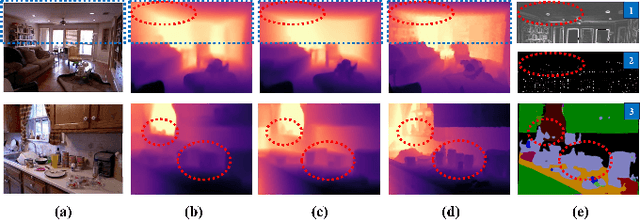
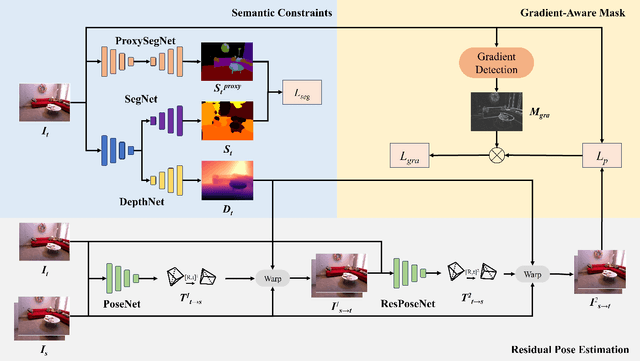
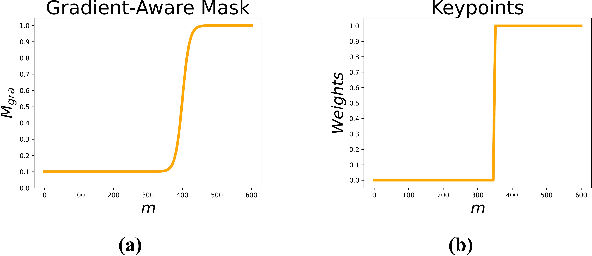
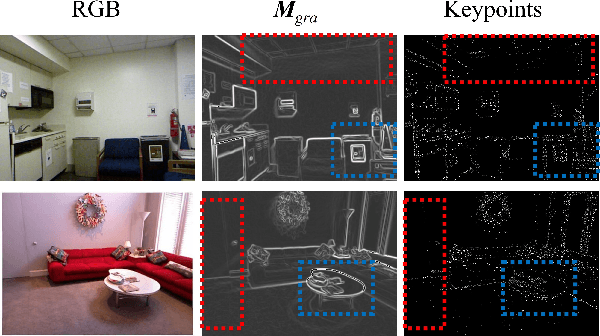
Self-supervised depth estimation has evolved into an image reconstruction task that minimizes a photometric loss. While recent methods have made strides in indoor depth estimation, they often produce inconsistent depth estimation in textureless areas and unsatisfactory depth discrepancies at object boundaries. To address these issues, in this work, we propose GAM-Depth, developed upon two novel components: gradient-aware mask and semantic constraints. The gradient-aware mask enables adaptive and robust supervision for both key areas and textureless regions by allocating weights based on gradient magnitudes.The incorporation of semantic constraints for indoor self-supervised depth estimation improves depth discrepancies at object boundaries, leveraging a co-optimization network and proxy semantic labels derived from a pretrained segmentation model. Experimental studies on three indoor datasets, including NYUv2, ScanNet, and InteriorNet, show that GAM-Depth outperforms existing methods and achieves state-of-the-art performance, signifying a meaningful step forward in indoor depth estimation. Our code will be available at https://github.com/AnqiCheng1234/GAM-Depth.
Few-Shot Point Cloud Semantic Segmentation via Contrastive Self-Supervision and Multi-Resolution Attention
Feb 21, 2023
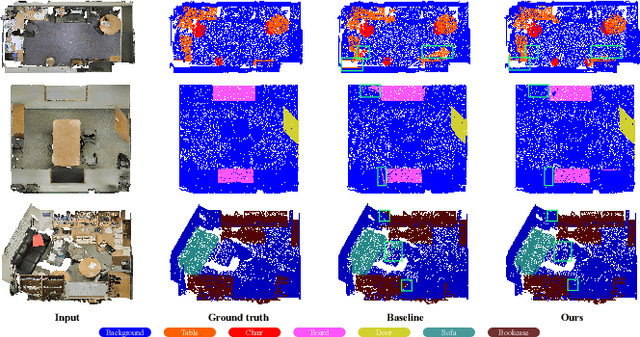
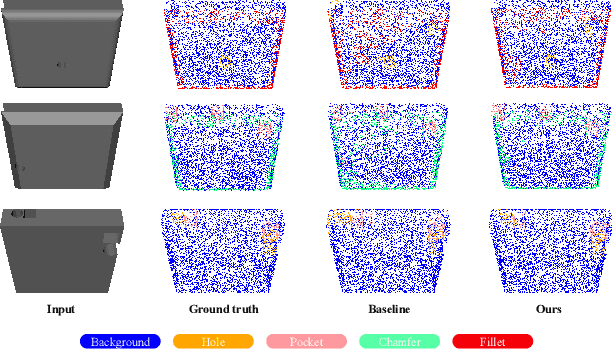
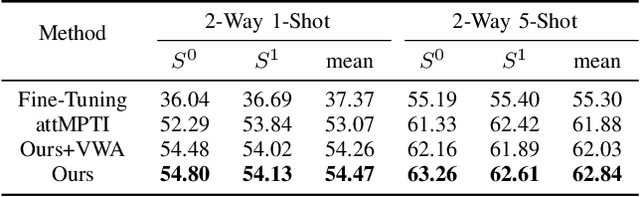
This paper presents an effective few-shot point cloud semantic segmentation approach for real-world applications. Existing few-shot segmentation methods on point cloud heavily rely on the fully-supervised pretrain with large annotated datasets, which causes the learned feature extraction bias to those pretrained classes. However, as the purpose of few-shot learning is to handle unknown/unseen classes, such class-specific feature extraction in pretrain is not ideal to generalize into new classes for few-shot learning. Moreover, point cloud datasets hardly have a large number of classes due to the annotation difficulty. To address these issues, we propose a contrastive self-supervision framework for few-shot learning pretrain, which aims to eliminate the feature extraction bias through class-agnostic contrastive supervision. Specifically, we implement a novel contrastive learning approach with a learnable augmentor for a 3D point cloud to achieve point-wise differentiation, so that to enhance the pretrain with managed overfitting through the self-supervision. Furthermore, we develop a multi-resolution attention module using both the nearest and farthest points to extract the local and global point information more effectively, and a center-concentrated multi-prototype is adopted to mitigate the intra-class sparsity. Comprehensive experiments are conducted to evaluate the proposed approach, which shows our approach achieves state-of-the-art performance. Moreover, a case study on practical CAM/CAD segmentation is presented to demonstrate the effectiveness of our approach for real-world applications.
Multi-Frequency-Aware Patch Adversarial Learning for Neural Point Cloud Rendering
Oct 07, 2022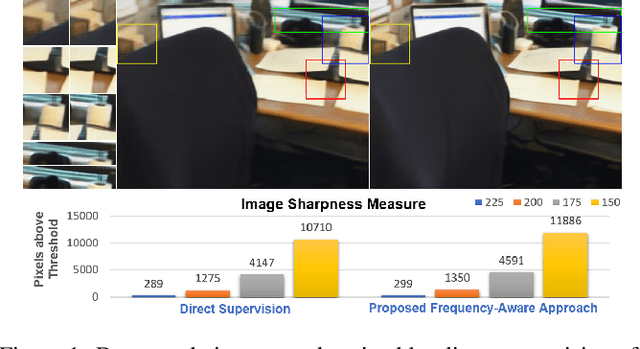
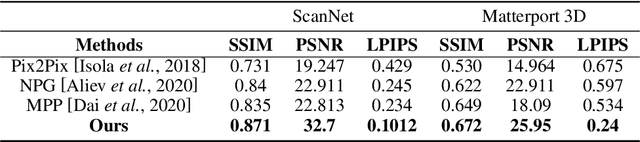
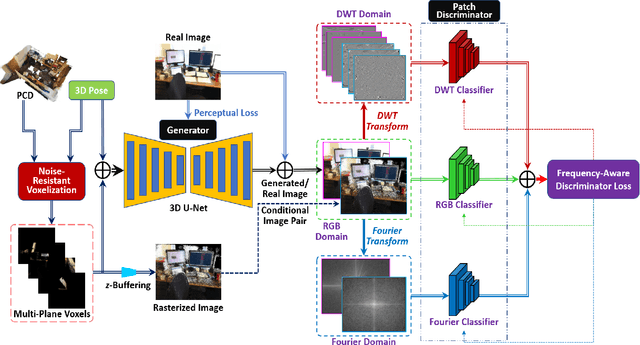
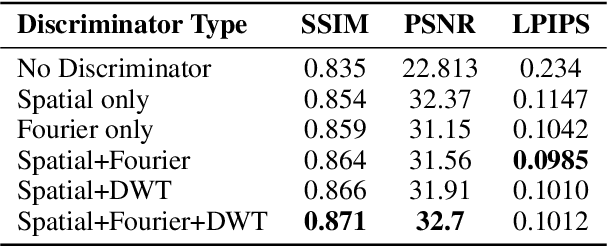
We present a neural point cloud rendering pipeline through a novel multi-frequency-aware patch adversarial learning framework. The proposed approach aims to improve the rendering realness by minimizing the spectrum discrepancy between real and synthesized images, especially on the high-frequency localized sharpness information which causes image blur visually. Specifically, a patch multi-discriminator scheme is proposed for the adversarial learning, which combines both spectral domain (Fourier Transform and Discrete Wavelet Transform) discriminators as well as the spatial (RGB) domain discriminator to force the generator to capture global and local spectral distributions of the real images. The proposed multi-discriminator scheme not only helps to improve rendering realness, but also enhance the convergence speed and stability of adversarial learning. Moreover, we introduce a noise-resistant voxelisation approach by utilizing both the appearance distance and spatial distance to exclude the spatial outlier points caused by depth noise. Our entire architecture is fully differentiable and can be learned in an end-to-end fashion. Extensive experiments show that our method produces state-of-the-art results for neural point cloud rendering by a significant margin. Our source code will be made public at a later date.