 Add to Chrome
 Add to Firefox
 Add to Edge
Opinion: Towards Unified Expressive Policy Optimization for Robust Robot Learning
Nov 13, 2025
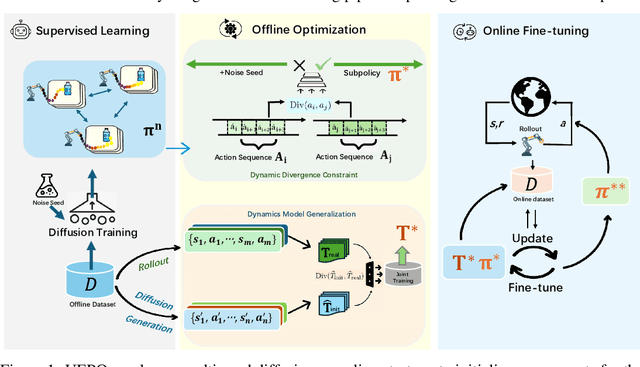
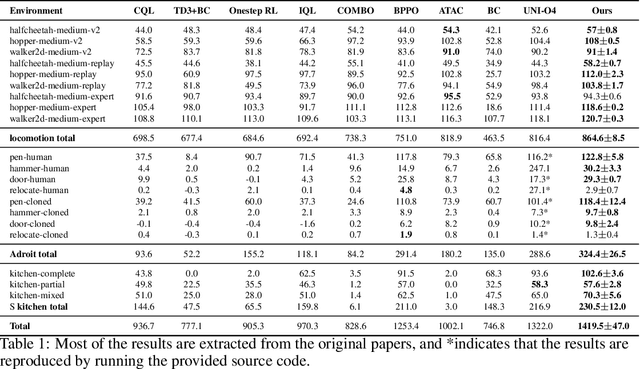
Offline-to-online reinforcement learning (O2O-RL) has emerged as a promising paradigm for safe and efficient robotic policy deployment but suffers from two fundamental challenges: limited coverage of multimodal behaviors and distributional shifts during online adaptation. We propose UEPO, a unified generative framework inspired by large language model pretraining and fine-tuning strategies. Our contributions are threefold: (1) a multi-seed dynamics-aware diffusion policy that efficiently captures diverse modalities without training multiple models; (2) a dynamic divergence regularization mechanism that enforces physically meaningful policy diversity; and (3) a diffusion-based data augmentation module that enhances dynamics model generalization. On the D4RL benchmark, UEPO achieves +5.9\% absolute improvement over Uni-O4 on locomotion tasks and +12.4\% on dexterous manipulation, demonstrating strong generalization and scalability.

LODE: Deep Local Deblurring and A New Benchmark
Sep 19, 2021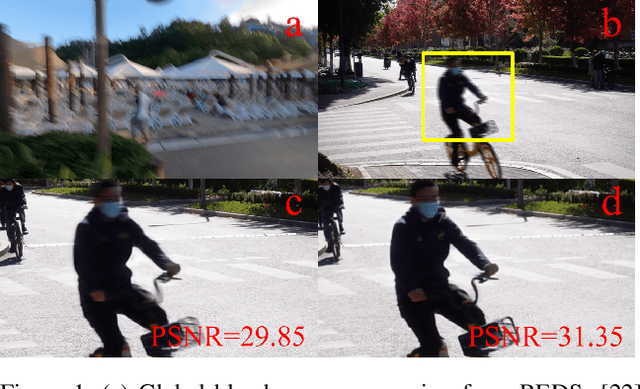


While recent deep deblurring algorithms have achieved remarkable progress, most existing methods focus on the global deblurring problem, where the image blur mostly arises from severe camera shake. We argue that the local blur, which is mostly derived from moving objects with a relatively static background, is prevalent but remains under-explored. In this paper, we first lay the data foundation for local deblurring by constructing, for the first time, a LOcal-DEblur (LODE) dataset consisting of 3,700 real-world captured locally blurred images and their corresponding ground-truth. Then, we propose a novel framework, termed BLur-Aware DEblurring network (BladeNet), which contains three components: the Local Blur Synthesis module generates locally blurred training pairs, the Local Blur Perception module automatically captures the locally blurred region and the Blur-guided Spatial Attention module guides the deblurring network with spatial attention. This framework is flexible such that it can be combined with many existing SotA algorithms. We carry out extensive experiments on REDS and LODE datasets showing that BladeNet improves PSNR by 2.5dB over SotAs for local deblurring while keeping comparable performance for global deblurring. We will publish the dataset and codes.