 Add to Chrome
 Add to Firefox
 Add to Edge
SG-WAM: Self-Guided World Modeling in Geometry-Aware Policy Space
Aug 02, 2026
World Action Models (WAMs) couple action generation with prediction of future states. Their effectiveness depends on whether future dynamics are modeled in a space that is both aligned with action generation and sufficiently geometry-aware to capture where and how actions change the scene. Existing WAMs typically satisfy only part of this requirement, relying on either perceptually heavy observation-space targets or auxiliary latent spaces that are not jointly structured for action relevance and geometry. We propose SG-WAM, a self-guided framework that learns geometry-aware action-conditioned dynamics directly in the policy-derived representation space. SG-WAM introduces learnable dynamics tokens and a Self-Guided World Predictor that forecasts their future latent states conditioned on intervening robot actions. Prediction targets are generated by an exponential moving average copy of the same policy backbone, providing stable supervision within the representation family used by the action expert. Geometric supervision further structures the policy image-token representations, providing spatially grounded context for the dynamics tokens and yielding a future-alignment space that is both action-relevant and geometry-aware. Latent future prediction, geometric grounding, and flow-matching action generation are jointly optimized end-to-end in a unified framework. Built on a 0.9B model without large-scale embodied pretraining, SG-WAM achieves 98.5% average success on LIBERO and 73% on LIBERO-Plus, while outperforming strong baselines in both in-distribution and out-of-distribution real-world evaluations.

NTR: Neural Token Reconstruction for Scene Token Bottleneck in End-to-End Driving
May 29, 2026Recent perception-free end-to-end (E2E) autonomous driving methods bypass explicit perception outputs by compressing dense image patch tokens into compact scene tokens for downstream trajectory generation and scoring. While these scene tokens form a compact visual bottleneck for the planner, they receive supervision solely from the planning objective, providing limited constraints on the encoded visual information. To address this limitation, we introduce Neural Token Reconstruction (NTR), a representation learning framework to directly constrain the compact scene-token bottleneck in perception-free driving. NTR introduces a self-distillation masked latent reconstruction objective that reconstructs masked patch-level latent features using only compact scene tokens as reconstruction memory. This forces reconstruction gradients to pass exclusively through the scene-token bottleneck, encouraging scene tokens to preserve richer and less redundant visual representations for planning. We further introduce semantic priors derived from foundation-model annotations as a weak semantic interface biasing reconstruction targets toward driving-related structures without introducing explicit perception heads. All auxiliary reconstruction components are removed at inference time, leaving the deployed planner unchanged. NTR achieves state-of-the-art performance on three public autonomous driving benchmarks, including 8.0461 RFS on Waymo E2E and 94.1 PDMS / 90.9 EPDMS on NavSim1&2. The learned scene tokens exhibit lower pairwise redundancy and higher effective rank, indicating that effective bottleneck supervision improves both compact visual representation learning and planning performance.
FD-VLA: Force-Distilled Vision-Language-Action Model for Contact-Rich Manipulation
Feb 02, 2026Force sensing is a crucial modality for Vision-Language-Action (VLA) frameworks, as it enables fine-grained perception and dexterous manipulation in contact-rich tasks. We present Force-Distilled VLA (FD-VLA), a novel framework that integrates force awareness into contact-rich manipulation without relying on physical force sensors. The core of our approach is a Force Distillation Module (FDM), which distills force by mapping a learnable query token, conditioned on visual observations and robot states, into a predicted force token aligned with the latent representation of actual force signals. During inference, this distilled force token is injected into the pretrained VLM, enabling force-aware reasoning while preserving the integrity of its vision-language semantics. This design provides two key benefits: first, it allows practical deployment across a wide range of robots that lack expensive or fragile force-torque sensors, thereby reducing hardware cost and complexity; second, the FDM introduces an additional force-vision-state fusion prior to the VLM, which improves cross-modal alignment and enhances perception-action robustness in contact-rich scenarios. Surprisingly, our physical experiments show that the distilled force token outperforms direct sensor force measurements as well as other baselines, which highlights the effectiveness of this force-distilled VLA approach.
DexGrasp-Diffusion: Diffusion-based Unified Functional Grasp Synthesis Pipeline for Multi-Dexterous Robotic Hands
Jul 13, 2024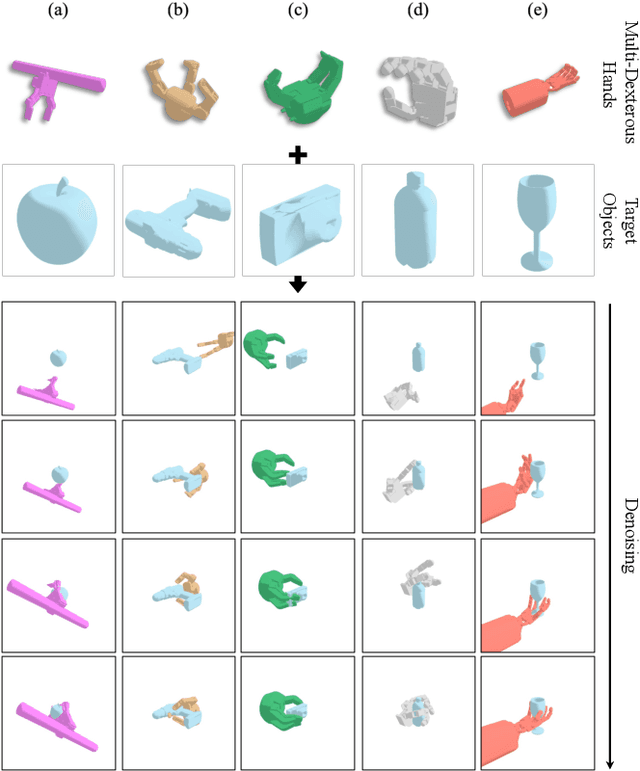
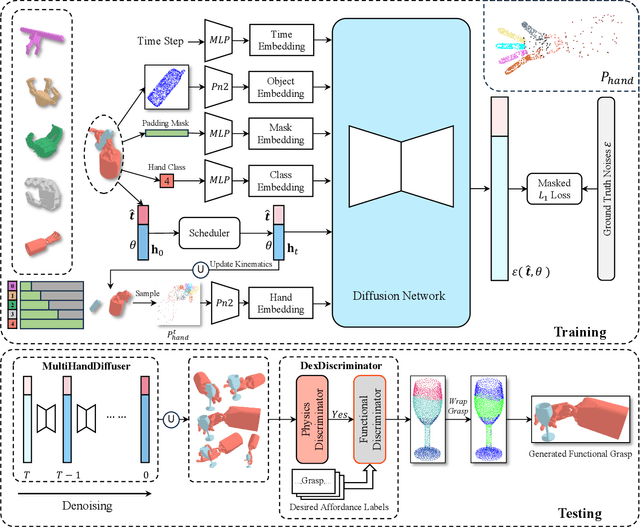

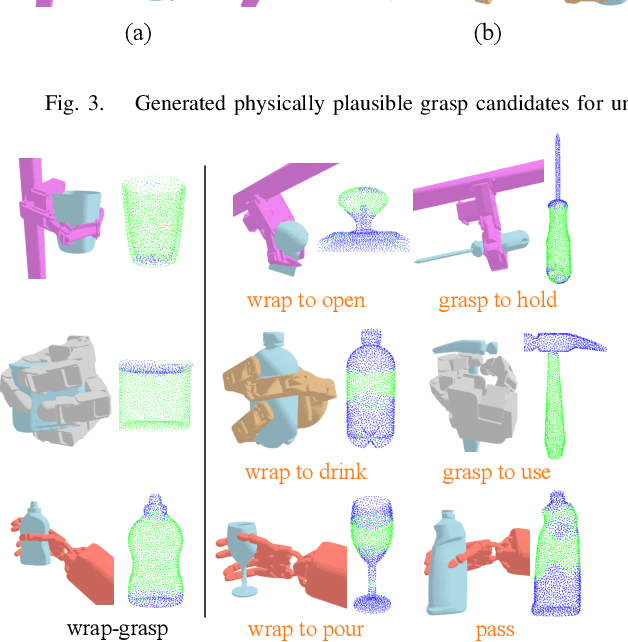
The versatility and adaptability of human grasping catalyze advancing dexterous robotic manipulation. While significant strides have been made in dexterous grasp generation, current research endeavors pivot towards optimizing object manipulation while ensuring functional integrity, emphasizing the synthesis of functional grasps following desired affordance instructions. This paper addresses the challenge of synthesizing functional grasps tailored to diverse dexterous robotic hands by proposing DexGrasp-Diffusion, an end-to-end modularized diffusion-based pipeline. DexGrasp-Diffusion integrates MultiHandDiffuser, a novel unified data-driven diffusion model for multi-dexterous hands grasp estimation, with DexDiscriminator, which employs a Physics Discriminator and a Functional Discriminator with open-vocabulary setting to filter physically plausible functional grasps based on object affordances. The experimental evaluation conducted on the MultiDex dataset provides substantiating evidence supporting the superior performance of MultiHandDiffuser over the baseline model in terms of success rate, grasp diversity, and collision depth. Moreover, we demonstrate the capacity of DexGrasp-Diffusion to reliably generate functional grasps for household objects aligned with specific affordance instructions.