 Add to Chrome
 Add to Firefox
 Add to Edge
Cloze: An Open Research Platform for Studying Human-AI Conversations in Mental Health Contexts
Jun 13, 2026
Cloze is an open-source web platform for conducting controlled, monitored studies of human-AI conversation in mental health research contexts. Consumer large language model (LLM) products such as ChatGPT, Claude, and Gemini are built for individual productivity, and offer researchers little experimental control, inconsistent data export, and no shared safety scaffolding that holds across providers. Cloze gives research teams a single environment in which they configure which models participants converse with, how the AI is instructed, how conversations are scheduled over time, and which safety constraints apply unconditionally, while every message is captured with full provenance (model version, prompt configuration, timing). The platform currently supports OpenAI, Anthropic, Google, and locally hosted open-weight models served through Ollama behind a unified interface, and runs in the cloud or fully on premises so that participant data need never leave an institution. Cloze is research infrastructure for building an evidence base on human-AI interaction in mental health contexts. It is not a therapeutic product.

Overview of the PsyDefDetect Shared Task at BioNLP 2026: Detecting Levels of Psychological Defense Mechanisms in Supportive Conversations
May 24, 2026We present an overview of PsyDefDetect, the shared task on detecting levels of psychological defense mechanisms in emotional support dialogues, co-located with BioNLP@ACL 2026. Grounded in the clinically validated Defense Mechanism Rating Scales (DMRS) framework, the task asks systems to classify a target seeker utterance, given its preceding dialogue context, into one of nine categories: seven hierarchical DMRS levels plus two auxiliary labels. Participants worked on PsyDefConv, a newly released corpus of 200 dialogues and 2336 help-seeker utterances annotated under DMRS with substantial inter-annotator agreement. The task attracted 172 participants on CodaBench who produced 563 submissions, with 21 teams officially registering their results for the final ranking. The best system achieved a macro F1-score of 0.420, surpassing the strongest fine-tuned baseline reported in the dataset paper by a notable margin, yet leaving clear headroom. Our analysis highlights (i) a persistent tendency to over-predict the majority High-Adaptive class, (ii) a widening gap between accuracy and macro-F1 that reveals class-imbalance sensitivity, and (iii) the value of theory-aware and LLM-based approaches for fine-grained defensive-function classification. We release all task materials and invite the community to continue work on this novel intersection of clinical psychology and NLP.
Depictions of Depression in Generative AI Video Models: A Preliminary Study of OpenAI's Sora 2
Mar 19, 2026Generative video models are increasingly capable of producing complex depictions of mental health experiences, yet little is known about how these systems represent conditions like depression. This study characterizes how OpenAI's Sora 2 generative video model depicts depression and examines whether depictions differ between the consumer App and developer API access points. We generated 100 videos using the single-word prompt "Depression" across two access points: the consumer App (n=50) and developer API (n=50). Two trained coders independently coded narrative structure, visual environments, objects, figure demographics, and figure states. Computational features across visual aesthetics, audio, semantic content, and temporal dynamics were extracted and compared between modalities. App-generated videos exhibited a pronounced recovery bias: 78% (39/50) featured narrative arcs progressing from depressive states toward resolution, compared with 14% (7/50) of API outputs. App videos brightened over time (slope = 2.90 brightness units/second vs. -0.18 for API; d = 1.59, q < .001) and contained three times more motion (d = 2.07, q < .001). Across both modalities, videos converged on a narrow visual vocabulary and featured recurring objects including hoodies (n=194), windows (n=148), and rain (n=83). Figures were predominantly young adults (88% aged 20-30) and nearly always alone (98%). Gender varied by access point: App outputs skewed male (68%), API outputs skewed female (59%). Sora 2 does not invent new visual grammars for depression but compresses and recombines cultural iconographies, while platform-level constraints substantially shape which narratives reach users. Clinicians should be aware that AI-generated mental health video content reflects training data and platform design rather than clinical knowledge, and that patients may encounter such content during vulnerable periods.
You Never Know a Person, You Only Know Their Defenses: Detecting Levels of Psychological Defense Mechanisms in Supportive Conversations
Dec 17, 2025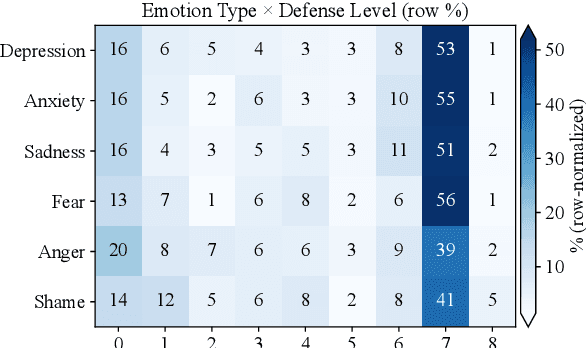
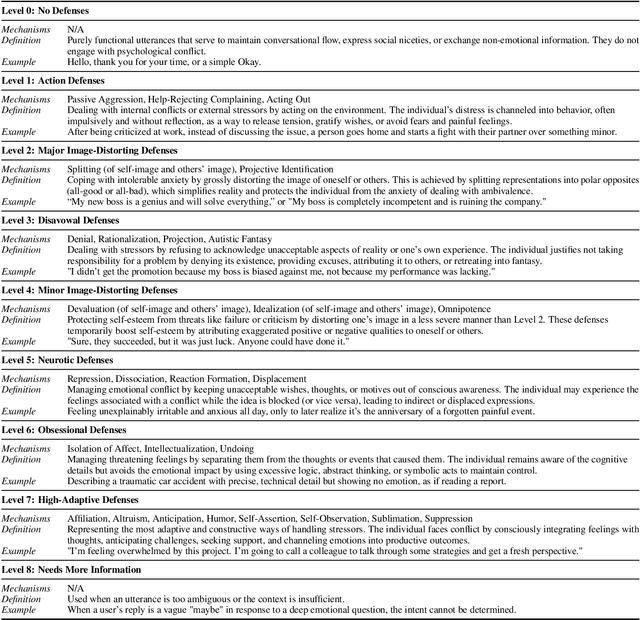
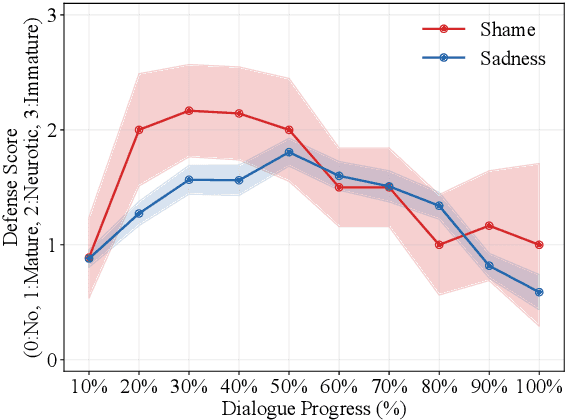
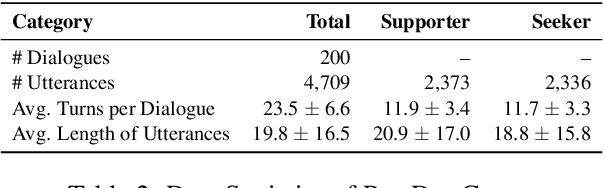
Psychological defenses are strategies, often automatic, that people use to manage distress. Rigid or overuse of defenses is negatively linked to mental health and shapes what speakers disclose and how they accept or resist help. However, defenses are complex and difficult to reliably measure, particularly in clinical dialogues. We introduce PsyDefConv, a dialogue corpus with help seeker utterances labeled for defense level, and DMRS Co-Pilot, a four-stage pipeline that provides evidence-based pre-annotations. The corpus contains 200 dialogues and 4709 utterances, including 2336 help seeker turns, with labeling and Cohen's kappa 0.639. In a counterbalanced study, the co-pilot reduced average annotation time by 22.4%. In expert review, it averaged 4.62 for evidence, 4.44 for clinical plausibility, and 4.40 for insight on a seven-point scale. Benchmarks with strong language models in zero-shot and fine-tuning settings demonstrate clear headroom, with the best macro F1-score around 30% and a tendency to overpredict mature defenses. Corpus analyses confirm that mature defenses are most common and reveal emotion-specific deviations. We will release the corpus, annotations, code, and prompts to support research on defensive functioning in language.
Optimizing Large Language Models for Detecting Symptoms of Comorbid Depression or Anxiety in Chronic Diseases: Insights from Patient Messages
Mar 14, 2025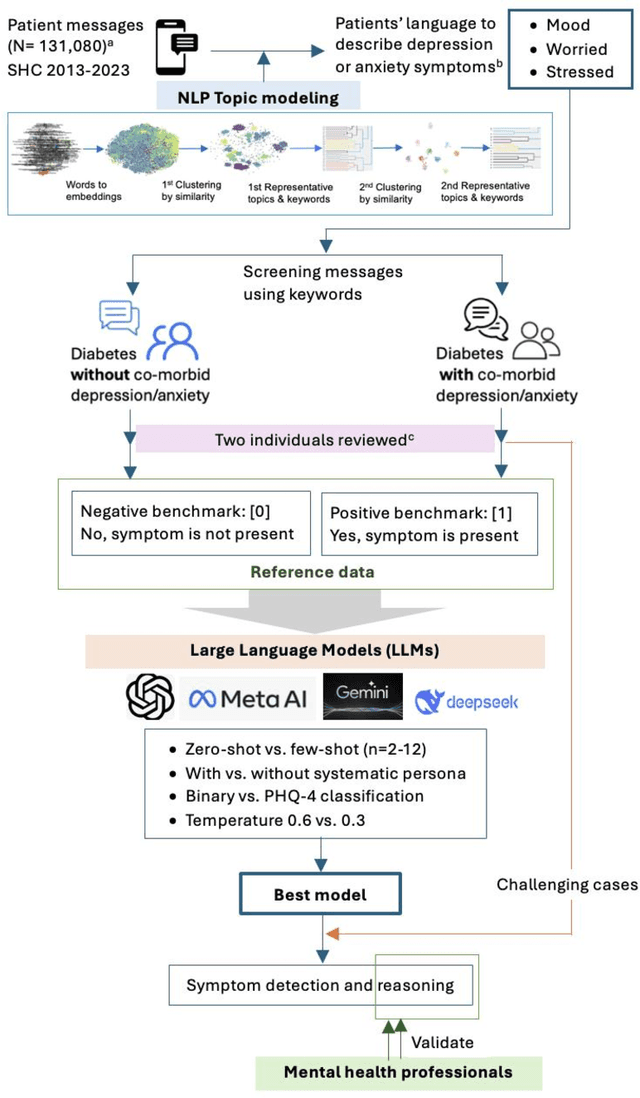
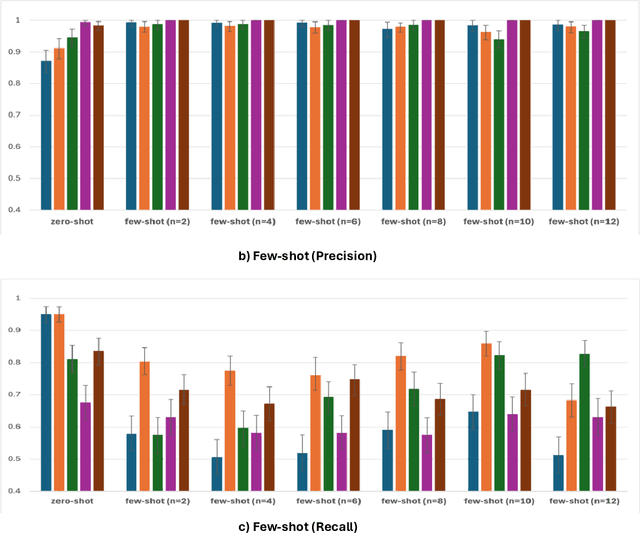
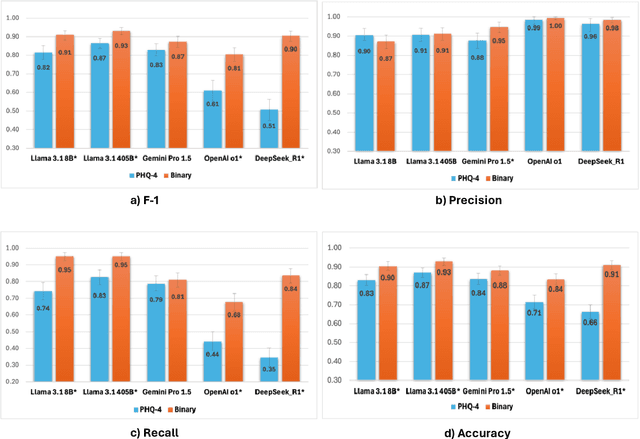
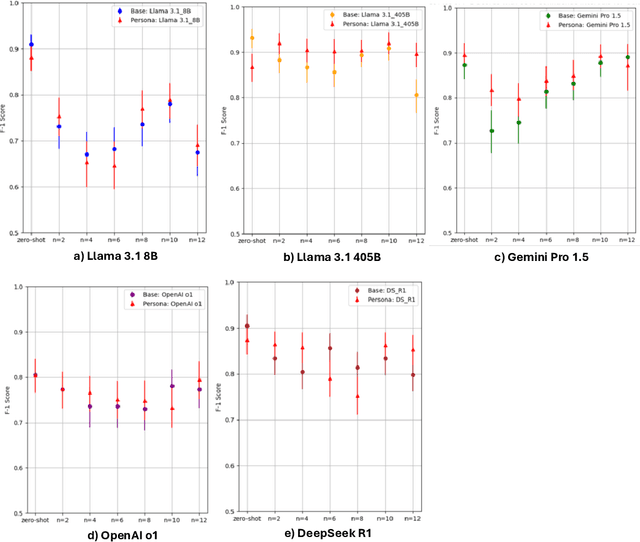
Patients with diabetes are at increased risk of comorbid depression or anxiety, complicating their management. This study evaluated the performance of large language models (LLMs) in detecting these symptoms from secure patient messages. We applied multiple approaches, including engineered prompts, systemic persona, temperature adjustments, and zero-shot and few-shot learning, to identify the best-performing model and enhance performance. Three out of five LLMs demonstrated excellent performance (over 90% of F-1 and accuracy), with Llama 3.1 405B achieving 93% in both F-1 and accuracy using a zero-shot approach. While LLMs showed promise in binary classification and handling complex metrics like Patient Health Questionnaire-4, inconsistencies in challenging cases warrant further real-life assessment. The findings highlight the potential of LLMs to assist in timely screening and referrals, providing valuable empirical knowledge for real-world triage systems that could improve mental health care for patients with chronic diseases.
Applying and Evaluating Large Language Models in Mental Health Care: A Scoping Review of Human-Assessed Generative Tasks
Aug 21, 2024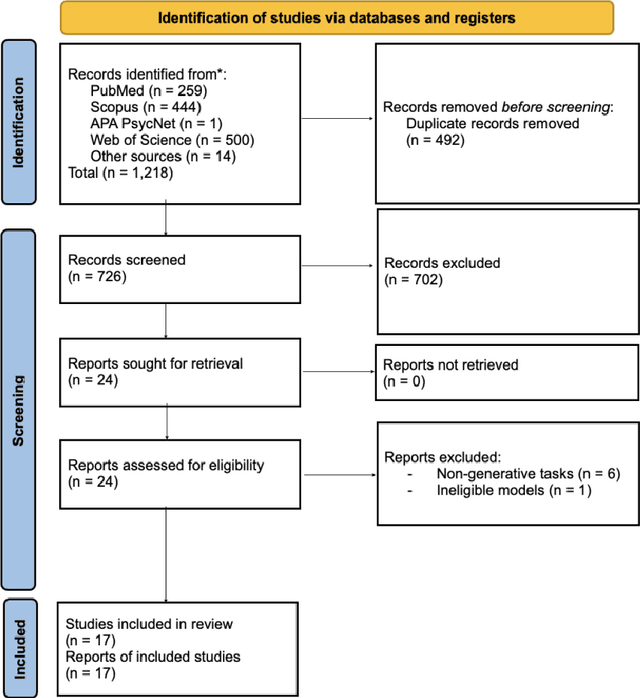


Large language models (LLMs) are emerging as promising tools for mental health care, offering scalable support through their ability to generate human-like responses. However, the effectiveness of these models in clinical settings remains unclear. This scoping review aimed to assess the current generative applications of LLMs in mental health care, focusing on studies where these models were tested with human participants in real-world scenarios. A systematic search across APA PsycNet, Scopus, PubMed, and Web of Science identified 726 unique articles, of which 17 met the inclusion criteria. These studies encompassed applications such as clinical assistance, counseling, therapy, and emotional support. However, the evaluation methods were often non-standardized, with most studies relying on ad hoc scales that limit comparability and robustness. Privacy, safety, and fairness were also frequently underexplored. Moreover, reliance on proprietary models, such as OpenAI's GPT series, raises concerns about transparency and reproducibility. While LLMs show potential in expanding mental health care access, especially in underserved areas, the current evidence does not fully support their use as standalone interventions. More rigorous, standardized evaluations and ethical oversight are needed to ensure these tools can be safely and effectively integrated into clinical practice.