 Add to Chrome
 Add to Firefox
 Add to Edge
Overview of the PsyDefDetect Shared Task at BioNLP 2026: Detecting Levels of Psychological Defense Mechanisms in Supportive Conversations
May 24, 2026
We present an overview of PsyDefDetect, the shared task on detecting levels of psychological defense mechanisms in emotional support dialogues, co-located with BioNLP@ACL 2026. Grounded in the clinically validated Defense Mechanism Rating Scales (DMRS) framework, the task asks systems to classify a target seeker utterance, given its preceding dialogue context, into one of nine categories: seven hierarchical DMRS levels plus two auxiliary labels. Participants worked on PsyDefConv, a newly released corpus of 200 dialogues and 2336 help-seeker utterances annotated under DMRS with substantial inter-annotator agreement. The task attracted 172 participants on CodaBench who produced 563 submissions, with 21 teams officially registering their results for the final ranking. The best system achieved a macro F1-score of 0.420, surpassing the strongest fine-tuned baseline reported in the dataset paper by a notable margin, yet leaving clear headroom. Our analysis highlights (i) a persistent tendency to over-predict the majority High-Adaptive class, (ii) a widening gap between accuracy and macro-F1 that reveals class-imbalance sensitivity, and (iii) the value of theory-aware and LLM-based approaches for fine-grained defensive-function classification. We release all task materials and invite the community to continue work on this novel intersection of clinical psychology and NLP.

Multi-dimensional Assessment and Explainable Feedback for Counselor Responses to Client Resistance in Text-based Counseling with LLMs
Feb 25, 2026Effectively addressing client resistance is a sophisticated clinical skill in psychological counseling, yet practitioners often lack timely and scalable supervisory feedback to refine their approaches. Although current NLP research has examined overall counseling quality and general therapeutic skills, it fails to provide granular evaluations of high-stakes moments where clients exhibit resistance. In this work, we present a comprehensive pipeline for the multi-dimensional evaluation of human counselors' interventions specifically targeting client resistance in text-based therapy. We introduce a theory-driven framework that decomposes counselor responses into four distinct communication mechanisms. Leveraging this framework, we curate and share an expert-annotated dataset of real-world counseling excerpts, pairing counselor-client interactions with professional ratings and explanatory rationales. Using this data, we perform full-parameter instruction tuning on a Llama-3.1-8B-Instruct backbone to model fine-grained evaluative judgments of response quality and generate explanations underlying. Experimental results show that our approach can effectively distinguish the quality of different communication mechanisms (77-81% F1), substantially outperforming GPT-4o and Claude-3.5-Sonnet (45-59% F1). Moreover, the model produces high-quality explanations that closely align with expert references and receive near-ceiling ratings from human experts (2.8-2.9/3.0). A controlled experiment with 43 counselors further confirms that receiving these AI-generated feedback significantly improves counselors' ability to respond effectively to client resistance.
RECAP: Resistance Capture in Text-based Mental Health Counseling with Large Language Models
Jan 21, 2026Recognizing and navigating client resistance is critical for effective mental health counseling, yet detecting such behaviors is particularly challenging in text-based interactions. Existing NLP approaches oversimplify resistance categories, ignore the sequential dynamics of therapeutic interventions, and offer limited interpretability. To address these limitations, we propose PsyFIRE, a theoretically grounded framework capturing 13 fine-grained resistance behaviors alongside collaborative interactions. Based on PsyFIRE, we construct the ClientResistance corpus with 23,930 annotated utterances from real-world Chinese text-based counseling, each supported by context-specific rationales. Leveraging this dataset, we develop RECAP, a two-stage framework that detects resistance and fine-grained resistance types with explanations. RECAP achieves 91.25% F1 for distinguishing collaboration and resistance and 66.58% macro-F1 for fine-grained resistance categories classification, outperforming leading prompt-based LLM baselines by over 20 points. Applied to a separate counseling dataset and a pilot study with 62 counselors, RECAP reveals the prevalence of resistance, its negative impact on therapeutic relationships and demonstrates its potential to improve counselors' understanding and intervention strategies.
PsyCLIENT: Client Simulation via Conversational Trajectory Modeling for Trainee Practice and Model Evaluation in Mental Health Counseling
Jan 12, 2026LLM-based client simulation has emerged as a promising tool for training novice counselors and evaluating automated counseling systems. However, existing client simulation approaches face three key challenges: (1) limited diversity and realism in client profiles, (2) the lack of a principled framework for modeling realistic client behaviors, and (3) a scarcity in Chinese-language settings. To address these limitations, we propose PsyCLIENT, a novel simulation framework grounded in conversational trajectory modeling. By conditioning LLM generation on predefined real-world trajectories that incorporate explicit behavior labels and content constraints, our approach ensures diverse and realistic interactions. We further introduce PsyCLIENT-CP, the first open-source Chinese client profile dataset, covering 60 distinct counseling topics. Comprehensive evaluations involving licensed professional counselors demonstrate that PsyCLIENT significantly outperforms baselines in terms of authenticity and training effectiveness. Notably, the simulated clients are nearly indistinguishable from human clients, achieving an about 95\% expert confusion rate in discrimination tasks. These findings indicate that conversational trajectory modeling effectively bridges the gap between theoretical client profiles and dynamic, realistic simulations, offering a robust solution for mental health education and research. Code and data will be released to facilitate future research in mental health counseling.
You Never Know a Person, You Only Know Their Defenses: Detecting Levels of Psychological Defense Mechanisms in Supportive Conversations
Dec 17, 2025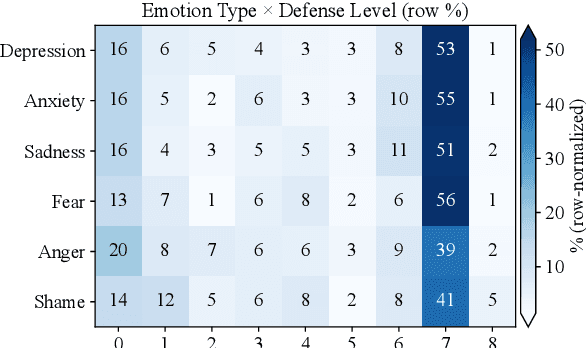
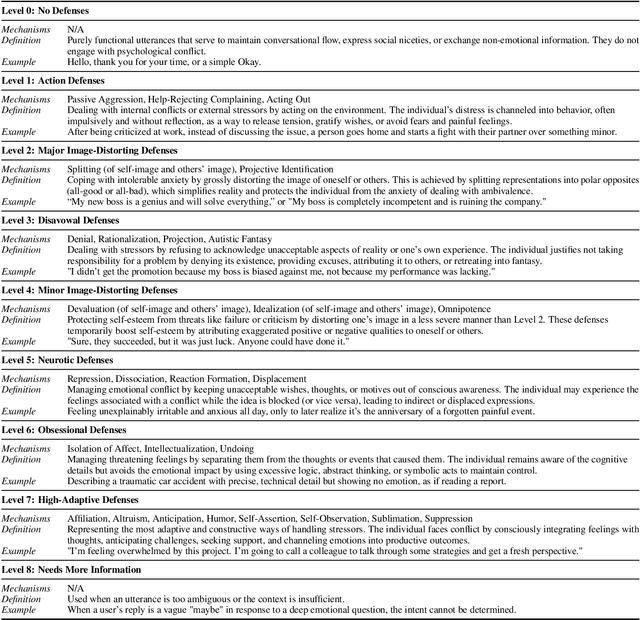
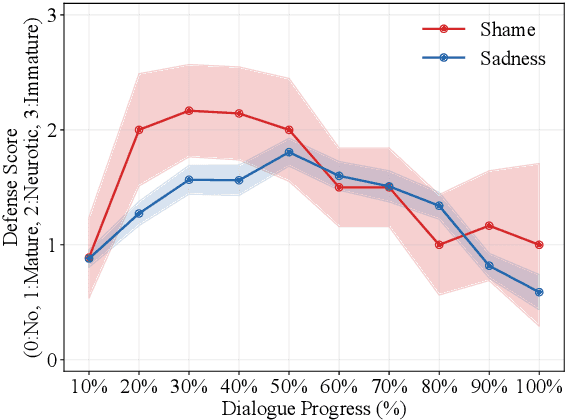
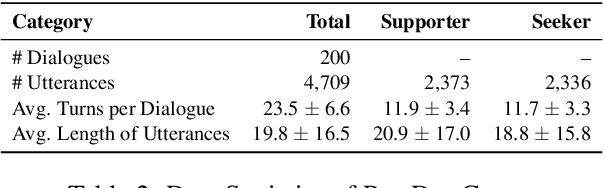
Psychological defenses are strategies, often automatic, that people use to manage distress. Rigid or overuse of defenses is negatively linked to mental health and shapes what speakers disclose and how they accept or resist help. However, defenses are complex and difficult to reliably measure, particularly in clinical dialogues. We introduce PsyDefConv, a dialogue corpus with help seeker utterances labeled for defense level, and DMRS Co-Pilot, a four-stage pipeline that provides evidence-based pre-annotations. The corpus contains 200 dialogues and 4709 utterances, including 2336 help seeker turns, with labeling and Cohen's kappa 0.639. In a counterbalanced study, the co-pilot reduced average annotation time by 22.4%. In expert review, it averaged 4.62 for evidence, 4.44 for clinical plausibility, and 4.40 for insight on a seven-point scale. Benchmarks with strong language models in zero-shot and fine-tuning settings demonstrate clear headroom, with the best macro F1-score around 30% and a tendency to overpredict mature defenses. Corpus analyses confirm that mature defenses are most common and reveal emotion-specific deviations. We will release the corpus, annotations, code, and prompts to support research on defensive functioning in language.
EPO: Diverse and Realistic Protein Ensemble Generation via Energy Preference Optimization
Nov 13, 2025Accurate exploration of protein conformational ensembles is essential for uncovering function but remains hard because molecular-dynamics (MD) simulations suffer from high computational costs and energy-barrier trapping. This paper presents Energy Preference Optimization (EPO), an online refinement algorithm that turns a pretrained protein ensemble generator into an energy-aware sampler without extra MD trajectories. Specifically, EPO leverages stochastic differential equation sampling to explore the conformational landscape and incorporates a novel energy-ranking mechanism based on list-wise preference optimization. Crucially, EPO introduces a practical upper bound to efficiently approximate the intractable probability of long sampling trajectories in continuous-time generative models, making it easily adaptable to existing pretrained generators. On Tetrapeptides, ATLAS, and Fast-Folding benchmarks, EPO successfully generates diverse and physically realistic ensembles, establishing a new state-of-the-art in nine evaluation metrics. These results demonstrate that energy-only preference signals can efficiently steer generative models toward thermodynamically consistent conformational ensembles, providing an alternative to long MD simulations and widening the applicability of learned potentials in structural biology and drug discovery.