 Add to Chrome
 Add to Firefox
 Add to Edge
Near-Field Wideband Localization using TTD-Based Terahertz Extremely Large-Scale Arrays
Mar 17, 2026
The synergy between extremely large-scale antenna arrays and terahertz technology in sixth-generation networks establishes a near-field wideband transmission environment, enabling the generation of highly focused beams. To leverage this capability for multi-source localization, we propose a direct localization method based on the curvature-of-arrival of spherical wavefronts for estimating the positions of multiple near-field users from wideband signals. Furthermore, to overcome the spatial-wideband effect, we introduce a hybrid analog/digital array architecture with true-timedelayers (TTDs). We derive a closed-form position error bound to characterize the fundamental estimation performance and optimize the analog coefficients of array by maximizing the trace of the Fisher information matrix to minimize this bound. Furthermore, we extend this method to a sub-optimal iterative method that jointly optimizes beam focusing and localization, without requiring prior knowledge of the source positions for array design. Simulation results show that the proposed array configuration design significantly enhances the performance of near-field wideband localization, while the presence of TTDs effectively mitigates the localization performance degradation caused by spatial-wideband effects.

Ziv-Zakai Bound for Near-Field Localization and Sensing
Feb 09, 2026The increasing carrier frequencies and growing physical dimensions of antenna arrays in modern wireless systems are driving renewed interest in localization and sensing under near-field conditions. In this paper, we analyze the Ziv-Zakai Bound (ZZB) for near-field localization and sensing operated with large antenna arrays, which offers a tighter characterization of estimation accuracy compared to traditional bounds such as the Cramér-Rao Bound (CRB), especially in low signal-to-noise ratio or threshold regions. Leveraging spherical wavefront and array geometry in the signal model, we evaluate the ZZB for distance and angle estimation, investigating the dependence of the accuracy on key signal and system parameters such as array geometry, wavelength, and target position. Our analysis highlights the transition behavior of the ZZB and underscores the fundamental limitations and opportunities for accurate near-field sensing.
Over-The-Air Extreme Learning Machines with XL Reception via Nonlinear Cascaded Metasurfaces
Jan 25, 2026The recently envisioned goal-oriented communications paradigm calls for the application of inference on wirelessly transferred data via Machine Learning (ML) tools. An emerging research direction deals with the realization of inference ML models directly in the physical layer of Multiple-Input Multiple-Output (MIMO) systems, which, however, entails certain significant challenges. In this paper, leveraging the technology of programmable MetaSurfaces (MSs), we present an eXtremely Large (XL) MIMO system that acts as an Extreme Learning Machine (ELM) performing binary classification tasks completely Over-The-Air (OTA), which can be trained in closed form. The proposed system comprises a receiver architecture consisting of densely parallel placed diffractive layers of XL MSs followed by a single reception radio-frequency chain. The front layer facing the MIMO channel consists of identical unit cells of a fixed NonLinear (NL) response, while the remaining layers of elements of tunable linear responses are utilized to approximate OTA the trained ELM weights. Our numerical investigations showcase that, in the XL regime of MS elements, the proposed XL-MIMO-ELM system achieves performance comparable to that of digital and idealized ML models across diverse datasets and wireless scenarios, thereby demonstrating the feasibility of embedding OTA learning capabilities into future communication systems.
Generation-Agnostic Zero-Energy Devices for Sustainable Connectivity, Sensing, and Localization
Nov 12, 2025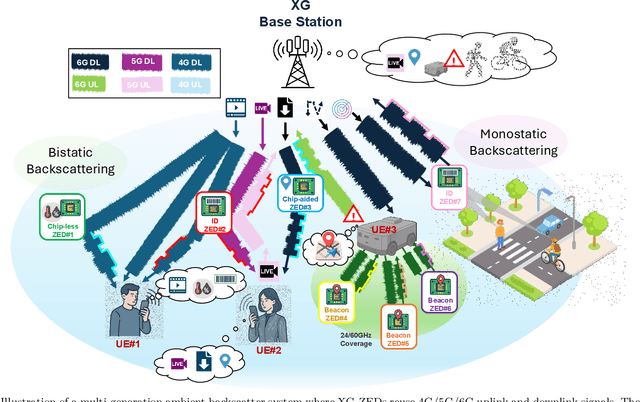
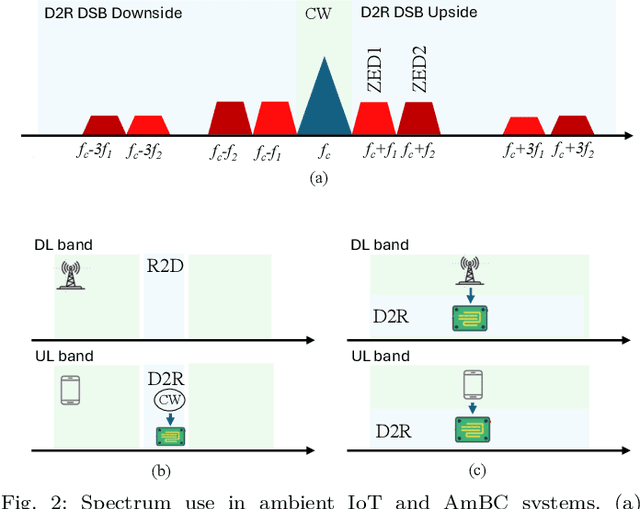
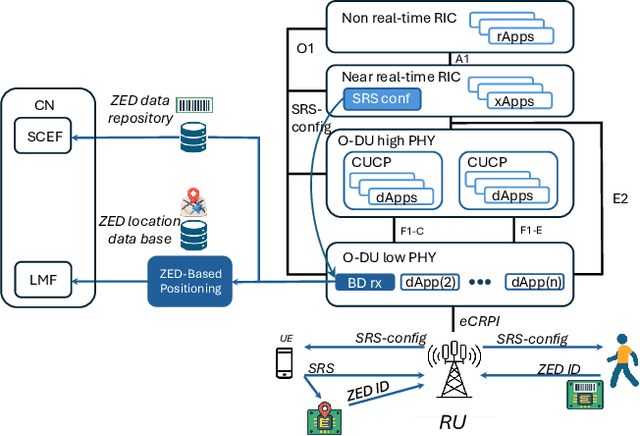
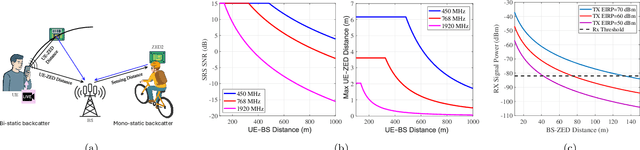
The massive scale of Internet of Things (IoT) connectivity expected in 6G networks raises unprecedented challenges in energy use, battery waste, and lifecycle sustainability. Current cellular IoT solutions remain bound to the lifetime of underlying network generations and rely on billions of disposable batteries, creating unsustainable economic and environmental costs. This article proposes generation-agnostic zero-energy devices (XG-ZEDs), a new class of backscatter based IoT devices that are battery-less, spectrum-agnostic, and future-proof across successive network generations. XG-ZEDs exploit existing ambient wireless signals for communication, sensing, and localization, transforming infrastructure and user devices into universal enablers of ultra-low-power connectivity. We review architectural classifications, communication protocols, network integration, and representative applications such as sensing, localization, and radio-SLAM, while outlining the challenges ahead.
Scalable RIS-Aided Beamforming Strategies for Near-Field MU-MISO via Multi-Antenna Feeder
Aug 12, 2025This paper investigates a modular beamforming framework for reconfigurable intelligent surface (RIS)-aided multi-user (MU) communications in the near-field regime, built upon a novel antenna architecture integrating an active multi-antenna feeder (AMAF) array with a transmissive RIS (T-RIS), referred to as AT-RIS. This decoupling enables coordinated yet independently configurable designs in the AMAF and T-RIS domains, supporting flexible strategies with diverse complexity-performance trade-offs. Several implementations are analyzed, including diagonal and non-diagonal T-RIS architectures, paired with precoding schemes based on focusing, minimum mean square error, and eigenmode decomposition. Simulation results demonstrate that while non-diagonal schemes maximize sum rate in scenarios with a limited number of User Equipments (UEs) and high angular separability, they exhibit fairness and scalability limitations as UE density increases. Conversely, diagonal T-RIS configurations, particularly the proposed focusing-based scheme with uniform feeder-side power allocation, offer robust, fair, and scalable performance with minimal channel state information. The findings emphasize the critical impact of UEs' angular separability and reveal inherent trade-offs among spectral efficiency, complexity, and fairness, positioning diagonal AT-RIS architectures as practical solutions for scalable near-field MU multiple-input single-output systems.
Frequency-selective Dynamic Scattering Arrays for Over-the-air EM Processing
Feb 11, 2025In this paper, we investigate frequency-selective dynamic scattering array (DSA), a versatile antenna structure capable of performing joint wave-based computing and radiation by transitioning signal processing tasks from the digital domain to the electromagnetic (EM) domain. The numerical results demonstrate the potential of DSAs to produce space-frequency superdirective responses with minimal usage of radiofrequency (RF) chains, making it particularly attractive for future holographic multiple-input multiple-output (MIMO) systems.
An Overview on Over-the-air Electromagnetic Signal Processing
Dec 20, 2024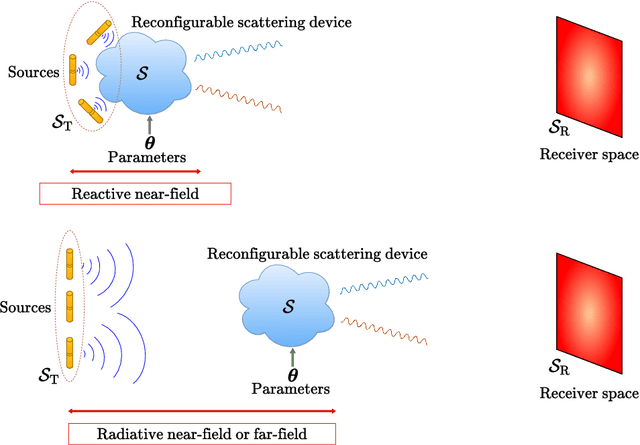
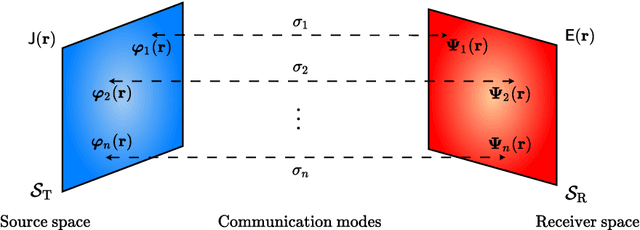
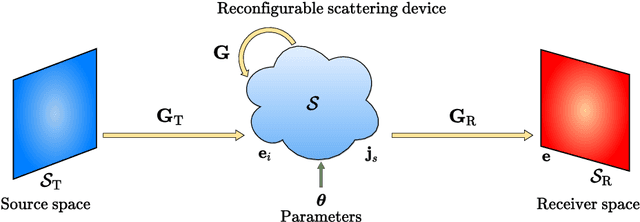
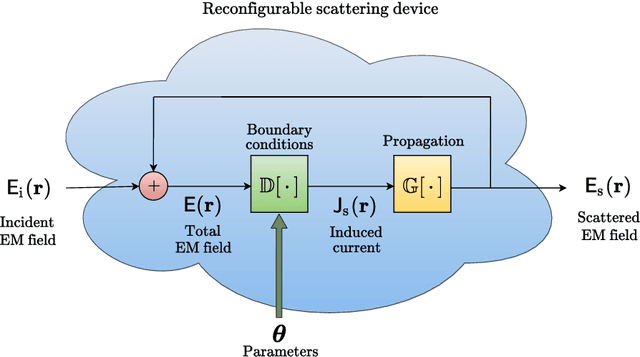
This article provides a tutorial on over-the-air electromagnetic signal processing (ESP) for next-generation wireless networks, addressing the limitations of digital processing to enhance the efficiency and sustainability of future 6th Generation (6G) systems. It explores the integration of electromagnetism and signal processing (SP) highlighting how their convergence can drive innovations for 6G technologies. Key topics include electromagnetic (EM) wave-based processing, the application of metamaterials and advanced antennas to optimize EM field manipulation with a reduced number of radiofrequency chains, and their applications in holographic multiple-input multiple-output systems. By showcasing enabling technologies and use cases, the article demonstrates how wave-based processing can minimize energy consumption, complexity, and latency, offering an effective framework for more sustainable and efficient wireless systems. This article aims to assist researchers and professionals in integrating advanced EM technologies with conventional SP methods.
An Overview on Over-the-airElectromagnetic Signal Processing
Dec 19, 2024This article provides a tutorial on over-the-air electromagnetic signal processing (ESP) for next-generation wireless networks, addressing the limitations of digital processing to enhance the efficiency and sustainability of future 6th Generation (6G) systems. It explores the integration of electromagnetism and signal processing (SP) highlighting how their convergence can drive innovations for 6G technologies. Key topics include electromagnetic (EM) wave-based processing, the application of metamaterials and advanced antennas to optimize EM field manipulation with a reduced number of radiofrequency chains, and their applications in holographic multiple-input multiple-output systems. By showcasing enabling technologies and use cases, the article demonstrates how wave-based processing can minimize energy consumption, complexity, and latency, offering an effective framework for more sustainable and efficient wireless systems. This article aims to assist researchers and professionals in integrating advanced EM technologies with conventional SP methods.
Beam Focusing for Near-Field Multi-User Localization
Jul 24, 2024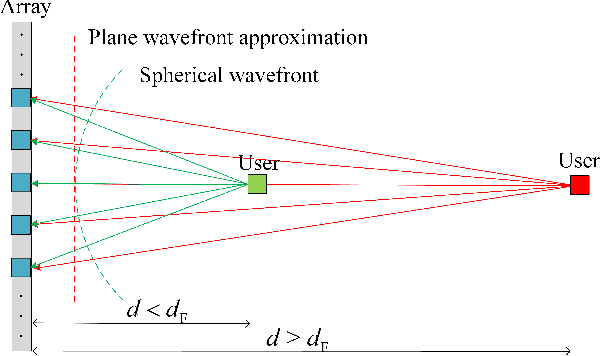
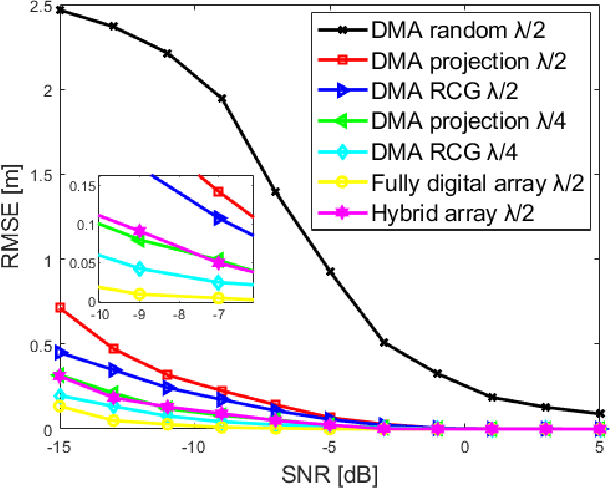
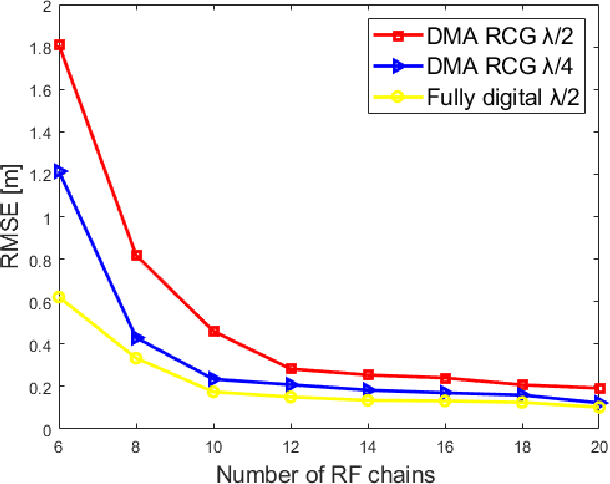
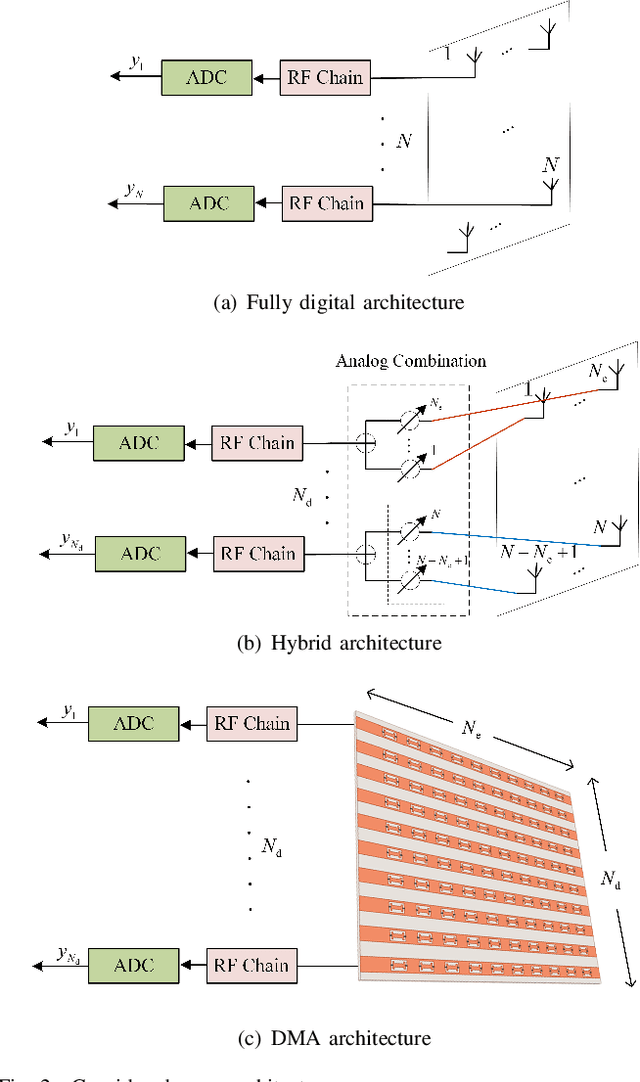
Extremely large-scale antenna arrays are poised to play a pivotal role in sixth-generation (6G) networks. Utilizing such arrays often results in a near-field spherical wave transmission environment, enabling the generation of focused beams, which introduces new degrees of freedom for wireless localization. In this paper, we consider a beam-focusing design for localizing multiple sources in the radiating near-field. Our formulation accommodates various expected types of implementations of large antenna arrays, including hybrid analog/digital architectures and dynamic metasurface antennas (DMAs). We consider a direct localization estimation method exploiting curvature-of-arrival of impinging spherical wavefront to obtain user positions. In this regard, we adopt a two-stage approach configuring the array to optimize near-field positioning. In the first step, we focus only on adjusting the array coefficients to minimize the estimation error. We obtain a closed-form approximate solution based on projection and the better one based on the Riemann gradient algorithm. We then extend this approach to simultaneously localize and focus the beams via a sub-optimal iterative approach that does not rely on such knowledge. The simulation results show that near-field localization accuracy based on a hybrid array or DMA can achieve performance close to that of fully digital arrays at a lower cost, and DMAs can attain better performance than hybrid solutions with the same aperture.
Bistatic Sensing at THz Frequencies via a Two-Stage Ultra-Wideband MIMO-OFDM System
May 28, 2024Only the chairs can edit The availability of abundant bandwidth at terahertz (THz) frequencies holds promise for significantly enhancing the sensing performance of integrated sensing and communication (ISAC) systems in the next-generation wireless systems, enabling high accuracy and resolution for precise target localization. In orthogonal frequency-division multiplexing (OFDM) systems, wide bandwidth can be achieved by increasing the subcarrier spacing rather than the number of subcarriers, thereby keeping the complexity of the sensing system low. However, this approach may lead to an ambiguity problem in target range estimation. To address this issue, this work proposes a two-stage maximum likelihood method for estimating target position in an ultra-wideband bistatic multiple-antenna OFDM-based ISAC system operating at THz frequencies. Numerical results show that the proposed estimation approach effectively resolves the ambiguity problem while achieving high resolution and accuracy target position estimation at a very low signal-to-noise ratio regime.