 Add to Chrome
 Add to Firefox
 Add to Edge
StatABench: Dataset and Framework for Evaluating Statistical Analysis Capabilities of LLMs
Jun 22, 2026
Statistical analysis is a broad, complex field requiring both domain knowledge and tool proficiency. While prior work has evaluated large language models (LLMs) in this domain, existing benchmarks remain limited in scope and format. To bridge this gap, we introduce StatABench (Statistical AnalysisBenchmark), a benchmark designed to systematically assess LLMs' statistical analysis capabilities. StatABench comprises two complementary components: Stat-Closed, containing 404 questions across 18 statistical topics in multiple formats (multiple-choice, fill-in-the-blank, decision-making, and practical application), and Stat-Open, featuring 30 complex open-ended modeling tasks adapted from professional competitions. We evaluate diverse LLMs using the LangChain MCP framework and multiple data science agents, and assess Stat-Open solutions via a validated LLM-as-Judge protocol. Experiments show that even GPT-5.1 achieves only 68.6% on Stat-Closed, while the best open-source model reaches 60.6%. On Stat-Open, the top agent framework scores 61.86 on average. These results reveal the gap between current LLMs and reliable statistical analysis, highlighting persistent challenges in tool-grounded reasoning, methodological decision-making, and end-to-end statistical modeling.

Bridging the Agent-World Gap: Text World Models for LLM-based Agents
Jun 08, 2026Large language model (LLM)-based agents are increasingly used in interactive textual environments, from web navigation and code editing to tool use and long-horizon dialogue. Yet many remain largely reactive, mapping observations to actions without an explicit model of how these environments are structured and evolve. This motivates text world models (TWMs): transition models over textual states that, given a state and a candidate action, predict the resulting webpage, terminal output, API response, or user reply, thereby supporting planning, efficient learning, and principled evaluation. We systematically review text world models for LLM-based agents, organized around a formal framework and the agent lifecycle: (1) Foundations, defining text world models and characterizing them by state representation and grounding domain; (2) Construction, taxonomizing LLM-as-WM and code-as-WM paradigms and reviewing methods for building them; (3) Application, examining how world models support agents at training time through experience synthesis and at inference time through planning, verification, and adaptation; and (4) Evaluation, covering both evaluation of the world model itself and its use as an evaluation environment for agents. We aim to consolidate this rapidly developing area, clarify its design space, and highlight open challenges for future research.
BiasScope: Towards Automated Detection of Bias in LLM-as-a-Judge Evaluation
Feb 10, 2026LLM-as-a-Judge has been widely adopted across various research and practical applications, yet the robustness and reliability of its evaluation remain a critical issue. A core challenge it faces is bias, which has primarily been studied in terms of known biases and their impact on evaluation outcomes, while automated and systematic exploration of potential unknown biases is still lacking. Nevertheless, such exploration is crucial for enhancing the robustness and reliability of evaluations. To bridge this gap, we propose BiasScope, a LLM-driven framework for automatically and at scale discovering potential biases that may arise during model evaluation. BiasScope can uncover potential biases across different model families and scales, with its generality and effectiveness validated on the JudgeBench dataset. It overcomes the limitations of existing approaches, transforming bias discovery from a passive process relying on manual effort and predefined bias lists into an active and comprehensive automated exploration. Moreover, based on BiasScope, we propose JudgeBench-Pro, an extended version of JudgeBench and a more challenging benchmark for evaluating the robustness of LLM-as-a-judge. Strikingly, even powerful LLMs as evaluators show error rates above 50\% on JudgeBench-Pro, underscoring the urgent need to strengthen evaluation robustness and to mitigate potential biases further.
Accelerating cardiac cine MRI beyond compressed sensing using DL-ESPIRiT
Nov 13, 2019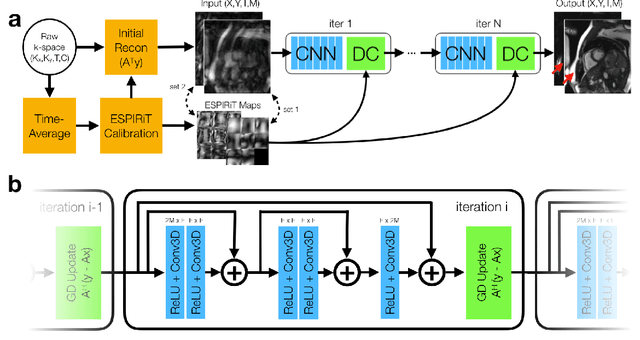
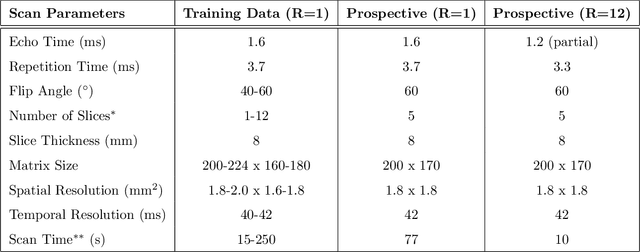
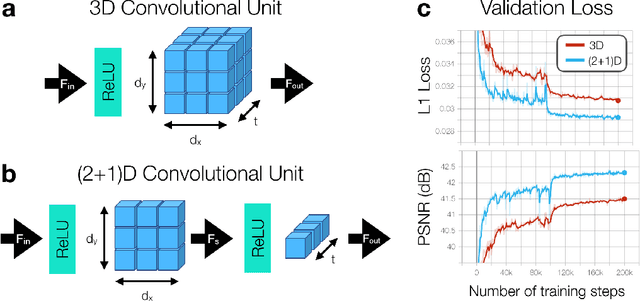
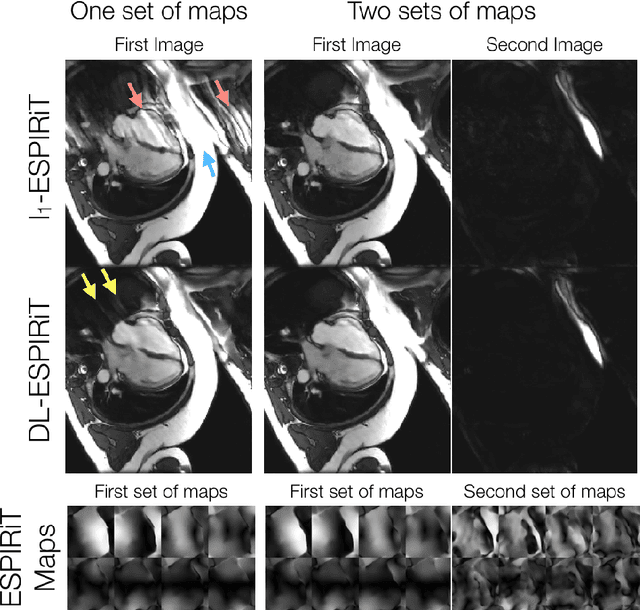
A novel neural network architecture, known as DL-ESPIRiT, is proposed to reconstruct rapidly acquired cardiac MRI data without field-of-view limitations which are present in previously proposed deep learning-based reconstruction frameworks. Additionally, a novel convolutional neural network based on separable 3D convolutions is integrated into DL-ESPIRiT to more efficiently learn spatiotemporal priors for dynamic image reconstruction. The network is trained on fully-sampled 2D cardiac cine datasets collected from eleven healthy volunteers with IRB approval. DL-ESPIRiT is compared against a state-of-the-art parallel imaging and compressed sensing method known as $l_1$-ESPIRiT. The reconstruction accuracy of both methods is evaluated on retrospectively undersampled datasets (R=12) with respect to standard image quality metrics as well as automatic deep learning-based segmentations of left ventricular volumes. Feasibility of this approach is demonstrated in reconstructions of prospectively undersampled data which were acquired in a single heartbeat per slice.