 Add to Chrome
 Add to Firefox
 Add to Edge
ManipArena: Comprehensive Real-world Evaluation of Reasoning-Oriented Generalist Robot Manipulation
Mar 30, 2026
Vision-Language-Action (VLA) models and world models have recently emerged as promising paradigms for general-purpose robotic intelligence, yet their progress is hindered by the lack of reliable evaluation protocols that reflect real-world deployment. Existing benchmarks are largely simulator-centric, which provide controllability but fail to capture the reality gap caused by perception noise, complex contact dynamics, hardware constraints, and system latency. Moreover, fragmented real-world evaluations across different robot platforms prevent fair and reproducible comparison. To address these challenges, we introduce ManipArena, a standardized evaluation framework designed to bridge simulation and real-world execution. ManipArena comprises 20 diverse tasks across 10,812 expert trajectories emphasizing reasoning-oriented manipulation tasks requiring semantic and spatial reasoning, supports multi-level generalization through controlled out-of-distribution settings, and incorporates long-horizon mobile manipulation beyond tabletop scenarios. The framework further provides rich sensory diagnostics, including low-level motor signals, and synchronized real-to-sim environments constructed via high-quality 3D scanning. Together, these features enable fair, realistic, and reproducible evaluation for both VLA and world model approaches, providing a scalable foundation for diagnosing and advancing embodied intelligence systems.

Revisiting Adaptive Rounding with Vectorized Reparameterization for LLM Quantization
Feb 02, 2026Adaptive Rounding has emerged as an alternative to round-to-nearest (RTN) for post-training quantization by enabling cross-element error cancellation. Yet, dense and element-wise rounding matrices are prohibitively expensive for billion-parameter large language models (LLMs). We revisit adaptive rounding from an efficiency perspective and propose VQRound, a parameter-efficient optimization framework that reparameterizes the rounding matrix into a compact codebook. Unlike low-rank alternatives, VQRound minimizes the element-wise worst-case error under $L_\infty$ norm, which is critical for handling heavy-tailed weight distributions in LLMs. Beyond reparameterization, we identify rounding initialization as a decisive factor and develop a lightweight end-to-end finetuning pipeline that optimizes codebooks across all layers using only 128 samples. Extensive experiments on OPT, LLaMA, LLaMA2, and Qwen3 models demonstrate that VQRound achieves better convergence than traditional adaptive rounding at the same number of steps while using as little as 0.2% of the trainable parameters. Our results show that adaptive rounding can be made both scalable and fast-fitting. The code is available at https://github.com/zhoustan/VQRound.
OpenCity3D: What do Vision-Language Models know about Urban Environments?
Mar 21, 2025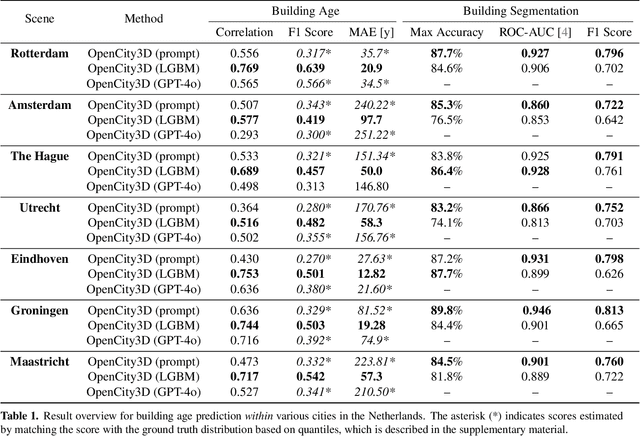

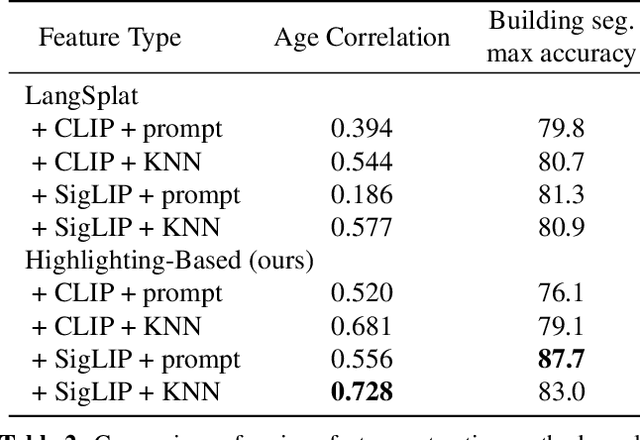
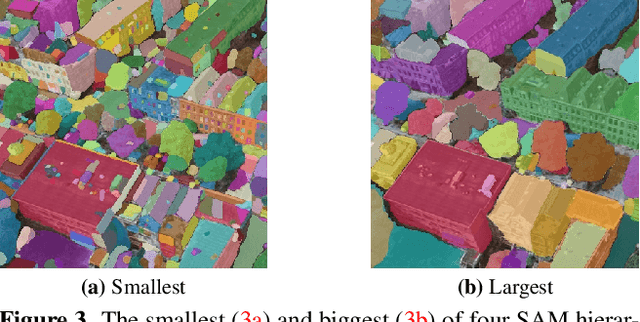
Vision-language models (VLMs) show great promise for 3D scene understanding but are mainly applied to indoor spaces or autonomous driving, focusing on low-level tasks like segmentation. This work expands their use to urban-scale environments by leveraging 3D reconstructions from multi-view aerial imagery. We propose OpenCity3D, an approach that addresses high-level tasks, such as population density estimation, building age classification, property price prediction, crime rate assessment, and noise pollution evaluation. Our findings highlight OpenCity3D's impressive zero-shot and few-shot capabilities, showcasing adaptability to new contexts. This research establishes a new paradigm for language-driven urban analytics, enabling applications in planning, policy, and environmental monitoring. See our project page: opencity3d.github.io